Proton Beam Treatment Cost Ranges Explained
Published proton beam treatment cost ranges by cancer and country, and what insurance, fractions and quotes change.
There’s no single proton beam treatment cost: published figures include Medicare prostate reimbursement above $32,000, about $147,600 for a five-week sarcoma course, and roughly USD 38,000–44,000 in 2025 Thai course estimates, none of which is automatically the patient’s bill.
The usual advice to compare prices across centres misses the harder question: are those prices measuring the same thing? An insurer’s reimbursement, a hospital’s delivery cost and a self-pay package aren’t interchangeable. Choosing the lowest number before identifying the unit, included services and expected clinical benefit can produce a financially misleading comparison.
Table of Contents
- Published Proton Beam Treatment Cost Ranges
- What Drives the Price of a Proton Course
- What the Photon Alternative Costs
- What Patients Pay After Insurance
- How to Compare Two Proton Quotes
- When the Higher Price Can Still Make Sense
Published Proton Beam Treatment Cost Ranges
Published amounts span different countries, diagnoses and accounting systems. The spread isn’t a reliable international shopping range because some figures describe what a payer reimburses, while others estimate what a facility spends.
Published proton course and reimbursement figures
| Setting | Figure | What it measures | Context |
|---|---|---|---|
| US Medicare prostate, conventional | About $19,000 | Full-course reimbursement | Historical report, not a current quotation |
| US Medicare prostate, proton | More than $32,000 | Full-course reimbursement | At least $13,000 above conventional |
| US complex proton rates | 12% cut | Reimbursement rate change | Fiscal 2014 to fiscal 2015 |
| US adolescent and young-adult sarcoma | About $5,904 per treatment; about $147,600 per five-week course | Clinical treatment-charge estimate | Late 2020 |
| Netherlands eye melanoma | About €12,062 per course; up to €137,229 per patient | Facility course versus patient-level cost | Activity-based costing |
| Netherlands head and neck | €89,716 or €49,452 | Course cost under alternative allocations | Same care, different accounting |
| Netherlands breast | About €45,567 per patient | Patient-level cost | Activity-based costing |
| Europe operation only | About €14,700 proton versus €7,600 photon per patient | Operating cost, business costs excluded | Earlier comparative research |
| Thailand 2025 RRCC model | About USD 38,000 per course | Treatment-course cost | Public-health costing model |
| Thailand 2025 cost-effectiveness | USD 43,989 proton versus USD 7,459 X-ray per course | Delivery cost | Cost-effectiveness analysis |
| India private treatment | Up to ₹50 lakh | Reported private treatment price | Not a public tariff |
| India Assam public proposal | ₹600 crore | Facility capital cost | Not a per-patient price |
The historical US prostate reimbursement comparison comes from The ASCO Post’s discussion of proton economics, which reports approximately $19,000 for conventional radiation versus more than $32,000 for protons, alongside the 12% complex-proton reimbursement reduction between fiscal 2014 and fiscal 2015. These are payment-policy observations, not promises about what a patient will owe today.
The Thai estimates also need their original labels. A 2025 Frontiers in Public Health study estimated approximately USD 38,000 per proton course using the RRCC v.24 model, while a separate 2025 Thai cost-effectiveness analysis estimated delivery costs of USD 43,989 for protons versus USD 7,459 for X-ray radiotherapy.
Read the measure before the amount
The table preserves distinctions that advertisements often flatten. Per fraction means per treatment session; per course describes a defined treatment episode; per patient follows the study’s patient-level accounting boundary. Don’t assume those boundaries include identical services.
Likewise, a public facility’s construction budget cannot establish a patient tariff. A centre can receive public capital support while operating under a separate reimbursement or eligibility system.
Practical rule: Treat a published amount as a benchmark only after you can finish this sentence: “This is the cost of this defined service, for this diagnosis, from this payer’s or provider’s perspective.”
The defensible conclusion isn’t that one country is cheapest. It’s that published prices become useful only after their definitions are matched.
What Drives the Price of a Proton Course
A proton course pays for more than the time a patient spends in the treatment room. The provider must finance and maintain a highly specialised installation, then distribute those expenses across the patients it treats.
By the 2010s, conventional multi-room proton centres typically required approximately $100 million–$200 million in capital investment, compared with about $30 million for a single-room facility, according to a Journal of Applied Clinical Medical Physics review. That scale helps explain why a short appointment can carry a substantial economic cost without implying that the appointment itself consumes an equivalent amount of staff time or materials.

The fixed-cost floor
The building is only part of the investment. Accelerators, beam-transport lines, gantries and integrated software must be installed, commissioned and supported before the facility can deliver care.
A planning submission published by CMS describes centres with two to six treatment rooms, taking more than three years to become operational, with installation and commissioning requiring at least 24 months. Those are planning-document estimates, not specifications that every modern centre must match.
Many resulting expenses are fixed costs: the facility incurs them even when a room has unused capacity. Financing, depreciation, maintenance and specialist technical staffing don’t disappear because fewer patients arrive.
This creates an important distinction between cost per course and price per course. Higher utilisation can spread the facility’s investment across more patients, lowering its calculated capital cost per course. It doesn’t necessarily reduce an insurer’s contracted payment or the centre’s self-pay quotation.
For benchmarking, the relevant questions include:
- Capacity used: Record treated volume and room utilisation, not just the number of treatment rooms.
- Facility configuration: Distinguish a compact installation from a multi-room centre.
- Accounting boundary: Establish whether the estimate includes financing and capital recovery or only operating expenses.
- Clinical workload: Check whether the centre’s case mix requires unusually intensive planning, imaging or anaesthesia.
A busy centre isn’t automatically clinically superior, and an underused centre isn’t automatically unsuitable. Utilisation explains part of the economics; it doesn’t establish treatment quality.
Accounting can change the benchmark without changing care
The Dutch evidence shows why a precise-looking figure can still be a fragile comparison. A time-driven activity-based costing study of a Dutch proton centre estimated head-and-neck course costs at €89,716 under one indirect-cost allocation and €49,452 when allocation used gantry size rather than fractions.
The same study reported approximately €12,062 per eye-melanoma course, patient-level costs of approximately €45,567 for breast cancer and €137,229 for eye melanoma, and earlier comparative operating estimates of approximately €14,700 for proton versus €7,600 for photon treatment per patient, excluding business costs.
Those amounts don’t describe equivalent baskets of care. The alternative head-and-neck allocations didn’t require a change in the treatment delivered. The accountants changed how they assigned shared expenses.
A lower calculated course cost can reflect a different accounting rule rather than a more efficient treatment service.
That distinction matters when a clinic uses a published costing study to justify its quote. The study may establish that proton delivery requires substantial resources, but it doesn’t establish that the quoted amount is the appropriate price for an individual patient.
What belongs in a usable cost explanation
A credible explanation should separate direct clinical work, shared operating expenses and capital-related expenses. Planning and delivery are different from interest charges, and both differ from the amount an insurer has agreed to pay.
The provider’s financial team should also identify what sits outside the quotation. Professional fees, additional imaging, anaesthesia and follow-up can change the comparison if one centre bundles them and another bills separately.
For an international comparison, don’t mistake an attractive exchange-rate conversion for standardisation. Convert the currency only after matching the service boundary. Otherwise, the exercise produces a more readable number without producing a more comparable one.
The analytical takeaway is straightforward: high infrastructure expenditure explains a premium, but doesn’t by itself prove either fair pricing or clinical value.
What the Photon Alternative Costs
The relevant alternative isn’t an abstract national average for conventional radiation. It’s the photon plan that could reasonably treat the same patient, with its own planning, delivery and follow-up requirements.
The published Thai comparison measures delivery costs within a particular costing model. The US prostate comparison measures Medicare reimbursement. Neither should be imported into another country as a current retail quotation, and neither establishes what a particular insurer will authorise.
Build a paired comparison
Request a comparison that keeps the clinical question constant:
- Diagnosis and treatment intent: Compare treatment for the same disease and purpose, rather than unrelated tumour groups.
- Treatment schedule: Record the proposed fractions and visits for each option. Don’t compare session prices when the schedules differ.
- Included services: Keep planning, imaging, professional fees and follow-up within the same boundary.
- Payer perspective: Compare allowed amounts with allowed amounts, or self-pay totals with self-pay totals.
A cheaper photon course isn’t automatically a worse treatment. Equally, a higher proton price doesn’t establish a meaningful reduction in complications for the person receiving it.
Separate the price question from the clinical question
The radiation oncologist’s comparison should explain what protons are expected to improve and how confident the team is about that improvement. A difference in planned radiation exposure is relevant, but the economic question is whether it is likely to change outcomes that matter to the patient.
For budgeting, retain separate columns for immediate treatment expenditure and possible downstream consequences. Don’t subtract hypothetical future savings from today’s bill as though those savings were guaranteed.
This produces a fairer decision: the photon option establishes the financial baseline, while the individual clinical assessment establishes whether paying more has a credible purpose.
What Patients Pay After Insurance
A treatment charge is not a household liability estimate. The amount a patient owes depends on coverage, the insurer’s allowed amount, network participation and the plan’s cost-sharing rules.
A clinical report discussing adolescent and young-adult sarcoma care gives late-2020 estimates of approximately $5,904 per proton treatment and $147,600 for a five-week daily course, while noting that insurance may not fully cover the expense. That figure cannot establish what an insured family will pay, and published proton-specific out-of-pocket ranges remain limited.
Build the household worksheet
Start with the proposed treatment and the exact insurance policy, not a generic statement that a centre accepts your insurer. Participation and coverage for the proposed service need to be confirmed separately.
| Worksheet field | What to record |
|---|---|
| Coverage decision | Written authorisation for the proposed indication and treatment |
| Network status | Facility and professional billing arrangements |
| Allowed amount | Insurer-recognised amount, distinct from billed charges |
| Cost sharing | Remaining deductible, copayments and coinsurance |
| Spending protection | Applicable out-of-pocket limit and excluded expenses |
| Separate medical charges | Imaging, anaesthesia, consultations and follow-up |
| Nonmedical spending | Travel, accommodation, local transport and lost earnings |
For terminology, My Policy Quote’s explanation of annual limits on covered healthcare costs can help you interpret an out-of-pocket maximum. Your actual plan documents must establish which services and payments count toward that limit; don’t assume it caps every expense associated with treatment.
Resolve approval before committing money
A centre’s verbal expectation of coverage isn’t the same as a written payer decision. Request confirmation of the approved treatment, billing entities and any conditions before committing to non-refundable travel.
If coverage is denied, establish the appeal route and the clinical acceptability of the alternative before treating self-payment as the only remaining choice. A nominal discount won’t necessarily compensate for losing insurance protection.
Budget safeguard: Keep covered medical spending, potentially uncovered medical spending and nonmedical spending in separate totals.
For international care, break a package into treatment, lodging, visas, transport, management of complications and follow-up. A bundled advertisement may not explain who pays if the schedule changes or additional care becomes necessary.
A covered in-network course can cost the patient less than a lower-priced self-pay course abroad. That isn’t a claim that domestic treatment is always cheaper; it’s the result of comparing the household’s liability rather than the facility’s headline charge.
How to Compare Two Proton Quotes
Put the written quotations beside the proposed treatment plans. The objective is to identify differences that require explanation before deciding which offer represents better value.
Check the clinical and billing boundaries
-
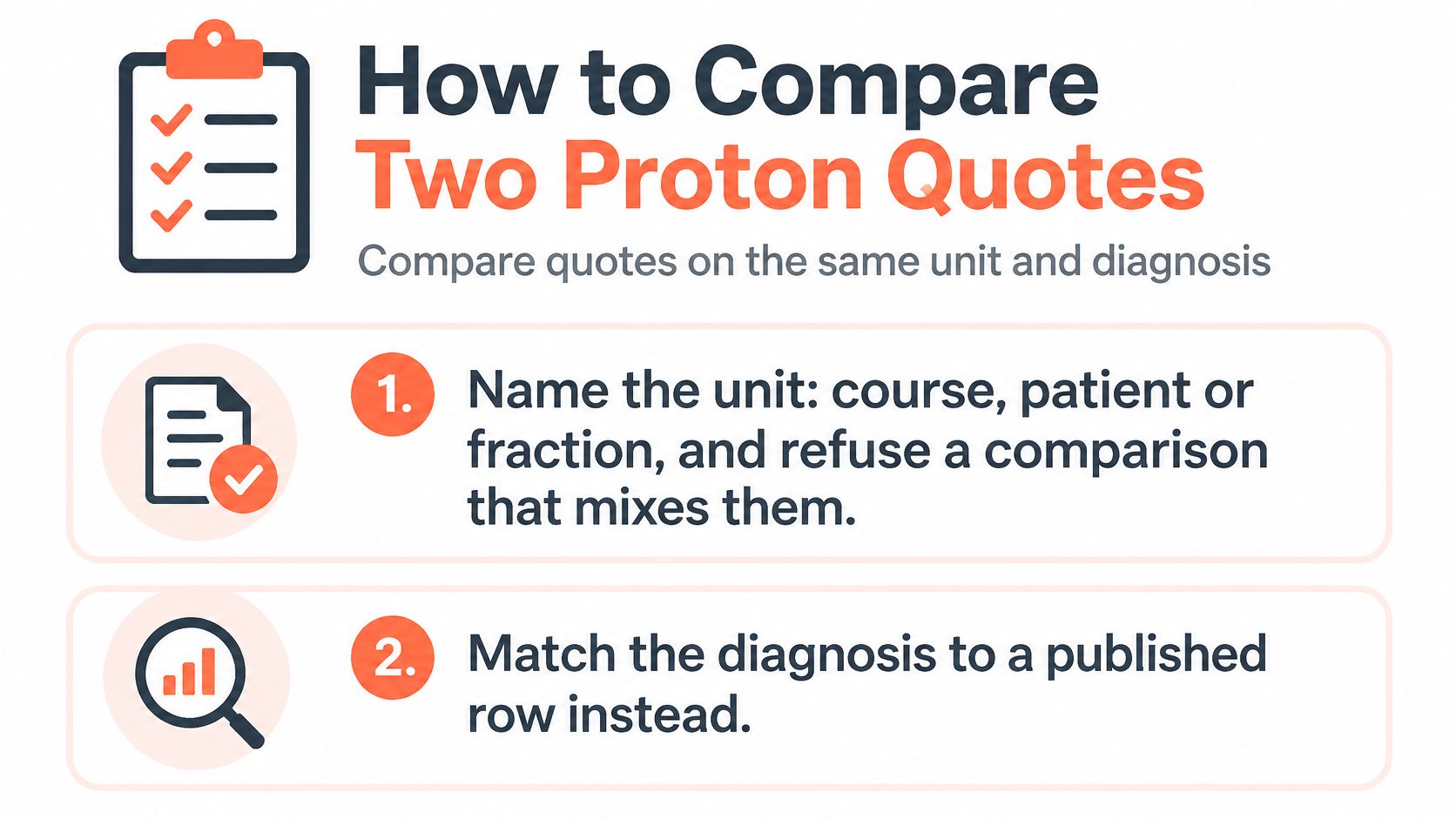
Name the unit. Mark each quotation as per fraction, per course or per patient. If it uses a package price, attach a written definition of the package rather than assuming it covers the whole treatment episode.
-
Match the diagnosis. Record the tumour site, treatment intent and whether the proposal concerns initial treatment or retreatment. A centre-wide average is a poor substitute for the actual proposed case.
-
List included services. Identify planning, imaging, professional fees, anaesthesia where relevant, follow-up and any capital-recovery component. Mark exclusions explicitly; an empty field isn’t confirmation that a service is included.
-
Record facility context. Note centre age, gantry configuration and treated volume where available. Use these to understand a provider’s cost explanation, not to infer that a higher-volume centre must offer better care.
Turn the quotation into a decision document
-
Separate payer and patient amounts. Keep billed charges, negotiated allowed amounts and estimated patient liability in distinct fields. Record the assumptions behind the estimate so a later coverage change is visible.
-
Price the actual schedule. Use the proposed appointment calendar to calculate lodging, transport and time away from work. Include a practical contingency for changes without assuming that an advertised package covers them.
-
Attach the photon comparator. Obtain the clinically appropriate IMRT or other X-ray plan and its corresponding financial estimate. The useful comparison is between feasible treatment choices, not between one quote and a national average.
-
Confirm authorisation status. Distinguish an application, a likely approval and an issued approval. Travel arrangements should reflect the decision received, not the decision everyone hopes to receive.
Paediatric anaesthesia, retreatment and clinical-trial participation deserve explicit billing clarification. For trial care, identify which services the study pays for and which remain routine clinical charges; don’t assume participation means treatment is free.
A quote without a defined unit, an included-service list and a patient-liability estimate isn’t ready to accept or reject. It’s incomplete paperwork.
At Longevity Clinics, we provide editorial analysis, not individual clinic recommendations or personal medical advice. Booking and pricing enquiries must go directly to the treating clinic.
When the Higher Price Can Still Make Sense
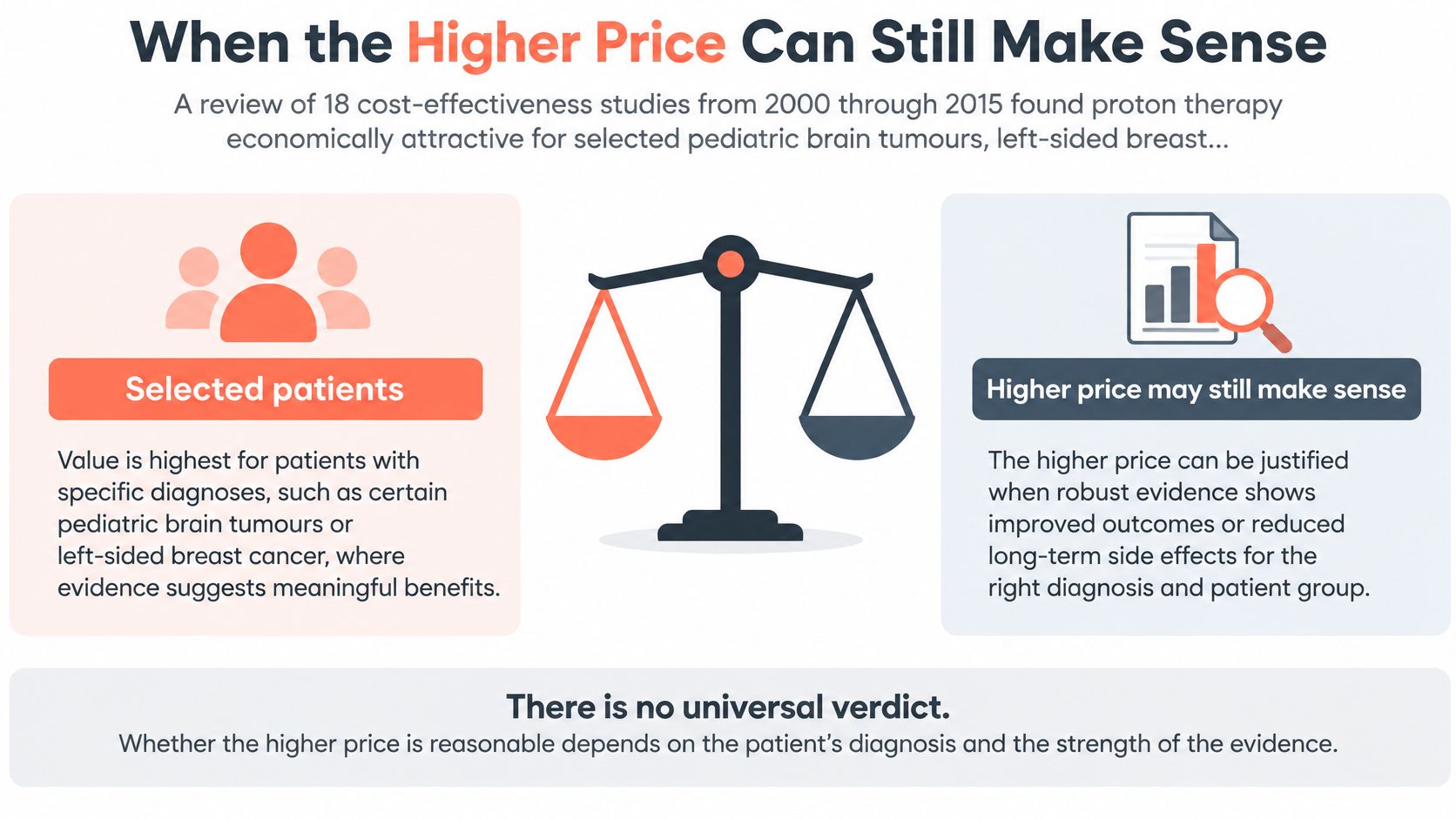
Cost-effectiveness is not the same as affordability. A treatment can represent reasonable long-term value for a health system while remaining unaffordable to a self-paying patient. It can also be affordable after insurance without offering enough clinical advantage to justify choosing it.
The economic findings discussed in The ASCO Post’s historical review are indication-specific, not a blanket endorsement of proton therapy. The distinction between selected patients and an entire cancer category is essential.
Where proton therapy has looked cost-effective
| Clinical group | Economic finding | Source |
|---|---|---|
| Some paediatric brain tumours | Attractive in selected patients | Review of 18 studies published from 2000 through 2015 |
| Left-sided breast cancer with high cardiac risk | Attractive in selected patients | Same systematic review |
| Certain locally advanced non-small-cell lung cancers | Attractive in selected patients | Same systematic review |
| Selected head-and-neck cancers | Attractive in selected patients | Same systematic review |
| Uveal melanoma | Attractive | Same systematic review |
| Prostate cancer | Suboptimal | Same systematic review |
| Early-stage lung cancer | Suboptimal | Same systematic review |
| HPV-positive oropharyngeal cancer | Approximately $288,000 per quality-adjusted life-year | Later single analysis |
| HPV-negative oropharyngeal cancer | Approximately $516,000 per quality-adjusted life-year | Later single analysis |
These findings shouldn’t be interpreted as individual treatment instructions. A quality-adjusted life-year, or QALY, combines survival and health-related quality of life; its economic use doesn’t tell a family what the insurer will cover.
Pay for a plausible benefit, not the technology label
A review of proton therapy economics and coverage describes the relevance of late toxicity and longer-term costs, particularly for younger patients, alongside historical coverage restrictions where comparative effectiveness was uncertain. It also provides the context for reported private Indian treatment prices of up to ₹50 lakh and the proposed Assam public facility’s ₹600 crore capital budget.
Public investment may change access and financing. It doesn’t prove that proton treatment is cost-effective for every tumour, just as a private price doesn’t measure the treatment’s clinical benefit.
The strongest economic case requires a credible chain: the proposed plan reduces a relevant risk, that reduction is likely to improve the patient’s future health, and the expected improvement is meaningful relative to the additional expenditure. Avoided toxicity is a potential benefit to evaluate, not an automatic credit against the invoice.
Use conditional decisions
- Pursue a proton assessment when the patient’s anatomy and diagnosis create a credible opportunity to reduce important harm, and the financial estimate is complete.
- Resolve coverage before committing when the clinical case is plausible but payer acceptance remains uncertain. A specialist’s recommendation and an insurer’s approval answer different questions.
- Give the photon option serious weight when the expected incremental benefit is weak and choosing protons would create a substantial self-pay burden. High-quality conventional treatment isn’t a failure to obtain advanced care.
The useful conclusion isn’t that protons are universally worth the premium or never worth it. The premium is defensible only when the individual clinical rationale and the actual financial exposure support the same decision.
Take the completed comparison worksheet, written quotations and proposed treatment plans to your radiation oncologist and insurer before booking travel. Ask the clinician to identify the expected patient-specific benefit and the insurer to confirm your liability in writing. Longevity Clinics’ content isn’t medical advice; a qualified medical professional must confirm whether proton therapy is appropriate before you start or change treatment.