Anti Aging Program Guide: What Real Evidence Says
An evidence-based anti aging program guide separating proven longevity medicine from marketing claims. Learn how to evaluate safety, evidence, and credibility.
The most useful anti aging program in 2026 is the one that refuses to promise reversal of aging as if that were already settled science. The U.S. Food and Drug Administration says no medication has been proven to slow or reverse the aging process FDA anti-aging products guidance, so the question isn’t which clinic sells the boldest promise. It’s which clinic can show you, clearly, what it measures, who supervises it, what it sells, and what outcomes it can defend.
Table of Contents
- What an Anti Aging Program Is in 2026
- How Anti Aging Programs Became a Global Category
- Common Interventions and Their Evidence Strength
- Biomarkers, Epigenetic Clocks, and Biological Age Scores
- Program Formats and What Each One Delivers
- Safety, Regulation, and the Regenerative-Medicine Question
- A Four-Axis Framework for Evaluating Any Program
What an Anti Aging Program Is in 2026
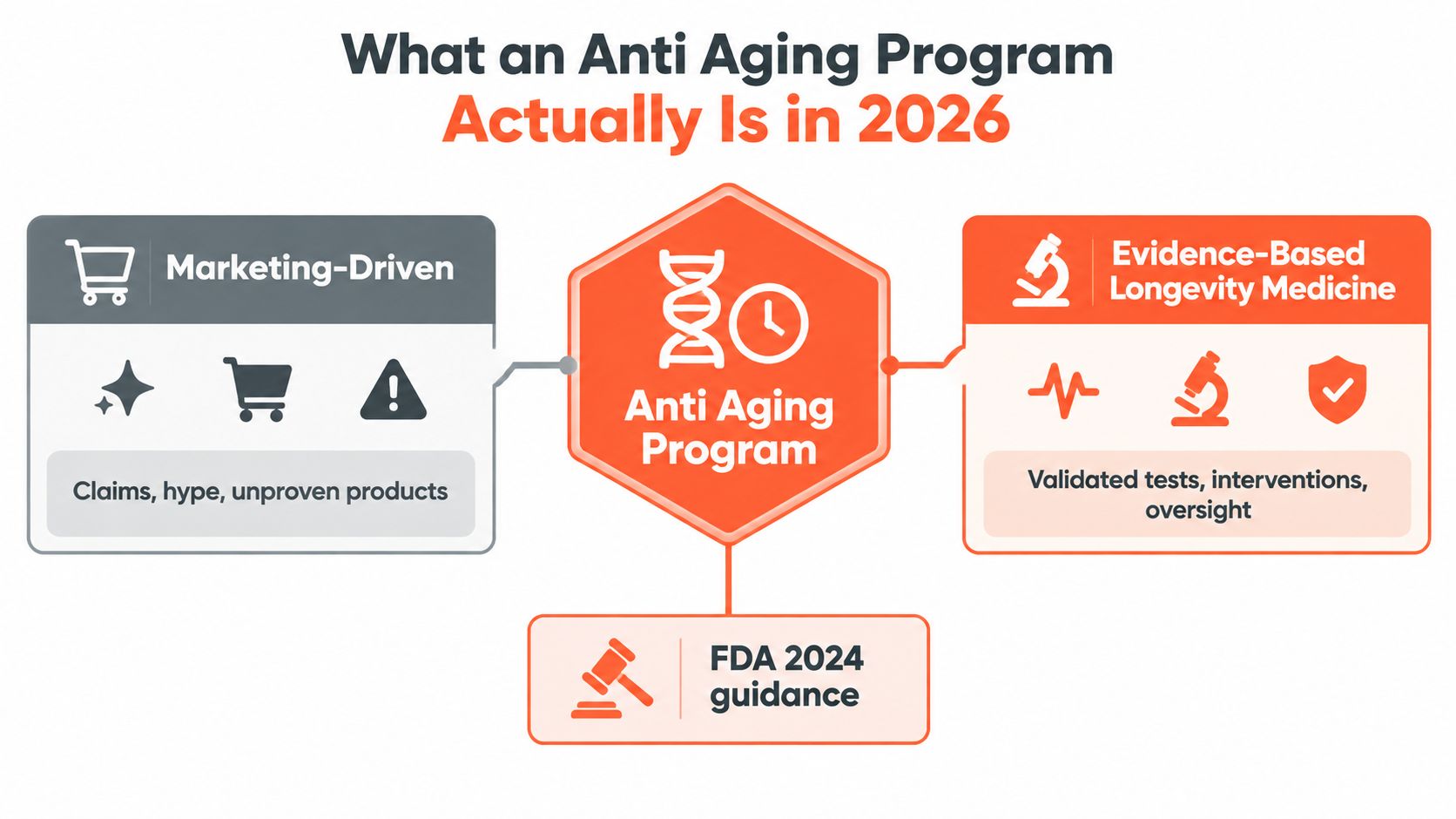
A credible anti aging program is a structured clinical offering, not a jar, drip, peptide stack, or clock score sold as a shortcut. It may combine diagnosis, lifestyle coaching, preventive medicine, cosmetics, and selected off-label interventions, but each part should be clearly labeled. That separation matters because a program can sound advanced while still resting on weak evidence or loose oversight.
The older consumer script said to find the right anti-aging product. The current reality is more useful and less tidy. A residential retreat, a concierge membership, and a standard outpatient clinic can all claim longevity expertise, yet they differ sharply in monitoring, follow-up, and accountability. A retreat may offer immersion and convenience, a membership may offer repeat touchpoints, and a clinic may offer tighter medical decision-making, but none of those formats guarantees evidence quality on its own.
What a credible program separates
A serious offering separates approved, off-label, investigational, cosmetic, and unsupported interventions instead of blending them into one premium package. That separation marks the line between medical evaluation and retail theater.
Practical rule: if a clinic cannot tell you which part of its program is proven, which part is experimental, and which part is only aesthetic, you are not buying precision, you are buying ambiguity.
The most useful working definition is simple. A legitimate anti aging program should disclose its evidence standard for each intervention, its monitoring plan, its adverse-event pathway, and its regulatory status. Anything less invites confusion between better skin, better biomarkers, and better health.
How Anti Aging Programs Became a Global Category
The category grew because clinics could sell certainty before science had settled the case. A 2004 review of age-management practice already described anti-aging programs as attracting patients despite limited proof of medical benefit, while growth hormone and related medicines were being promoted for age-related use without approval for that indication.
That dynamic still shapes the market. Clinics can package testing, physician time, supplements, and a polished setting into a single offer, and the bundle can look more rigorous than it is. Buyers see structure. Operators see margin. Those are not the same thing.
The legacy problem that never went away
Human growth hormone remains the clearest example of marketing outrunning indication. The FDA states that HGH is a drug, not a dietary supplement, and that its approved uses are limited to defined medical conditions FDA anti-aging products guidance. That distinction matters because many modern programs repeat the same pattern with different products and softer language.
Independent directories now group clinics across residential, outpatient, and membership formats, but format alone does not solve the incentive problem. A glossy retreat can still fall short on follow-up. A small outpatient practice can still be disciplined if it tracks outcomes, explains tradeoffs, and avoids conflicts.
The category became global because the demand is global, and because aging itself is a broad target that invites broad promises. Some parts of an anti aging program rest on firmer ground, such as physical activity and nutritional support in frailty-oriented care. Other parts are still speculative, especially when a pill or infusion is presented as a general answer to aging itself. The useful question is not whether the label sounds modern. It is whether the clinic can justify each part of the offer on its own terms.
Common Interventions and Their Evidence Strength
Most anti aging programs draw from the same menu, even when they brand it differently. The better way to read that menu is by evidence strength, not prestige, celebrity packaging, or how many machines sit in the room.
Lifestyle and cardiometabolic optimization sit at the strongest end of the spectrum because they are tied to established health outcomes, not just intermediate markers. Exercise, blood-pressure control, nutrition, sleep, smoking cessation, and body-composition management are less glamorous than a stem-cell pitch, but they are far easier to defend clinically. A program that starts here is usually doing something real.
Where the evidence gets thinner
Hormone testing, supplementation, metformin, rapamycin, peptides, IV infusions, and regenerative services occupy very different parts of the evidence terrain. Some of these interventions have real value, the problem is that clinics present them as if they all carry the same level of proof. They do not.
Rapamycin shows why nuance matters. In the U.S. National Institute on Aging’s Interventions Testing Program, launched in 2004, results had been published for 14 non-genetic interventions by 2015 ITP review. Across those experiments, rapamycin was the only intervention that consistently increased both median and maximum lifespan in male and female mice, with median lifespan gains of approximately 14–26% in females and 9–23% in males. That is real preclinical longevity evidence, but it is still mouse evidence, and the same review says the relevance to humans remained undetermined.
The late-life start point is part of why the data drew attention. The original experiments began administration at about 20 months of age in mice, which is roughly comparable to late-middle or older adulthood in humans. Some reports from the same programme also found lifespan extensions of approximately 28–38% under particular experimental conditions. Those findings make rapamycin central to longevity research. They do not make it a proven human anti-aging treatment.
| Intervention | Evidence Category | Typical Claim | Validated Outcome |
|---|---|---|---|
| Exercise, nutrition, sleep, smoking cessation | Strongest and most established | Improves longevity, resilience, and function | Better cardiometabolic risk, fitness, strength, and quality of life |
| Hormone testing and replacement | Mixed, condition-dependent | Restores youth or energy | Benefit only in defined deficiencies or approved indications |
| Metformin and rapamycin | Investigational for aging | Slows aging biology | Human aging benefit not yet proven |
| Peptides and IV infusions | Weak to mixed | Recharges, repairs, rejuvenates | Usually surrogate claims, not validated aging outcomes |
| Stem cells and exosomes | High-risk, high-uncertainty | Regenerates tissue, reverses aging | No general anti-aging approval, safety and efficacy limited |
Bottom line: the stronger the claim sounds, the more carefully you should ask what outcome was measured.
The cleanest programs also separate surrogate biomarkers from meaningful clinical outcomes. A drop in a lab value does not automatically mean lower disease risk, better function, or longer independent living. Clinics that blur that line are usually selling interpretation, not evidence.
Biomarkers, Epigenetic Clocks, and Biological Age Scores
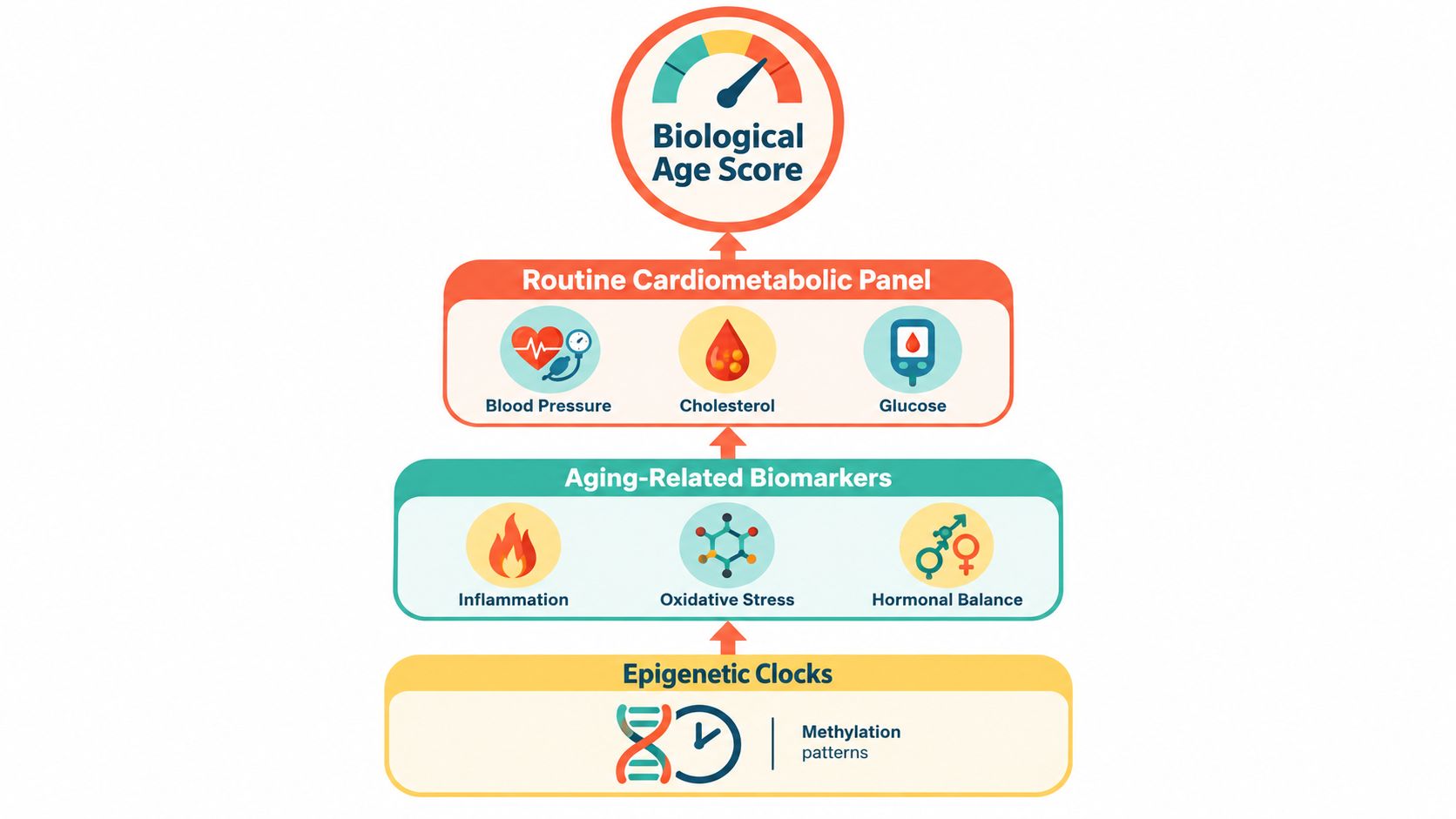
Biological age scores are useful only when clinics treat them as signals, not verdicts. A routine cardiometabolic panel, an aging-focused biomarker set, and an epigenetic clock answer different questions, and clinics that blur them together are usually trying to make the test sound more conclusive than it is.
The CALERIE randomized controlled trial is the cleanest anchor for that point. In that trial, 220 healthy, non-obese adults were assigned to a 25% calorie-restriction target or an ad-libitum control diet for two years CALERIE summary. Blood-cell DNA methylation analysis found that calorie restriction slowed DunedinPACE by about 3%, while PhenoAge and GrimAge did not change significantly. The same trial summary makes the limitation plain, clocks can disagree.
How to read a biological age result
The practical meaning is modest. A favorable clock score does not prove fewer illnesses, preserved function, or longer survival. The trial authors said the treatment effects were small and that definitive validation still requires long-term follow-up using healthy-aging outcomes, including chronic disease incidence and mortality CALERIE summary.
That caution matches the broader expert view. A 2025 geroscience trial-endpoints consensus reported that 94% of experts did not consider any single biomarker, or biomarker panel, an adequate primary outcome for showing slowed aging, while 60% considered blood-based biomarkers appropriate as secondary endpoints geroscience consensus. That is the hierarchy readers should keep in mind when a clinic presents a clock reading as proof of anti-aging success.
The most credible use of these tools is inside a larger monitoring plan. Blood pressure, lipid and glycaemic risk, fitness, strength, body composition, cognition, sleep, and adverse-event tracking should sit alongside any clock. That approach uses biomarkers to support a clinical strategy, not replace one.
If a clinic offers clock testing, ask four questions: which assay is used, how often retesting occurs, what tissue was sampled, and what clinical outcome the score is supposed to predict. A useful reference point for minimum diagnostic expectations is the minimum credible diagnostic baseline.
Program Formats and What Each One Delivers
Format shapes what an anti aging program can realistically do. A residential week can compress testing, coaching, and supervised routines into a short window. An outpatient diagnostic day can deliver a dense baseline with specialist input. An ongoing membership can support repeat measurement and behavior change over time. The catch is simple: none of those formats guarantees depth unless the clinic uses the format well.
A useful way to judge them is to ask how they score on diagnostic depth, medical supervision, conflict freedom, and evidence base. That four-axis lens, used in independent clinic scoring, explains why format alone is a weak proxy for quality. A glossy retreat can be lighter on substance than a plain diagnostic visit if the latter has clearer testing, better clinical oversight, and tighter follow-up.
Matching format to the actual goal
Residential programs are strongest when the goal is immersion, supervised behavior change, or a reset around meals, exercise, and recovery. They are weaker when the clinic presents the stay itself as proof that the program works. Without structured follow-up, a retreat can become an expensive snapshot. For a closer look at what a residential stay can and cannot deliver, see an analysis of longevity retreats.
Outpatient diagnostic days fit people who want a baseline, a second opinion, or a risk stratification exercise. The risk is diagnostic intensity masquerading as therapeutic depth. A long testing day does little if no one owns the next step.
Membership or concierge models work best when the program needs longitudinal management, repeat labs, and protocol adjustment. They fail when the recurring fee mainly funds repeated testing with little change in plan. At that point, escalation, communication, and accountability matter more than the brochure.
Practical rule: if the format does not match the goal, the program is probably being sold for convenience, not for outcomes.
Independent clinic directories have compared programs across formats and regions using this kind of rubric, which is useful because the same quality can appear in very different containers. A two-day executive workup can be more rigorous than a polished residential retreat if the team orders better tests, explains the findings clearly, and follows through. A binder of results and a supplement list is thin. Supervised change with measurable follow-up is real work.
Safety, Regulation, and the Regenerative-Medicine Question
The risk jumps here. Regenerative offerings often arrive wrapped in futuristic language, but the regulatory and safety picture is usually less glamorous than the marketing. The FDA states that no exosome products are FDA-approved and warns that unapproved regenerative products have been associated with blindness, tumor formation, neurological events, serious infections, immune reactions, and contamination risks FDA consumer alert on regenerative medicine products.
That warning should change how you read claims about stem cells, exosomes, peptides, infusions, and “cellular rejuvenation.” These aren’t all the same thing, and “experimental” isn’t a single category. A therapy might be studied inside a properly authorized clinical trial, offered under a limited regulatory pathway, or marketed outside the rules with unsupported claims. Those are very different levels of legitimacy.
Questions to ask before agreeing to any regenerative offering
- Trial identity: What is the protocol number or trial registration, if any?
- Product source: Where did the cells, exosomes, or biologic material come from?
- Batch controls: What sterility, infectious-disease, and identity testing was done?
- Clinical oversight: Which licensed clinician is responsible for prescribing and escalation?
- Adverse-event plan: What happens if there’s a reaction, infection, or delayed complication?
- Refund and follow-up: Is there a defined retreatment policy and a real follow-up window?
A recent review also noted the absence of FDA-approved exosome products for dermatologic use and limited long-term safety data, which is why glossy facial-rejuvenation language deserves extra skepticism. The stronger the promise of tissue regeneration, the more carefully the clinic should document manufacturing, consent, and surveillance.
The right takeaway isn’t that every regenerative idea is bad. It’s that novelty can’t replace regulatory standing, and a polished sales deck can’t substitute for documented product controls. If a clinic won’t slow down enough to explain the product and the protections, it’s asking you to accept risk without enough information.
A Four-Axis Framework for Evaluating Any Program
A serious evaluation starts with four questions, and they’re more useful than asking whether the clinic offers the newest peptide or the most exotic scan. The axes are diagnostic depth, medical supervision, conflict freedom, and evidence base. Score each one separately, because a polished program can still fail hard on one axis while looking impressive on the others.
How to grade the offering
Diagnostic depth asks whether the workup spans cardiovascular, metabolic, body composition, fitness, cognitive, and sleep domains, or whether it leans on one premium panel and a lot of branding. Medical supervision asks who prescribes, who reviews results, and how the clinic handles escalation when something abnormal appears.
Conflict freedom asks whether the clinic sells the treatments it recommends, earns referral fees, or has equity ties that blur judgment. For a detailed look at that issue, see conflict of interest in healthcare. Evidence base asks whether each intervention is presented as approved, off-label, investigational, cosmetic, or unsupported, without rhetoric trying to collapse those categories.
A simple scoring approach works well. Give each axis a separate score, then ask whether the total reflects real structure or just expensive packaging. A high score on diagnostics can’t rescue a weak evidence base, and a strong physician face doesn’t erase a bad incentive structure.
The best anti aging program isn’t the one that sounds most impressive. It’s the one that can tell you exactly what it can measure, what it can’t, who is accountable, and which parts of the plan are still hypothesis rather than fact.
If you’re comparing anti aging programs now, start with the four axes, then request the clinic’s diagnostic list, supervision structure, conflict disclosures, and evidence labeling in writing before you book anything. If the answers are vague, keep looking, because transparency is the first real test of whether a program deserves your trust and your budget.