Conflict of Interest in Healthcare: A Practical Guide
Learn what conflict of interest in healthcare really means, how financial and structural ties distort care, and what to ask before you pay for treatment.
The scale of conflict of interest in healthcare is larger than most patients realise. A 2024 analysis of US Open Payments records found 85,087,744 industry payments worth $12.13 billion made to 826,313 of 1,445,944 eligible physicians between 2013 and 2022. That means 57.1% of eligible physicians received at least one reportable payment during the decade, while 93.8% of payments were associated with at least one marketed medical product (JAMA analysis of Open Payments records).
Those figures don’t prove that a particular doctor prescribed improperly. They do show that financial relationships are routine, recurring, and often connected to products already being sold. For patients choosing private diagnostics, longevity programmes, surgery, supplements, or algorithmic risk assessments, disclosure is only the starting point. The more useful question is whether the clinic’s ownership, revenue model, referral arrangements, and editorial safeguards leave patients with a meaningful choice.
Table of Contents
- What Conflict of Interest in Healthcare Actually Means
- The Main Types of Conflicts You Will Encounter
- How Conflicts Distort the Evidence Base
- A Walk Through a Longevity Clinic Visit
- Disclosure Rules and Regulatory Standards Worth Knowing
- How to Evaluate a Clinic’s Conflict Freedom
- Building Conflict Freedom Into How You Choose Care
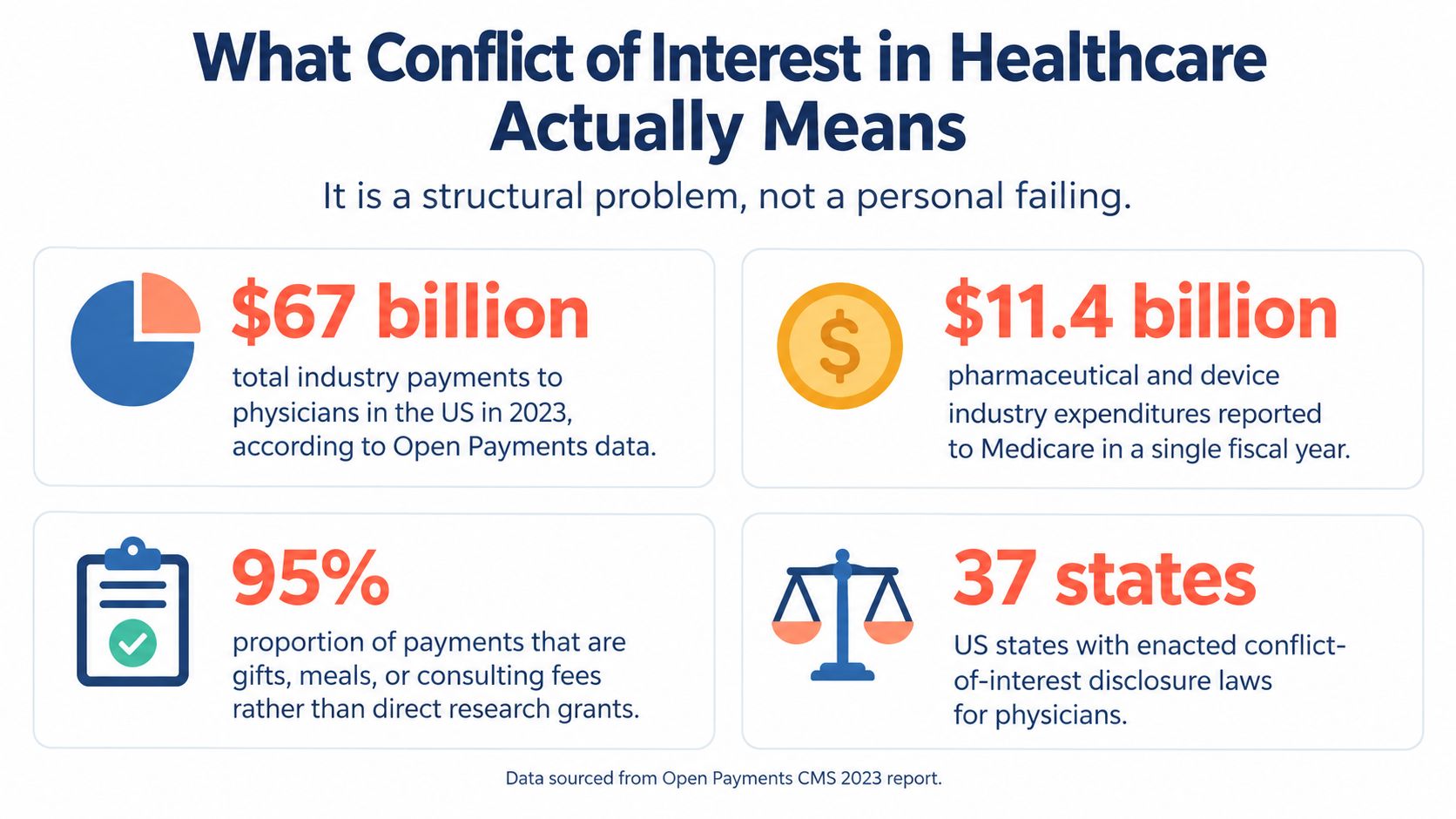
What Conflict of Interest in Healthcare Actually Means
Conflict of interest in healthcare is a relationship that could plausibly influence clinical judgment, evidence interpretation, or recommendations. It does not establish dishonesty. It identifies an incentive that may pull professional judgment toward a commercial, institutional, personal, or research interest.
A clinician may act in good faith while working inside a system that rewards additional testing, treatment volume, product sales, or referrals. For a reviewer, the relevant question is therefore structural: how does the clinic make money, who controls the recommended service, and can the patient decline it without losing access to independent advice?
Payment data illustrate why a single average is a weak editorial measure. The distribution is heavily skewed, with many small transfers and a smaller group receiving substantially larger amounts, as reported in the JAMA analysis of payment distributions. For scoring, that pattern means ownership, product-linked payments, and recurring commercial relationships deserve more weight than an isolated educational payment.
Disclosure is visibility, not resolution
Disclosure makes a relationship visible, but it does not show whether the clinician considered alternatives, could refuse a revenue-generating service, or receives compensation tied to treatment volume. Patients need to assess the decision pathway, not just the disclosure statement.
The practical distinction is between visible conflicts and structural conflicts:
- Visible conflicts include declared consulting fees, speaking payments, research funding, royalties, or stock ownership.
- Structural conflicts include ownership of a laboratory, pharmacy, imaging centre, supplement company, or treatment facility.
- Referral conflicts arise when a clinic benefits from directing a patient to a particular surgeon, laboratory, or partner.
- Bundled conflicts appear when a programme charges one price for a package and earns more as it adds tests, procedures, infusions, or products.
- Data and AI conflicts emerge when a clinic owns the model, dataset, licensing arrangement, or downstream service connected to an automated recommendation.
These categories should not receive identical scores. A modest educational payment may affect perception, while ownership of the business selling the recommended intervention can shape the entire recommendation pathway. A reviewer can record who owns the service, who receives the money, whether alternatives are offered, whether prices are itemised, and whether an independent clinician can review the recommendation.
Practical rule: Ask not only “Did the clinician disclose a relationship?” Ask “Could the clinician recommend less and still earn the same revenue?”
Conflict freedom does not require the absence of every financial relationship. It means the patient retains credible choice, receives clear alternatives, and can obtain advice that is not controlled by the clinic’s revenue structure.
The Main Types of Conflicts You Will Encounter
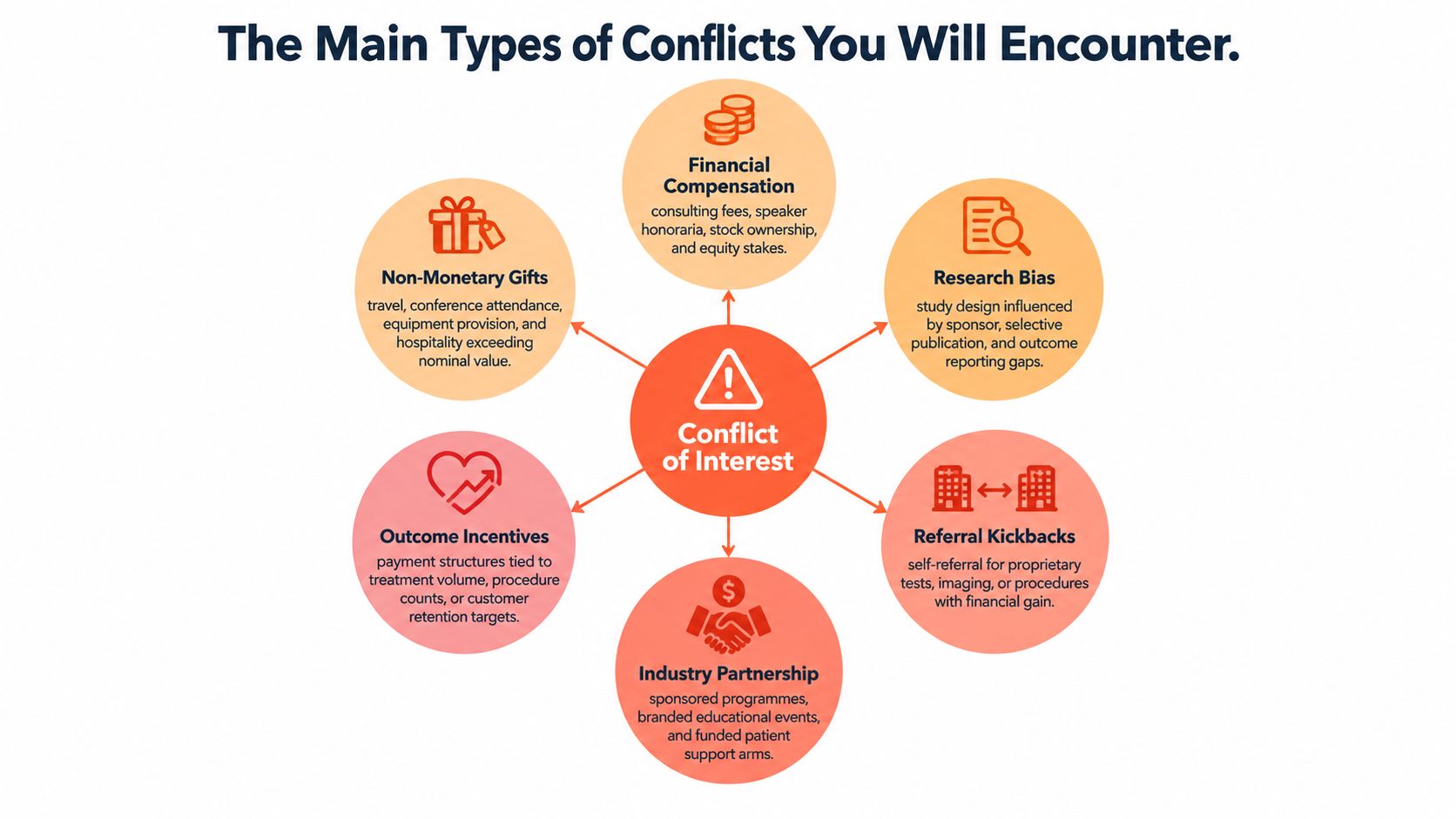
A conflict of interest is easier to evaluate when its mechanism is visible. The relevant question is not just whether money changed hands, but whether the relationship can alter what a patient is offered, how options are ranked, or where treatment revenue goes.
Direct compensation and non-monetary benefits
A physician may receive consulting fees, speaking honoraria, travel, equipment, or hospitality from a manufacturer. Payment records are most informative when they identify the product or company involved, because the commercial relationship may matter more than the label attached to the payment (JAMA payment analysis).
A consulting fee does not establish misconduct. It does create a review point: does the clinician recommend that company’s product, hold an interest in it, or present its evidence without independent assessment? The amount, frequency, and purpose of the benefit also help distinguish an isolated educational relationship from a continuing commercial tie.
Research and sponsorship
A company may fund a study of its own drug, device, diagnostic, or platform. Sponsorship can affect the research question, comparator, selected outcomes, analysis, or wording of the conclusion. Patients need not dismiss every sponsored study, but the sponsor should be recorded alongside the study design and results.
Referral revenue
A clinic may direct patients to a laboratory, imaging provider, surgeon, or procedure centre in which it has a financial interest. The referral may still be clinically appropriate. A reviewer should check whether the clinic receives a fee, owns part of the provider, or benefits through a formal partnership, and whether comparable alternatives are presented.
Ownership and self-referral
Ownership creates a direct connection between advice and revenue. If a physician owns the pharmacy dispensing a supplement, the imaging centre performing a scan, or the facility delivering an infusion, the recommendation can generate income for the decision-maker.
The scoring question is whether the same recommendation would be made without that financial stake. Itemised pricing and a documented alternative make the answer easier to test.
Outcome and volume incentives
Compensation may rise with procedure counts, treatment volume, membership retention, or customer conversion. A salaried clinician therefore operates under a different incentive structure from one whose earnings increase with each test, infusion, procedure, or product sold. The arrangement deserves disclosure even when the service itself has clinical value.
AI and data infrastructure
AI can create interests that do not appear on a conventional physician disclosure page. WHO guidance on ethics and governance for artificial intelligence in health stresses the need to identify responsibility, transparency, and risks surrounding systems used in care (WHO guidance on ethics and governance of AI for health).
A clinic may benefit through model ownership, licensing, preferred-provider arrangements, proprietary data, or treatment revenue that follows an automated recommendation. Patients should ask who owns the model, how it was validated, whether a clinician can override it, and who profits from the intervention it suggests. These answers show whether technology expands patient choice or channels it toward the clinic’s own commercial pathway.
How Conflicts Distort the Evidence Base
Industry influence can enter the evidence base before a patient reaches a consulting room. It may affect which treatments receive research attention, how studies are designed, which outcomes are emphasised, and how findings are presented.
A Cochrane methodology review examined 75 studies of industry funding and research outcomes. Drug- and device-company-sponsored studies were more likely to report favourable efficacy results and favourable conclusions than studies funded by other sources. The association was not explained by differences in conventional risk-of-bias assessments. The same review reported a relative risk of 1.32 for favourable efficacy results, with a 95% confidence interval of 1.21 to 1.44, and a relative risk of 1.87 for favourable harm results, with a 95% confidence interval of 1.54 to 2.27 (Cochrane Handbook review of funding and outcomes).
These figures do not show that sponsorship makes every result false. They show why funding should be scored as an editorial variable alongside randomisation, blinding, attrition, endpoints, and statistical analysis. A study can meet conventional quality criteria while its sponsor still has influence over the questions asked or the conclusions emphasised.
Sponsorship changes how evidence is read
A randomized experiment involving physicians found that funding disclosure affected professional judgment even when the underlying trial quality was held constant. Compared with no funding disclosure, industry sponsorship reduced assessments of methodological rigor, confidence in the results, and willingness to prescribe the hypothetical drug (randomized physician experiment in the New England Journal of Medicine).
| Outcome | Odds ratio, industry versus no disclosure | 95% confidence interval |
|---|---|---|
| Assessment of methodological rigor | 0.63 | 0.46 to 0.87 |
| Confidence in results | 0.71 | 0.51 to 0.98 |
| Willingness to prescribe | 0.68 | 0.49 to 0.94 |
| Willingness to prescribe, industry-funded versus NIH-funded trial | 0.52 | 0.37 to 0.71 |
The implication is precise: sponsorship acts as an independent signal in clinical judgment. Readers who assess study methods but ignore ownership and funding have not completed the appraisal.
The issue is especially visible in commercial fields such as hormone optimisation. A clinic may identify a deficiency, sell the treatment, monitor its effects, and publish educational material about the same intervention. A hormone optimisation clinic guide can prompt questions about who funds the evidence, who owns the product, and who benefits when treatment continues.
A reviewer should translate those answers into risk adjustment. Commercially connected interventions warrant stronger safeguards, including independent replication, external guideline support, complete outcome reporting, and a clear separation between sponsor influence and editorial judgment. A clinic with transparent ownership, independent referral options, and no revenue tied to continuation should score better on conflict freedom than one that controls the evidence, recommendation, and sale.
A Walk Through a Longevity Clinic Visit
A high-end longevity programme can turn one consultation into a chain of paid decisions. The patient arrives expecting a careful assessment, then receives a diagnostic bundle containing blood tests, imaging, functional measurements, genetic analysis, and proprietary biomarkers. A single invoice makes the package look coherent, even when its components serve different purposes.
The first review question is who owns each component. Does the clinic operate the laboratory, add a margin to external testing, or receive income when a particular scan or biomarker is ordered? The bundle may be clinically sensible, partly useful, or excessive. Its packaging does not answer that question.

The score creates a pathway
After testing, the clinic presents a proprietary risk score. It may combine familiar clinical information with measurements that patients cannot independently interpret. A reviewer should ask to see the score’s validation cohort, the outcome it predicts, and whether the threshold for action was set by the same clinic that sells follow-up monitoring.
The patient should also ask whether clinicians can override the result and whether the clinic earns more when the score triggers additional services. These questions assess the commercial pathway around the tool, rather than treating the score as a self-contained clinical fact.
The next appointment may introduce a supplement stack. The clinic could sell the products directly, obtain them through a preferred supplier, or recommend brands owned by an affiliated company. Individual products may have a defensible rationale, while the combined recommendation still creates a revenue path that should be stated plainly.
Small incentives can form one large system
IV infusions, frequent follow-ups, and referrals to a partnered specialist can extend the programme. Each step may have a medical rationale. The conflict becomes measurable when one organisation controls diagnosis, interpretation, product selection, treatment delivery, and follow-up revenue, while offering no independent alternative.
A patient should request an itemised price, the reason for each service, and written alternatives, including the option to do less. The decisive test is counterfactual: would the recommendation survive if the clinic earned no money from the test, supplement, infusion, or referral?
A longevity medicine overview can help distinguish broad preventive concepts from specific commercial packages. The clinic must still disclose ownership, referral arrangements, and incentives. A reviewer can then score conflict freedom by weighing those ties against patient choice. If reducing tests or supplements would materially reduce clinic revenue, that financial effect belongs in the consent discussion.
Disclosure Rules and Regulatory Standards Worth Knowing
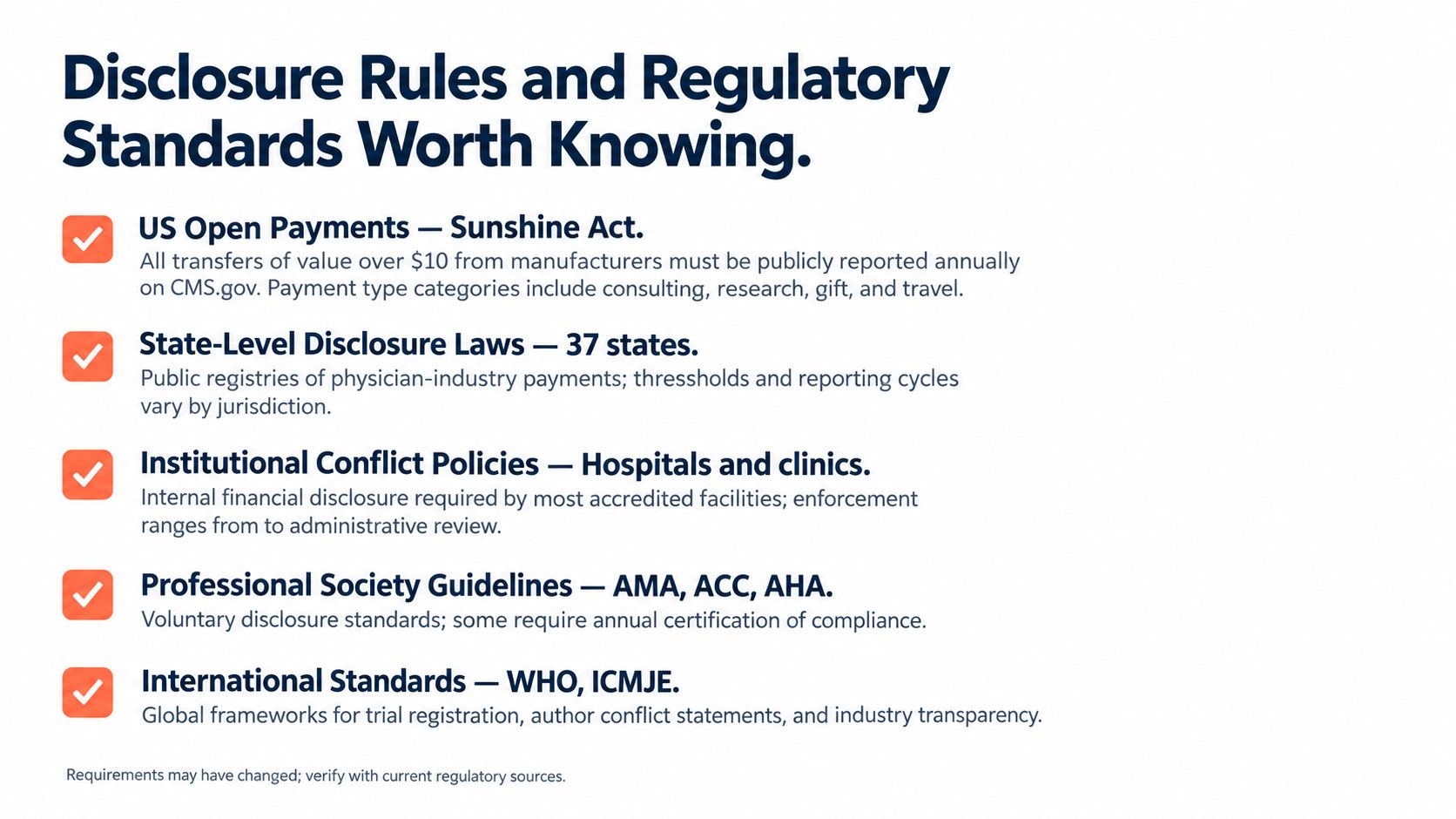
In the United States, Open Payments records the nature and amount of industry payments, along with the associated product and recipient. That makes financial relationships searchable rather than invisible. It does not decide whether a recommendation was clinically appropriate, so patients still need to interpret the relationship in context.
Three safeguards perform different jobs
Disclosure identifies the relationship. A useful statement names the parties, the type of connection, the relevant product or service, and whether the clinician owns or sells what they recommend. Vague declarations such as “industry relationships may exist” provide little value for assessing a clinic’s conflict freedom.
Recusal removes the conflicted person from a specific decision. A clinician who owns a diagnostic provider might refer the patient to an independent colleague for interpretation instead of deciding alone.
Structural separation limits the relationship’s influence on the decision. Relevant controls include separating clinical assessment from sales, prohibiting compensation tied to prescribing or referral volume, and offering an independent alternative when the clinic profits from the proposed intervention.
These safeguards can be recorded as separate review variables. A clinic receives stronger marks when it identifies ownership, uses recusal where appropriate, and protects patient choice through independent options. Disclosure alone earns less confidence when the same organisation controls assessment, products, and follow-up revenue.
Regulation is not the same as protection
Rules differ by jurisdiction and organisation. A clinic may publish a disclosure page while withholding ownership details, itemised prices, second-opinion routes, or a clear way to decline a commercial recommendation.
The Malaysian Medical Council’s guidance connects disclosure with financial, personal, and professional interests related to AI tools. That framing matters because an algorithmic recommendation can carry commercial influence even when no clinician appears to sell the resulting product (official Malaysian Medical Council AI document).
Patients should check current requirements with the relevant regulator because rules can change. For review purposes, the practical test is stricter than legal compliance: record the relationship, identify who benefits, check whether an independent decision-maker is available, and assess whether declining the recommendation would reduce the clinic’s revenue. Those findings turn conflict of interest into an editorial variable that can be compared across providers.
How to Evaluate a Clinic’s Conflict Freedom
A clinic’s conflict freedom can be assessed with documents and direct questions. Start before the consultation, when marketing claims and ownership information are easier to examine without pressure.
Ask the clinic:
- Who owns the laboratory, pharmacy, imaging centre, supplement brand, or treatment facility?
- Does the clinic receive referral fees, commissions, revenue shares, or preferred-provider benefits?
- Are clinicians paid per service, per treatment, per product, per referral, or according to retention?
- Can I decline a test or treatment without losing access to ordinary medical care?
- Will you provide an independent alternative if the clinic profits from the proposed intervention?
- Can a clinician override an AI recommendation, and will you explain the basis for doing so?
- Will I receive itemised pricing rather than only a bundled programme price?
The answers should be specific. “We follow ethical standards” isn’t an ownership statement. “Our doctors are independent” doesn’t explain whether the clinic owns the pharmacy or whether compensation rises with treatment volume.
A reviewer’s scoring method
An independent reviewer can score conflict freedom on a 0 to 100 scale using a transparent rubric. The score shouldn’t pretend to measure a doctor’s character. It should measure the strength of the safeguards around the recommendation.
One practical weighting gives the greatest attention to ownership and structural incentives, because those can affect the full patient pathway. Referral revenue and product margins come next. Sponsorship and ordinary professional payments remain relevant, but their significance depends on amount, recipient, product connection, and whether the clinician sells the recommended intervention.
Patient choice deserves its own category. A clinic scores better when it provides itemised prices, independent second opinions, alternatives, recusal procedures, and a clear right to decline. A detailed disclosure page can’t compensate for a business model that makes refusal difficult.
The strongest score is not the clinic with the longest disclosure page. It is the clinic that can demonstrate independence when independence costs revenue.
Use a health optimisation clinic comparison to structure questions about diagnostics, supervision, evidence, and commercial incentives. Longevity Clinics, for example, publishes conflict freedom as one axis in its comparative clinic reviews, alongside diagnostic depth, medical supervision, and evidence base. Treat that kind of score as a starting point, then request primary documents from the clinic itself.
Building Conflict Freedom Into How You Choose Care
Conflict freedom should sit beside diagnostic depth, medical supervision, and evidence quality when you compare healthcare programmes. It deserves extra weight when a clinic sells bundled diagnostics, proprietary scores, supplements, infusions, procedures, or memberships that reward ongoing use.
A patient doesn’t need to demand a conflict-free world. A more realistic standard is a care pathway with visible incentives and meaningful alternatives.
Request:
- Itemised pricing, so you can see which services and products generate revenue.
- Ownership disclosure, covering laboratories, pharmacies, data platforms, and treatment providers.
- Independent review, especially when the clinic sells the proposed intervention.
- AI transparency, including the model owner, validation population, limitations, and clinician override.
- Separation from sales, so the person deciding what you need isn’t rewarded for what you buy.
- A right to decline, without losing access to ordinary clinical care.
Patients already respond to conflict signals. In a randomized experiment on public physician-payment information, patients rated physicians who had received more than $13,000 from industry lower for honesty than physicians who received no payments, while disclosure didn’t materially change perceived clinical competence or trust in the medical profession (evidence on patient responses to physician payment information).
That finding points to a useful conclusion. Patients aren’t necessarily asking whether a clinician is competent. They’re asking whether the recommendation is financially independent. Clinics that answer that question with governance, recusal, itemised prices, and genuine alternatives will set a higher standard than clinics that just publish more disclosures.
Before paying for a longevity or private healthcare programme, ask for its ownership statement, compensation model, referral policy, itemised prices, AI governance details, and independent second-opinion process. If the clinic can’t explain who benefits from each recommendation, choose a provider that can.