Concierge Benefits in Longevity: What You Actually Get
Discover what concierge benefits actually deliver in longevity medicine—from personalized care to advanced diagnostics. Learn what you really get.
Paying for concierge medicine doesn’t automatically buy better health. It buys a different operating model: faster contact, more clinician time, broader evaluation, and someone responsible for following the thread when care becomes fragmented. Whether those features produce meaningful clinical value depends on what the programme measures after the membership fee is paid.
For a longevity patient, the useful questions are practical. How quickly can you reach a clinician when something changes? How thoroughly are you evaluated? Does anyone act on the data over time? And what does that process cost compared with the clinical value it creates? The four-axis lens used here is access, diagnostics, continuity, and cost.
Table of Contents
- What Concierge Benefits Really Mean in Longevity Medicine
- The Three Layers of a Concierge Membership
- Typical Membership Features and How They Show Up
- Concierge Versus Standard Care
- Do Faster Access and Longer Visits Change Outcomes
- Who Actually Benefits and What the Trade-offs Hide
- What to Verify Before Joining a Concierge Programme
- Common Questions About Concierge Benefits
What Concierge Benefits Really Mean in Longevity Medicine
Concierge medicine is often sold as a route to better health. The evidence supports a narrower interpretation. It can improve responsiveness and coordination, yet available research does not establish that paying a retainer extends life or consistently improves hard clinical outcomes.
The model is more accurately a premium access-and-coordination layer. A longevity-focused membership may provide same-day or next-day contact, longer consultations, expanded testing, interpretation of risk, and a designated clinician to organise follow-up. Standard primary care may offer many of these services, but appointment scarcity and shorter consultations can make proactive care difficult to deliver.
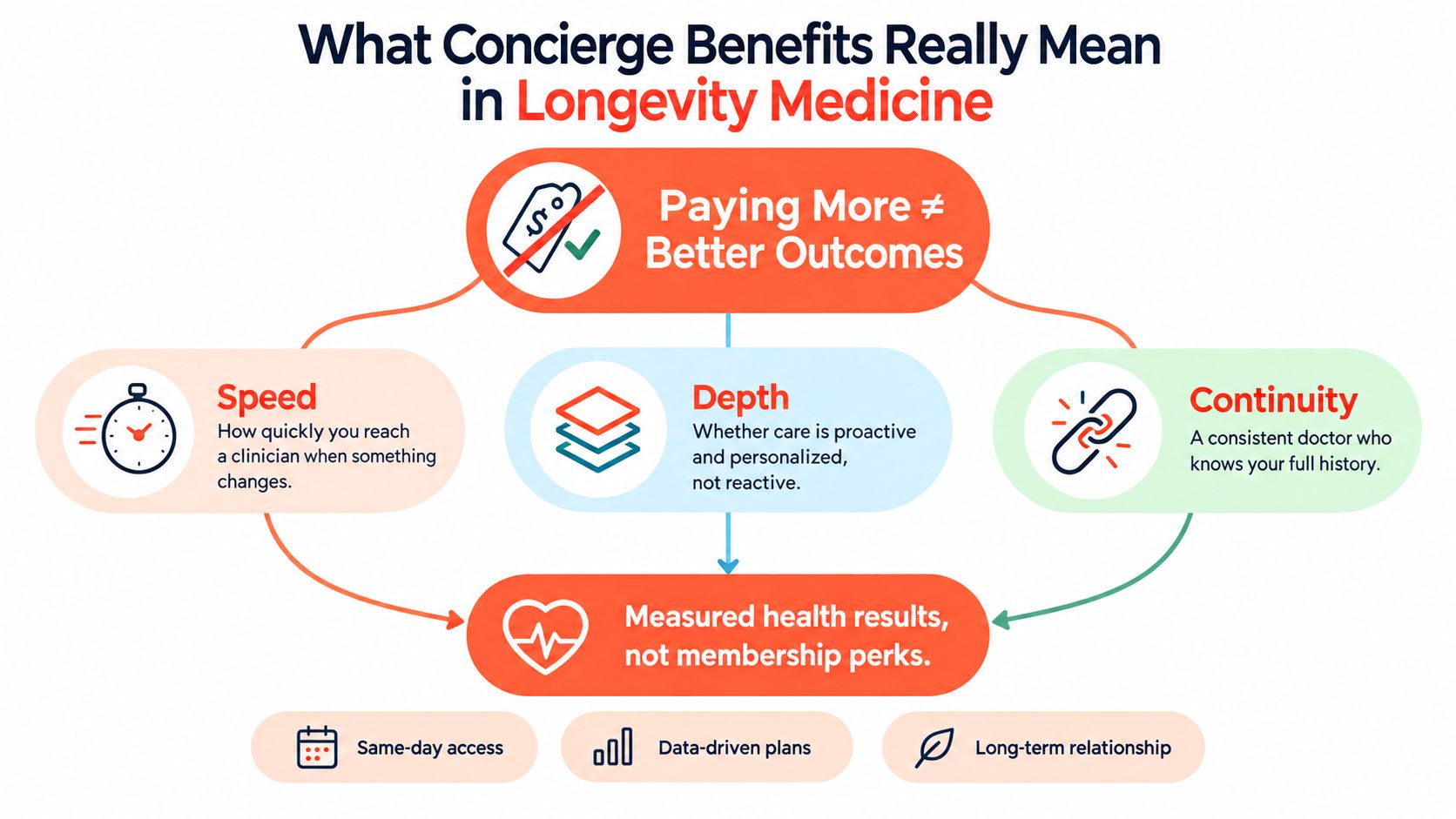
Access is the first measurable benefit
Concierge access can reduce waiting and make a new symptom, abnormal result, or medication problem easier to address promptly. The operational gain is real, but its clinical value depends on what happens after contact. A faster appointment matters only if it produces appropriate interpretation and a documented next step.
Speed alone does not improve diagnosis. A rapid consultation can still be shallow when the clinician lacks relevant history, fails to compare trends, or orders tests without linking them to a decision.
Depth and continuity determine whether access matters
Longevity programmes may add expanded biomarkers, imaging, risk modelling, and wearable data to a preventive assessment. Those services create value only when findings change treatment, monitoring, or referral decisions. More measurements increase cost without necessarily improving care if nobody explains their significance or follows the results.
Continuity provides the third axis. A consistent clinician can recognise changes across several results instead of treating each consultation as an isolated event. Readers comparing programme structures should therefore distinguish a longevity clinic from a general premium primary-care arrangement. A guide explaining what a longevity clinic is provides a useful starting point.
Longevity Clinics’ four-axis lens makes the test explicit: assess access, diagnostics, continuity, and cost separately. A programme that delivers only one or two may be expensive convenience rather than preventive medicine that changes decisions. The membership fee is justified only when the added access and analysis lead to better choices, sustained follow-up, or earlier action.
The Three Layers of a Concierge Membership
A concierge membership is easier to assess through a patient’s year of care than through a feature list. Consider a new laboratory result arriving on a Tuesday morning. The relevant question is whether the member can reach a qualified clinician, understand the finding, and receive a documented next step before uncertainty becomes delay.
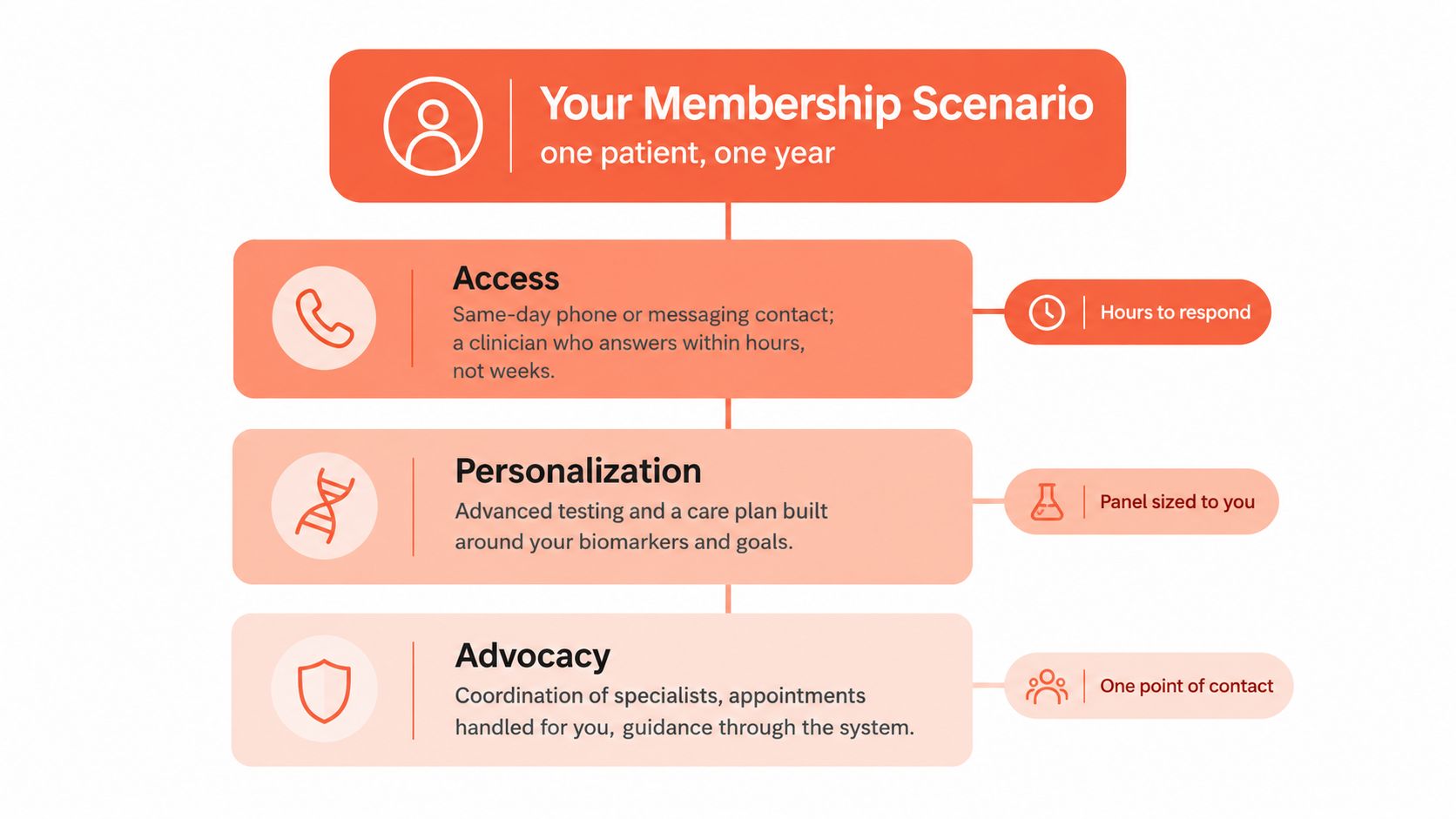
The three layers below describe the membership’s service components. Longevity Clinics’ four-axis lens, access, diagnostics, continuity, and cost, is the evaluation framework. A service can exist without producing measurable clinical value, so each layer should be tested against those four criteria.
Layer one is access
Access covers the communication channel and the response process. Depending on the programme, it may include direct phone or messaging contact, same-day advice, and appointments arranged within a short operational window rather than after repeated calls.
For the Tuesday result, useful access means a clinician reviews the finding, explains its urgency, and records whether the member needs repeat testing, medication review, imaging, or specialist input. The value lies in informed triage, not merely in reaching a human. The reviewer also needs enough medical context to interpret the result responsibly.
The model’s expansion helps explain why access became a defining membership feature. One commercial market estimate reports a small number of U.S. providers by 2000, about 500 physicians by 2005, and more than 5,000 physicians across over 500 providers by 2010 (historical market summary). These figures indicate reported adoption, not better outcomes, and the commercial source should be treated accordingly.
Layer two is service
Service includes the time and administrative work around clinical decisions. An annual visit may allow a wider review, while recurring contact, travel-medicine advice, records review, and referral coordination reduce tasks transferred to the patient.
A coordinator who gathers cardiology notes and imaging reports can reduce repeated history-taking and prevent missing documents from delaying a decision. The clinical benefit remains conditional. The practice should identify who owns the task, when it is due, and how completion is confirmed.
Layer three is testing
Testing is often the least comparable part of a longevity membership. One programme may offer cardiometabolic markers, inflammatory or hormone assays, imaging, genetic risk analysis, and wearable integration. Another may advertise advanced diagnostics while charging separately for most tests.
A bundle may appear cheaper than purchasing services individually, but price comparisons matter only after clinical justification and review are established. Additional data earns its place when it changes a decision, triggers appropriate follow-up, or improves monitoring. Otherwise, testing can increase fees and uncertainty without strengthening care.
Typical Membership Features and How They Show Up
A brochure lists benefits as nouns. A patient experiences them as workflows. The difference matters because some features alter clinical decisions, while others mainly remove administrative friction.
The practical catalogue
Access means the member knows whom to contact and what response to expect. A direct channel can replace a general triage queue, but a promise of access should specify whether a physician, nurse, coordinator, or automated system responds.
Visit design changes the consultation from a narrow complaint review into a broader assessment. A longer appointment can create space for sleep, exercise, nutrition, cognition, medication use, family history, and personal goals. It still won’t guarantee that every topic receives clinically useful attention.
Diagnostics may include expanded laboratory testing, imaging, risk scores, and wearable data. The important question is not the size of the panel. It’s whether the clinic defines action thresholds, repeats meaningful measures, and explains false positives or uncertain findings.
Coordination becomes visible when one person books referrals, transfers records, tracks pending reports, and confirms that the specialist’s recommendation returns to the primary clinician. Without ownership, “coordination” may mean little more than giving the patient a referral list.
Continuity appears in trend review. A dashboard showing movement in a biomarker can be useful, but only if the clinician connects that movement to symptoms, medication, behaviour, and risk.
| Feature Category | What It Includes | Practical Change for the Member |
|---|---|---|
| Access | Direct communication and rapid appointment pathways | Less waiting and clearer escalation when a concern appears |
| Visit time | Extended preventive and follow-up consultations | More opportunity to connect symptoms, history, and goals |
| Diagnostic depth | Expanded biomarkers, imaging, risk assessment, or wearables | Potentially earlier identification of actionable risk, if reviewed properly |
| Care coordination | Referral booking, record transfer, and follow-up tracking | Fewer disconnected tasks for the patient |
| Longitudinal review | Repeated measurements and clinician trend analysis | Decisions based on change over time rather than isolated results |
The clinical dividing line is simple. A feature earns clinical value when it changes what the care team does. A faster message, a polished dashboard, or a premium waiting room can improve the member experience without improving health.
Concierge Versus Standard Care
Concierge medicine changes the financing and operating model of primary care, not the underlying need for sound diagnosis, prevention, medication management, and referral. Standard care remains the route into insured healthcare systems. Its limitations often reflect capacity and staffing rather than a lack of clinical knowledge.
The more useful comparison concerns what each model makes the patient pay for, and what remains outside the arrangement. Standard practices generally work within insurance benefits, while concierge programmes charge a membership fee for defined access and service commitments. Insurance, specialist consultations, laboratory work, imaging, prescriptions, and hospital care may still generate separate costs. A retainer therefore supplements healthcare spending rather than replacing it.
Membership size also changes the economics of the relationship. A smaller roster can give a physician more control over scheduling, communication, and follow-up. That arrangement may support continuity, but it does not by itself show that clinical decisions are better. Prospective members should ask how many patients each clinician serves, who covers absences, and which services are included in writing.
Using Longevity Clinics’ four-axis scoring lens, the comparison should focus on the chain from service to result. Does added availability trigger a clinically appropriate response? Does additional testing alter treatment or monitoring? Does physician ownership close referrals and review results, or merely transfer administrative work to the member? Does repeated measurement lead to a documented change in care?
The evidence review is more informative about the experience and process of care than about long-term disease endpoints. It associates concierge-style models with faster access, satisfaction, engagement, preventive care, and early detection, while high-quality longitudinal evidence for harder outcomes remains limited (the evidence review). That leaves a practical test for buyers: require the clinic to define which outcomes it tracks and how those results influence decisions.
A longer consultation is an input, not proof of benefit. Clinical value appears only when the extra time, testing, or coordination changes management, prevents avoidable deterioration, or improves measurable function. A polished member experience can exist without that change.
Do Faster Access and Longer Visits Change Outcomes
Faster access is a process advantage, not an outcome. Reaching a clinician soon after symptoms or an abnormal result appears may support earlier assessment, treatment adjustment, or avoidance of an unnecessary emergency visit. Each mechanism is plausible, yet none proves that membership improves long-term health.
The review cited earlier links concierge-style care with quicker access, satisfaction, engagement, prevention, and early detection. Its access finding is the strongest outcome-adjacent signal available, but it does not establish lower mortality or fewer major cardiovascular events. Using Longevity Clinics’ four-axis lens, the question is whether faster contact changes a clinical decision, not whether it makes the service feel more responsive.
The spending signal is uncomfortable
A 2023 study summarised by Penn LDI found that switching to concierge primary care was associated with health spending rising by about 50% relative to pre-enrolment levels. Spending remained more than 25% higher one year after the switch, while mortality did not measurably change during the study period (Penn LDI study summary).
That finding does not make every membership wasteful. It indicates that improved access can produce more frequent or earlier healthcare use without an immediate survival benefit. For a longevity programme, evaluation should therefore track diagnostic lead time, risk-factor control, appropriate treatment changes, continuity, and follow-up completion, rather than rely on lifespan promises.
A premium needs an outcome denominator
A cost-per-QALY analysis compares the cost of a programme with the health gain it produces, usually measured in quality-adjusted life-years. Applying that standard would require outcomes beyond satisfaction and access. A defensible programme should report how often abnormal findings receive timely review, how many recommendations are completed, and whether tracked risk markers improve.
Faster care has value when it produces a better decision or prevents meaningful deterioration. Otherwise, the premium may be purchasing a better service experience rather than measurable clinical benefit.
Who Actually Benefits and What the Trade-offs Hide
Concierge medicine is often described as a universal solution to poor access. Coverage is more limited than that. Recent industry reporting says adoption remains below 2% of U.S. physicians and is concentrated in urban and suburban, higher-income regions, while rural expansion remains limited (industry coverage of concierge trends).
That concentration creates a paradox. The model promises faster access and more clinician time, yet it’s least available in places where people may face the greatest shortages. It can improve the experience for members without functioning as a broad access solution.
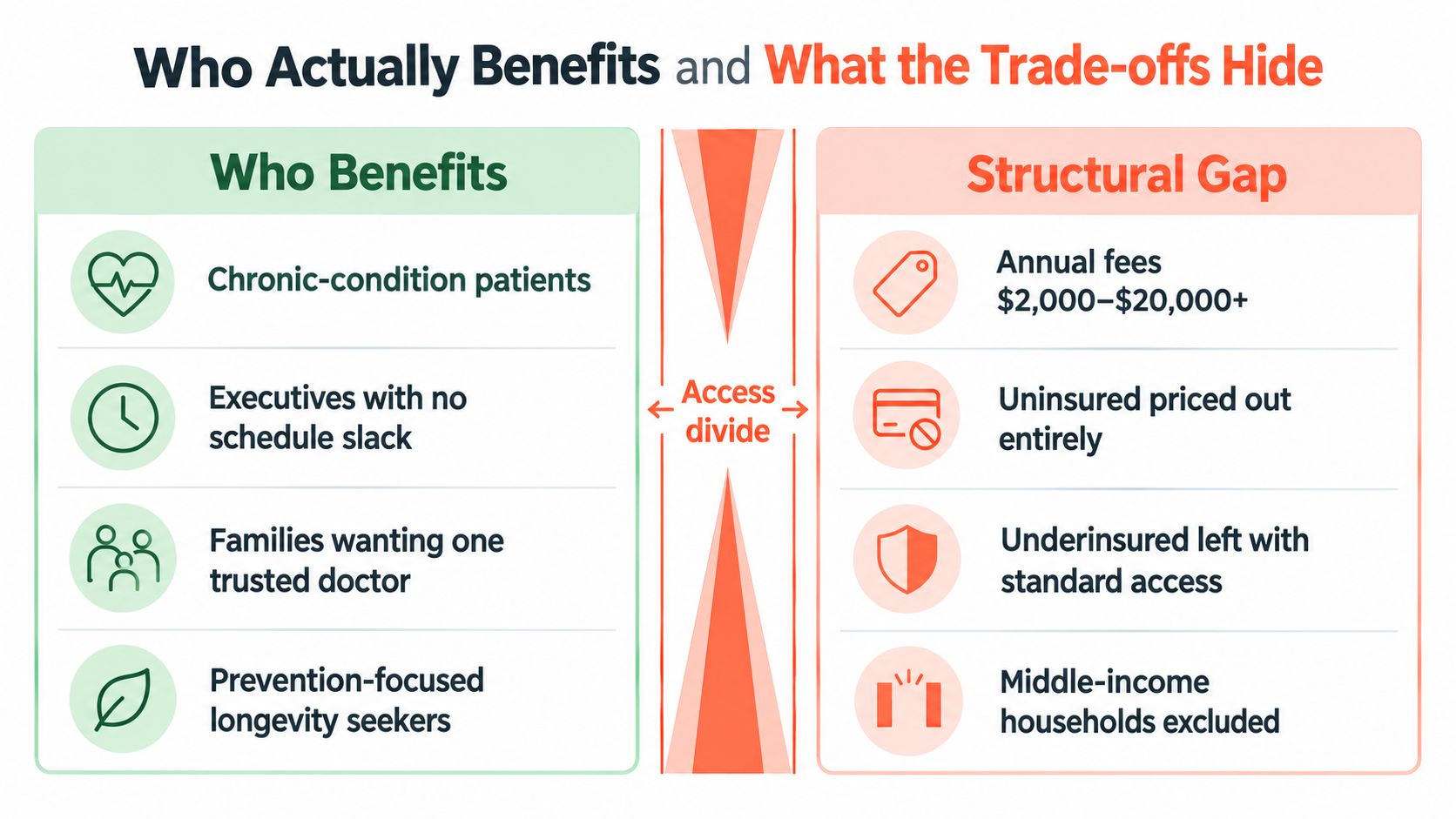
The strongest fit is not always the healthiest person
A patient with several chronic conditions may gain substantial value from one clinician coordinating medications, specialists, investigations, and follow-up. A time-poor executive may value rapid access because delays create work disruption, although that’s a productivity benefit rather than proof of better clinical outcomes.
Someone with a strong family history of preventable disease may also benefit if the clinic can translate risk information into appropriate screening and sustained monitoring. By contrast, an already healthy person seeking optimisation may pay for a large quantity of testing without receiving decisions that materially change care.
Cost and incentives shape the result
The market’s growth estimates show that concierge medicine is no longer a niche arrangement. One estimate places the global market at USD 24.63 billion in 2026, projected to reach USD 37.98 billion by 2031, with a 9.05% CAGR (market estimate). Growth indicates demand. It doesn’t validate every diagnostic or treatment sold inside the model.
A further concern is whether the clinic earns additional revenue from tests, supplements, imaging, or emerging therapies. Recent coverage notes enthusiasm for higher-cost offerings such as peptide therapies, while evidence for those services may not have matured (analysis of concierge-sector developments).
For a practical discussion of the fee itself, see this analysis of concierge medicine cost. The decision isn’t “is concierge worth it?” in the abstract. It’s which patient receives enough access, coordination, and actionable prevention to justify the total cost.
What to Verify Before Joining a Concierge Programme
An introductory call should function like due diligence, not a sales presentation. Ask the clinic to describe what happens from the first abnormal result to the documented follow-up decision. If the answer depends on informal promises, the membership may not deliver the continuity it advertises.
Four questions that expose the model
Financial conflict freedom. Ask whether the clinic receives revenue from laboratories, imaging centres, supplements, or treatments it recommends. A red flag is an agreement that bundles vague “wellness optimisation” while giving no separation between medical advice and commercial sales.
Diagnostic minimums. Ask for the exact baseline tests included in the fee, the tests that cost extra, and the clinical reason for each category. A red flag is a long menu of advanced options without a stated review process or action threshold. The minimum credible diagnostic framework can help readers assess whether the term has a defined meaning.
Regulatory standing. Confirm the physician’s licence, board certification, and the clinic’s applicable accreditation or regulatory status. A red flag is marketing that emphasises proprietary protocols while making credentials, prescribing authority, or emergency arrangements difficult to verify.
Follow-up protocol. Ask who reviews results, how urgent findings are escalated, and how specialist recommendations return to the primary clinician. A red flag is a membership that promises quarterly contact but doesn’t specify whether the contact includes chart review, decision-making, or only coaching.
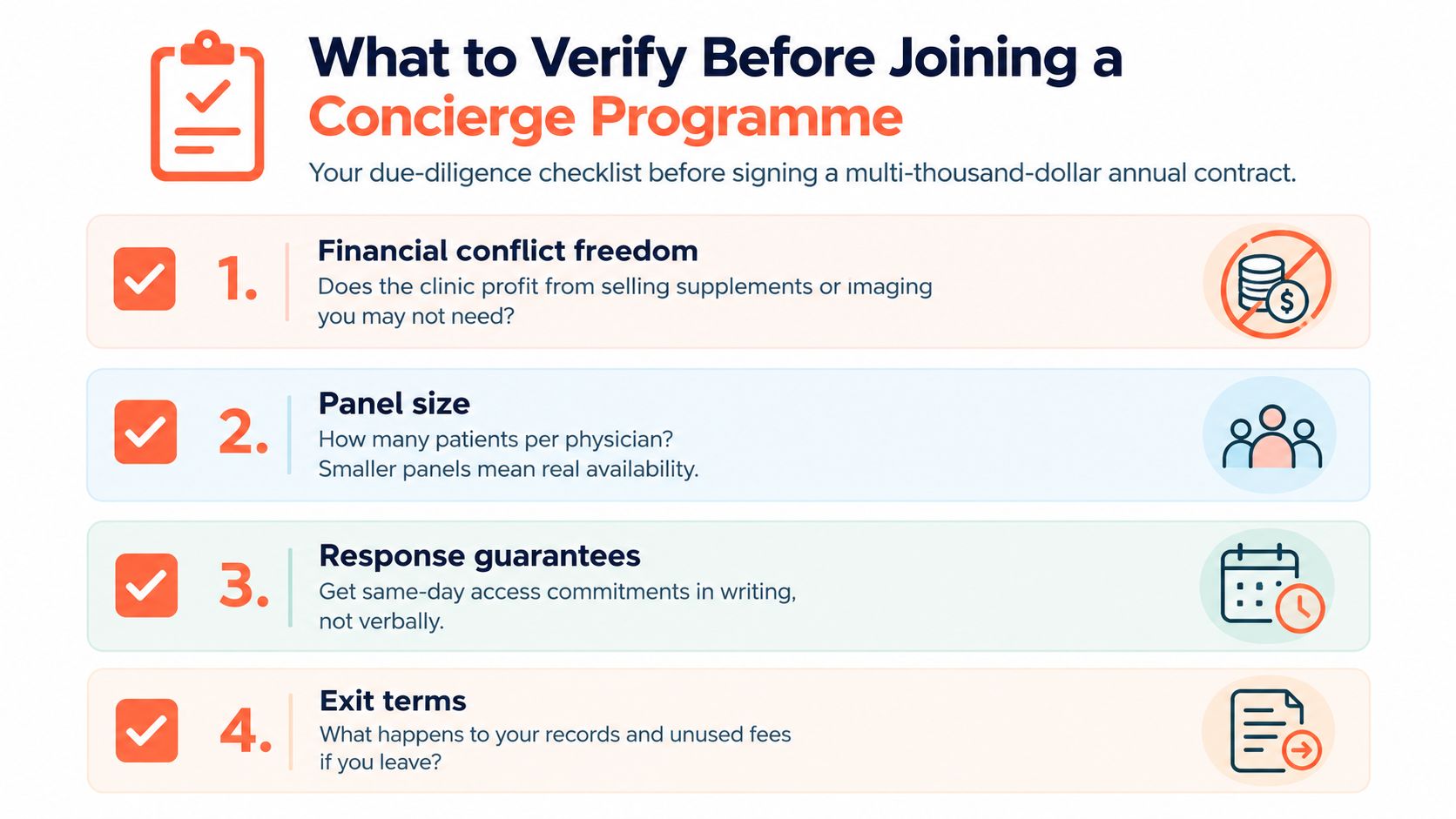
Read the exit clause as carefully as the welcome pack
The contract should explain cancellation, refunds, record transfer, unused services, external billing, and responsibility during travel or emergencies. It should also distinguish membership services from insurance-covered care.
Longevity Clinics applies a four-axis approach covering diagnostic depth, medical supervision, conflict freedom, and evidence base when comparing private programmes. That kind of separation is useful because a clinic can score well on access while remaining weak on evidence or commercial independence.
Ask for proof in writing: response commitments, included diagnostics, clinician responsibility, and exit terms should appear in the agreement, not only in the consultation.
Common Questions About Concierge Benefits
Can I use insurance alongside a membership?
Usually, the membership and insurance serve different functions. The retainer generally covers enhanced access, physician time, and selected services, while insurance may remain relevant for specialist care, hospital treatment, prescriptions, laboratory work, or imaging. Confirm whether the practice bills your insurer and which services are excluded.
Can I use an HSA or FSA?
Tax treatment depends on the applicable rules, your plan, and the structure of the membership. Don’t assume that the full fee qualifies. Ask the clinic for documentation and verify eligibility with your account administrator or tax professional before treating the payment as reimbursable.
Can the concierge physician replace my primary-care doctor?
Some programmes provide primary care, while others focus on prevention, diagnostics, or executive health and expect you to maintain a separate primary-care relationship. Ask who handles acute illness, prescriptions, referrals, preventive screening, and after-hours escalation.
What happens if I travel or relocate?
International and cross-border services vary considerably. Some practices may offer remote communication or help coordinate local care, but licensing, prescribing rules, emergency response, and record transfer can limit what a physician can do outside their jurisdiction.
Can family members join?
Many practices offer family enrolment, but pricing, access rights, age limits, and included services vary. Ask whether every member receives the same clinician access and diagnostic package, or whether the household arrangement mainly reduces administrative duplication.
These logistics often determine whether concierge benefits fit your life. A membership can be clinically useful and still be unsuitable if its exclusions, travel limitations, billing model, or family terms conflict with how you use healthcare.
If you’re comparing concierge or longevity memberships, request the written fee schedule, included diagnostic list, response commitments, clinician credentials, conflict disclosures, and exit terms before booking. Use those documents to score each programme across access, diagnostics, continuity, and cost, then choose the model that can demonstrate measurable follow-up rather than just offering the longest list of perks.