Conflict of Interest Disclosure: What Clinics Must Reveal
Learn what a conflict of interest disclosure must include for longevity clinics, how to read incentives, and how Longevity Clinics grades conflict freedom.
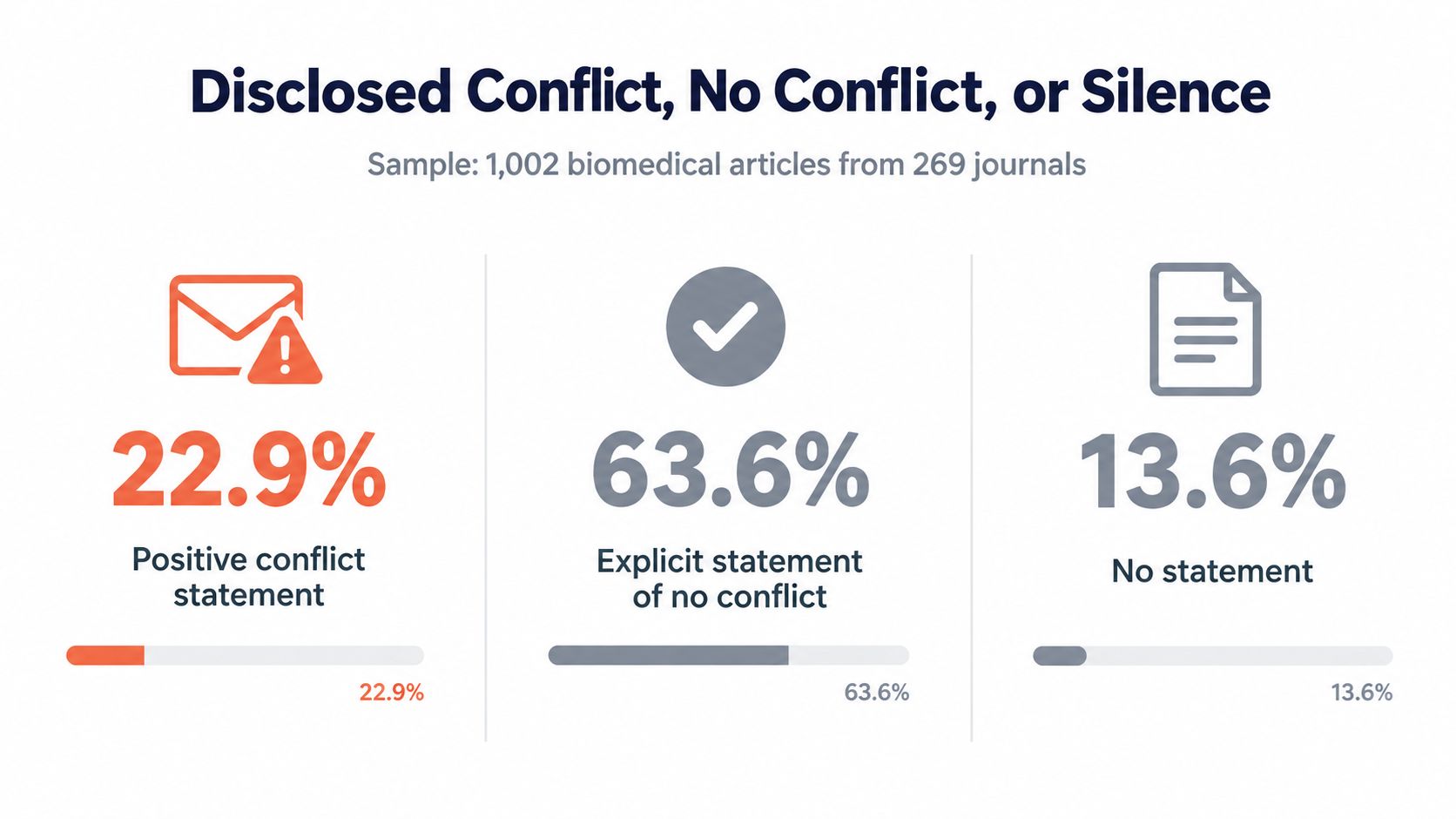
A blank disclosure record cannot establish whether a clinic has no conflict or has failed to report one. In a cross-sectional study of biomedical publishing, 13.6% of included articles had no conflict-of-interest statement at all. The distinction matters: silence does not demonstrate independence, while a disclosed interest does not prove that advice was compromised.
For longevity care, assess relationships beyond payments to individual clinicians. Ownership, referral arrangements, laboratory ties, funding, and access to underlying data may shape recommendations or reporting. A disclosure is useful when it identifies who holds each relationship and what decisions it could affect. Then compare those statements with available information about the clinic. If the clinic provides no disclosure, treat its conflict status as unknown, not neutral.
Table of Contents
- Disclosure Checklist Every Clinic Should Publish
- Disclosed Conflict, No Conflict, or Silence
- Reading Disclosed Incentives by Risk Level
- Hidden and Cross-Border Conflicts Most Profiles Miss
- How Longevity Clinics Grades Conflict Freedom
- Worked Example Comparing Two Clinic Disclosures
- Confirm the Disclosure Before You Book
Disclosure Checklist Every Clinic Should Publish
A useful conflict-of-interest disclosure is a structured record of relationships that could influence clinical advice or an editorial assessment, not a single disclaimer at the foot of a webpage. For every entry, ask three things: What’s the relationship? Who holds it? What decision, test, product, or claim could it affect?
The ICMJE framework covers financial and non-financial relationships that could bias, or reasonably appear to bias, the work. It also calls for funding sources and an account of each sponsor’s role in study design, data collection, analysis, interpretation, writing, and publication restrictions. A disclosure should say whether the authors had access to the underlying data and describe the scope and continuity of that access. ICMJE’s conflict-of-interest recommendations provide a useful model for clinics and publications alike.
A working checklist
| Category | What to disclose | Red flag if absent |
|---|---|---|
| Ownership and equity | Named owners, shareholders, and any parent company | Owner unnamed or ownership described only as “private group” |
| Referral or affiliate revenue | Whether any fee is paid per patient referred or per test ordered | Silence on referral pathways in a clinic that sells test bundles |
| Speaking, consulting, and advisory fees | Payers, amounts or ranges, and dates | Clinicians promoted in marketing with no fee history stated |
| Paid clinical work | Paid work for manufacturers, supplement brands, or device makers | No statement from clinicians who also sell products |
| Parent company, laboratory, or device ties | Which labs, imaging centres, or device suppliers are owned or contracted | In-house testing presented as independent without explanation |
| Intellectual property | Patents, licences, or royalties on protocols or products | No statement while protocols carry a proprietary name |
| Institutional funding and sponsor role | Funders and their roles in design, analysis, and publication | Research cited as independent but sponsor role is unstated |
| Access to source data | Who holds raw data, for how long, and who can publish it | Outcome claims without any data-access statement |
Some entries need context to be useful. “The clinic uses an affiliated laboratory,” for example, names a relationship but doesn’t say whether the lab is owned by the clinic, whether the clinic receives revenue from testing, or whether patients can use an independent lab. Ask what connects the relationship to the recommendation.
Reviewers and editors need the same screening as authors. Someone with a relationship that could affect their assessment should recuse themselves from that assignment, rather than rely on a general disclaimer. A complete record gives every category a dated “yes” or “no,” names the relationship where one exists, and states when an update is required after a change in ownership, funding, or employment.
Disclosed Conflict, No Conflict, or Silence
A review of 1,002 biomedical articles across 269 journals found three distinct disclosure states: 22.9% reported a conflict, 63.6% explicitly declared no conflict, and 13.6% provided no statement. These categories offer a useful framework for assessing clinic profiles, but they do not carry equal evidentiary weight. A named relationship documents an interest; a nil declaration records an explicit denial; silence leaves the matter unresolved.
The distinction matters because a blank disclosure cannot show whether anyone assessed financial, professional, institutional, cross-border, or non-financial interests. It should be recorded as unknown, not treated as evidence that a clinic is independent. An explicit nil declaration is more informative, though it remains a statement to check against available ownership and registry records.
Commercial exposure also warrants attention. In the study, positive disclosures appeared in 26.6% of primary research articles about drugs, devices, or surgical procedures, compared with 15.4% of articles outside those areas, a statistically significant difference (P < 0.001). This association does not establish that a particular clinic has a conflict. It does support closer examination when commercial products or services are central to the clinic’s work.
| State | What it means | Reader action |
|---|---|---|
| Disclosed conflict | A relevant interest exists and is named | Trace its connection to the recommendation and record it in the profile |
| Explicit nil declaration | The clinic states that no relevant interest exists | Record the statement and check it against ownership records and registries |
| Missing disclosure | No statement is provided either way | Mark it unknown, request a statement, and do not count it as neutrality |
Assign one state to each disclosure category in every clinic profile. A clinic may disclose a relationship in one category, declare none in another, and provide no information about the rest. Keeping these records separate shows what the clinic has stated, what can be checked, and where uncertainty remains.
Reading Disclosed Incentives by Risk Level
A nutrition label is useful because it connects ingredients to what you’re buying. Apply the same logic to a disclosed incentive: does the clinic’s income rise when it recommends a particular test, package, or product? The closer that link is, the more directly the incentive could reward a recommendation.
| Incentive | How it can bias advice | Question to ask | Risk level |
|---|---|---|---|
| Equity or ownership in the clinic | Profit rises with enrolment and upselling | What share do owners hold, and do they earn from add-ons? | High |
| Referral or affiliate fee per patient | Rewards sending patients to specific tests or products | Is any fee paid per enrolment or per order? | High |
| Membership fee tied to test bundles | Renewal may depend on continued purchases | Can members decline add-ons without losing core access? | Medium to high |
| Proprietary laboratory or device partnership | May steer testing toward an in-house platform | Can results be exported to an independent laboratory? | Medium to high |
| Paid speaking or advisory role | Relationships may colour endorsements | Who pays, how much, and when did the role start? | Medium |
| Prestige or academic affiliation | Can lend a halo to evidence claims | Does the affiliation fund the work or only lend a name? | Low to medium |
Equity and per-referral revenue are high-risk signals because the potential financial reward connects directly to enrolment or ordering. That doesn’t establish that a recommendation is wrong; it identifies a pathway worth tracing. Ask whether an owner benefits from add-ons, or whether a referral fee is paid when a patient orders a particular test.
Membership fees tied to test bundles are less direct but still deserve scrutiny. If access or renewal depends on continued purchases, ask whether patients can decline add-ons without losing their core membership. For lab and device partnerships, find out whether the clinic’s arrangement shapes which tests are offered and whether results can be sent to an independent provider.
Speaking or advisory work creates a different kind of connection. It may not pay per patient, but the payer, timing, and scope help readers understand the relationship. Prestige affiliations can also shape how evidence is presented, especially if an institution funds the work. Their risk rises when the relationship includes financial support rather than a name alone.
Use the rating as a prompt, not a verdict. A disclosed incentive opens a question about how advice is formed; it doesn’t answer whether a recommendation changed.
In the worked example below, a membership bundle linked to a parent laboratory shows how a potential incentive becomes a practical question about test choice and independent verification.
Hidden and Cross-Border Conflicts Most Profiles Miss
A payment search can show one part of a clinic’s financial ties, but it cannot establish that no other conflicts exist. The JAMA review of institutional conflicts and disclosure systems examines the limits of disclosure systems that focus on individual payments. For readers, the distinction matters: a database entry documents a reported relationship, while an empty result leaves other relationships unknown.
Records also require checking against disclosures elsewhere. The linked review discusses discrepancies between conference disclosures and Open Payments records, and gaps in institutional disclosure requirements. Its scoping review found that 59% of included research focused only on financial institutional conflicts, with evidence concentrated in the United States. Those findings point to a coverage problem: payment records may be available, yet still offer an incomplete view of how institutions shape care.
A useful inquiry therefore extends beyond whether a doctor received money. Ask whether the clinic, parent company, laboratory, device supplier, investor, governing charity, or proprietary platform could benefit from a recommendation. A cross-border clinic may not be covered by a central public registry, so the answer may depend on comparing several records and direct disclosures.
Start with ownership. Company registration records can help establish who controls the clinic and whether a parent company is involved. Then ask in writing about laboratory, device, and referral arrangements, and review any published funder list for institutional support. These checks can reveal connections that a physician-payment database would not show.
Some influences may not appear in financial records at all. Prestige, professional affiliations, and reliance on a clinic’s own data can shape how evidence is produced or presented, although their presence alone does not prove that advice is biased. The relevant question is what connection exists and how it could affect a recommendation.
Missing information at any layer is uncertainty, not proof of neutrality. Apply that standard to individual and institutional ties alike.
How Longevity Clinics Grades Conflict Freedom
Longevity Clinics evaluates programmes using a 0–100 composite across four axes, one of which is conflict freedom. Its stated editorial policies include no paid placements, sponsored sections, affiliate links, equity, referral revenue, or pre-publication review by clinics. The publication’s methodology sets out the inclusion criteria and scoring definitions readers can use to inspect how profiles are assessed.

Evidence that earns credit
| Grading signal | Evidence that earns credit | Effect when missing |
|---|---|---|
| Ownership | Named owners and any parent company | Axis held at the lower band and flagged as uncertain |
| Referral and affiliate revenue | Explicit declaration of none, or disclosure with the pathway removed | Axis reduced; profile notes the unresolved pathway |
| Editorial independence | No pre-publication review by the clinic | Profile flagged; review can’t be published as final |
| Update cadence | Annual disclosure plus event-based updates after ownership or funding changes | Stale disclosures are re-checked before the next review |
| Conflict response | Documented recusal, second review, altered weighting, or prominent notice | A passive statement alone earns no credit |
A clear policy describes what happens when someone identifies a conflict. Authors, reviewers, editors, and the publisher each need to disclose their own relevant interests. ICMJE guidance calls for reviewers with a relevant conflict to recuse themselves, and for editors to do the same when deciding related manuscripts. COPE guidance extends the responsibility across editorial teams, boards, managers, owners, and publishers. ICMJE’s annotated recommendations also support documenting how a conflict is handled rather than stopping at disclosure.
That response could mean recusal, an independent second review, altered weighting, source substitution, or a prominent notice for readers. Each action creates a record of how the relationship was managed. Annual declarations, alongside updates when ownership, funding, or employment changes, help keep that record current.
Longevity Clinics publishes clinic profiles and a comparative directory, with a conflict-freedom score within its four-axis rubric. A missing item lowers confidence in that axis; it is never treated as neutral by default. Readers can consult the stated methodology to see how the publication defines and applies its scoring.
Worked Example Comparing Two Clinic Disclosures
Consider two hypothetical clinics offering the same membership programme. The comparison isn’t a claim about real providers. It shows why a reader should look for specific, checkable entries rather than relying on the wording of a disclaimer.
Clinic A names its owners, identifies a parent laboratory, states that it pays no referral fees, and dates its latest disclosure within the year. Its membership bundle includes a scan performed by that parent company. The disclosed connection gives the reader a precise question: can patients export results to an independent laboratory?
If the clinic explains how it manages that relationship, the reader can assess the safeguard as well as the incentive. For example, an account of how patients can obtain outside testing would give the disclosure a verifiable pathway. The relationship remains relevant, but the clinic has made it possible to investigate what it means for a patient’s choices.
Clinic B’s footer says “no conflicts of interest,” but names no owners, calls its testing “in-house” without explaining the arrangement, and gives no update date. The nil declaration is explicit as written, yet the missing ownership and testing details prevent the reader from checking whether the clinic has a financial or institutional tie to the services it recommends. The right classification for those missing entries is unknown, not verified independence.
| Question for Clinic B | Why it matters |
|---|---|
| Who owns the clinic, including any parent company? | Lets the reader check the nil declaration against ownership records |
| Which laboratory performs the tests, and who owns or contracts with it? | Clarifies what “in-house” means and who may benefit |
| Can results be sent to an independent laboratory? | Shows whether patients can seek outside testing |
| When was the disclosure last reviewed? | Helps establish whether the information is current |
Before booking, a reader could send those questions in writing and keep the reply with the date. A clinic that offers specific answers gives readers something to verify; an unanswered question remains an information gap, whatever the footer says.
For another view of how programmes are presented and compared, readers can consult the Longevity Clinics review directory. The practical lesson is straightforward: the more specific the disclosure, the more a reader can check.
Confirm the Disclosure Before You Book
Use this routine before paying a deposit or accepting a recommendation. Record the clinic’s wording and the date you checked it, so you can distinguish what the clinic states from what you independently confirm.
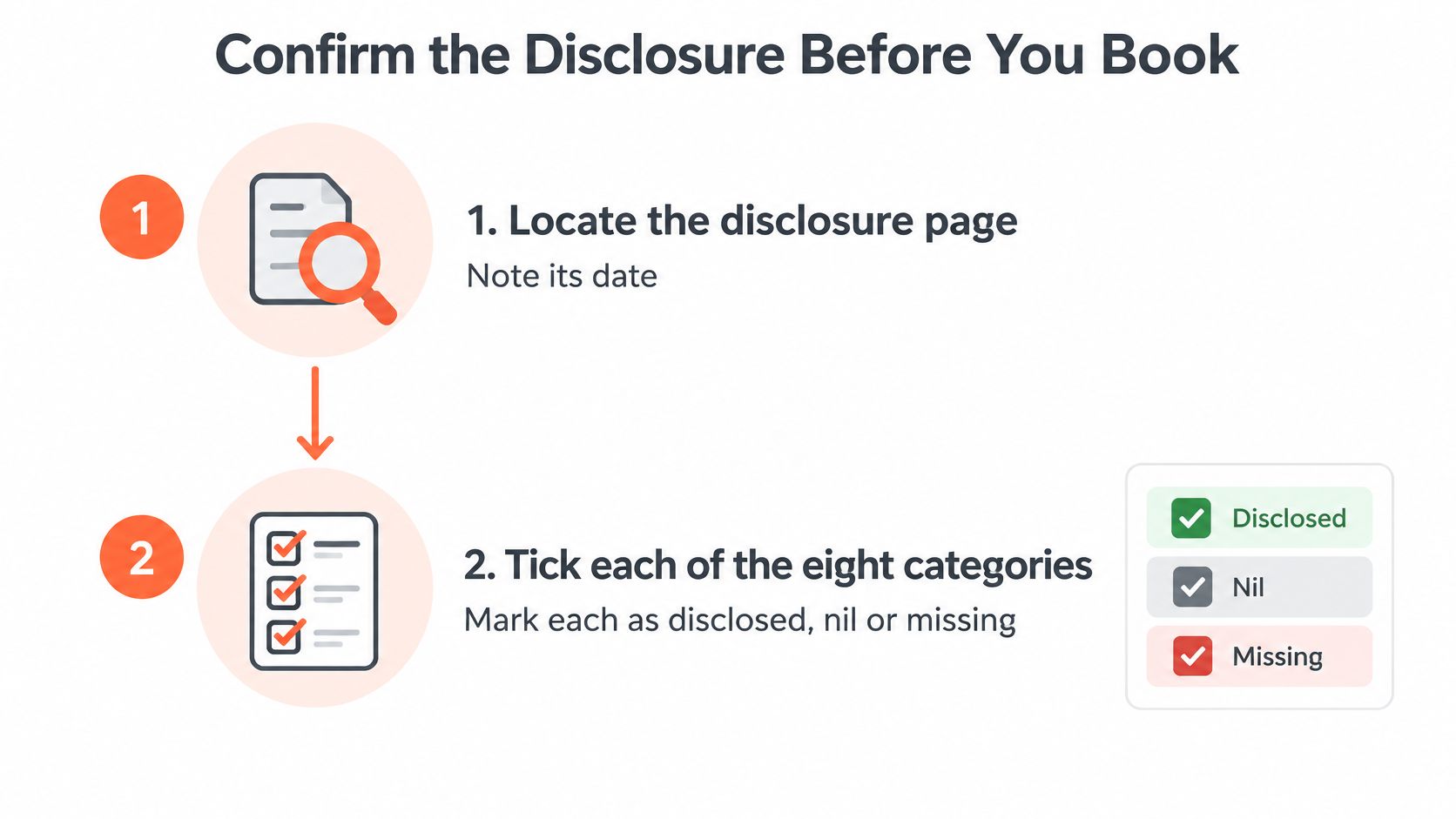
- Locate the disclosure page. Note its date. A page without a date is harder to assess for currency.
- Check all eight categories. Mark each as disclosed, nil, or missing using the checklist above.
- Trace each disclosed incentive. Connect it to the test, package, or product it may reward.
- Verify ownership and parent-company ties. Compare the clinic’s statements with company registration or regulator records where available.
- Ask about every missing item in writing. Save the response and its date; no response leaves the item unresolved.
- Compare the clinic’s profile. Use the Longevity Clinics comparison tool to line up programmes side by side and review how their conflict-freedom assessments differ.
Proceed only when every category is either disclosed with a traceable pathway or stated as nil with records you can verify. Pause if an item remains unanswered, and check the published methodology to understand how any grade was assigned before you commit. Ask the clinic for its dated disclosure and supporting details before you book, then keep its written response with your decision records.