7 Longevity Clinic Reviews: Compare Before You Pay
Explore 7 longevity clinic reviews with scores, costs, strengths, weaknesses and practical guidance for comparing high-cost programmes.
The most expensive longevity programme isn’t necessarily the most credible, and the longest test menu isn’t necessarily the best treatment plan. The price tag is not the treatment plan. Before comparing clinics, compare the resources telling you which clinics deserve your money.
Useful longevity clinic reviews should help you distinguish diagnostic breadth from clinical usefulness, medical supervision from concierge service, and evidence from marketing. They should also make costs, follow-up responsibilities and commercial conflicts easier to investigate. A polished review that doesn’t explain those distinctions offers limited protection against an unsuitable purchase.
The resources below serve different purposes. Some publish editorial assessments, some organise prices and credentials, and others collect patient-experience signals. Longevity Clinics offers a transparent editorial starting point through standardised profiles, but its scores, like any publication’s ratings, should inform research rather than replace medical judgement.
Buying principle: Use reviews to identify what needs verification, not to outsource the decision about which treatments you should receive.
These are review and research resources, not recommendations to attend particular clinics. The practical question is which combination helps you assess evidence, accountability and the complete cost of care before paying.
Table of Contents
- 1. Longevity Clinics
- 2. CureMed
- 3. World Longevity Clinics
- 4. Global Clinic Rating (GCR)
- 5. longevitycost
- 6. 2100.health
- 7. longevity.io
- Longevity Clinic Reviews: 7-Item Comparison Matrix
- Turn a Shortlist into a Safe Buying Decision
1. Longevity Clinics
Best for comparing the substance of different programme formats. Longevity Clinics is an independent editorial publication, not a clinic or medical provider. Its published methodology assesses diagnostic depth, medical supervision, conflict freedom and evidence base, allowing readers to examine more than amenities or treatment-menu length.
The publication’s clinic directory presents 19 reviewed programmes with standardised 0–100 editorial scores. Its profiles and comparison tools organise information about diagnostics, interventions and follow-up across residential, outpatient and membership services. That structure is useful because a diagnostic visit and an ongoing medical relationship shouldn’t be treated as interchangeable purchases.
The strongest feature is the separation of evaluation axes. A programme can offer extensive testing without equally strong supervision or evidence. Looking at the components, rather than accepting the composite score, helps readers identify that mismatch.
Independence Requires More Than a Label
The publication states that it accepts no paid placements, clinic commissions or affiliate links. It describes reader-funded journal content and a separately managed benchmarking report that clinics can purchase, with an editorial firewall protecting reviews.
That disclosure matters, but readers should still inspect how the publication supports individual conclusions. Its reliance on publicly verifiable material makes source checking possible, while also limiting what it can establish about care delivered behind closed doors.
- Strongest use: Compare programme structure, evidence labelling, disclosed incentives and follow-up arrangements using consistent categories.
- Practical limitation: The directory is selective rather than exhaustive, and a public-source review isn’t an on-site clinical audit.
- Before paying: Check the profile’s supporting material against the clinic’s current proposal, named clinicians and written treatment terms.
My assessment is that Longevity Clinics works best as a structured starting point, especially when unlike programmes initially look difficult to compare. Its editorial score isn’t a medical endorsement, and the clinic prices discussed in profiles shouldn’t be mistaken for the cost of accessing the publication.
Ask a final question of any highly rated programme: does its strongest-rated feature address your actual clinical need, or merely make the package more impressive?
2. CureMed
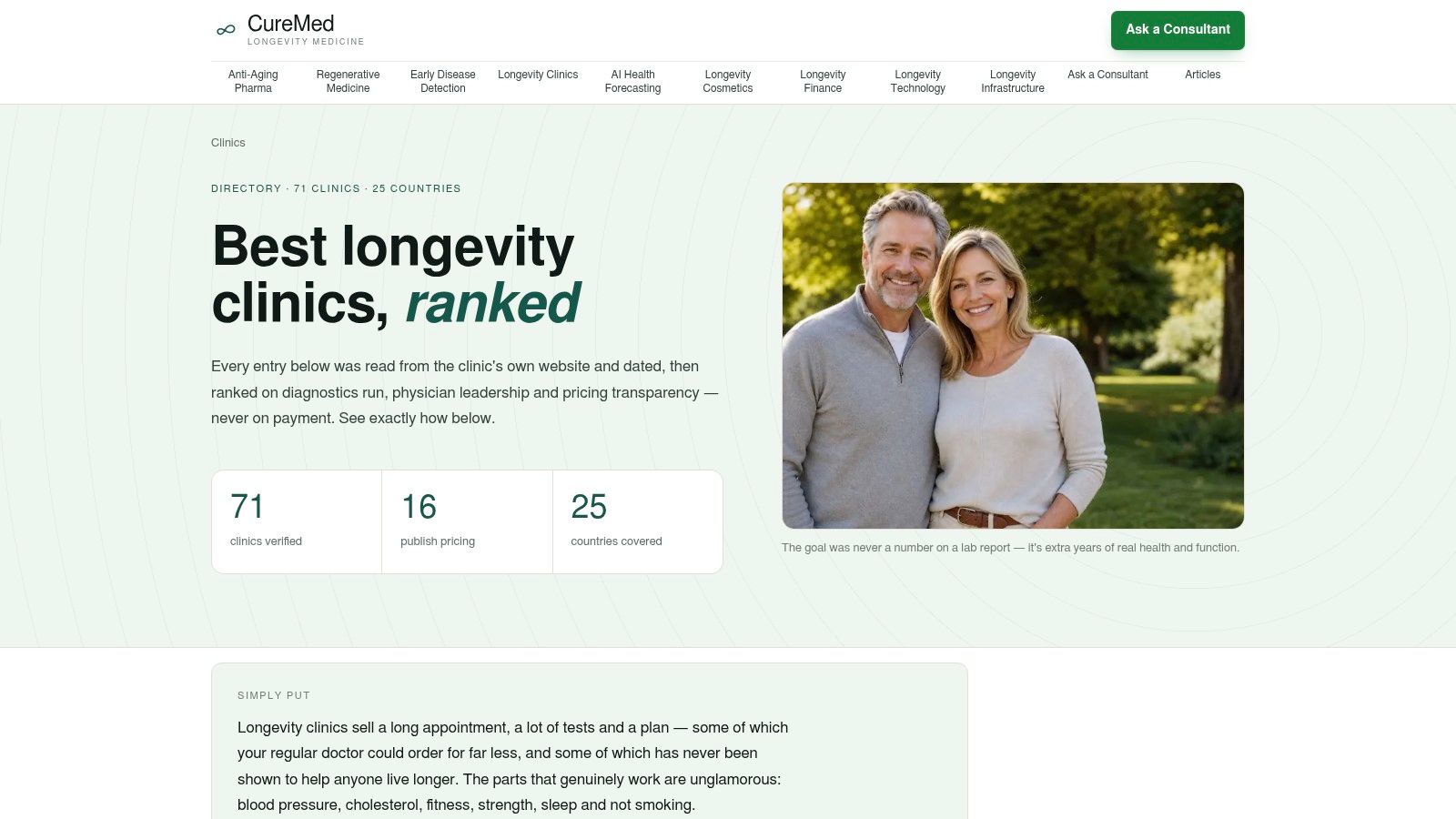
A shortlist is more useful when you understand the language used to sell it. CureMed’s longevity-clinic directory and buying guides combine provider discovery with discussion of evidence, costs, credentials and questions to ask before purchasing.
Its strongest use case is orientation. CureMed describes comparison criteria including diagnostics, physician leadership, pricing transparency and distinguishing features. Those categories help a newcomer move beyond asking which clinic offers the most services.
The limitation is the underlying information. Rankings that rely substantially on clinic-published descriptions can organise those descriptions without independently establishing that the advertised care consistently occurs.
Separate Education From Verification
Use CureMed to identify claims worth investigating, then ask for documentation. A named medical director is a starting point for checking professional registration, not proof that the director will personally assess you or supervise every intervention.
- Evidence questions: Which services address established risk factors, and which are offered as experimental longevity interventions?
- Accountability questions: Who reviews your results, authorises treatment and manages complications?
- Commercial questions: Does the quoted programme require additional purchases from the clinic or associated suppliers?
For background before comparing packages, the publisher’s guide to longevity medicine provides another educational reference. Keep educational explanations separate from evidence supporting a particular clinic’s treatment claims.
CureMed is therefore best used to improve the questions you ask, not to certify the answers. Verify the date of each listing, request current inclusions and ask whether the ranking evaluates documented outcomes or primarily describes advertised capabilities.
A helpful comparison would distinguish a clinic with a clearly accountable physician from one that merely lists physician involvement. Don’t assume those arrangements are equivalent.
3. World Longevity Clinics

An international shortlist needs care-model context. World Longevity Clinics combines clinic profiles, rankings and comparison tools with guidance on residential, outpatient, hospital-based and membership programmes. Its stated position that editorial scores are research aids rather than medical-quality certifications is an important boundary.
The platform is particularly useful for asking what happens beyond the initial assessment. A residential programme may provide an intensive visit, while a membership may promise continued access. Neither description, by itself, establishes who owns an abnormal result or coordinates care after you return home.
A clinic’s responsibility shouldn’t end where your travel itinerary ends.
Compare the Handoff, Not Just the Visit
The platform’s attention to follow-up and regulation can help readers investigate continuity. Ask whether the clinic will send interpretable records to your existing doctor, arrange referrals and specify who handles urgent findings.
That matters when diagnostic breadth is a selling point. In a German population-based cohort, 32% of whole-body MRI participants had potentially relevant incidental findings, illustrating why reviewers should examine downstream management rather than count discoveries alone (whole-body MRI findings and downstream healthcare costs).
The methodological limitation is editorial aggregation. A composite score combines judgements; it doesn’t establish the appropriateness of a particular scan or intervention for you. Where profiles can be claimed by clinics, inspect whether statements originate with the provider or have independent support.
Use World Longevity Clinics to compare programme models and develop an international shortlist. Before booking, request the clinic’s written abnormal-finding protocol, referral arrangements and follow-up charges.
The more revealing comparison isn’t which programme promises the deepest assessment. It’s which programme explains, in advance, how it will manage uncertainty without leaving you to coordinate the consequences.
4. Global Clinic Rating (GCR)
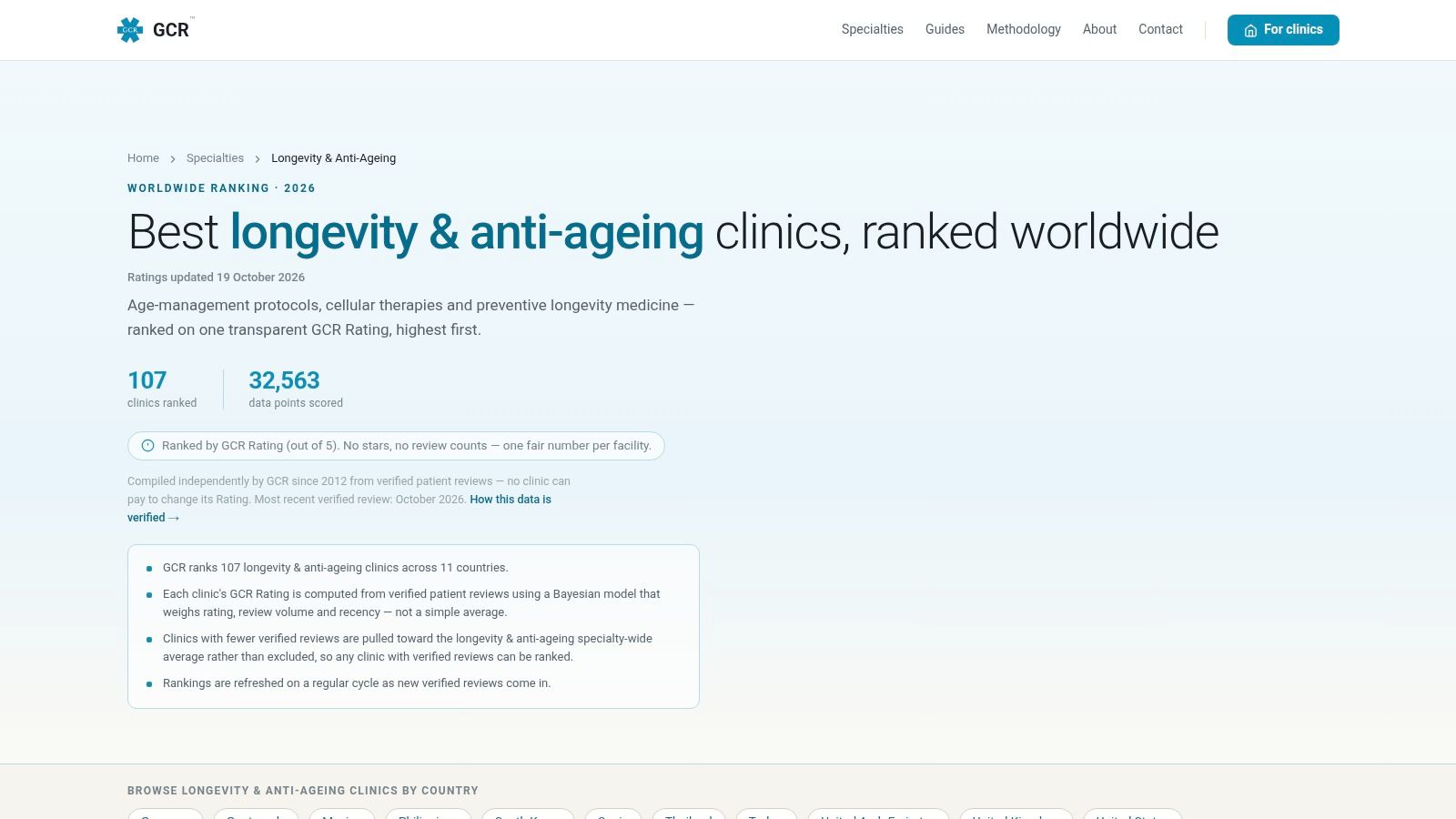
Patient reviews answer a different question from editorial assessments: what did respondents experience? Global Clinic Rating’s longevity-clinic rankings provide patient-review signals, with review volume and recency included in the described rating model.
That makes GCR useful for investigating communication, organisation and reported service experience. It doesn’t make patient ratings a measure of clinical appropriateness, treatment efficacy or added healthy lifespan. A smooth visit and an evidence-based treatment plan are separate considerations.
A useful caution comes from an executive-health clinic study: 94 of 111 clients submitted feedback, producing reported combined satisfaction of 98.9%, but the observational dataset came from a single clinic and didn’t establish longevity benefits (executive-health client satisfaction study). The missing responses also matter when interpreting the headline result.
Read the Reviews Behind the Rating
GCR’s adjustment for review volume is useful context, but readers should still examine what reviewers discuss. Praise for accommodation or attentive staff doesn’t answer whether testing was justified or complications were managed well.
- Look for specificity: Does feedback describe result explanations, access to clinicians and follow-through?
- Check relevance: Are reviewers discussing the programme you’re considering, rather than unrelated services at the same facility?
- Recognise missing evidence: Silence about adverse events or long-term outcomes isn’t confirmation that neither is a concern.
Compare patient-experience signals with the criteria behind an editorial longevity-clinic ranking, rather than treating either as a substitute for the other.
GCR is strongest as a reputation cross-check. If patient accounts contradict a clinic’s promised follow-up model, ask for clarification before paying. If they’re uniformly positive but discuss only hospitality, you still need separate evidence about medical care.
5. longevitycost
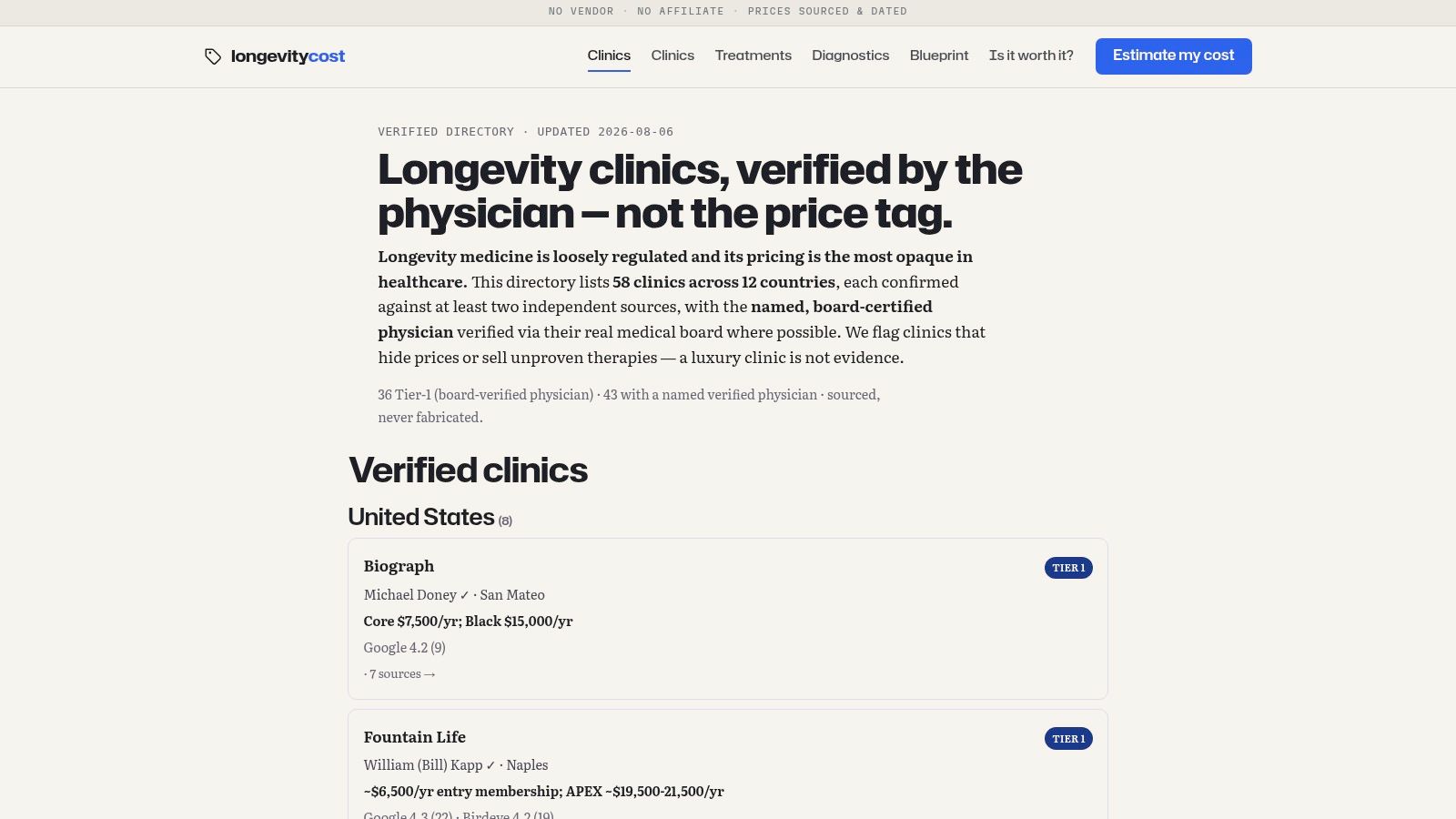
A published price is useful only when you know what it buys. longevitycost’s clinic directory focuses on pricing, named physicians, credentials and source-backed listing details. That combination makes it useful for early budgeting and provider research.
Its advantage over a purely editorial ranking is practical: readers can investigate whether a clinic publishes fees and identifies the people responsible for care. Where listings include professional registrations, source counts or external review snippets, treat them as separate information categories rather than a combined quality guarantee.
A verified listing can indicate that details were checked without establishing whether the programme is appropriate for you. Likewise, a physician’s registration doesn’t demonstrate the efficacy of every intervention offered under that physician’s supervision.
Convert Starting Prices Into Comparable Quotes
Ask each shortlisted clinic to separate clinical time, diagnostics, treatments, interpretation and follow-up. If accommodation is included, distinguish it from medical spending so you’re comparing equivalent services.
- Included care: Request the actual tests and consultations, not just a package name.
- Conditional charges: Ask what you’ll pay if results trigger repeat testing, specialist assessment or additional treatment.
- Ongoing obligations: Clarify renewal terms, prescription management and whether repeat assessments require another package purchase.
The directory’s credential information is most valuable when it leads to a direct check with the relevant professional register. Confirm the clinician’s identity, current registration and role in your proposed programme.
My assessment is that longevitycost works best as a quote-preparation tool. It can help you establish what to ask about, but a displayed starting price shouldn’t become your assumed total budget.
A clinic that provides a detailed exclusion list may be easier to budget for than one advertising a simpler headline price. Transparency about what isn’t included deserves attention alongside the amount itself.
6. 2100.health
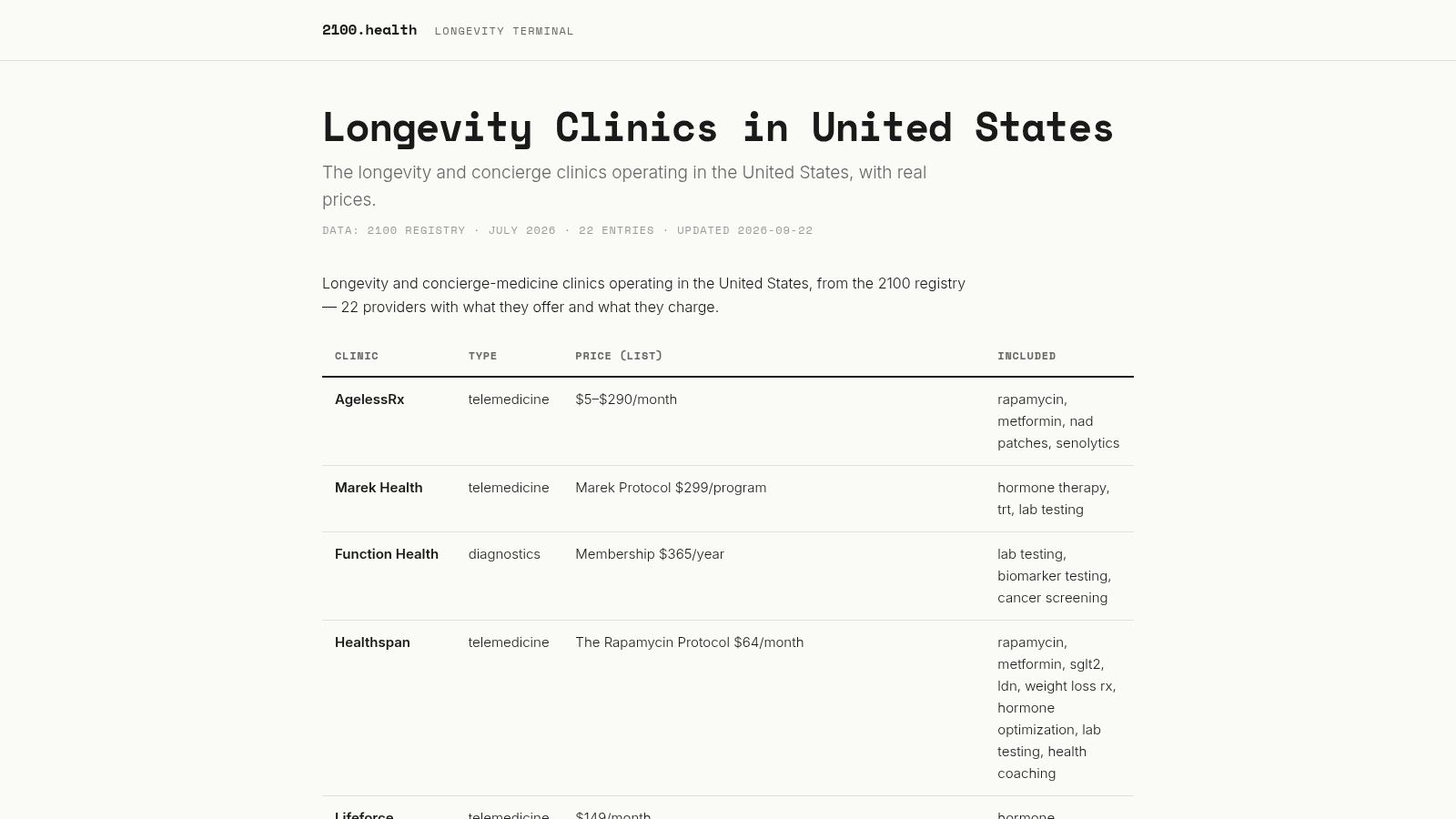
You may not need the kind of programme you originally searched for. 2100.health’s United States longevity-clinic registry organises clinics and related services, including diagnostic businesses and residential offerings, with reported prices for some listings.
Its strongest use is comparing service formats before comparing brands. A reader seeking help interpreting existing results has a different purchasing question from someone considering residential care. The registry’s breadth can help identify those distinctions before a sales consultation frames every need as a full package.
However, a registry listing isn’t a patient review, clinical audit or independent determination of treatment suitability. Price snapshots may also describe only a particular service, not the complete relationship you would need.
Budget safeguard: Compare the cost of obtaining information with the cost of getting that information interpreted and acted on.
Check What Sits Behind the Service Label
Use the listing to establish whether you’re considering a test provider, a medical practice or a wider programme. Then ask who is responsible for interpretation, prescribing, referrals and complications.
Regulatory verification becomes especially important if a provider advertises regenerative interventions. The FDA’s consumer alert on stem cells and exosomes warns about unapproved products and serious reported harms, including infections, tumour formation and blindness.
A directory’s inclusion of a service doesn’t establish regulatory authorisation. Request the exact product category, proposed indication, applicable regulatory status and any research documentation before considering treatment.
2100.health is therefore best for market mapping and initial budgeting. Use it to identify the care format worth investigating, then verify the current price, medical responsibilities and evidence directly. Don’t interpret availability as validation.
7. longevity.io
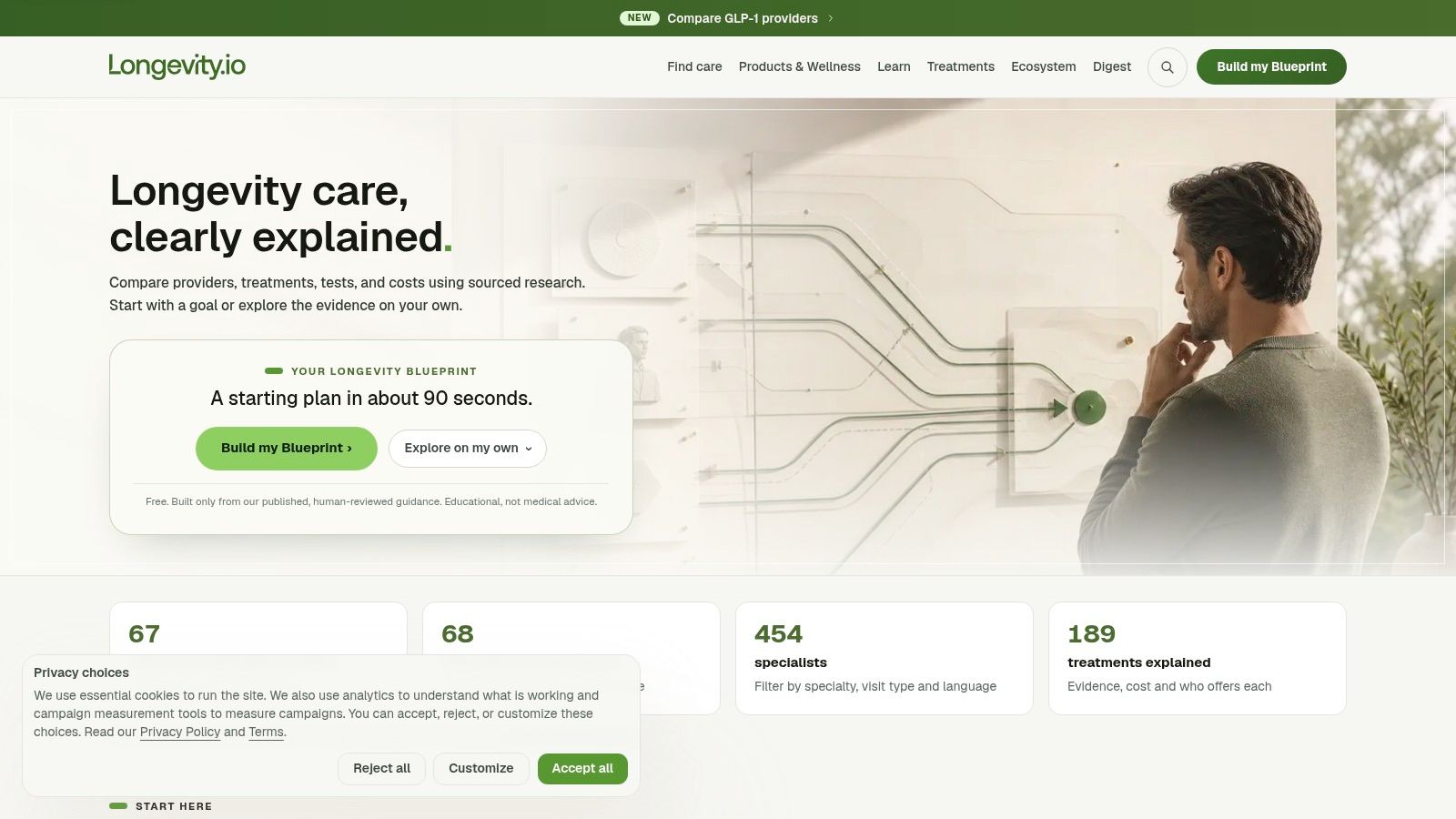
longevity.io broadens the comparison beyond physical clinics through information on telehealth providers, diagnostic tests, specialists and treatments. Its strongest use is testing whether a full clinic package is the right purchasing unit at all.
Its educational material and Blueprint tool can support research, but the tool is described as educational rather than medical advice. A directory entry, treatment explainer and provider comparison should also be read as different content types with different evidentiary limits.
The platform states that it doesn’t sell paid directory rankings, while separately disclosing that paid partnerships may affect provider placement in some comparisons. That distinction makes page-level disclosure important: an overall independence statement doesn’t answer how every recommendation is selected.
Ask Whether the Test Changes Care
The broader treatment and diagnostics context is useful when clinics promote biological-age panels. Before comparing test brands, ask whether a result would change management in a way supported by patient-outcome evidence.
A roadmap for clinical translation of longevity interventions identifies major validation gaps in ageing biomarkers, including insufficient interventional reversibility data. A precise-looking score shouldn’t be treated as a validated measure of remaining lifespan or proof that a treatment has improved health.
- For diagnostic comparisons: Look for analytical validity, reproducibility and an explicit treatment decision linked to the result.
- For provider comparisons: Check whether placement reflects editorial selection, a commercial relationship or another arrangement.
- For educational tools: Use the output to prepare questions, not to start treatment independently.
longevity.io is most useful as a scope-checking resource. It helps readers investigate alternatives to an all-inclusive package while keeping attention on the evidence behind individual components.
The key buying question is whether each component adds actionable clinical value. Purchasing more components doesn’t resolve uncertainty about any of them.
Longevity Clinic Reviews: 7-Item Comparison Matrix
| Platform | Scope | 🔄 Research Effort | 📊 Comparison Output | ⭐ Key Advantage | 💡 Best Use / Caveat |
|---|---|---|---|---|---|
| Longevity Clinics | 19 programmes across 8 countries; English and German | Low–moderate; standardised profiles and tools | Four-axis scores, rankings, costs, diagnostics, and evidence context | Transparent methodology; states it accepts no clinic payments or paid placements | Useful for evidence-focused comparisons; coverage is selective, not exhaustive |
| CureMed | 71 clinics across 25 countries | Low; directory and buying guides organise key details | Rankings covering diagnostics, physician leadership, and pricing transparency | Combines clinic comparisons with guidance on evidence, credentials, and costs | Good for building an initial shortlist; rankings rely substantially on clinic-published information |
| World Longevity Clinics | 47 clinics across 18 countries | Low–moderate; profiles and comparison tools support shortlisting | Editorial scores and guidance on care models, follow-up, and regulation | Highlights differences among residential, outpatient, hospital, and membership models | Useful for international comparisons; scores are not clinical certifications |
| Global Clinic Rating (GCR) | 107 facilities across 11 countries | Low; searchable ranking with country filters | Ratings based on verified patient reviews, including review volume and recency | Offers broad coverage and patient-reputation signals | Useful for exploring reported experiences; ratings do not measure clinical outcomes |
| longevitycost | Clinic directory with prices and provider details where available | Moderate; users may need to check sources and current fees | Price, clinician credentials, locations, and some external rating snippets | Brings cost and credential information together | Useful for early budgeting and provider research; verification signals are not quality ratings |
| 2100.health | U.S. clinics and related services | Low–moderate; listings support market exploration | Service summaries and price snapshots for some programmes and tests | Covers varied provider types, including diagnostics businesses | Useful for initial U.S. market research; confirm prices, inclusions, and follow-up costs |
| longevity.io | Clinics, telehealth, diagnostics, specialists, and treatments | Moderate; broad platform requires navigating separate sections | Filters and comparisons across care models, tests, and providers | Adds educational context beyond clinic listings | Useful for comparing different care options; paid partnerships may affect placement in some sections |
Turn a Shortlist into a Safe Buying Decision
The strongest approach combines resources without pretending they measure the same thing. Use Longevity Clinics for standardised editorial profiles, longevitycost and 2100.health for price and service-format research, and CureMed and World Longevity Clinics for additional clinical and market context. Add GCR for patient-experience signals and longevity.io when comparing clinics with telehealth or standalone testing.
Keep the intended outcome explicit. The World Health Organization reported life expectancy of 73.3 years and healthy life expectancy of 62.8 years in 2023, a distinction that explains why living longer and living longer in good health aren’t interchangeable claims (WHO life expectancy and healthy life expectancy estimates). A better biomarker result, favourable review or attractive package doesn’t establish either outcome.
Require Written Answers Before a Deposit
Turn your shortlist into comparable written proposals. Each clinic should identify the responsible clinician, exact inclusions, exclusions, follow-up arrangements and evidence supporting the proposed interventions.
- Verify accountability: Check professional registration and establish who handles abnormal findings, referrals and complications.
- Verify the complete cost: Include repeat testing, interpretation, medication, ongoing care and potential downstream assessment.
- Verify evidence and regulation: Separate established prevention from experimental interventions, and request the relevant authorisation or research documentation.
- Verify incentives: Ask about supplement sales, referral arrangements and financial relationships affecting recommendations.
If a review resource doesn’t disclose a commercial relationship, treat that as missing information, not evidence that no relationship exists. If a clinic won’t explain what happens after an uncertain finding, don’t assume follow-up is included.
A score, review or attractive price is an input to due diligence, not a substitute for a clinician-led suitability assessment. The purpose of comparison is to narrow uncertainty enough for that assessment to be productive.
Choose a shortlist, request itemised proposals and take them to a registered clinician who understands your medical history. Before paying a deposit, require written answers about responsibility, follow-up, evidence and total costs. If those answers remain unclear, postpone the purchase rather than paying for clarity later.