Executive Health Screening: What to Expect in 2026
Discover how executive health screening helps high-net-worth patients catch risks early, with premium diagnostics and tailored prevention plans for 2026.
Executive health screening is a structured preventive-care service model, and Mayo Clinic’s programme began in 1971 after corporations and businesspeople asked for a way to protect key employees as a business investment. Mayo later reported that the Scottsdale programme began in 1987, started with 26 executives, and now serves more than 2,400 executives annually across that site alone, while its broader network serves over 20,000 executives each year.
That scale is the surprising part. The strongest executive screening programmes are not defined by how many tests they cram in, but by how well they choose the right tests, interpret them in context, and close the loop when something abnormal turns up.
Table of Contents
- The Origins and Evolution of Executive Health Screening
- Core Components and Evidence-Based Test Bundles
- Residential Versus Outpatient Screening Logistics
- Privacy, Concierge Care, and Discretion Features
- How to Choose the Right Screening Program
- Conclusion: Prioritizing Value Over Volume in Screening
The Origins and Evolution of Executive Health Screening
A chief executive once walked into a clinic expecting a routine physical and found something more deliberate. Around Mayo Clinic, prevention became a coordination problem, not a checkbox exercise. That shift explains why executive health screening developed into a distinct service line rather than a dressed-up annual checkup.

Why the model changed
Mayo’s early programme grew out of a business need. Companies wanted quicker access for people whose health affected operations, travel, and continuity. A Mayo Clinic alumni retrospective notes that the programme began in 1971, and that Scottsdale later opened in 1987 with 26 executives Mayo Clinic Alumni history retrospective.
Over time, the model became a coordinated clinical visit that brought several assessments together in one short encounter. Prevention and specialist review were meant to work as a single process, not as separate appointments. That history matters because it explains why modern programmes often promise speed, privacy, and breadth in the same package.
The practical change was just as important. A credible programme today usually includes a full medical history, physical examination, screening for cancer and cardiovascular disease, a cardiac stress test, medication and immunisation review, and a look at nutrition, stress, alcohol, tobacco, and other behavioural risks Mayo Clinic Alumni Association document. That bundle is not valuable because it is large. It is valuable when the tests are chosen for the person in front of the clinician.
What that history teaches
The origin story also reveals the central mistake many buyers make. A screening programme can look impressive because it offers many tests, yet still add little if the testing is not tied to risk stratification and follow-up. Like a tool kit filled with specialist instruments, breadth only helps when you know which tool fits the job and what happens after the first result.
A programme built for a small executive population can also become a repeat-use service for individuals and employers. That is why executive screening now sits at the intersection of medicine, market design, and occupational risk.
Practical rule: if a clinic cannot explain how it moved from “many tests” to “the right tests,” it is still thinking in package language, not clinical logic.
For executives, the appeal is easy to understand. Expedited access, several assessments in one visit, and physician review all save time. The risk is just as clear. Once the format feels premium, it becomes easy to assume every extra test adds value. Evidence-based screening and marketing often part ways at that point.
Core Components and Evidence-Based Test Bundles
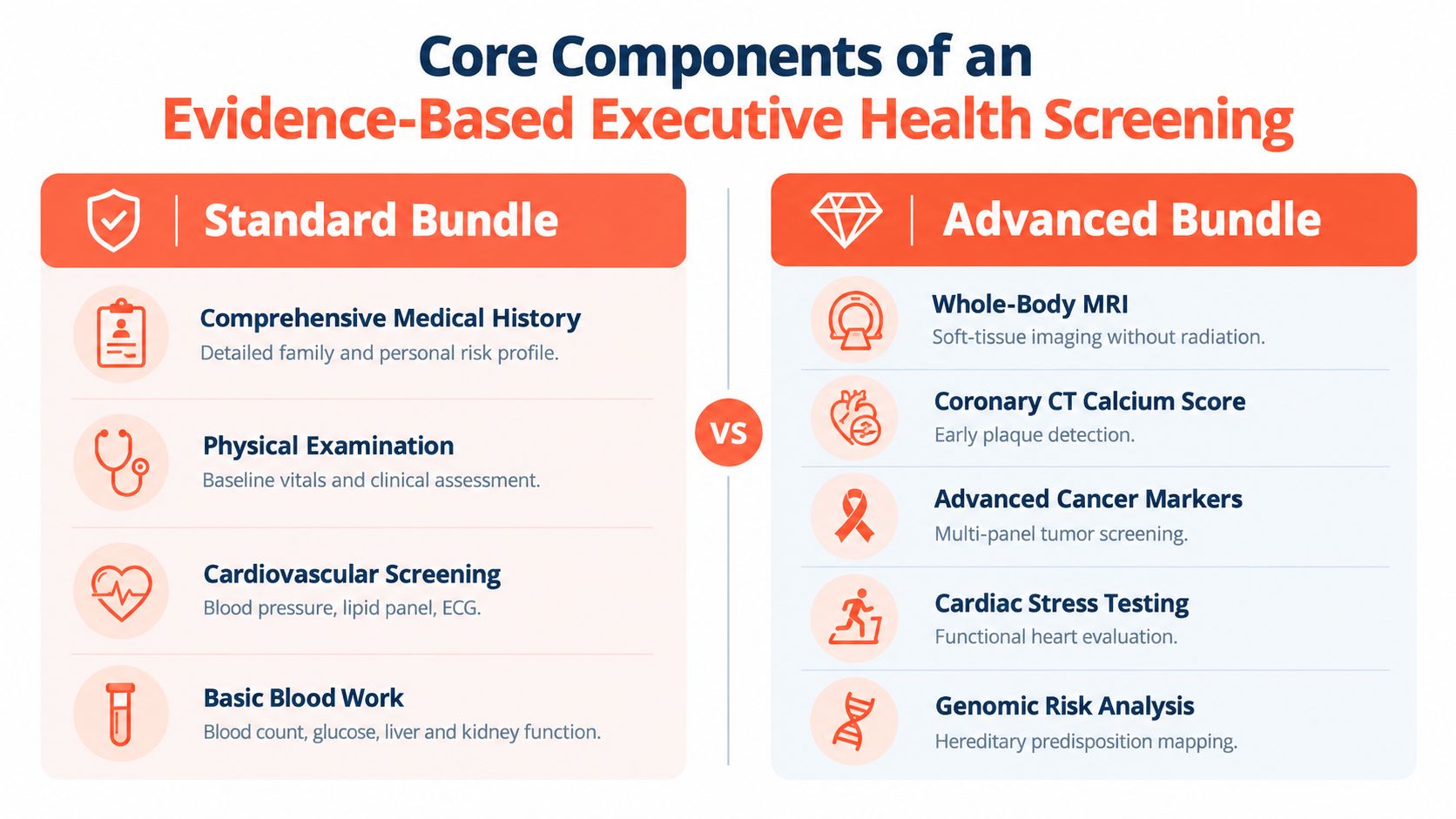
A credible executive health screening begins with disciplined risk assessment, not flashy imaging. The value lies in selecting tests that fit age, family history, symptoms, medication use, and occupational realities. If a programme cannot show that line of reasoning, it is selling volume.
What belongs in a credible bundle
A defensible package starts with the clinical history, the physical exam, and risk-based screening for cardiovascular and cancer concerns. It should also review medications, immunisations, and behavioural risks such as stress, alcohol, tobacco, and nutrition, because those factors often change what a doctor recommends.
For a benchmark on what a defensible workup includes, see the minimum credible diagnostic set.
The package should be selective. The U.S. Preventive Services Task Force gives colorectal-cancer screening a high-certainty assessment of substantial net benefit for adults aged 50 to 75, but recommendations still vary by age, sex, family history, smoking exposure, and other risks. A credible programme documents who qualifies for each test, when it should be repeated, and what happens if the result is abnormal USPSTF recommendations.
Where low-value testing starts
The problem is simple. More tests do not automatically mean better care. A recent review of periodic adult health examinations concluded that indiscriminate annual combinations of clinical examinations, laboratory tests, and imaging have not been shown to reduce morbidity or mortality, and may cause harm through overdiagnosis and overtreatment evidence review. A Cochrane summary of 15 trials involving 251,891 participants found no clear reduction in illness or mortality from broad health checks Cochrane review summary.
A package filled with extra panels can still be weak medicine. If a test does not change management, it can still change anxiety, follow-up burden, and cost.
Practical rule: ask one question before every non-symptom test, “What will we do differently if this is abnormal?”
Whole-body MRI shows the same pattern. It may find a lot, but it is not established as a routine preventive screen for asymptomatic executives. A systematic review of 12 studies involving 5,373 asymptomatic people found pooled critical or indeterminate incidental findings of 32.1%, with false-positive findings in six studies and a pooled proportion of 16.0% systematic review. In another review, roughly 94% of asymptomatic adults had at least one radiologic abnormality, up to 30% underwent additional investigation, and only 1.1 to 1.6% had pathologically confirmed cancer systematic review.
For a time-poor buyer, the lesson is straightforward. The length of the bundle tells you nothing; the quality of its risk stratification tells you everything.
Residential Versus Outpatient Screening Logistics
The choice between residential and outpatient screening is less about prestige than fit. Some executives want a concentrated medical retreat. Others need a clinic that fits between flights, board meetings, and family obligations. Both models can work, but they solve different problems.
Residential programmes
Residential screening usually suits people who want an immersive experience with more time on site, fewer interruptions, and a feeling of separation from daily demands. It can be attractive when the goal is a more complete diagnostic day, private recovery time, or a setting that supports multiple consultations without the friction of commuting. The trade-off is obvious, you’re committing more time away from work and home, and travel becomes part of the medical plan.
The strongest case for a residential format is continuity inside the stay itself. If a clinician needs to add testing, review findings, or coordinate several specialists in one visit, the structure can make that easier. The risk is that the programme may feel more thorough because it is longer, even when the added time does not meaningfully improve the quality of the underlying decisions.
Outpatient programmes
Outpatient screening is usually the better fit for executives with tight calendars. It compresses the visit into a shorter window, reduces travel burden, and makes it easier to return to work the same day or the next. For many people, that convenience matters more than a hotel suite or a multiday itinerary.
An outpatient model also tends to expose whether the clinic is well organized. If the facility can deliver a focused history, needed testing, physician interpretation, and a clear follow-up path without wasted motion, that’s a sign of operational maturity. If it feels rushed, fragmented, or overly scripted, the format itself won’t rescue the programme.
The cleanest way to compare the two is to ask what you’re buying besides time. If you value privacy, travel reduction, and a fast decision loop, outpatient often wins. If you want a quiet environment with room for repeated review and a more immersive assessment, residential may be better. Either way, use the same standard, does the format improve care, or does it just make the package feel more premium? Residential versus outpatient screening
Privacy, Concierge Care, and Discretion Features
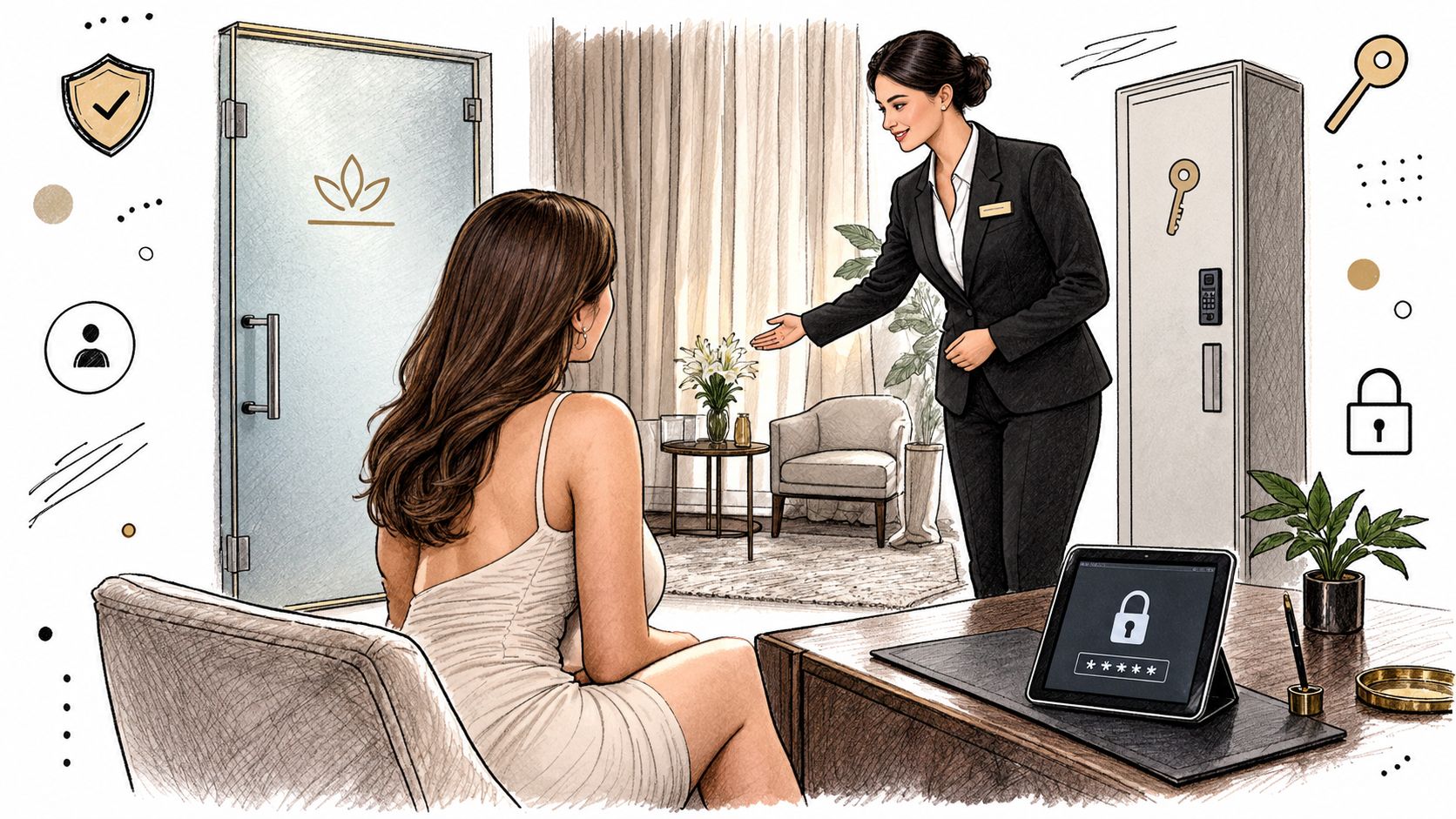
For many executives, privacy isn’t a nice extra, it’s part of the clinical value. Health information can affect board roles, travel, insurance decisions, succession planning, and family conversations. A clinic that handles that data carelessly creates avoidable risk.
What discretion should look like
A serious clinic should use dedicated staff, secure digital portals, and clear reporting pathways so results don’t get lost in general administrative workflows. It should also tell you who sees your records, how abnormal findings are escalated, and how follow-up is coordinated if you’re travelling or based in another country. If the clinic can’t describe those steps plainly, assume the process is weaker than the brochure suggests.
Concierge-style features can be useful when they support the medicine. Personalized scheduling, private rooms, direct access to specialists, and a named clinician for follow-up all reduce friction. They matter most when they make it easier to complete the right work, not when they merely make the visit feel exclusive.
What to ask before you book
Ask how the programme handles records transfer, especially if you split your care across borders. Ask whether the clinic will send a clean summary to your home doctor, and whether it owns the follow-up after an abnormal result or expects you to manage that alone. That second question matters more than most buyers realise.
If the clinic sells discretion but cannot explain follow-up ownership, the service is incomplete.
A useful benchmark is whether the clinic can separate the diagnostic day from the continuity plan. The screening visit is only the start. Real value comes from making sure the findings land in the right place and that someone is responsible for what happens next concierge benefits.
How to Choose the Right Screening Program
The strongest executive health screening programmes read like a clinical case for or against each test. They explain why a test is included, what result would actually change care, and how uncertainty will be handled. That is the standard worth using.
Start with evidence, not volume
A good programme should separate guideline-supported tests from optional extras. It should also spell out eligibility criteria, test intervals, contraindications, and what happens when a result is abnormal. That matters because adding tests without a clear action threshold can lead to incidental findings, repeat procedures, and uncertainty without proving better outcomes USPSTF recommendations.
A physician-led review matters because executives are not average-risk clones. Travel, sleep disruption, hypertension, cardiometabolic risk, family history, and medication use all change pre-test probability, so the same test can have very different value in two people. Good programmes adjust to those differences. Weak ones apply the same package to everyone and call it personal care.
Compare programmes with the right questions
Before you choose a provider, ask:
- Evidence Base: Which tests are supported by current preventive guidance, and which are commercial add-ons?
- Medical Supervision: Who interprets the results, and is there a physician responsible for follow-up?
- Privacy Standards: How are records stored, shared, and transferred?
- Turnaround Time: How quickly do you get the report, and who explains it?
- Continuity of Care: What happens after an abnormal result, especially if you travel often?
- Conflict Freedom: Does the clinic disclose whether it benefits from recommending more testing?
Those questions help you compare clinics on quality rather than on theatre. A clinic that answers them clearly usually has a better operating model. A clinic that avoids them is often selling confidence instead of clinical value a family-medicine recommendation list on avoiding low-value testing (Choosing Wisely Canada).
Ask one more question before you book. What would the clinic leave out, and why? A careful, evidence-based programme can say no to low-yield imaging, unnecessary panels, and inflated promises. That restraint is a sign of judgment, not a weakness.
Conclusion: Prioritizing Value Over Volume in Screening
Executive screening works best when it follows the logic of preventive medicine, not a luxury catalogue. The key test is whether the programme matches risk to the person, explains the results clearly, and has a named follow-up pathway. A clinic that does those things can add real value. A clinic that just offers more tests can leave you with more uncertainty, not more protection.
The key question is not how much is scanned, but how well the screening is targeted. Broad checkups and indiscriminate testing can miss the point, because they may create false alarms, overdiagnosis, overtreatment, and avoidable anxiety. That does not make executive health screening a poor choice. It means the programme has to justify itself through disciplined judgment.
The best providers make three things easy to see. First, the tests fit the risk profile. Second, abnormal findings have a clear route for review and action. Third, the output leads to actual care, not a polished report that sits in your inbox. For executives choosing between options, that is the standard worth using.