Longevity Medicine: How Clinics Actually Work
Longevity medicine explained through clinic evidence, diagnostics, and treatment quality. Learn how to evaluate longevity medicine programs before you invest.
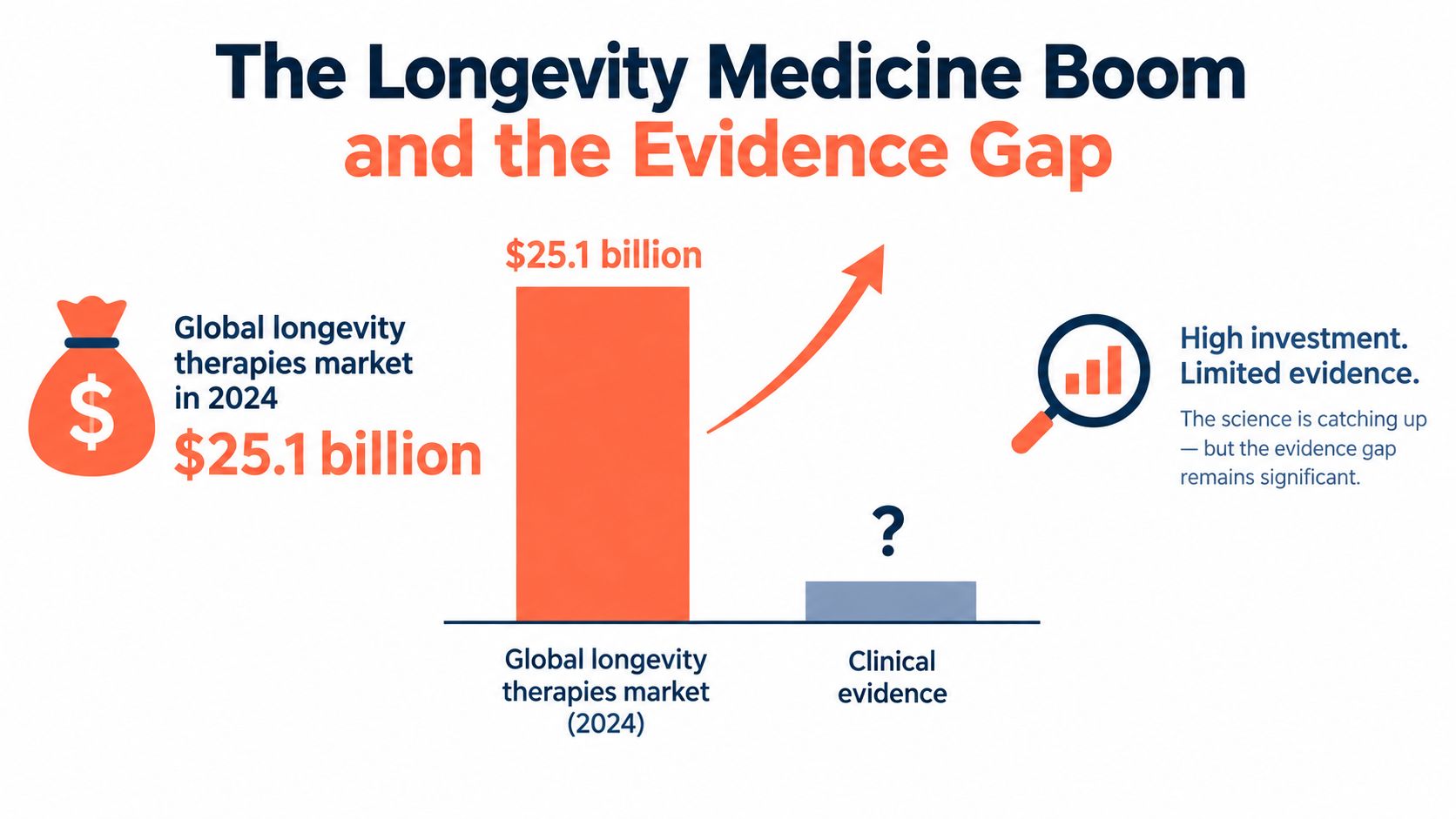
No longevity medicine intervention has yet been clinically proven to extend human healthspan, even as the global longevity and anti-senescence therapies market reached $25.1 billion in 2020 and is projected to approach $44.2 billion by 2030. The uncomfortable conclusion is that commercial momentum has outpaced clinical validation.
That doesn’t make every longevity clinic useless. It does mean patients should evaluate these programs as products with different evidence profiles, incentives, and follow-up models, not as interchangeable medical upgrades. After reviewing more than 20 longevity clinics, I score programs against four questions: how deep their diagnostics go, who supervises care, how conflicts are managed, and whether their interventions have credible human evidence.
The strongest programs usually look less futuristic than their marketing. They identify ordinary but consequential risks, measure physical function, improve exercise and metabolic health, and explain what remains uncertain. The weakest programs often do the opposite, leading with expensive testing and promising that a better biological-age score will translate automatically into a longer life.
Table of Contents
- The Longevity Medicine Boom and the Evidence Gap
- What Longevity Medicine Actually Claims to Do
- Diagnostics That Separate Credible Programs From Marketing
- Residential, Outpatient, and Membership Clinic Models Compared
- The Biomarker Trap and Why Better Numbers Do Not Equal Longer Life
- How to Evaluate Any Longevity Medicine Program Before You Book
The Longevity Medicine Boom and the Evidence Gap
Longevity medicine is now a defined product category, but its commercial maturity exceeds its clinical validation. Clinics package diagnostics, biomarkers, lifestyle interventions, preventive care, and emerging therapies into programs that appear more coherent than the underlying evidence. The sector is projected to grow at a 6.1% compound annual growth rate through 2030, according to Strategy&’s analysis of longevity therapeutics.
That growth tells patients something about demand, access, and marketing. It does not establish that a program extends healthspan or improves survival. A patient may be buying a detailed biological-age assessment, a personalized protocol, repeated testing, and ongoing clinical oversight, while the clinical value of each component remains uneven.
Why market size cannot validate a treatment
Revenue demonstrates that consumers and investors will pay for longevity-related services. It cannot show that a therapy changes disease risk, preserves function, or extends life. A market can expand because patients want earlier risk detection, private care provides more clinician time, or new tests create a persuasive narrative around aging. Those drivers support commercialization, not treatment efficacy.
The scientific record is more cautious. No longevity intervention has been established for widespread clinical use, and many aging biomarkers still lack validated evidence that interventions can reliably reverse them. Also, changing a biomarker has not consistently been shown to improve outcomes that patients value.
Reviews of human aging trials have described biomarker findings as “promising but limited.” Later research has brought greater structure to the field by examining named measures across lifestyle and pharmacological interventions. That shift matters because it turns broad anti-aging claims into testable research questions. It remains evidence development, not confirmation of the commercial model.
The product-evaluation consequence
Patients should evaluate what the program delivers. The purchase may be a useful cardiovascular risk assessment, supervised exercise, and coordinated preventive care. It may instead be a collection of impressive tests and speculative add-ons with limited clinical relevance.
Using the same independent scoring logic that Longevity Clinics applies to every program it reviews, uncertainty should be recorded as a product characteristic. A credible clinic separates established care, promising monitoring tools, and experimental interventions. It explains which outcomes are measured, how follow-up is handled, and which claims remain unproven. The evidence gap does not invalidate every longevity service. It sets the standard for judging whether the service offers medical value or mainly sells a compelling story.
What Longevity Medicine Actually Claims to Do
Longevity medicine generally aims to preserve healthspan, meaning the period of life in which a person retains physical, cognitive, and metabolic function. In practice, clinics pursue that aim through four overlapping tools: conventional risk management, lifestyle intervention, biomarker tracking, and emerging therapies.
The first category is the least glamorous and often the most defensible. It includes identifying cardiovascular and metabolic risk, addressing inadequate physical activity, improving sleep habits, and supporting nutrition. A 2026 systematic review of randomized controlled trials found that 11 studies reported improvements in intrinsic capacity and quality of life, with exercise alone or within multidomain programs associated with better multidimensional healthspan outcomes. The review also found limited evidence for calorie restriction and daily supplementation compared with the stronger case for supervised aerobic or resistance training, as described in the systematic review of exercise and multidomain interventions.
Three levels of clinical claims
A useful way to read a clinic website is to sort its claims into three levels.
-
Established health management: Exercise supervision, prevention-focused medical care, and treatment of recognized metabolic or cardiovascular risk belong here. These interventions may improve function or reduce risk without proving that they slow every biological process associated with aging.
-
Promising measurement and personalization: DNA methylation clocks, broader biomarker panels, targeted supplements, and some medication strategies may help characterize risk or guide a conversation. They require cautious interpretation because a measurable response isn’t the same as a demonstrated patient benefit.
-
Experimental intervention: Off-label combinations, unvalidated senolytics, regenerative procedures, and protocols built around mechanistic plausibility should be labelled experimental. A biological rationale can justify research. It can’t substitute for human outcome evidence.
The problem is that marketing language often collapses these levels. A clinic may place supervised training, an epigenetic test, an infusion, and an experimental drug discussion inside one “optimization” package. That packaging can make the weakest component borrow credibility from the strongest.
Biomarkers are not outcomes
A biomarker can help estimate risk, identify a pattern, or monitor change. It can’t automatically establish that a patient will live longer or remain healthier. The distinction matters because patients may otherwise interpret a favorable report as proof that an expensive intervention worked.
A responsible clinician should be able to answer three questions for every test. What does it measure? How reliable and clinically established is it? What decision will change if the result is high, low, or unchanged? If the answer to the third question is “none,” the test may be interesting without being useful.
Diagnostics That Separate Credible Programs From Marketing
A credible longevity assessment starts with clinical reasoning, not with the most exotic test available. The clinician should understand the patient’s history, current symptoms, medications, family risks, physical activity, sleep, and goals before ordering a large panel. Testing only becomes valuable when a result can change management.
I use a simple diagnostic floor when reviewing programs. It isn’t a universal prescription, and it should be adapted to the patient, but it helps distinguish a medical assessment from a shopping list.
The diagnostic floor
A sensible program should consider:
-
Age-appropriate prevention: Cardiovascular, metabolic, and other screening should reflect the patient’s age, history, symptoms, and recognized risk factors.
-
Core laboratory context: Basic metabolic measures and relevant inflammation or hormonal assessments can provide context when a clinician explains why each test matters.
-
Functional capacity: Grip strength, balance, aerobic fitness, or another meaningful functional measure can show how a patient performs, not only what appears in blood.
-
Longitudinal comparison: Repeat testing should have a clear interval and purpose. A baseline without a plan for interpretation is an expensive snapshot.
The exact contents will vary. A person with symptoms, established disease, or complex medication use may need conventional medical evaluation before any optimization program. A healthy executive seeking performance tracking may need a narrower assessment than a patient with multiple risk factors. The credible feature is not maximal testing. It’s the connection between the test, the interpretation, and the action.
Tests that need careful framing
Advanced DNA methylation biomarkers, including GrimAgeV2, PCGrimAge, PCPhenoAge, SystemsAge, and DunedinPACE, have shown responsiveness across lifestyle and pharmacological interventions in recent international work. DunedinPACE also emerged as the strongest mortality predictor among 14 consensus biomarkers in a recent analysis, alongside measures such as handgrip strength, inflammation, standing balance, and cognitive health, as reported in this analysis of consensus aging biomarkers.
That makes these tools scientifically interesting, not automatically treatment-defining. Clinics should present them as risk-stratification instruments and tracking signals, not as validated surrogate endpoints.
A useful minimum-credible diagnostic framework for longevity programs should therefore ask whether each result affects a decision. Be cautious when a consultation emphasizes a long hormone panel, telomere measurement, continuous glucose monitoring, or advanced imaging without explaining the management pathway. The warning sign isn’t the test itself. It’s the absence of clinical context.

Practical rule: Don’t ask whether a clinic offers more tests. Ask which result would make the clinician change your treatment, and what happens if the result doesn’t change.
Residential, Outpatient, and Membership Clinic Models Compared
The format of a longevity program changes the patient experience, but it doesn’t determine the quality of the medicine. A luxurious residential setting can deliver fragmented care, while an ordinary outpatient practice can provide careful follow-up. The key variables are continuity, supervision, coordination, and whether the program can convert findings into sustainable behavior.
Residential programs compress assessment into an intensive visit or stay. Patients may complete diagnostics, consult several clinicians, begin exercise or nutrition work, and leave with a protocol. This format suits people who value concentrated attention or need help starting a structured plan. The risk is that a highly controlled environment can create confidence that disappears once the patient returns to normal routines.
Outpatient care spreads the process across visits. Patients can implement changes in their own environment, review results gradually, and involve their usual physicians when needed. That structure may support realism and follow-up, but it can fail when different providers don’t share records or when the patient receives recommendations without a clear priority order.
Membership and concierge programs emphasize access over compression. They may include periodic assessments, messaging, proactive monitoring, and ongoing clinician contact. Continuity can be valuable, but recurring revenue can also encourage clinics to add low-value services or maintain testing schedules that don’t reflect a genuine clinical need. The comparison of residential and outpatient longevity care is useful when judging the practical trade-off between intensity and continuity.
Clinic Format Comparison
| Format | Best For | Key Risk | Typical Cost Level |
|---|---|---|---|
| Residential | Patients seeking concentrated assessment and structured initiation | Short-term immersion may not translate into durable habits | High |
| Outpatient | Patients who want gradual implementation and routine-based follow-up | Fragmented coordination or inconsistent adherence | Moderate to high |
| Membership | Patients prioritizing continuing access and preventive oversight | Recurring fees may bundle unnecessary services | Variable to high |
The best format depends on the problem being solved. Someone who needs a detailed starting assessment may value residential care. Someone managing a long-term metabolic or exercise plan may benefit more from outpatient follow-up. Someone who wants access and accountability may prefer membership, provided the contract specifies what clinicians do, how often they review data, and what happens when the program ends.
A format can improve access to care, but it can’t rescue an intervention with weak evidence or a protocol with no measurable follow-up.
Before booking, examine the exit plan. Does the clinic send records to the patient’s primary physician? Does it define which tests should be repeated? Does it explain how clinicians will respond to side effects, nonresponse, or a decline in function? Those details tell you more about medical maturity than the setting’s design.
The Biomarker Trap and Why Better Numbers Do Not Equal Longer Life
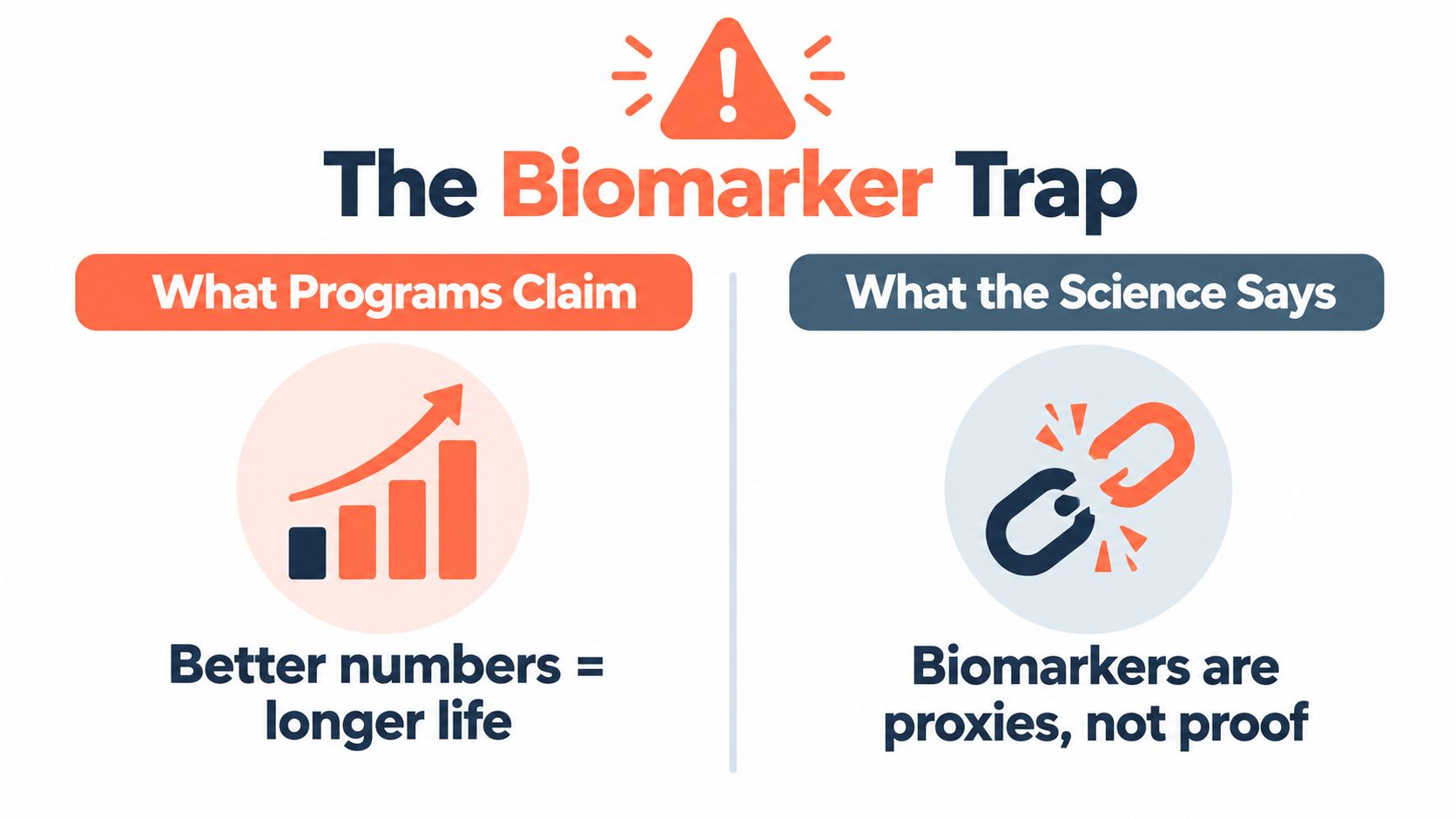
A better biological-age score is not evidence that a patient will live longer or remain healthier. That conclusion remains unestablished. A biomarker may move in a favorable direction while symptoms, physical function, quality of life, and long-term clinical risk remain unchanged. For anyone evaluating longevity medicine as a product category, the relevant question is whether a measurement changes care and predicts an outcome that matters.
The CALERIE trial shows why score-based claims require restraint. Participants followed a calorie-restriction intervention over an extended period. Post hoc analyses reported reductions in DunedinPACE and PhenoAge, but the findings did not apply consistently across every aging clock. One intervention produced different results depending on the measure, rather than a universal reversal of biological age.
What a changing score can and cannot tell you
A favorable biomarker trend may indicate that a physiological process has changed. It can help a clinician identify a risk profile that deserves attention, and it may help researchers compare interventions. It does not establish that the intervention produced a meaningful improvement in healthspan, particularly when the measure has not been validated as a surrogate endpoint.
No aging biomarker has been approved by U.S. regulators for routine clinical use. The measures may still have research or monitoring value. Clinics should describe them as indicators under evaluation, not as established substitutes for preserved function, lower disease risk, or better quality of life.
The expensive add-on problem
Longevity programs often bundle scans, supplements, infusions, devices, and wellness treatments. Red-light therapy, cold plunges, infrared saunas, and similar additions may appeal to patients, yet human evidence for many popular extras remains limited. A review of clinical and regulatory challenges also identifies unresolved questions about cost-effectiveness, standardized endpoints, and the economic validation of composite aging clocks.
This creates a predictable allocation problem. Patients may pay for dramatic reports while giving less attention to supervised exercise, risk-factor treatment, and sustained follow-up. A reviewer should therefore ask, “Did the program improve something I can feel, measure, or clinically manage?” A lower score alone is not a patient outcome.
A biomarker is a signal about risk or biology. It isn’t a receipt proving that a therapy bought you more healthy years.
Ask the clinic to separate monitoring from treatment. If a biomarker changes, what action follows? If it does not, will the clinician adjust the protocol, stop it, or recommend another paid intervention? The answers show whether the program uses data to guide care or to maintain engagement. That distinction should carry more weight in an independent clinic score than the number of tests on the package.
How to Evaluate Any Longevity Medicine Program Before You Book
A longevity program should earn its place in your care plan through evidence, clinical discipline, and transparent incentives. Longevity Clinics applies an independent scoring framework to the programs it reviews. Use the same framework before booking: assess diagnostic depth, medical supervision, conflict freedom, and evidence base. Together, these categories expose weaknesses that luxury branding, extensive testing, and polished consultations can conceal.
Diagnostic depth means starting with relevant baselines and measuring function, not just adding novel laboratory tests. Ask why each test is ordered, how the result will be interpreted, and which findings could change the protocol. A test has limited clinical value if the clinic cannot explain what decision it informs.
Medical supervision concerns who designs and adjusts the program, what qualifications they hold, and how they manage risk. The clinic should distinguish licensed clinical decisions from coaching, wellness services, and experimental offerings. It should also explain how its clinicians coordinate with your existing doctors and records.
Conflict freedom examines financial incentives. Request disclosures covering supplements, devices, laboratories, and pharmaceutical relationships. If the clinic earns additional revenue when it recommends a product, that relationship should be stated clearly before you make a decision. Membership and concierge care models may offer greater access, but access does not establish medical value.
Evidence base requires honesty for each intervention. The program should identify human outcome evidence where it exists, label experimental modalities, and separate mechanistic theories from demonstrated benefit. A change in a biomarker is not equivalent to improved symptoms, function, disease risk, or survival.
Six questions worth asking in the consultation
-
Who designs and adjusts my protocol? Request names, qualifications, and a clear boundary between medical care and coaching.
-
Which results will change my treatment? An unclear answer may indicate that testing is informative without being clinically useful.
-
What human outcome data supports the flagship intervention? Ask whether the evidence concerns symptoms, function, disease risk, biomarkers, or laboratory mechanisms alone.
-
How are referrals and vendor relationships handled? The answer should identify relevant financial incentives and referral arrangements.
-
What happens if my biomarkers improve but I feel worse? The clinic should prioritize symptoms, function, safety, and clinical judgment over a favorable score.
-
Can I receive the methodology in writing? Request the testing schedule, intervention rationale, follow-up plan, cancellation terms, and process for sharing records.
Longevity Clinics is one editorial resource that compares private programs through these categories, public evidence, regulator records, and professional information. You can perform the same review by requesting documentation directly and checking whether the clinic makes uncertainty visible.
Before paying a deposit, request a written protocol. Mark each element as established, promising, or experimental. A credible program will explain how it identifies risk, improves function, monitors safety, and changes course when evidence or your response requires it. Choose only after comparing the diagnostic plan, clinician credentials, conflicts, evidence, follow-up, and total commitment in writing. A clinic that treats a changing biomarker as proof of a longer life has not met that standard.