DEXA Scan Body Composition: What It Really Measures
What a DEXA scan body composition test measures, how precise it really is, its limits for longevity tracking, and how to read your clinic report.
A DEXA scan body composition report can look more precise than it really is. That’s the trap. A person sees a lower body-fat number, celebrates the progress, and assumes the machine has told the truth in full, when the change may be smaller than the test’s own noise.
The more useful question isn’t, “What did the printout say?” It’s, “What does this machine measure, how much change can I trust, and what conditions make the result meaningful?” If you’re reading a DEXA scan body composition report as if it were a simple before-and-after score, you’re giving it more certainty than it deserves.
Table of Contents
- Why Your DEXA Result Might Be Lying to You
- What a DEXA Scan Body Composition Test Measures
- Why Longevity Clinics Treat DEXA as a Core Baseline
- How Precise a DEXA Scan Really Is
- What a DEXA Scan Cannot Tell You
- How to Prepare for Your Scan
- Reading Your DEXA Report Like a Clinician
- Your Next Steps Before Booking a Scan
Why Your DEXA Result Might Be Lying to You
A patient comes back from a longevity workup, compares two reports, and sees a two-point drop in body fat. That sounds like success, so the temptation is to treat it as proof that the diet, training, or supplement stack worked. The problem is that a DEXA result is not a perfect mirror, it’s a measurement with built-in noise.
The issue isn’t that the test is useless. It’s that the test is often oversold. A change on the page only matters if it clears the threshold of measurement error, and the clinic used the same scanner, the same protocol, and the same software each time.
The three questions that matter
Before you celebrate or panic, ask three things. What exactly did the scanner measure. Was the change big enough to rise above noise. Were both scans done under the same conditions.
Practical rule: a DEXA change is only persuasive when it’s larger than the test’s own variability and was collected under consistent conditions.
That’s the lens this article uses throughout. What does DEXA measure? When can you trust a change? What should you ask before you book the next scan?
What a DEXA Scan Body Composition Test Measures
A DEXA scanner uses two low-energy X-ray beams to estimate how different tissues absorb the signal. In plain language, it creates a three-colour map of the body, separating bone, fat, and lean soft tissue by how each one interacts with the beam. The result is not magic, but it is a structured estimate that’s more informative than body weight alone.
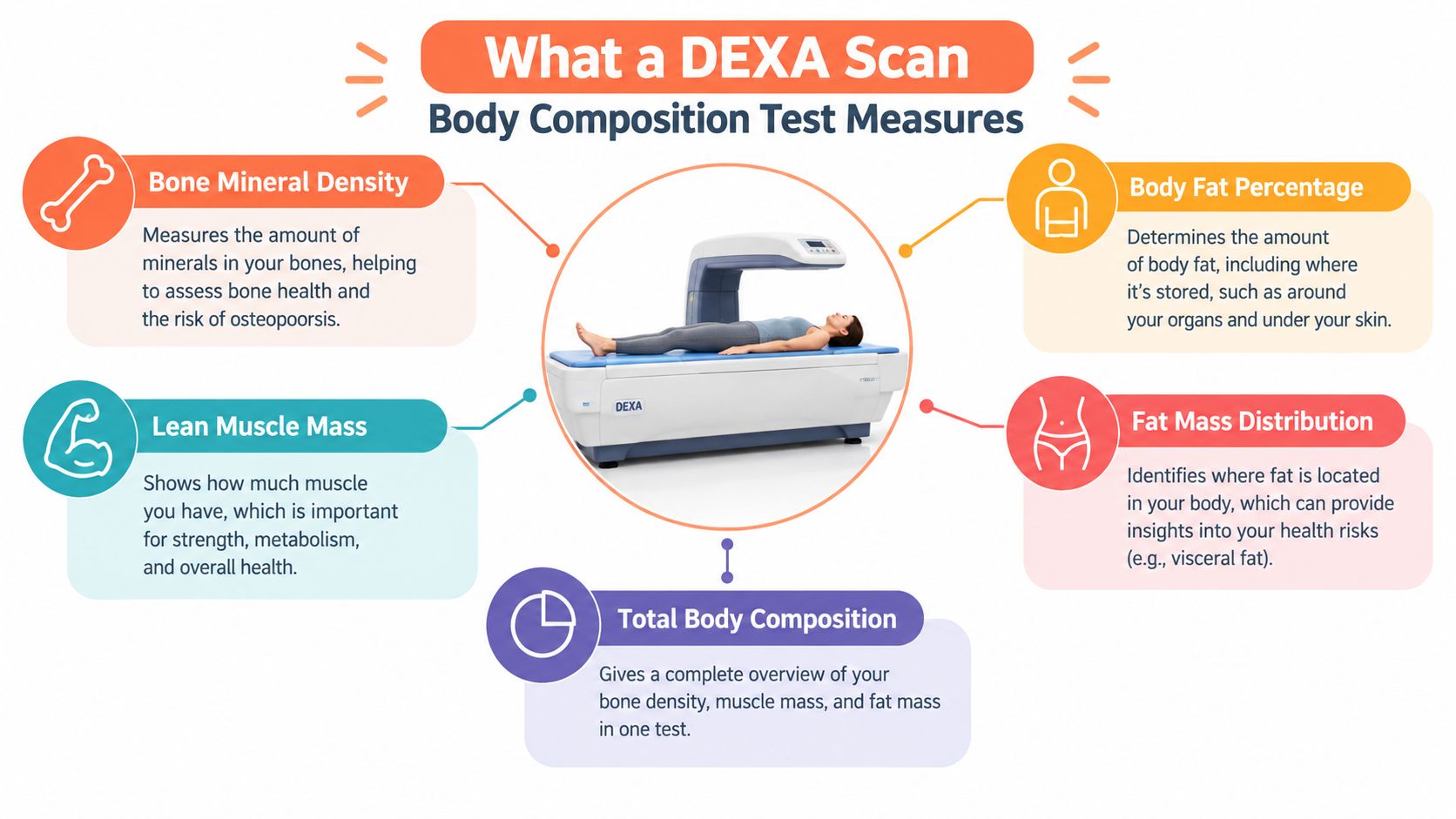
Core idea: DEXA is best understood as a body map with three broad compartments, bone, fat, and lean tissue, not as a direct “muscle meter” or a direct visceral-fat detector.
The main numbers on the report
Bone mineral density tells you how dense the bones are, which is why DEXA first became famous in osteoporosis care. On a body composition report, that line still matters because bone is part of the whole-body picture, not an afterthought.
Total fat mass is the amount of fat the scanner estimates across the body. Fat-free mass includes everything that is not fat, which means muscle, organs, bone, and body water all sit inside that bucket.
Body-fat percentage is the familiar number people often fixate on. It expresses fat mass as a share of total body weight, which makes it useful for trend watching, but only if the scan conditions are controlled.
Why regional data matters more than a single total
The best reports break the body into regions, such as arms, legs, and trunk. That helps you notice whether change is happening where you expect it, or whether one part of the body is carrying most of the shift. For example, the same body-fat percentage can hide very different patterns if one person stores more mass centrally and another more evenly.
Many reports also show android and gynoid regions. Those labels matter because they give a rough sense of fat distribution, which is more informative than a single global number. A whole-body score can look stable while one region changes in a way that matters for training, ageing, or weight-loss follow-up.
Why Longevity Clinics Treat DEXA as a Core Baseline
Weight alone can be misleading in either direction. A muscular person can look heavy on the scale, while someone with a “normal” weight can still carry too much fat in the wrong places. That’s why longevity medicine tends to use body composition as a baseline, not as a vanity metric.
A DEXA baseline gives clinicians a starting point for discussions about muscle preservation, fat distribution, and whether a patient is trending toward a healthier or less healthy body composition over time. It also helps separate genuine lean-mass loss from simple scale fluctuation, which is especially useful when someone is dieting, training harder, or trying to age with more reserve.
What it changes in practice
A clinician can use the report to anchor decisions about protein intake, resistance training, and whether a weight-loss plan is too aggressive. If the numbers suggest lean tissue is falling faster than expected, the plan may need to be adjusted. If the fat pattern is central rather than peripheral, the conversation shifts toward risk reduction and follow-up strategy.
For readers comparing assessments, the scan sits alongside bloodwork, exam findings, and other diagnostics as one quantitative piece of a broader longevity workup. It’s one reason a program like Longevity Clinics’ overview of longevity medicine treats body composition as part of a larger diagnostic picture rather than a standalone score.
Why a baseline is often more useful than a one-off result
A single scan can reassure or alarm you, but a baseline does something better. It gives future scans context. Without that anchor, you’re left guessing whether a reported change is real, preparation-related, or just the scanner behaving a little differently on a different day.
That’s why smart clinics use DEXA to support decisions, not to replace judgment. The report is only as useful as the follow-up plan attached to it.
How Precise a DEXA Scan Really Is
Every body-composition test has noise. Precision error is the size of that noise, which means it tells you how much repeated scans can vary even when the body hasn’t changed. If the change on your report is smaller than the test’s noise, you should treat it cautiously.
One 2026 study reported duplicate-scan precision error of about 1.2% for body-fat percentage and 0.7% for fat-free mass in healthy women, while the International Society for Clinical Densitometry sets minimum acceptable precision at 3% for total fat mass, 2% for total lean mass, and 2% for percent fat (Mito Health summary of DEXA precision and preparation factors). That doesn’t mean every clinic performs at the same level, but it does give you a sense of the scale at which changes become more believable.
How to read the number in real life
If your report says body fat fell by a tiny amount, that may be real, or it may be within normal measurement noise. If the report shows a larger shift, it’s more persuasive, especially if the same scanner and software were used and the prep was consistent.
The point isn’t to chase a perfect threshold from a magazine article. The point is to compare your change against the test’s own variability. That’s also why a clinic should be able to tell you what precision it expects and how it controls the scan process.
Useful habit: keep the scanner, the protocol, and the analysis software the same for follow-up scans. If those change, comparison gets weaker fast.
Longevity programs often talk about body composition as if the numbers were fixed truth. They aren’t. If you’re looking at a repeat scan, treat the report like lab data. A result matters most when the method is stable, the conditions are controlled, and the change is big enough to exceed noise.
For readers comparing diagnostic standards, a minimum credible diagnostic spread for longevity care should include a clear explanation of how repeat body-composition testing is interpreted, not just whether the test is offered.
What a DEXA Scan Cannot Tell You
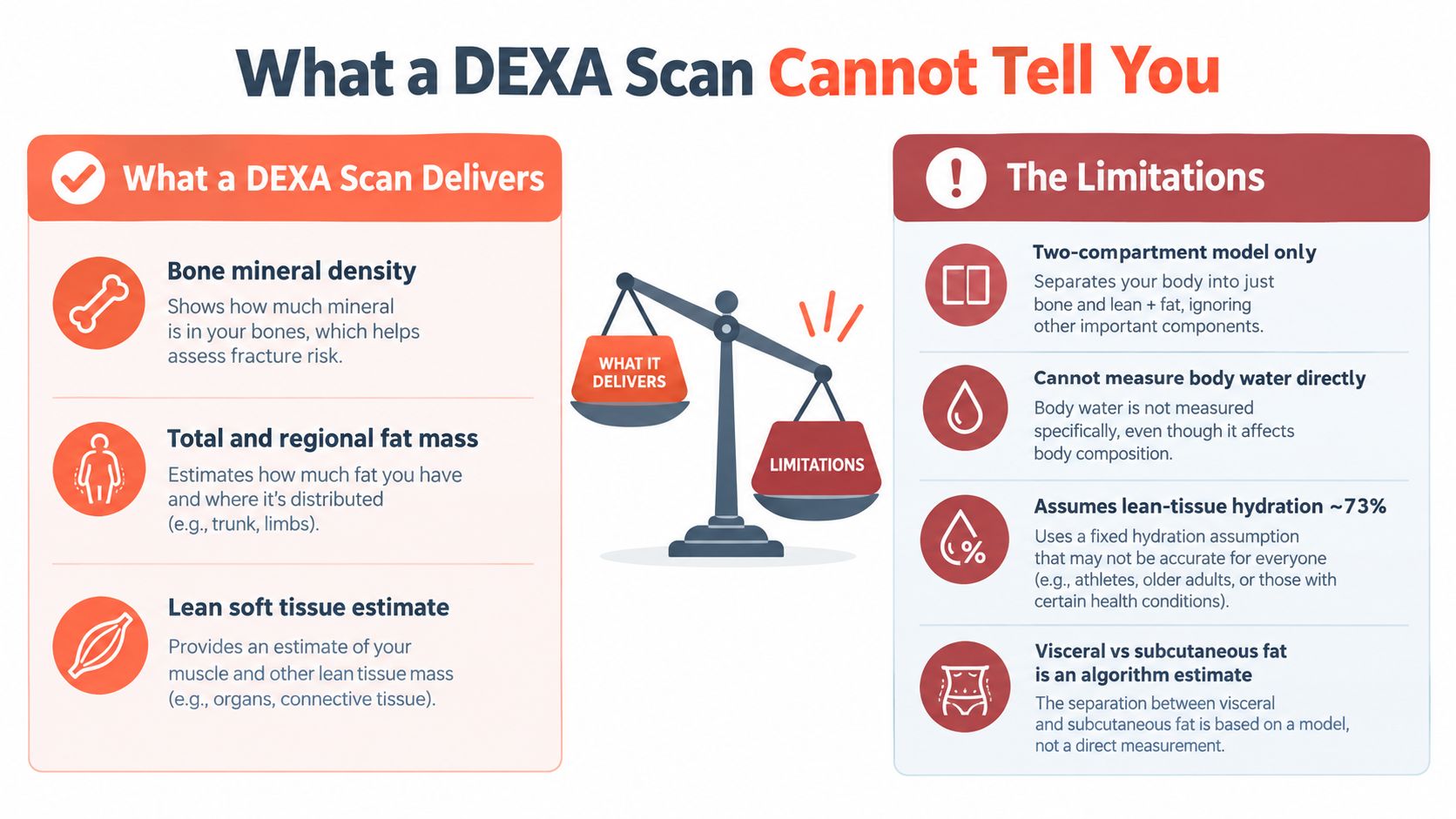
A DEXA scan is not a direct water meter, and that matters more than most marketing copy admits. It uses a two-compartment model, which means it divides the body into fat and fat-free tissue and then estimates the rest from assumptions. Because it can’t directly measure body water, anything that shifts hydration can change the result.
That’s why recent exercise, contrast agents, hydration shifts, body-size limits, and fluid retention can all distort the estimate. The effect is especially important in older adults, athletes, and people with edema or other fluid changes, where lean-mass estimates can move for reasons that have little to do with true tissue gain or loss (review on DEXA limitations and systematic bias).
The visceral-fat claim needs a careful reading
People often book a DEXA scan because they want to know their “visceral fat.” That phrase is common in marketing, but the scan does not isolate abdominal fat the way CT or MRI can. Trunk measurements bundle chest, abdomen, and pelvis, which means they give a broad estimate rather than a clean map of one depot.
A 2026 DXA-versus-MRI study found DXA overestimated lean mass, especially in android regions for both men and women, and independent reviews note that DEXA can’t separate adipose tissue compartments as finely as imaging modalities that directly visualize abdominal fat (DXA versus MRI review and regional limitation discussion). That’s the key distinction. DEXA is practical for broad tracking, but it isn’t a substitute for imaging designed to look at abdominal adiposity in detail.
The honest takeaway
Use DEXA when you want a sensible body-composition snapshot that can be repeated over time. Be cautious when someone presents it as if it were the same thing as CT or MRI for risk stratification. If a clinic is using DEXA as a proxy for abdominal risk, ask what it can truly measure and what it cannot.
How to Prepare for Your Scan
If you want a result you can compare later, make the scan day boring and repeatable. Consistency matters more than people think. The same body can look different on paper if preparation changes.
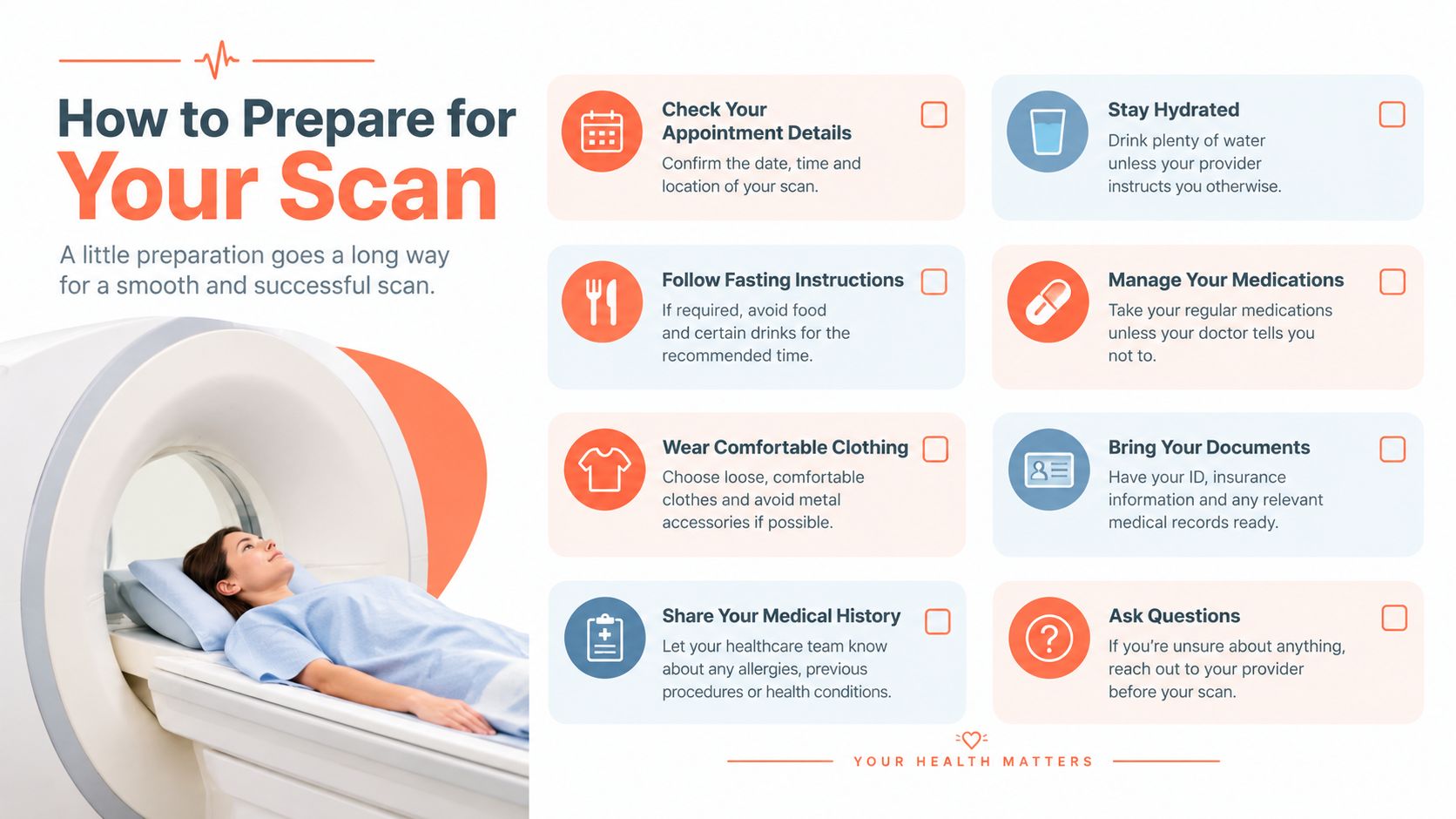
A simple prep checklist
- Avoid hard training beforehand. Intense exercise can shift fluid distribution and make lean-mass estimates less steady.
- Stay normally hydrated. Don’t intentionally dehydrate, because fluid changes can distort the scan.
- Wear metal-free clothing. It reduces artifact and makes positioning easier.
- Empty your bladder before the scan. That keeps one variable from adding noise.
- Book follow-ups under similar conditions. Same time of day, same basic routine, same clinic setup whenever possible.
What to ask the front desk
Ask whether the clinic wants you fasted for a specific window before the appointment. Ask whether they want you to avoid exercise for a particular period. Ask what they consider a standard preparation protocol for repeat scans.
The point is not to turn the appointment into a ritual. The point is to keep avoidable variables from becoming fake body changes. If one scan happens after a lifting session, a long flight, or a dehydrating day, and the next one doesn’t, the comparison gets weak.
Reading Your DEXA Report Like a Clinician
A good report tells a story, but not every line deserves the same level of trust. The useful numbers are the ones that help you decide what to do next, not the ones that sound impressive in a waiting room.
| Report metric | Reliability for tracking | How to use it |
|---|---|---|
| Total fat mass | Good if scan conditions are consistent | Watch for real shifts over time, not day-to-day fluctuation |
| Fat-free mass | Useful, but sensitive to preparation | Interpret alongside hydration, training, and timing |
| Body-fat percentage | Easy to understand, but noise matters | Compare only against prior scans done the same way |
| Regional lean and fat values | Very useful for pattern changes | Look for whether change is central, peripheral, or balanced |
| Android and gynoid breakdowns | Helpful context | Use as distribution clues, not as exact visceral-fat truth |
| Bone mineral density | Strongest when used for bone care | Treat separately from body-composition trends |
| Single-scan “visceral fat” scores | Use with caution | Ask how the clinic defines the estimate and what it really represents |
What to trust, and what to question
The best parts of a report are the total and regional lean and fat values, because they help you see the pattern rather than obsessing over one absolute number. The more decorative outputs are the ones that promise certainty the machine doesn’t have.
If a clinic offers a percentile boast or a “visceral fat rating” without explaining the method, be skeptical. That doesn’t mean the report is worthless. It means the label may be more polished than the measurement.
Ask three direct questions before you accept the result at face value. What scanner was used. What software version generated the analysis. What precision error does the clinic expect for repeat testing.
Your Next Steps Before Booking a Scan
A first DEXA baseline makes sense for many readers over 40, especially if they’re starting a longevity program, changing training, or trying to lose fat without losing muscle. It’s also useful if you want a factual starting point before you invest in months of effort. A repeat scan only earns its keep when a real change is plausible and the clinic can reproduce the same setup.
If you’re comparing clinics, don’t ask whether they “offer DEXA.” Ask how they use it. A good clinic should be able to say which scanner it uses, how it handles repeat testing, and what threshold it uses to decide whether a change is meaningful. That kind of answer matters more than glossy report screenshots.
For readers comparing concierge-style options, Longevity Clinics’ note on concierge medicine cost is one place to start thinking about whether the diagnostic package is worth the spend, but the same logic applies anywhere body composition is sold as part of a premium assessment.
Before you pay, ask yourself four things. Will this scan change a decision. Will the same machine be used next time. Will the clinic explain its precision. Will the report help me preserve muscle, reduce fat in a meaningful pattern, or monitor a genuine trend?
A DEXA scan is powerful when you treat it like a measurement tool, not a verdict. The informed reader gets more from the printout because they know where it’s solid, where it’s noisy, and where the marketing starts to outrun the evidence.