Full Body MRI Screening: What It Detects and What It Misses
Full body MRI screening promises early answers, yet most findings are benign and outcomes data are thin. Here is what the evidence actually shows.
A full body MRI screening can look like preventive medicine, but the published numbers read more like a downstream-cost engine. In one meta-analysis, the pooled pathologically confirmed cancer detection rate was 1.57% among 9,024 asymptomatic participants, while a separate evidence base found critical incidental findings in 13.4% and indeterminate findings in 13.9% of people scanned. That gap matters because most buyers are not paying for a diagnosis, they’re paying for a cascade that may or may not end in one.
Table of Contents
- The 1.6% Problem in Full Body MRI Screening
- What Actually Happens During a Whole-Body Scan
- What the Scans Actually Detect
- False Positives, Biopsies, and the Cost of Looking
- Where Medical Societies Actually Stand
- Cost, Benefit, and the Question Screening Cannot Answer
- Minimum Reporting Standards a Credible Programme Should Meet
- When Full Body MRI Screening Might and Might Not Be Worth It
The 1.6% Problem in Full Body MRI Screening
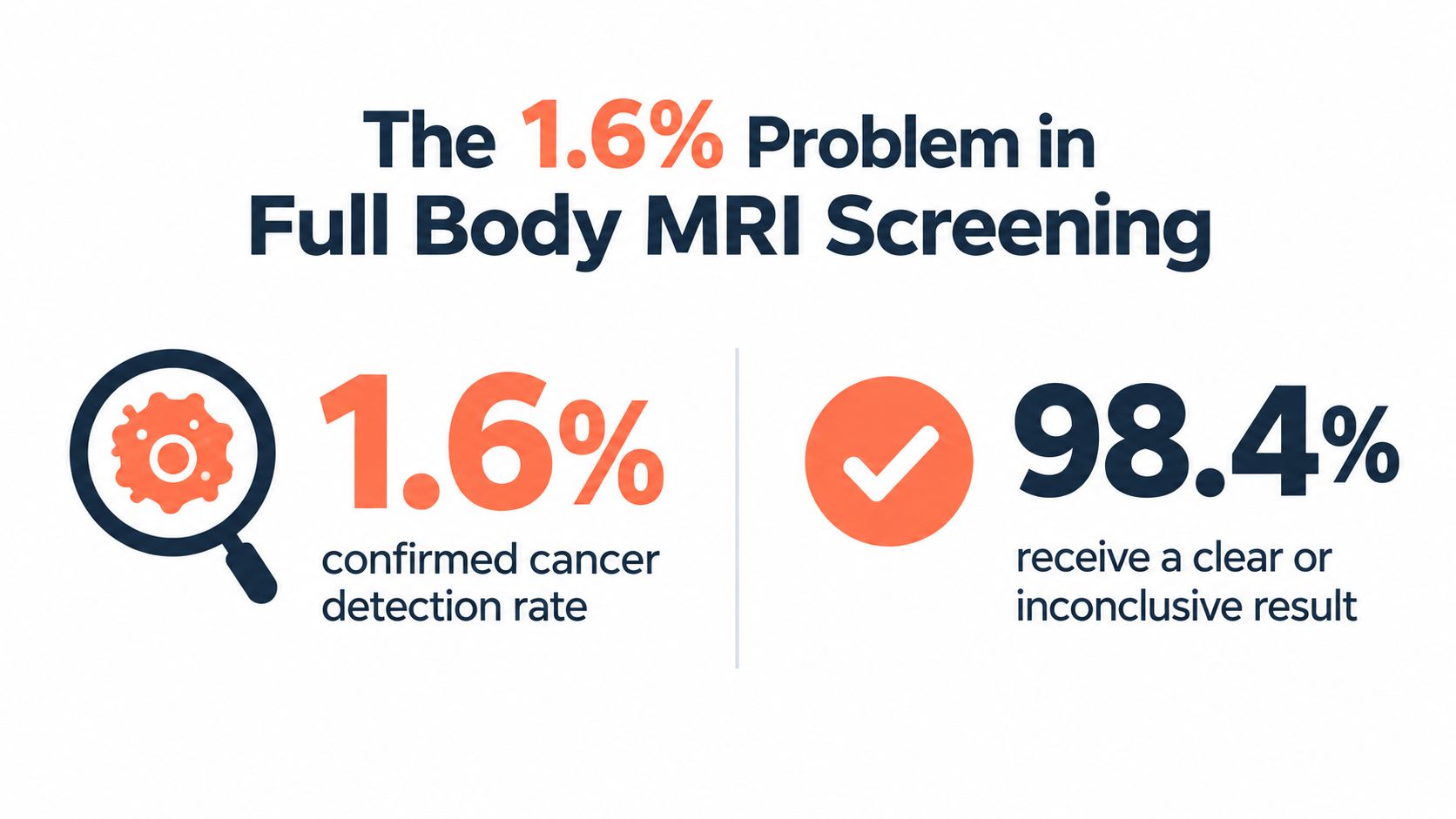
The number clinics tend to minimize is the one that matters most. A 2025 systematic review and meta-analysis of 10 studies covering 9,024 asymptomatic people reported a pooled pathologically confirmed cancer detection rate of 1.57% (source). That is the endpoint buyers should anchor on, because it reflects confirmed cancer rather than vague abnormalities.
The downstream load is much larger than the cancer yield. Another systematic review and meta-analysis found critical incidental findings in 13.4% of participants and indeterminate findings in 13.9% (source). For a buyer, that means the more likely output is a report that triggers interpretation, follow-up, and possible referral, not a diagnosis of malignancy.
Detection is not benefit
A scan can identify tissue changes without proving better health outcomes. The evidence still does not show that elective screening in healthy adults reduces morbidity or mortality, so the central question is whether the result changes management in a way that improves care.
Practical rule: before booking, ask the clinic which health outcome improved in published cohorts, and what happened after the report was issued.
A useful way to judge full body MRI screening is to treat it as a cost-and-cascade decision. Ask how often the programme generates follow-up, how often those follow-ups resolve into meaningful disease, and how much uncertainty the report leaves behind. In longevity clinics, that is the decision buyers are making.
What Actually Happens During a Whole-Body Scan
The scan itself is only one part of the product. A whole-body MRI appointment is a single imaging event that covers multiple regions in one sitting, but the exact scope depends on the clinic’s protocol. You are positioned on the table, the scanner moves you into the bore, and repeated sequences are acquired while you remain still.
That apparent simplicity hides real variation. WB-MRI protocols differ by field strength, diffusion-weighted imaging, anatomical coverage, contrast use, acquisition time, motion control, and radiologist expertise, so two clinics can sell “the same” test while delivering materially different examinations (source).
Why protocol choice changes the downstream workload
Sensitive sequences show more tissue detail, and that increases the number of incidental cysts, degenerative changes, normal variants, and other non-actionable findings that need classification.
The practical issue is not image quality alone. It is the report-making process that follows the scan. If the protocol is broad and poorly specified, the downstream burden becomes broader and harder to predict.
A clinic comparison lens makes the difference between screening and targeted diagnostic imaging clear. A private screening session marketed to healthy people serves a different purpose from an MRI ordered to answer a specific clinical question, so reporting thresholds should be set accordingly. A useful consumer baseline is a private health screening overview that treats elective testing as a purchase with follow-up consequences rather than one-off reassurance.
What the Scans Actually Detect
The participant-level picture is broader than a simple positive or negative result. In one review of 6,214 whole-body MRI examinations, investigators recorded 17,961 abnormal findings. 91% were judged benign, while 9% were considered oncologically relevant and needed further investigation (source).
The report a buyer usually gets back
At the participant level, the same evidence base found that about 95% had at least one abnormal finding, around 30% needed additional investigation, and only 1.8% had findings reported as suspicious for cancer. Clinics that blur these outcomes overstate what a screening report delivers. A buyer should expect a mix of reassurance, uncertainty, and follow-up tasks, not a clean final answer.
| Outcome | Pooled rate | Source context |
|---|---|---|
| Confirmed cancer detection | 1.57% | Pooled pathologically confirmed cancer detection in asymptomatic adults |
| At least one abnormal finding | ~95% | Participant-level abnormal findings in whole-body MRI examinations |
| Additional investigation needed | ~30% | Participant-level follow-up burden in the same review |
| Suspicious for cancer | 1.8% | Findings reported as suspicious for cancer in the same review |
All rates from the Springer review above.
Negative doesn’t always mean resolved
A “clear” scan still leaves room for uncertainty about what was looked at, how strict the reading threshold was, and whether the protocol could show every relevant lesion. A small adrenal nodule is a good example. It may be labeled indeterminate, then trigger a dedicated adrenal MRI, interval imaging, endocrine testing, or, in some clinics, biopsy discussion if the appearance or growth pattern is concerning.
That follow-up burden is the true product buyers are purchasing. Whole-body MRI often generates a management pathway rather than a final resolution, and the downstream work can be more important than the initial scan fee.
False Positives, Biopsies, and the Cost of Looking
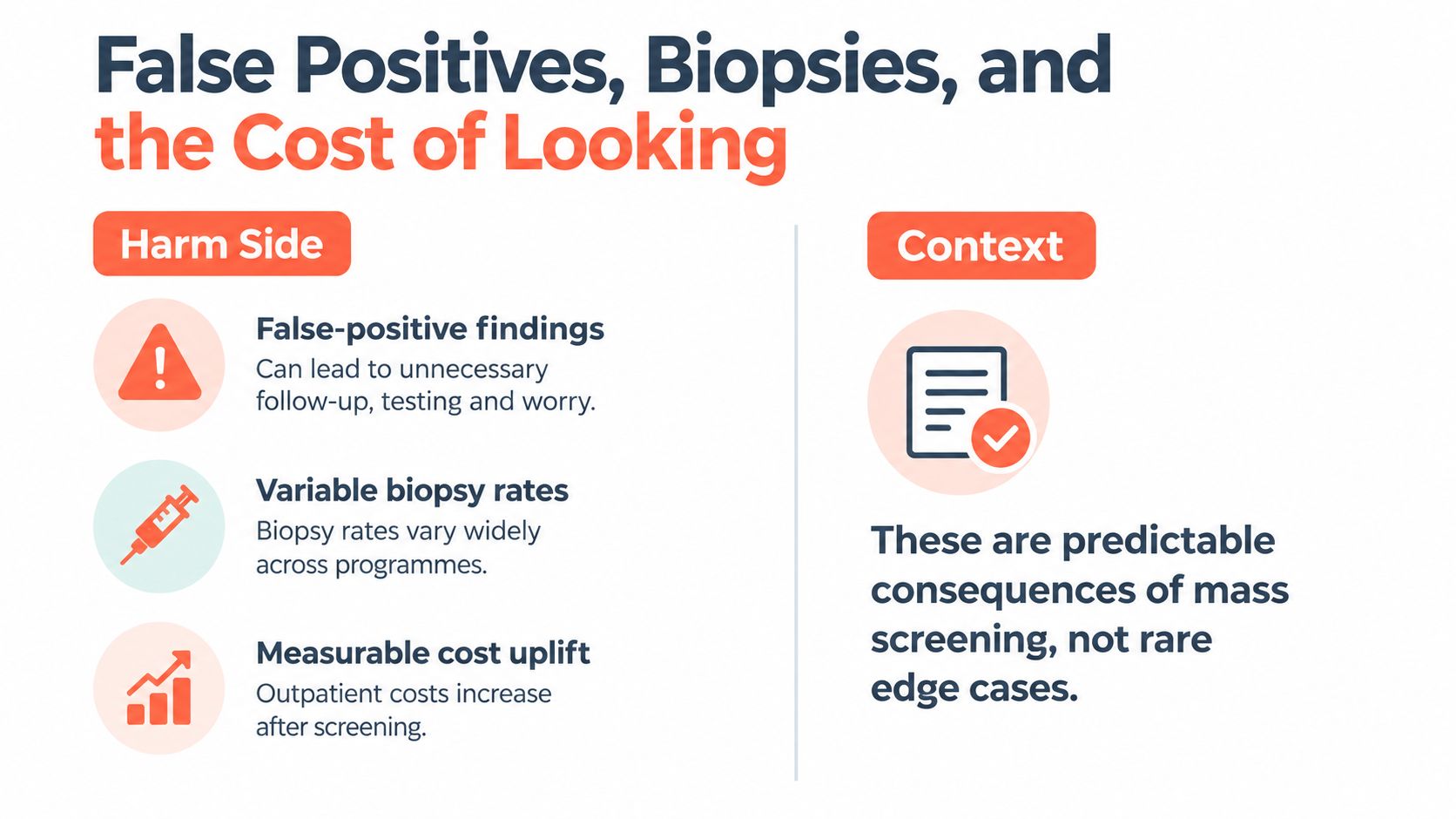
A screening pathway can create more follow-up than certainty. In the 2019 review, the pooled false-positive proportion was 16.0% among studies that verified reported findings, while critical incidental findings were 13.4% and indeterminate findings 13.9% (source). In a low-prevalence population, that is the expected trade-off for very sensitive imaging.
Biopsy burden is less predictable and varies by programme. In the same evidence base, reported biopsy rates after screening ranged from 2% to 22% (source). The label “whole-body MRI” does not tell buyers how often a clinic escalates from a finding to tissue sampling, repeat imaging, or specialist referral.
The cost shows up after the scan fee
The cost signal is visible after the appointment. Participants in one population study incurred average outpatient costs of €2,839 over two years versus €2,547 among non-participants, an increase of €295 and 11.6% (source). The uplift is associative, not causal, but €295 over two years is the visible part of a follow-up pathway.
A clinic can sell one scan, but the patient often finances the review pathway.
If a provider cannot say how often it recalls, biopsies, or sends people into repeat imaging, the buyer is taking on open-ended downstream costs without a clear bill.
Where Medical Societies Actually Stand
The conservative benchmark is clear. The American College of Radiology says evidence is insufficient to recommend total-body MRI for people without symptoms, risk factors, or a relevant family history, and it cites the absence of demonstrated cost-effectiveness or life-prolonging benefit (source). That is a direct warning against treating elective screening as routine prevention.
The evidence synthesis on incidental findings reaches the same practical conclusion. MRI is strong medicine in the right indication, and the failure here is applying a diagnostic tool to a screening population. For asymptomatic people outside research settings, the use case is hard to defend.
What this does and doesn’t mean
Clinically indicated MRI for symptoms, known cancer-predisposition syndromes, or surveillance after a prior malignancy is a different product with a different goal.
The divide is between diagnostic care and consumer screening. Longevity-clinic buyers should compare those two categories carefully, especially if the selling point is reassurance rather than a specific management decision. For a broader governance lens on who benefits from a test and who profits from it, see the journal discussion of conflict of interest in healthcare.
Cost, Benefit, and the Question Screening Cannot Answer
An honest cost-benefit calculation has four parts. First, the scan price. Second, the chance of an actionable finding. Third, the probability of follow-up, biopsy, or repeat imaging. Fourth, the still-unproven effect on survival or quality of life. The published evidence already tells you that the follow-up burden is not trivial, and that the main benefit claim remains unproven.
The useful comparison is not “MRI versus doing nothing.” It’s “MRI versus guideline-based screening plus symptom-driven diagnosis.” A clean whole-body scan doesn’t replace mammography, cervical screening, colorectal screening, or low-dose CT for eligible high-risk smokers. It also doesn’t close the evidence gap around whether broad screening changes long-term outcomes.
Why detection alone doesn’t justify the spend
Detection statistics can make a programme look productive while leaving the core question untouched. A scan that finds more abnormalities may still create more downstream appointments without improving outcomes that patients care about. That’s why the outpatient-cost uplift matters. It’s a real-world marker that the process extends beyond the scanner room.
The key analytical error is to treat a technically impressive result as an endpoint. In practice, it’s usually a midpoint. The report either resolves quickly, or it opens another file, another visit, and another decision.
Minimum Reporting Standards a Credible Programme Should Meet
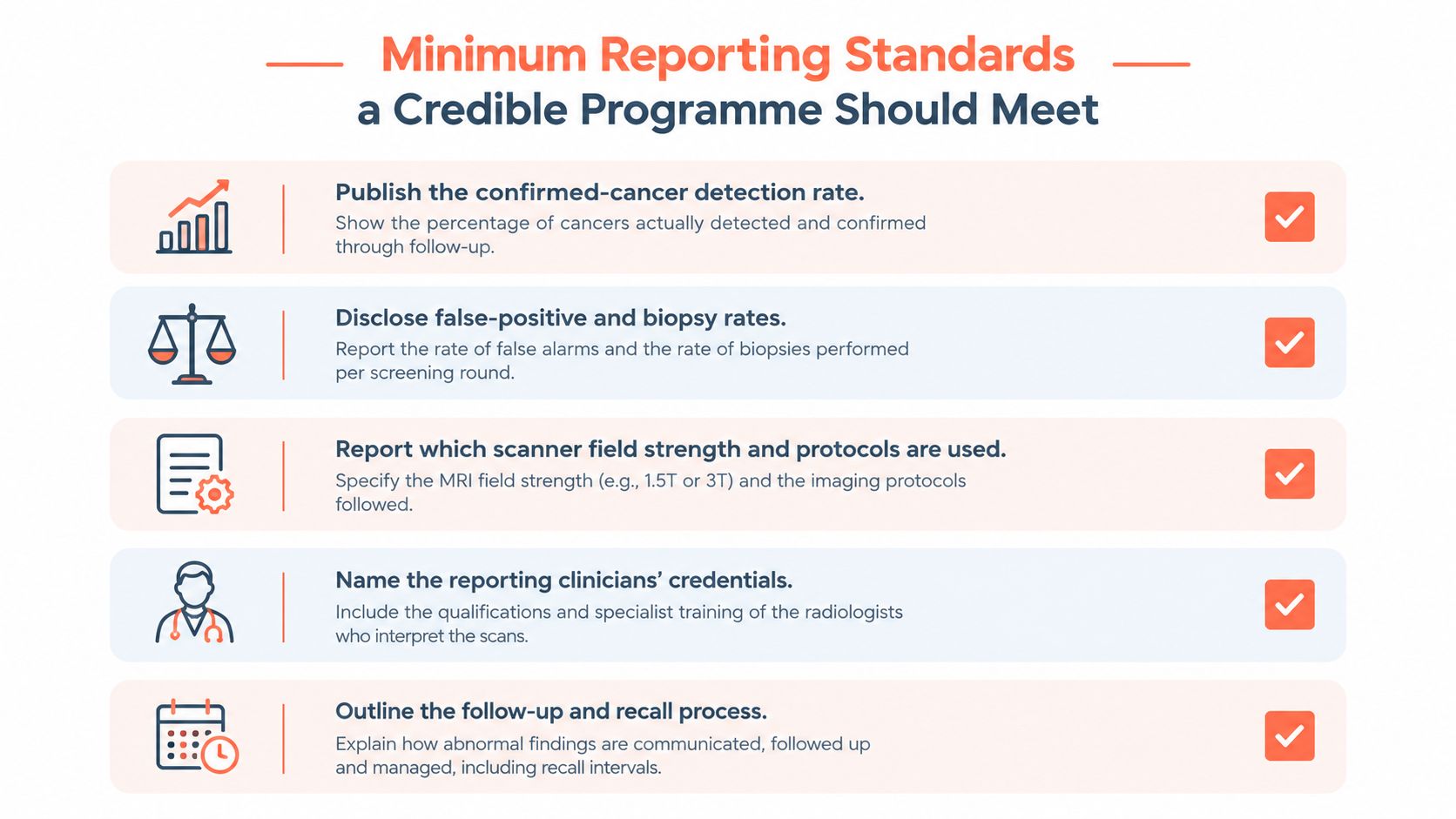
A credible programme should disclose what it really does, not just what it claims to detect. The minimum useful reporting set starts with confirmed-cancer detection rate, not suspected-lesion counts, because suspected lesions can’t be compared cleanly across programmes. It should also publish false-positive rate, biopsy rate, recall rate, additional-imaging rate, and time to resolution.
The heterogeneity in the literature is the reason this matters. If protocols differ by scanner strength, sequences, field of view, or radiologist expertise, then a clinic that omits its operational details is asking buyers to trust an unverified label. That’s not prudence. It’s opacity.
What to ask for before paying
- Confirmed-cancer outcome: Ask for the rate of pathologically confirmed cancers, not just suspicious findings.
- Downstream burden: Ask for false positives, biopsy rates, recall rates, and additional imaging.
- Protocol disclosure: Ask what scanner field strength, body coverage, and sequences are used.
- Reader credentials: Ask who reads the study and what qualifications they hold.
- Follow-up pathway: Ask who coordinates escalation, when the process stops, and how results are communicated.
A reporting page that skips any of those items is missing the data that would let you judge value. One practical benchmark is the minimum credible diagnostic checklist, because screening claims only become meaningful when the workflow is visible.
When Full Body MRI Screening Might and Might Not Be Worth It
Whole body MRI screening can be defensible when the clinical question is specific and the result would change management. That includes surveillance for known cancer-predisposition syndromes, follow-up after prior malignancy, and targeted questions where the care pathway is already defined. In those settings, the scan is part of diagnosis or surveillance, not generic prevention.
It’s much harder to justify as routine screening in low-risk, asymptomatic adults. The current evidence doesn’t show that broad scanning improves survival, quality of life, or cost-effectiveness, and it does show that the process generates abnormalities, extra testing, and added cost. That’s a poor trade if the buyer is hoping for certainty.
The decision frame
Ask three questions before you pay. Is there a baseline risk that makes finding something likely enough to matter? Is there a family history, symptom, or known condition that creates a real management pathway? And if the report is abnormal, who owns the next step?
If the answer to those questions is vague, the scan is probably being sold as reassurance. Reassurance is expensive when it comes with follow-up ambiguity.
If you’re comparing whole-body MRI offerings, ask for the confirmed-cancer rate, recall rate, biopsy rate, and follow-up pathway in writing before you book. Then compare the scan against guideline-based screening you already need, because detection only has value when the next step is clear and clinically useful.