Private Health Screening: A Complete Guide for 2026
Learn what private health screening includes, how to prepare, and what to expect before booking your appointment in 2026.
A thorough private health screening package can feel like a responsible investment in your future. The popular advice is simple: the more tests you take, the more disease you’ll catch, and the healthier you’ll become. That advice is incomplete.
Screening can identify important risks before symptoms appear, but it can also uncover findings that lead to repeat scans, specialist appointments, biopsies, treatment decisions, anxiety, and unexpected costs. A test isn’t valuable merely because it detects something. Its value depends on whether the finding is meaningful, whether effective treatment exists, and whether the full follow-up pathway improves outcomes.
Table of Contents
- The Myth of More Tests Equal Better Health
- What the Evidence Says About Screening
- Understanding the Trade-offs of Common Screening Tests
- How to Compare Private Screening Packages
- The Hidden Burden of Abnormal Results
- Making Your Screening Decision with Confidence
The Myth of More Tests Equal Better Health
A private health screening package with an impressive list of blood tests, imaging studies, genetic panels, and functional assessments may look more thorough than a targeted medical review. Yet diagnostic depth and clinical value aren’t the same thing. A scan can reveal more detail without helping you live longer or make a better decision.
The difference is similar to using a very sensitive smoke detector in every room of a house. It may detect steam from a shower, dust in the air, or a burnt piece of toast alongside a real fire. More alerts don’t necessarily mean a safer house. They can also make it harder to identify the warnings that require immediate action.

Detection is only the beginning
A screening test usually doesn’t diagnose disease by itself. It identifies a result that may deserve interpretation or confirmation. That distinction matters because an abnormal result can mean several different things:
- A genuine disease signal: The finding may indicate a condition that needs treatment or monitoring.
- A benign variation: Some abnormalities are harmless and never cause symptoms.
- A false positive: The test suggests a problem that is not present.
- An uncertain finding: The result may remain unclear until further investigation.
A premium package can therefore create a larger decision workload without creating a proportionate health benefit. The patient may need to decide whether to repeat the test, seek another opinion, undergo an invasive procedure, or accept uncertainty.
Practical rule: Before asking how many tests a package includes, ask what decision each test is intended to support.
A targeted approach is often more useful
Good preventive care starts with context. Your age, symptoms, family history, previous results, medications, smoking history, and known conditions can change which tests make sense. A test that is appropriate for someone with a strong inherited risk may be unnecessary for an asymptomatic person with no relevant risk factors.
The same principle applies to private health screening. A package should explain which part of your existing care it complements and which part it duplicates. It should also identify what happens after every clinically significant result.
The strongest question isn’t, “How thorough is this package?” It’s, “What will we do differently if the result is normal, borderline, or abnormal?”
What the Evidence Says About Screening
More tests can produce more findings without producing better health. Prevention works when a test leads to an effective decision. If an abnormal result triggers repeat testing, scans, procedures, or prolonged anxiety without improving outcomes, the screening pathway has created work and risk as well as information.
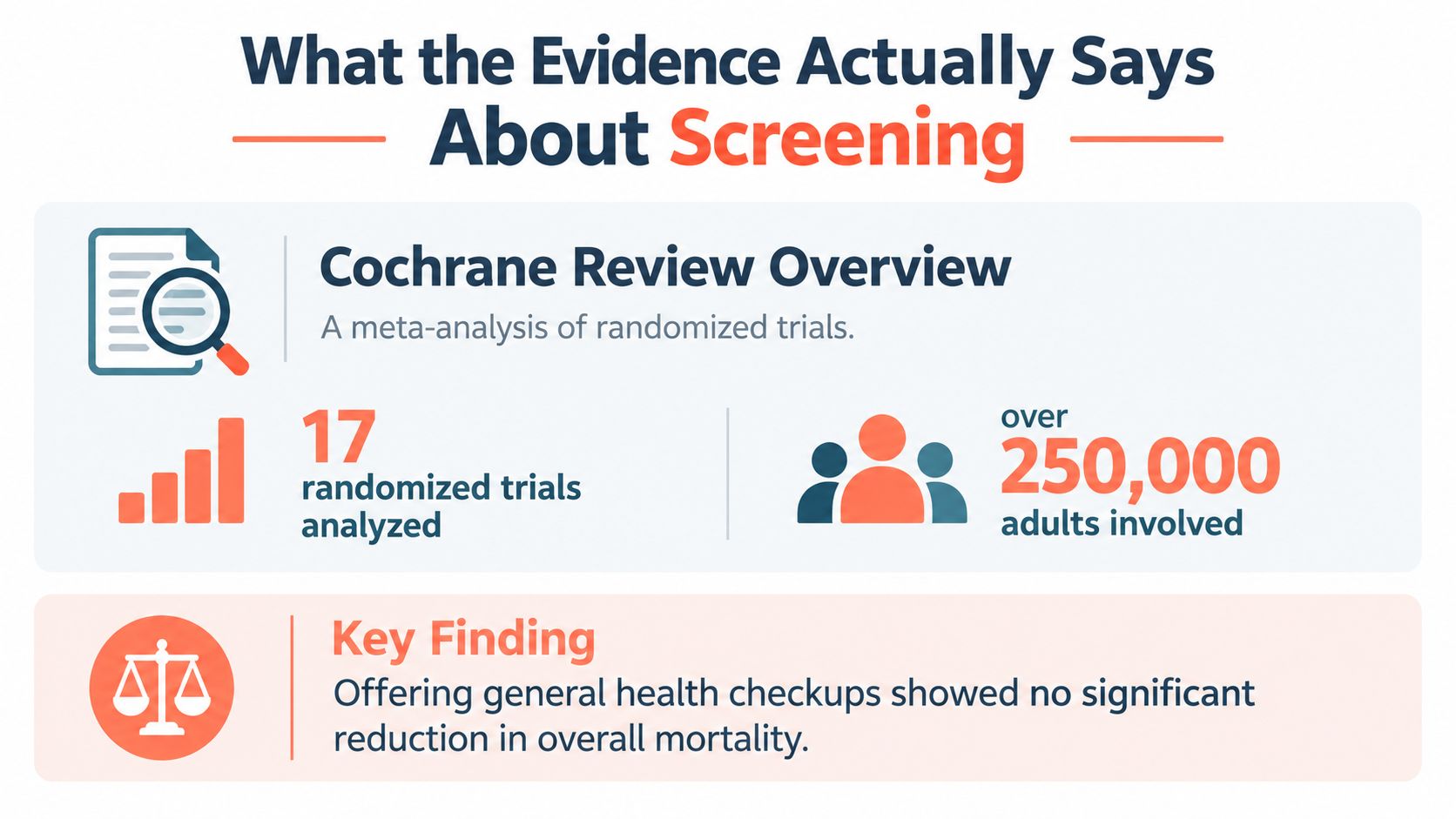
A 2019 Cochrane review examined 17 randomized trials, with 15 reporting outcomes, involving 251,891 adults. Among the trials assessing mortality, 11 included 233,298 participants and recorded 21,535 deaths. Median follow-up was 10 years, and individual studies followed participants for 4 to 30 years, as reported in the Cochrane evidence review of general health checks.
What the review found
General health checks produced little or no reduction in all-cause mortality, cancer mortality, or cardiovascular mortality compared with usual care. The evidence was rated high certainty for all-cause and cancer mortality, and moderate certainty for cardiovascular mortality.
This result applies to broad health-check programmes, not automatically to every individual screening test. Earlier pooled evidence from 14 randomized trials involving 182,880 adults showed similar results. The reported risk ratios were 0.99 for total mortality, 1.03 for cardiovascular mortality, and 1.10 for cancer mortality, with none statistically significant.
The review also found more diagnoses without clear reductions in morbidity, hospital admissions, referrals, disability, or work absence. In practice, screening can enlarge the chain of decisions: an uncertain result may lead to a repeat test, specialist review, imaging, or an invasive procedure. Each step can bring cost, inconvenience, complications, and worry.
What this means for private screening
Judge a private programme as a pathway. Its value depends on how test selection, confirmation, treatment, and follow-up connect:
- Test selection: Does each test have a credible purpose for this person?
- Risk targeting: Is it offered to people likely to benefit?
- Confirmation: What happens after an abnormal or borderline result?
- Treatment effectiveness: Can acting on the finding improve health?
- Outcome measurement: Does the provider track meaningful outcomes, rather than only the number of abnormalities detected?
A normal result can provide useful information, but it cannot guarantee that disease will not develop. An abnormal result can lead to helpful care, but it does not establish a diagnosis by itself. Before testing begins, a clinician should explain both possibilities and the likely next steps.
For a practical comparison framework, see this guide to preventive health screening. The key question is simple: more information is useful when it improves a decision and when the downstream burden is properly managed.
Understanding the Trade-offs of Common Screening Tests
Screening tests are not interchangeable ways to “find problems early.” They differ in the people they were designed for, the evidence supporting them, and what follows an abnormal result. A test may detect a real abnormality yet still offer little benefit if it leads to unnecessary procedures, treatment, or anxiety.
Mammography and lung CT
Cancer screening can reduce deaths in selected populations. Randomized trials have shown mortality benefits for screening some breast, colorectal, cervical, and lung cancers, according to the National Cancer Institute’s explanation of screening statistics.
The size of that benefit needs careful explanation. Among women aged 50–59, more than 1,300 mammography screenings are needed to save one life, according to the same NCI source. Mammography is not therefore pointless. The figure shows why an individual should hear the absolute benefit, not only that screening “reduces risk.” It also helps put false positives, callbacks, and overdiagnosis into proportion.
The National Lung Screening Trial studied heavy smokers, a defined higher-risk group. Low-dose spiral CT reduced lung-cancer mortality by approximately 15%–20% relative to chest X-ray. The roughly 20% relative reduction corresponded to an absolute mortality difference of about 0.4 percentage points after approximately seven years, from 1.7% to 1.3%, as reported in the same NCI analysis of the National Lung Screening Trial. Those results should not automatically be applied to every healthy adult requesting a scan. An abnormal lung image can also begin a chain of repeat imaging, specialist review, and invasive testing.
PSA testing
PSA screening shows how early detection can create difficult decisions. It may identify prostate cancers that would never cause symptoms, exposing some men to biopsy complications, psychological distress, overtreatment, and treatment-related harm without a matching health benefit.
The U.S. Preventive Services Task Force recommendation on prostate-cancer screening states that the balance worsens with age. For men aged 70 years or older, expected harms outweigh benefits, so routine PSA screening is not recommended.
A private package should not include PSA testing by default without explaining the pathway after a raised result. That discussion should cover baseline risk, repeat testing, possible biopsy, treatment consequences, and circumstances in which stopping further testing may be reasonable. The test is only the first decision.
Whole-body MRI
Whole-body MRI is attractive because it does not use ionising radiation. That feature does not eliminate the downstream burden of incidental findings, false positives, anxiety, invasive follow-up, or overdiagnosis. A scan can reveal a structural change without showing whether it matters.
A systematic review found radiologic abnormalities in approximately 94% of screened individuals, with up to 30% requiring additional investigation. Only about 1.1%–1.6% had pathologically confirmed cancer, and no randomized controlled trials had shown that screening reduces morbidity or mortality, according to the systematic review of whole-body MRI screening. These findings illustrate the difference between detecting abnormalities and improving outcomes.
| Test or approach | Potential value | Important trade-off |
|---|---|---|
| Mammography | Can reduce mortality in appropriate populations | Benefit may be modest in absolute terms and screening can overdiagnose disease |
| Low-dose lung CT | Can benefit people at higher risk, such as heavy smokers | Results from a defined high-risk population should not be generalised to everyone |
| PSA testing | May identify some clinically important prostate cancers | Can detect cancers that would never cause symptoms and lead to unnecessary treatment |
| Whole-body MRI | Can reveal structural abnormalities without ionising radiation | Incidental findings can trigger investigations without an established mortality benefit |
Cancer overdiagnosis estimates cited by the NCI place breast-cancer overdiagnosis at about 19% of screen-detected cases and prostate-cancer overdiagnosis at 20%–50%. The practical question is whether finding a condition at that time improves the person’s health enough to justify the tests, decisions, and worry that may follow.
How to Compare Private Screening Packages
Start by listing what you already receive through ordinary preventive care. Include previous test results, current medications, family history, symptoms, and any recommended screening that you haven’t completed. A private package should fill a clearly identified gap, not merely repeat familiar measurements in a more expensive setting.
Use five practical checks
Clinical validation comes first. Ask what evidence supports each test and whether the provider distinguishes screening from diagnosis. A test can be technically advanced without having proven benefit for asymptomatic people.
Review the range rather than admiring the headline. Request the complete test list, including biomarkers, imaging, genetic assessments, and functional tests. Then ask which results trigger action and which are just reported for interest.
Follow-up support determines safety. Find out who reviews the results, how quickly a clinician contacts you, and whether the provider coordinates repeat testing or specialist referral. Ask whether the package ends when the report is issued.
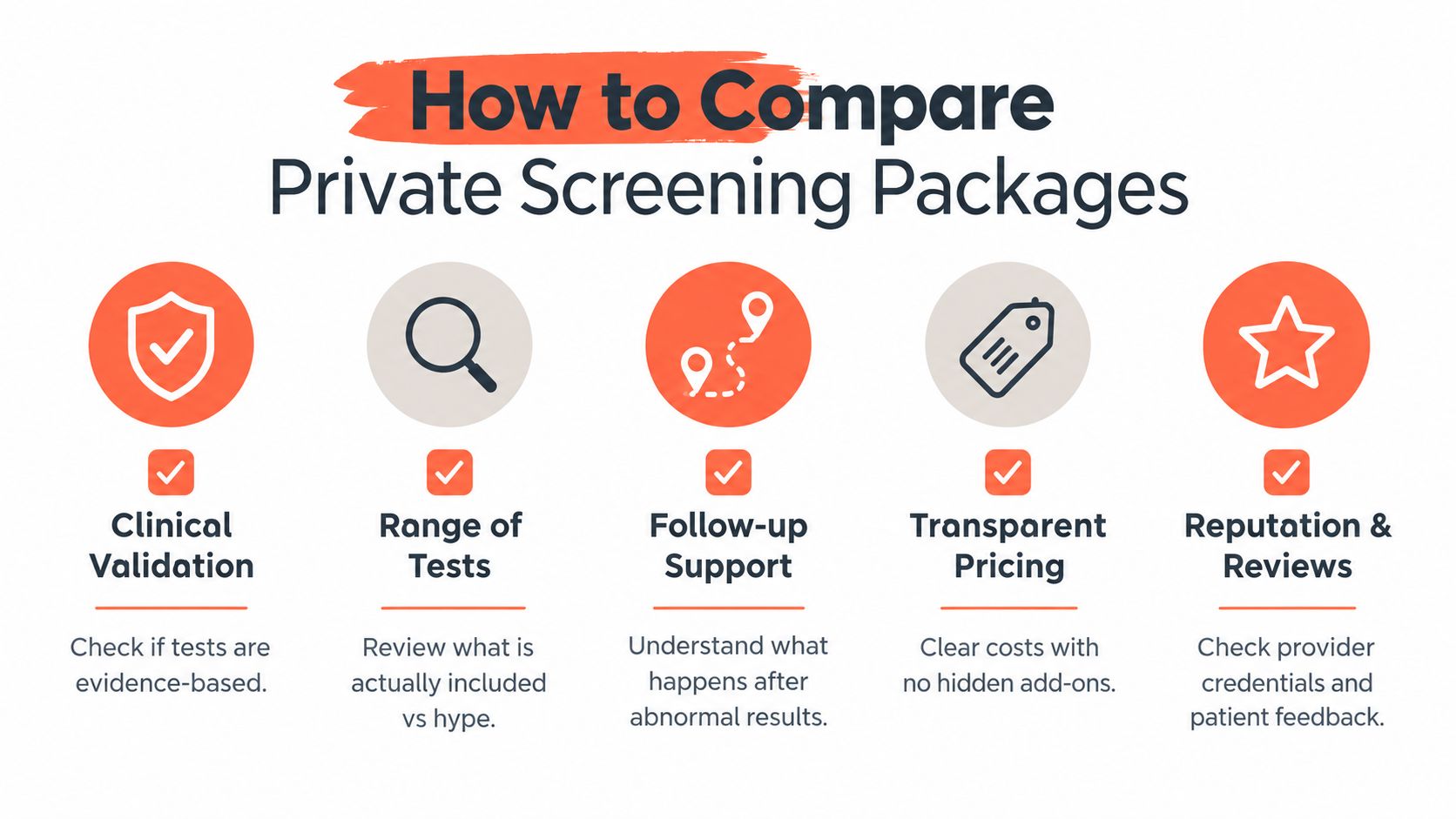
Transparent pricing should include the next step. A provider may clearly state the price of the initial package while leaving follow-up costs unclear. Ask who pays for repeat imaging, pathology, specialist appointments, and procedures if an abnormality appears.
Reputation needs more than testimonials. Check clinician credentials, medical oversight, complaints processes, conflicts of interest, and whether the provider publishes its clinical protocols. Patient reviews can describe communication and administration, but they can’t establish that a screening test improves outcomes.
Build a comparison table
A simple table can expose gaps that marketing language hides:
| Question | What a strong answer includes |
|---|---|
| Why is this test included? | A defined clinical purpose and relevant target population |
| What happens after an abnormal result? | Named clinical responsibility and a documented referral pathway |
| What happens after a normal result? | Clear limits on reassurance and appropriate next steps |
| What does the package duplicate? | A comparison with routine preventive care |
| What remains uncertain? | Limitations, false positives, overdiagnosis, and evidence quality |
| What could I pay later? | Follow-up investigations, consultations, and procedures |
A comparison tool such as a private screening package comparison resource can help organise these questions across providers. The tool matters less than the method. A package with fewer, better-justified tests and strong follow-up may be safer than a larger package with unclear clinical governance.
The Hidden Burden of Abnormal Results
A screening package can feel reassuring until its report creates a problem that did not previously affect your life. The appointment is usually the simple part. The harder work begins when the wording says “indeterminate,” “requires correlation,” or “further assessment recommended.”
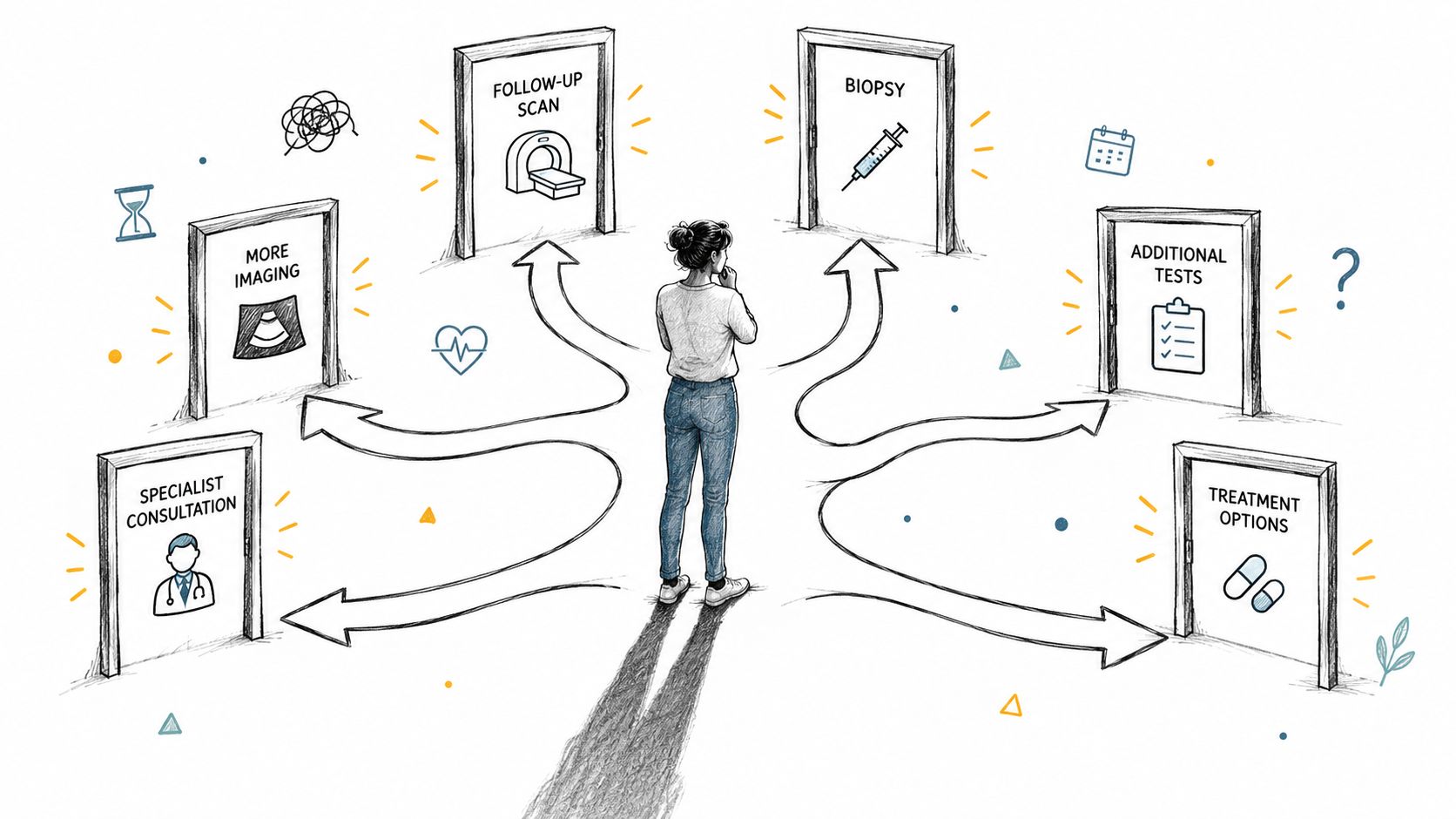
Consider a person who feels well and chooses whole-body MRI for reassurance. The scan identifies a small area that is neither clearly normal nor clearly concerning. That uncertainty can set off a chain of decisions: repeat imaging, a focused scan, specialist review, laboratory testing, or a biopsy. Each step may provide useful information, but each can also introduce another waiting period, another interpretation, and another decision.
An abnormality isn’t the same as a diagnosis
As noted earlier, approximately 94% of people screened with whole-body MRI had a radiologic abnormality, and up to 30% underwent additional investigation. The review also reported pathologically confirmed cancer in about 1.1%–1.6% of participants and found no randomized controlled trials showing reduced illness or death from this approach, according to the review of whole-body MRI in asymptomatic adults.
These findings do not make every abnormality harmless. They show why a high detection rate is a poor substitute for evidence that screening improves health. A finding may be genuine and medically interesting while remaining unlikely to change treatment or outcomes.
The downstream burden can include:
- Clinical appointments: Primary-care review, radiology clarification, or specialist assessment may be needed.
- Additional testing: Follow-up imaging or laboratory work can help characterise the finding.
- Invasive procedures: Some pathways lead to biopsy or another procedure, with risks of their own.
- Emotional strain: Waiting for clarification can affect sleep, concentration, and daily activities.
- Financial exposure: The package may not cover later consultations, scans, pathology, or treatment.
- Opportunity cost: Time spent investigating an incidental finding can divert attention from known risks that need action.
Governance should be visible
A responsible provider should explain its referral thresholds and how it distinguishes actionable findings from indeterminate ones. Ask whether a radiologist independently verifies the report, who receives it, and what support is available if you choose not to pursue further investigation.
A screening programme is only complete when the provider can explain and safely manage the decisions its report creates.
The most useful questions are practical:
- Who will contact me if something is abnormal?
- How will you classify the finding?
- Who arranges the next test or referral?
- What costs aren’t included?
- How long can I expect the process to take?
- When is it reasonable to stop investigating?
A provider that cannot answer these questions may be offering diagnostic intensity without enough decision support. A clear plan for uncertainty matters as much as the scan itself.
Making Your Screening Decision with Confidence
Private health screening makes the most sense when it answers a specific clinical question. Start with your goal. Are you overdue for an established screening programme, worried because of family history, monitoring a known condition, or seeking a general health baseline? Each goal calls for a different conversation.
Then ask what information would change your behaviour or treatment. If no plausible result would lead to a clear action, the test may offer curiosity rather than useful prevention.
A decision sequence
- Review your foundation: Discuss symptoms, blood pressure, medications, lifestyle risks, family history, vaccinations, and established screening with a qualified clinician.
- Identify the gap: Write down what routine care has covered and what remains incomplete.
- Test selectively: Choose investigations linked to your risk and a defined clinical decision.
- Plan before testing: Agree on how normal, borderline, and abnormal results will be interpreted.
- Protect your future self: Confirm follow-up responsibility, likely investigations, costs, and stopping rules.
A normal result shouldn’t replace attention to symptoms, and a high-risk family history shouldn’t be dismissed because one package reports reassuring findings. Screening is one part of prevention, alongside treatment of known conditions, smoking cessation, physical activity, vaccination, and appropriate routine care.
You can also examine the practical questions around concierge medicine costs and care models before committing to a membership or screening pathway. The right choice depends on the quality of clinical reasoning and follow-up, not the prestige of the setting.
The safest mindset is neither automatic enthusiasm nor blanket scepticism. Choose the test only when its possible benefit outweighs its downstream burden for you, and make sure a clinician can guide every decision that follows.
Before booking private health screening, ask the provider for the complete test list, evidence for each test, referral thresholds, follow-up responsibility, and all likely costs after an abnormal result. Take that information to your primary-care clinician and compare the package with your existing preventive care. Don’t pay for a larger menu until you know which result could change your care and who will help you act on it.