Grade Evidence Rating Explained for Longevity Programmes
Learn how a grade evidence rating works, how GRADE scores certainty, and how to apply it to longevity clinic interventions before you commit money or time.
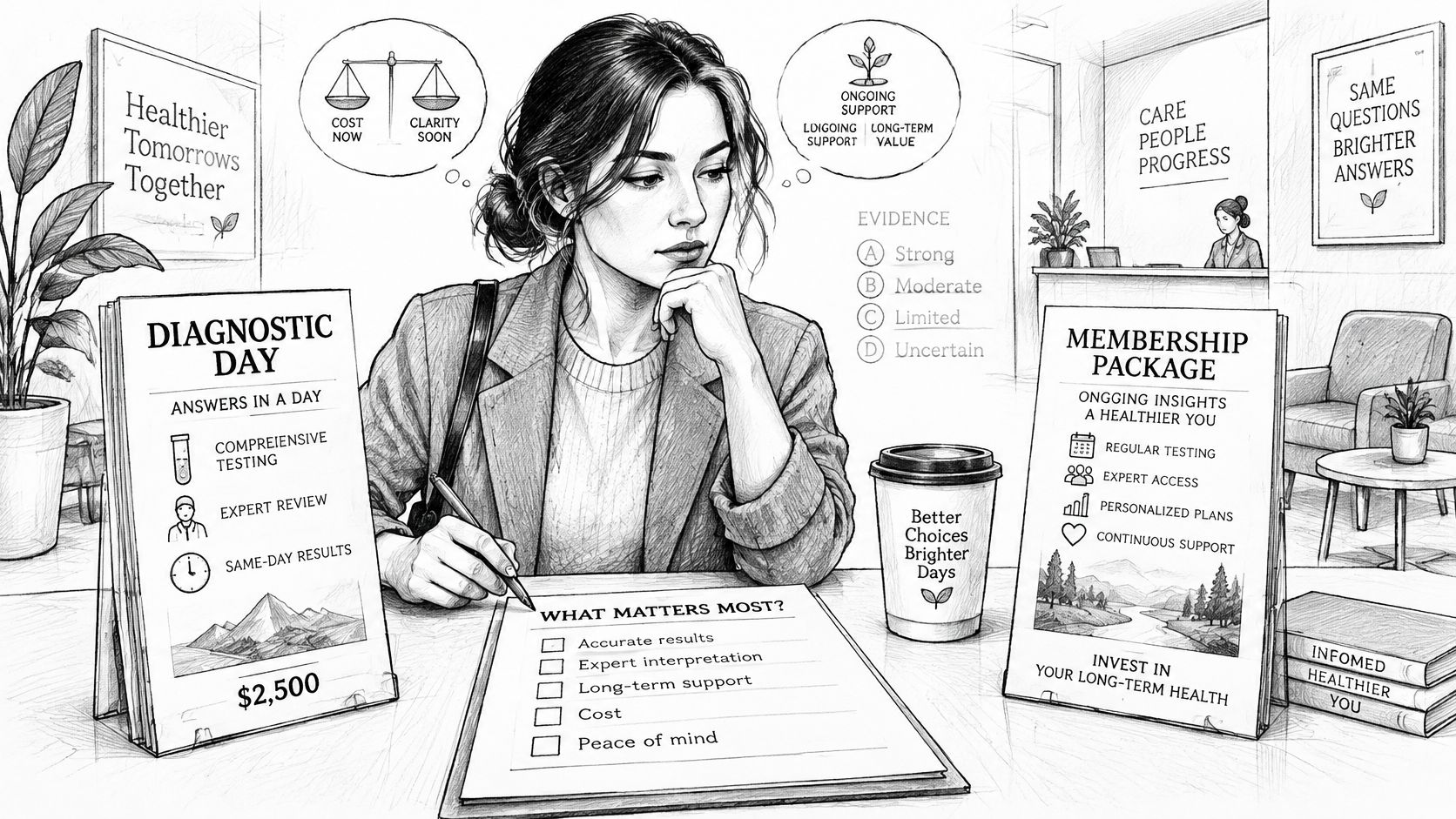
You’re comparing a diagnostic day with an ongoing longevity membership. Both brochures look reassuring: extensive testing, personalised plans, medical oversight and references to published research. Before you commit, you need to know whether that research supports the result you want, not just the service being sold.
Table of Contents
- Why Evidence Grades Matter Before You Pay for Longevity Care
- What a GRADE Rating Measures and Why It Exists
- The Five Downgrade Domains Behind Every Rating
- Mapping Evidence Certainty to Clinic Rubric Axes
- Why a Strong Rating Can Still Mismatch Your Goal
- Applying Evidence Grades to Longevity Interventions
- Comparing Clinic Programmes and Your Next Step
Why Evidence Grades Matter Before You Pay for Longevity Care
The difficult question isn’t whether a clinic can show you a scientific paper. It’s whether the evidence supports its particular promise to someone like you. A diagnostic package might offer information, while a membership promises continuing intervention. Those are different purchases, and neither becomes worthwhile merely because the brochure uses the phrase evidence-based.
Consider a hypothetical consultation. You want to preserve your independence as you age, but the clinician describes changes in laboratory measurements. Those measurements might be relevant, yet you still need an explanation connecting the reported change to your goal. Don’t silently substitute the clinic’s measurable endpoint for the outcome you care about.
Start with the promise, not the package
Treat every benefit claim as a question that needs an answer:
- What would improve? Ask the clinic to name the outcome rather than describe the treatment as advanced or personalised.
- Who was studied? Request enough information to compare the participants with your own health situation.
- What would justify continuing? Agree on how you and your clinician would recognise meaningful benefit, unacceptable harm or insufficient evidence.
This is also a useful moment to separate scientific support from commercial incentives. Ask who recommends the treatment, who supplies it and who receives payment if you proceed. The discussion of conflict of interest in healthcare offers another lens for examining that relationship.
Before you pay: Ask for the evidence behind the benefit you’re buying, not merely the test or treatment you’ll receive.
You don’t need to become a systematic reviewer to ask better questions. You need a way to distinguish confidence from enthusiasm, and a clear place to record what remains uncertain. That makes the conversation more useful than either accepting every claim or dismissing everything unfamiliar.
What a GRADE Rating Measures and Why It Exists
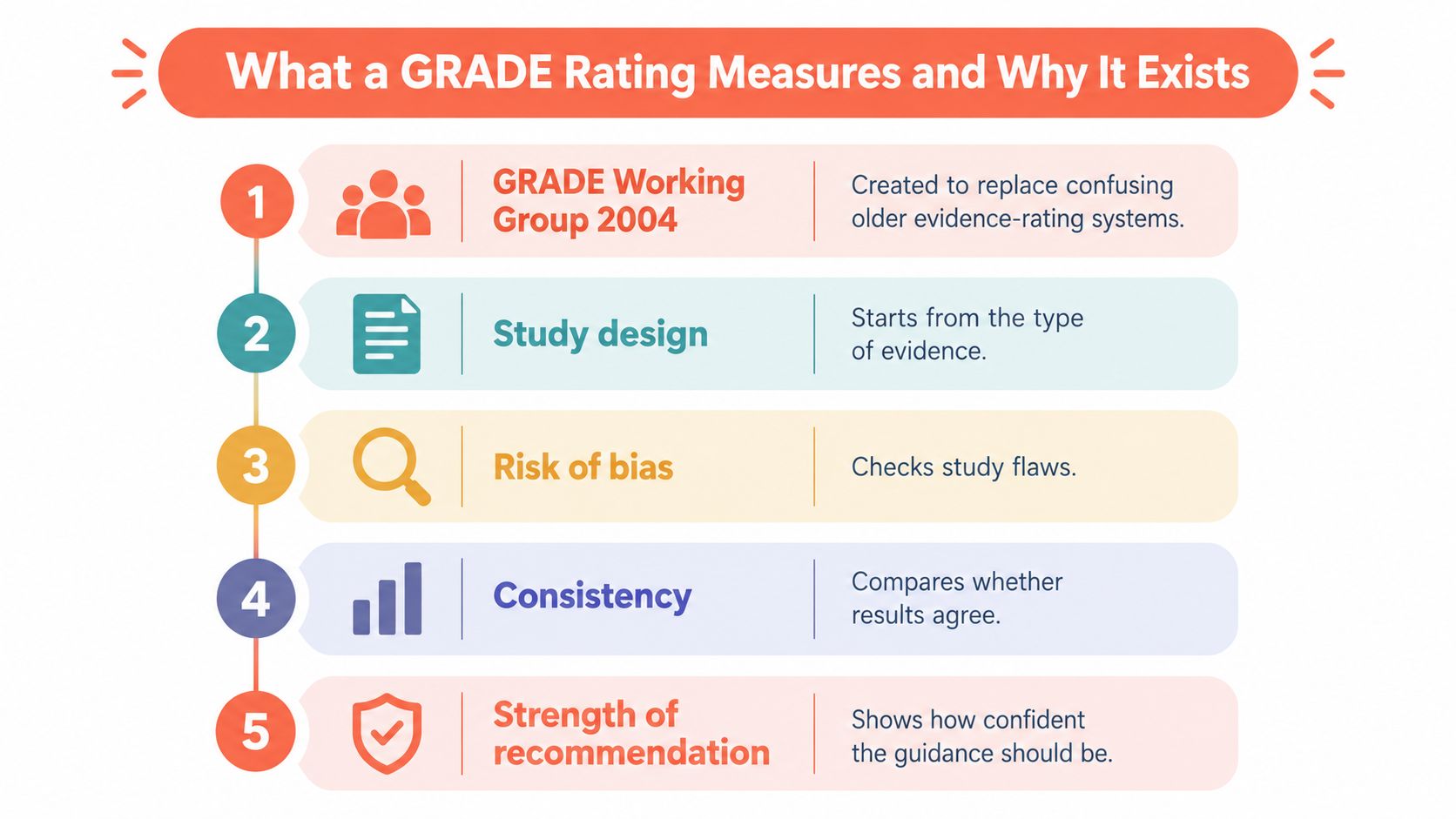
GRADE stands for Grading of Recommendations Assessment, Development and Evaluation. The GRADE Working Group first proposed the approach in 2004 to replace a confusing variety of earlier rating systems with a transparent, structured framework, as described in the BMJ explanation of GRADE and recommendation strength.
Think of a weather forecast. Confidence about rain tomorrow isn’t a verdict on the whole season. Similarly, a GRADE evidence rating expresses confidence in an estimated effect for a particular outcome. It isn’t an all-purpose quality badge for a study, treatment or clinic.
Reading the certainty language
The BMJ framework linked above describes four certainty categories. Each tells you how confident reviewers are that the estimated effect is close to the true effect.
| Certainty category | Plain-language meaning |
|---|---|
| High | Reviewers are very confident that the true effect is close to the estimate. |
| Moderate | The true effect is probably close, but it could differ substantially. |
| Low | The true effect may differ substantially from the estimate. |
| Very low | The estimate is highly uncertain. |
The word effect deserves attention. It means the difference an intervention makes compared with an alternative, not just what happened after someone received treatment. When reading a claim, look for that comparison rather than assuming that any improvement was caused by the intervention.
Certainty also isn’t a measure of how impressive a benefit sounds. A carefully established small effect and an uncertain large effect represent different situations. You may reasonably care about both the reliability of the estimate and whether the benefit would matter to you.
Confidence isn’t an instruction
Evidence certainty and recommendation strength are separate judgments. As the BMJ framework explains, recommendations also account for benefits, harms, patient values, preferences and resources.
A practical way to understand the distinction is to separate two questions: How confident are we about what happens? and What should this patient do? Answering the first doesn’t automatically settle the second.
A clinician should therefore explain the reasoning between the evidence and the recommendation. If the evidence is uncertain, the recommendation shouldn’t be presented as inevitable. If the evidence is strong, you still deserve a conversation about the balance of consequences and whether the intervention fits your priorities.
The Five Downgrade Domains Behind Every Rating
A rating begins with the evidence available, then changes when reviewers identify reasons for doubt. For intervention effects, randomised controlled trials generally start at high certainty, while observational studies generally start lower. The Cochrane Handbook’s guidance on assessing certainty describes five principal downgrade domains.
The examples below are hypothetical illustrations, not findings about particular longevity treatments. Their purpose is to help you recognise the reasoning behind a downgrade rather than memorise a label.
Problems with how evidence is produced
Risk of bias concerns flaws that could distort a study’s result. Suppose researchers assessing a subjective outcome know which participants received the intervention. Their expectations could influence the assessment. The useful question is whether the study’s methods adequately protected against that possibility.
Publication bias concerns which findings become available. Suppose favourable findings are published while unfavourable findings remain unavailable. Reviewing only the published evidence could give an exaggerated impression of benefit. A polished bibliography doesn’t answer whether relevant results are missing.
These domains address different problems: one concerns how a study was conducted, while the other concerns whether reviewers can see the relevant body of research.
Problems with what the results tell us
- Inconsistency: Imagine studies of a similar intervention reporting substantially different results. Reviewers need to examine the disagreement rather than treating every favourable result as another vote for benefit.
- Indirectness: Suppose the study tested a different population, intervention, comparator or outcome from the question being asked. The evidence may be informative without directly answering the clinic’s claim.
- Imprecision: An estimate may sit within a wide confidence interval that includes both meaningful benefit and harm. A favourable central estimate doesn’t resolve that uncertainty.
Cochrane describes a display running from four circles for high certainty to one circle for very low certainty, using filled and unfilled symbols to make the category visible. The symbols are convenient, but the accompanying explanation matters more.
A useful evidence summary tells you why confidence was reduced, not just which category reviewers selected.
Ask the clinic for that explanation when it cites a rating. “Downgraded for imprecision” is more informative than “promising evidence,” because it identifies what remains unresolved. It also helps you distinguish a carefully qualified claim from one that leaves out its limitations.
Mapping Evidence Certainty to Clinic Rubric Axes
A clinic can provide attentive supervision while offering an intervention with uncertain benefits. It can also cite convincing research without clearly explaining its financial incentives. Treating those features as interchangeable makes comparison harder.
A practical editorial rubric separates diagnostic depth, medical supervision, conflict freedom and evidence base. The published clinic-scoring methodology provides a place to examine how those dimensions are defined and weighted. They answer different questions and should remain visible separately.
GRADE Certainty Levels Read on the Evidence Base Axis
The table below is a buyer’s interpretation, not a formal conversion from GRADE categories into clinic points. The certainty meanings introduced earlier remain unchanged; the practical issue is how cautiously a clinic should frame its claim.
| GRADE certainty level | What it means for the estimate | Reading for the evidence base axis |
|---|---|---|
| High | Little doubt about the estimated effect | A reliable basis for the specific supported claim, subject to checking its fit |
| Moderate | Meaningful uncertainty remains | Present the benefit with explicit qualifications |
| Low | Substantial revision remains possible | Describe the benefit as uncertain, not established |
| Very low | The estimate offers limited confidence | Treat the claim as a hypothesis and label experimental use prominently |
This interpretation helps you inspect the wording around an intervention. A clinic shouldn’t turn qualified evidence into an unqualified promise just because it delivers the treatment within a well-organised programme.
Keep unlike judgments separate
Diagnostic depth asks what the programme investigates. Medical supervision asks who oversees care and how clinical responsibility is organised. Conflict freedom concerns incentives and editorial or commercial independence. None of these is a substitute for demonstrating a claimed benefit.
For your own comparison, keep a separate note for each dimension. Record evidence gaps alongside strengths rather than allowing an impressive feature to erase an unrelated concern.
- For the evidence entry: Write down the intervention, the claimed outcome and the certainty assessment.
- For supervision: Record who reviews results, makes treatment decisions and handles follow-up.
- For incentives: Note any disclosed relationships relevant to recommendations or purchases.
A composite score depends on its weights. Before comparing headline ratings across programmes, inspect the methodology and the underlying breakdown. Don’t create a numerical GRADE conversion yourself unless the scoring method explicitly defines one.
The most useful score is one you can unpack. You should be able to see whether a favourable overall assessment reflects strong evidence, extensive services, organised oversight or some combination of these.
Why a Strong Rating Can Still Mismatch Your Goal
Suppose a hypothetical intervention reliably changes an aging-related blood measurement during a short study. You’re considering it because you want to remain physically independent later in life. Even if the measurement result is convincing, the question you need answered is different.
A surrogate endpoint is a measurement used in place of the patient-important outcome of interest. The BMJ Best Practice introduction to GRADE explains why differences between the evidence and the target question can require downgrading for indirectness. Certainty about a marker doesn’t automatically establish certainty about disability-free survival, cognitive function or all-cause mortality.
Trace the claim to your goal
Write the reasoning as a chain:
Intervention → measured change → expected patient benefit
Then ask the clinic to identify which connection its evidence supports. Does the research establish the measured change, the meaningful health outcome, or both? Keep any unsupported connection visible rather than filling it in with a plausible explanation.
This matters when assessing a combined programme. Evidence concerning individual components doesn’t, by itself, establish the effect of the whole protocol. Your question concerns what happens when those components are offered together, in the proposed doses and schedule, to the intended patients.
High confidence in an answer is useful only after you’ve checked that it answers your question.
Ask about endpoint, population, duration and comparator
Use these questions to test whether the evidence fits:
- Endpoint: Did researchers measure the outcome I value, or something intended to stand in for it? Ask for the justification connecting the two.
- Population: Were participants reasonably similar to me? Evidence from people receiving treatment for an established disease may not directly answer a prevention question in relatively healthy adults.
- Duration: Did researchers follow participants long enough to evaluate the promised result? Don’t assume a short-term observation answers a long-term question.
- Comparator: What was the intervention compared with? Ask whether that alternative resembles the choice you’re making.
These aren’t reasons to reject research automatically. They’re reasons to qualify what you can conclude from it.
For example, a disease-management study might still help a clinician think through a preventive intervention. But the clinician should name the extrapolation rather than present the application as directly proven. The same discipline applies whether you’re considering a local outpatient service, a residential programme abroad or a continuing membership.
A strong rating is not the problem. Using it beyond the question it supports is the problem.
Applying Evidence Grades to Longevity Interventions
Consider a hypothetical clinic claim that a protocol improved an aging biomarker. Don’t begin by asking whether the result sounds exciting. Begin by requesting the study report, the exact endpoint and the clinic’s explanation of what constitutes meaningful improvement.
The CDC guidance on GRADE certainty criteria provides the methodological basis for examining imprecision and the narrow circumstances in which observational evidence may be upgraded. A practical assessment should go beyond whether a reported result crossed a threshold for statistical significance.
Build a claim-specific evidence note
Use the following checklist when discussing the proposed intervention:
- Prespecified meaningful difference: Was a minimal clinically important difference defined before researchers examined the results? If the clinic cannot identify a defensible threshold for the biomarker, ask how it distinguishes a detectable change from a worthwhile benefit.
- Absolute and relative effects: Request both when applicable. A relative description alone doesn’t tell you the underlying difference between groups.
- Confidence intervals: Read the interval around the estimate, not just the favourable headline. Check which clinically important possibilities remain compatible with the findings.
- Follow-up: Record how long outcomes were observed and whether the clinic’s promise extends beyond that period.
- Adverse events: Ask what harms were collected and reported. Keep the assessment of potential benefit beside the assessment of potential harm.
You don’t have to calculate these measures yourself. Ask the prescribing clinician to explain them in ordinary language and show where they appear in the evidence.
Scrutinise any proposed upgrade
As the CDC guidance explains, observational evidence may be upgraded for a large or very large effect, a clear dose-response gradient, or residual confounding that would plausibly reduce an observed benefit. The framework also recognises circumstances where confounding would create an apparent effect despite a measured result showing no effect.
These are specific methodological judgments, not permission to promote an observational finding because it seems persuasive. Reviewers must still consider the downgrade domains. An upgrade is a reasoned decision, not an automatic route to high certainty.
Return to the hypothetical biomarker claim. If its confidence interval spans meaningful benefit and harm, the favourable point estimate doesn’t remove the imprecision. If the protocol differs materially from the studied intervention, record that mismatch too.
When comparing an anti-aging programme, keep separate entries for established clinical claims, uncertain applications and experimental modalities. Ask the clinician to review those entries with you before agreeing to treatment.
The final wording should match the evidence. A biomarker change and a confirmed patient benefit are different claims. If the latter remains unproven, experimental status should be prominent, not buried beneath confident language.
Comparing Clinic Programmes and Your Next Step
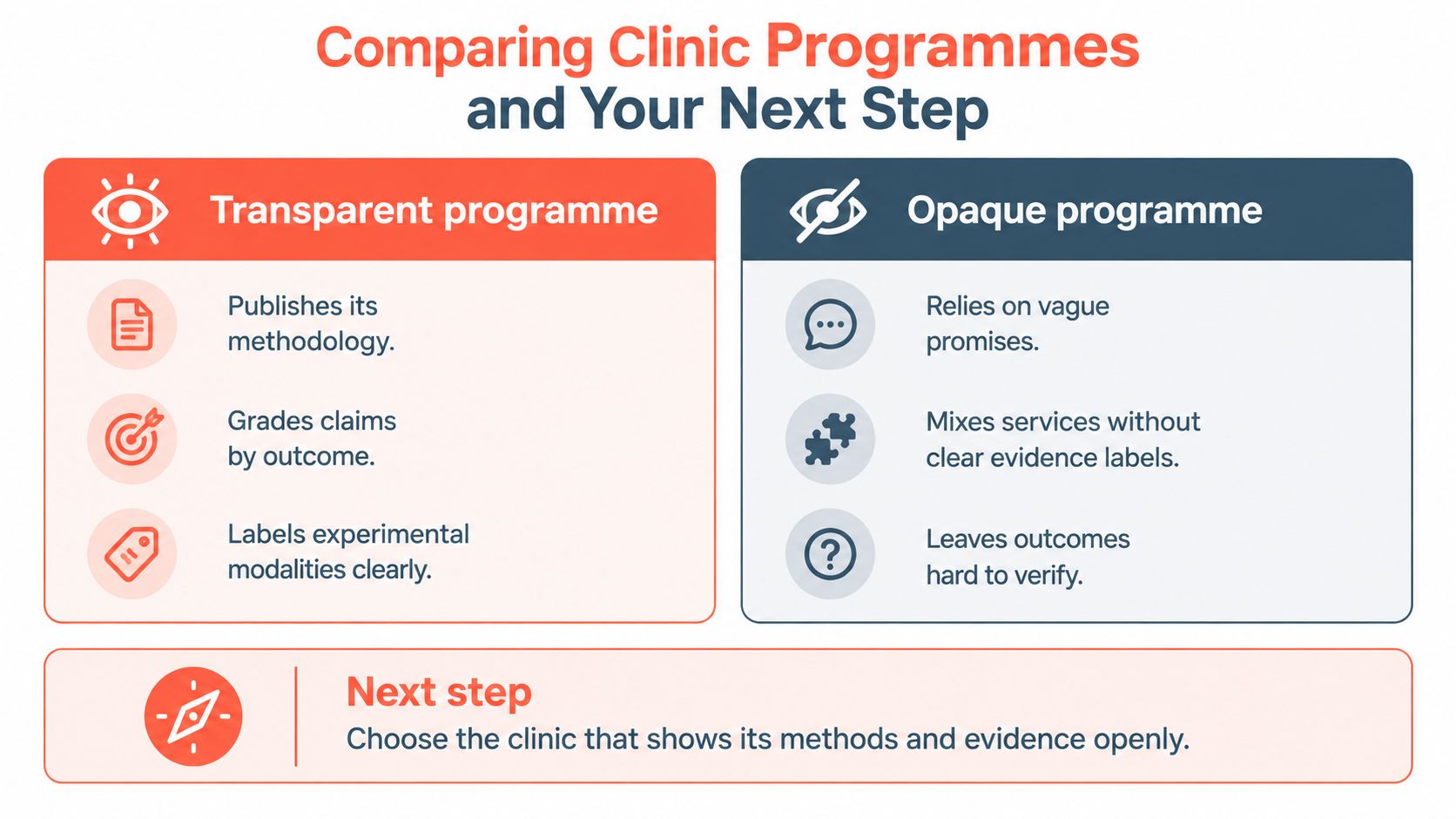
Compare how programmes handle an uncomfortable question: What can’t you confidently promise me? A transparent provider can identify the limits of its evidence and explain how those limits affect its recommendations. An opaque presentation may leave you with testimonials, biological explanations and the phrase clinically proven, but no clearly assessable claim.
For your decision, give more weight to documentation you can inspect than to confidence you can’t test. A plausible mechanism can help explain an idea. It shouldn’t replace evidence for the outcome being sold.
Compare the explanations, not just the services
A useful comparison file should contain:
- Traceable claims: Can you identify the research supporting each proposed benefit?
- Visible limitations: Does the provider explain uncertainty and label experimental modalities?
- Decision consequences: Does the clinician explain how the evidence affects the recommendation, rather than just handing you references?
You can examine published reviews, take the papers to a clinician independent of the sale, or use an editorial directory as an additional reference. Longevity Clinics is an independent, reader-funded publication that evaluates private longevity programmes through a transparent rubric covering diagnostic depth, medical supervision, conflict freedom and evidence base. It publishes its methodology, uses publicly verifiable material such as regulator records and peer-reviewed literature, and has no paid placements or affiliate links.
An editorial assessment is a starting point for questions, not a personal treatment recommendation. Check what documentation the assessment relies on and discuss your own circumstances with a clinician.
Choose a programme you’re seriously considering and write down the health outcome that matters most to you. List each proposed intervention beside its studied endpoint, then check the programme’s clinic profile for how its evidence is assessed. Bring the unresolved gaps to your consultation and ask for written clarification before committing your money, time or consent.