Health Optimization Clinic: What to Expect in 2026
Learn what a health optimization clinic offers, how it differs from traditional care, and what to look for when choosing a provider in 2026.
The most common advice about a health optimization clinic is also the least useful, namely, to look for the biggest test menu. That’s the wrong filter. In this field, the central question is whether the clinic turns findings into validated decisions, clear follow-up, and accountable care, or whether it sells a premium stack of measurements that never changes what happens next.
A credible clinic works in the space between standard screening and speculative anti-aging promises. The 2024 clinical framework describes these programs as preclinical prevention services that may use blood biomarker panels, whole-genome sequencing, epigenetic testing, physical exams, and cognitive assessments in people who don’t have diagnosed disease, while also warning that the sector still lacks consistent standardization, regulatory oversight, and strong evidence for many diagnostic and treatment approaches (peer-reviewed framework). That gap matters because a clinic can offer advanced measurements without proving those measurements predict better survival or less disability.
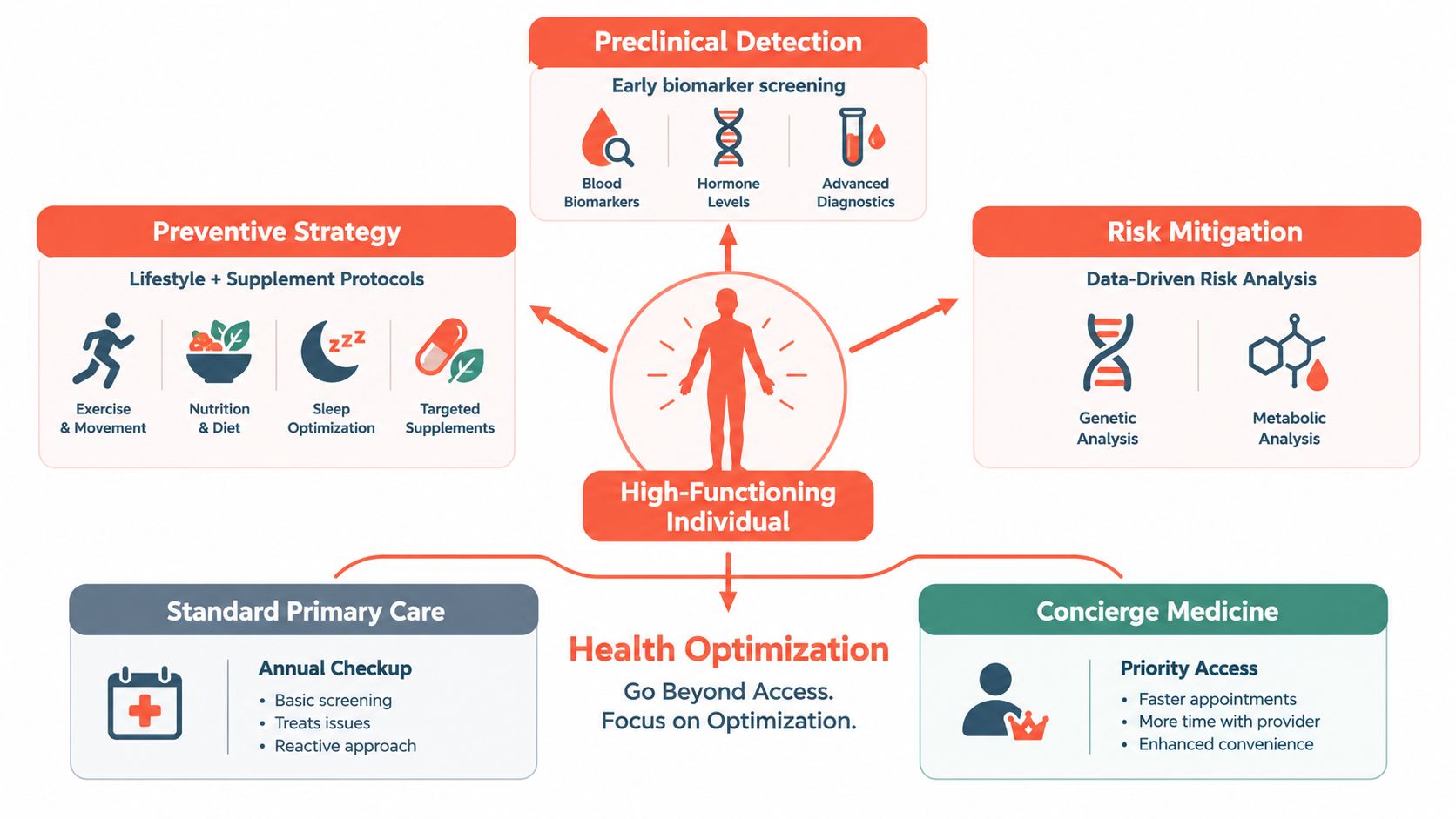
Table of Contents
- What a Health Optimization Clinic Actually Does
- From Caloric Restriction to Commercial Longevity Programs
- The Diagnostic Day, Personalization, and Follow-Up Workflow
- Typical Interventions and How Strong the Evidence Is
- A Four-Axis Framework for Evaluating Any Clinic
- Reading Between Licensed, Hospital Affiliation, and Clinical Utility
- Pre-Enrolment Checklist and Common Questions Answered
What a Health Optimization Clinic Actually Does
The test menu is often the least informative part of a health optimization clinic. Its real function begins after the diagnostic appointment, when clinicians must decide which findings matter, what action they justify, and who remains responsible for follow-up. The model sits between routine primary care and concierge medicine, serving people who feel well but want a more detailed assessment of future risk.
Where it fits in the care spectrum
Standard primary care commonly combines symptoms, age-based screening, and established risk factors. A health optimization clinic may begin earlier, before diagnosed disease, and add exploratory tools such as biological-age clocks, epigenetic scores, or multi-omic panels to measures including blood pressure, lipid levels, glucose markers, and validated cancer screening (clinical framework). These categories carry different levels of evidence, so they should not be interpreted as equivalent.
Regulatory status answers one question: whether a test, clinician, or facility is authorized to operate within defined rules. It does not establish that a measurement improves decisions or patient outcomes. Clinical utility requires a usable pathway from result to action.
Practical rule: ask what happens after an abnormal result. If the answer is unclear, the diagnostic menu is doing more work than the care model.
A credible programme sets pre-specified decision rules. A result may trigger a defined intervention, repeat interval, specialist referral, or treatment change. The post-diagnostic workflow should also specify who reviews the result, how uncertainty is communicated, and when the plan is reassessed.
Four questions expose the difference between a polished assessment and useful care: is the measurement analytically credible, does it change management, is the proposed response clinically safe, and is follow-up accountable? Those questions apply immediately, regardless of how advanced the equipment appears.
From Caloric Restriction to Commercial Longevity Programs
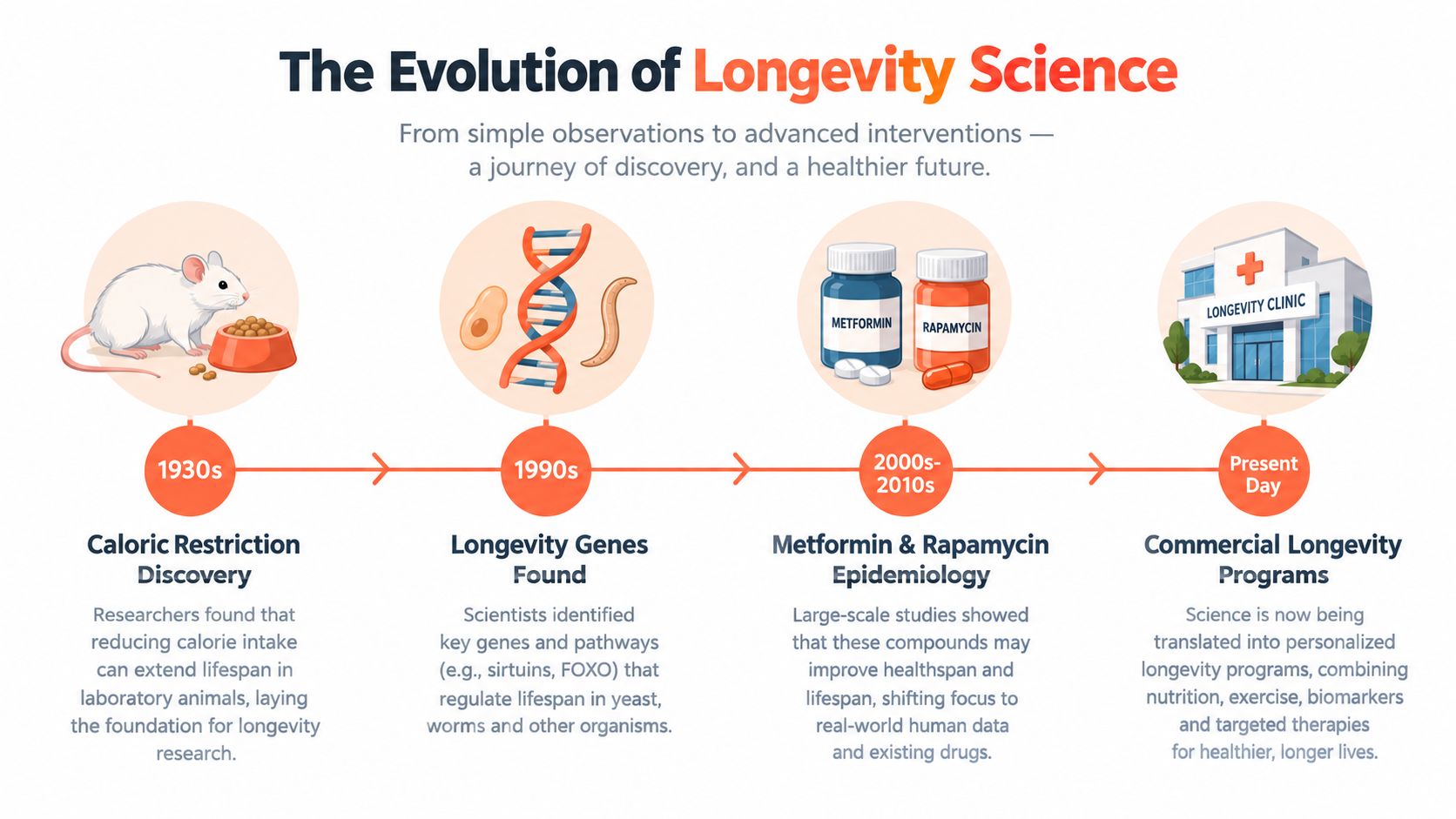
The commercial longevity market did not begin with a proven anti-aging treatment. Its lineage reaches back to caloric-restriction research in the 1930s, which made aging appear potentially modifiable rather than entirely inevitable (longevity medicine review). That research later informed human monitoring, biomarker testing, and outpatient programs built around measurable changes in metabolic and physiological function.
The commercial form of this lineage is the recurring health-optimization programme: a clinic collects tests, interprets risk markers, recommends interventions, and schedules reassessment. That workflow creates a more useful question than whether the programme sounds scientifically sound. What does the clinic do after a result arrives?
A plausible story, not a proven endpoint
Longevity clinics may draw on research into metabolic signalling, inflammation, insulin sensitivity, gene regulation, and cellular pathways. Those areas can justify investigation, but they do not automatically justify every test or treatment offered to a paying patient.
Clinics may report improved HbA1c, lower inflammatory markers, or a more favourable biological-age estimate. Such changes can be clinically relevant in the right context, yet they do not by themselves establish longer life, fewer hospitalizations, or preserved function. Completed randomized trials have not provided definitive lifespan evidence for the commercial longevity model. The practical distinction is between a measurable change and a decision that improves patient outcomes.
A clinic should therefore connect each measurement to four questions: is the result analytically credible, will it change management, is the proposed response safe, and is follow-up accountable? This framework shifts attention from the diagnostic display to the post-diagnostic workflow.
A good clinic explains what changed, why it matters, what action follows, and when the plan will be reviewed.
The historical lesson is not that longevity medicine lacks value. It is that a plausible biological lineage becomes useful care only when a clinic can translate findings into defensible decisions, monitor their effects, and acknowledge uncertainty instead of selling certainty.
The Diagnostic Day, Personalization, and Follow-Up Workflow
A diagnostic day can be medically compliant and still clinically unhelpful. A clinic may collect consent, use licensed professionals, and issue a technically valid report, yet leave the patient without a clear decision, treatment owner, or review date. The useful unit is the workflow, not the appointment.
Diagnostic testing should produce a decision-ready baseline
A credible programme begins with relevant intake, fasting laboratory work, imaging where indicated, body-composition assessment, and functional testing. The aim is not maximum data collection. It is a baseline that can be acted on, with each result linked to a decision, a responsible clinician, and a point at which the plan will be reassessed.
A VO₂ max result has value when it changes the training prescription or establishes a reference for later review. A blood panel or genome report requires the same discipline. Before ordering it, the clinic should be able to explain who interprets the result, what finding would alter management, how the patient will be informed, and what happens if the result is abnormal or inconclusive. A technically valid test without that pathway is administrative completion, not useful care.
The minimum-credible diagnostic standard provides a practical reference for judging whether an initial assessment has enough structure to support decisions.
Personalization requires clinical prioritization
Personalization is not the same as producing a larger report. A physician should rank findings by modifiability, expected clinical importance, safety, and the quality of available evidence. Blood pressure, glucose markers, medication status, sleep, training tolerance, and musculoskeletal limits generally deserve earlier attention because established interventions can address them. Exploratory markers should remain secondary unless the clinic can state how they change care.
A flagged ApoB should lead to a defined lipid-management plan and a scheduled repeat test. A low VO₂ max should lead to training that matches the patient’s starting capacity, limitations, and response over time. The plan should identify the intervention, its rationale, its owner, and its review date.
Follow-up determines clinical utility
Follow-up is the point at which regulatory process becomes clinical accountability. The clinic should name the reviewer, set a retesting interval, define escalation for concerning findings, and record whether the intervention helped, caused harm, or produced no meaningful change. Those four checks, analytical credibility, actionability, safety, and accountability, separate a usable programme from a polished diagnostic package.
A patient is paying for decisions that continue after the first lab draw, not for a day of testing alone. If the post-diagnostic path is missing, the programme cannot demonstrate clinical utility, regardless of how advanced its equipment or reports appear.
Typical Interventions and How Strong the Evidence Is
A health optimization clinic may combine exercise coaching, metabolic management, hormone care, compounded therapies, and omics-driven supplements. These interventions differ in evidence, regulatory status, and practical value. A polished programme should make those distinctions visible instead of presenting every service as equally established.
Evidence and regulation are separate questions
Supervised exercise programming has a strong preventive-care evidence base. The World Health Organization benchmark is 150 to 300 minutes per week of moderate-intensity aerobic activity, or 75 to 150 minutes of vigorous activity, plus muscle-strengthening work on at least two days weekly (WHO benchmark summary). A clinic adds value by adapting that guidance to the patient’s capacity, limitations, goals, and response. The post-diagnostic test is whether the plan is reviewed and adjusted, not whether the clinic can prescribe exercise.
Metabolic optimization, including lipid management, weight-loss protocols, and nutrition support, also relies on established clinical tools. Hormone replacement occupies a narrower category. It can be appropriate when clinically indicated and carefully supervised, but it is not a general anti-aging intervention. Compounded biologics, peptide stacks, NAD+ infusions, exosomes, and similar offerings generally have weaker evidence and may sit outside standard approval pathways.
| Intervention Family | Evidence Strength | Regulatory Status | Typical Example |
|---|---|---|---|
| Supervised exercise and conditioning | Strong | Standard clinical and fitness practice | VO₂ max-guided training plan |
| Metabolic and cardiometabolic optimization | Strong to moderate | Mostly approved tools | Lipid management and structured weight loss |
| Hormone therapy when clinically indicated | Moderate | Prescription-only | Testosterone or thyroid treatment |
| Compounded biologics and infusion stacks | Weak | Often outside mainstream approval pathways | NAD+ infusion or peptide protocol |
| Omics-driven supplement regimens | Heterogeneous | Mostly unregulated | Genomics-based supplement bundle |
The useful distinction is between regulatory compliance and clinical utility. A prescription-only intervention may meet formal requirements yet add little value if the clinic cannot explain its indication, expected outcome, monitoring plan, or stopping rule. Conversely, a low-risk lifestyle intervention may have substantial utility when linked to a defined target and follow-up review.
After the diagnostic day, ask who reviews the result, what action follows, and when the response is assessed. For hormone-specific claims and common clinic practices, see this overview of hormone optimization clinic practices. Evidence, safety, actionability, and follow-up should determine the programme’s value, not the number of modalities on its menu.
A Four-Axis Framework for Evaluating Any Clinic
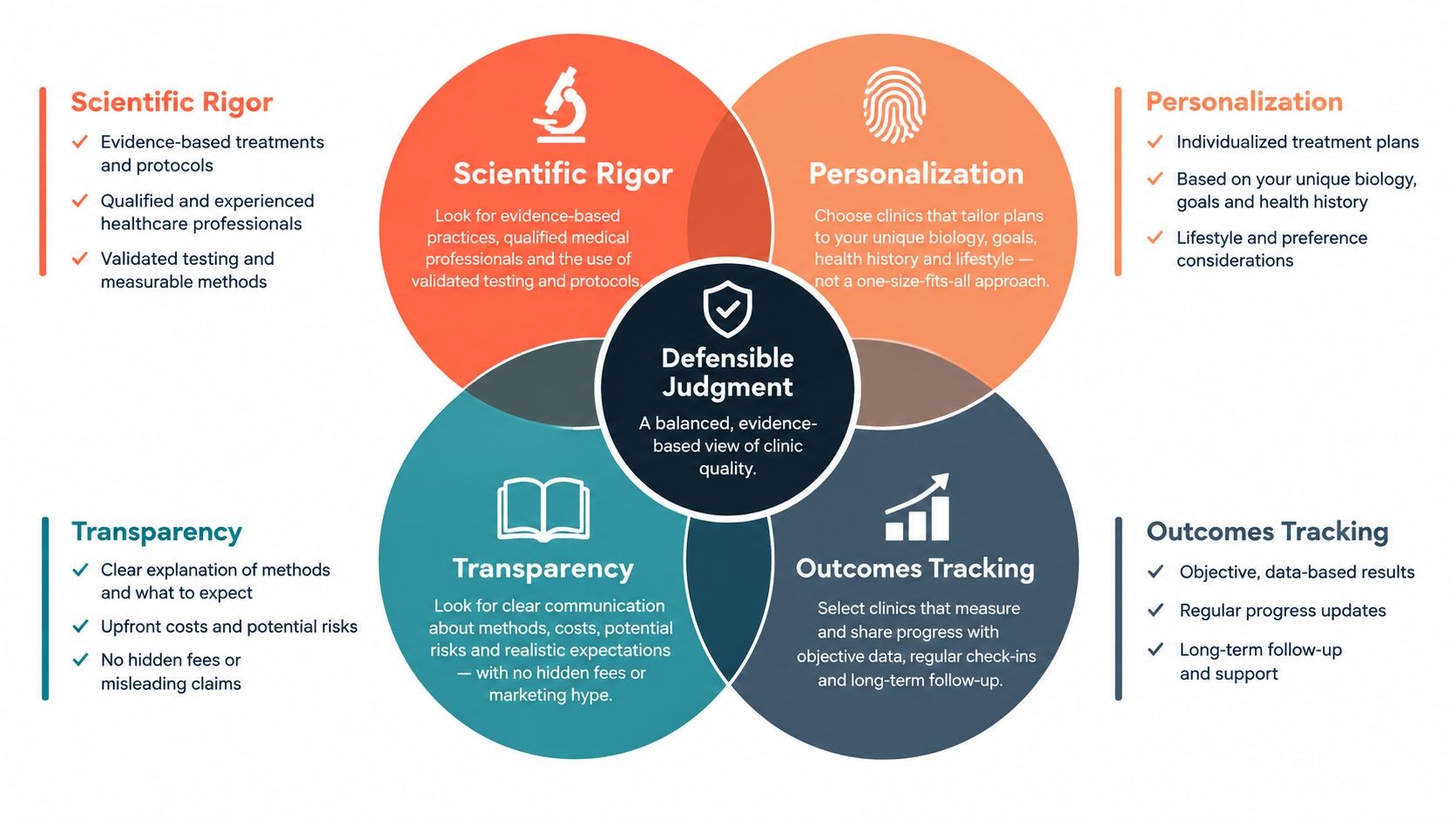
A clinic should be judged on four independent axes, especially after the diagnostic day. The tests matter only if someone interprets the findings, chooses an intervention, and checks whether it produced the intended response. This framework separates clinical utility from polished branding and from regulatory compliance, which answers a different question.
The four axes
1. Diagnostic depth. Does the clinic use validated biomarkers and functional assessments, or mainly a curated selection of marketable tests? A credible programme can explain why each test was ordered, which decision it may change, and what happens when the result is normal, abnormal, or uncertain.
2. Medical supervision. Which licensed clinicians review the findings, prescribe interventions, and remain accountable after the first appointment? Ask who converts a result into a plan, who handles adverse effects, and who reassesses the response. If responsibility changes with the service purchased, supervision may be fragmented.
3. Conflict freedom. How are clinicians paid, and does revenue depend on selling additional services? A perfect incentive structure is unrealistic, but the clinic should disclose relevant financial relationships and explain why each recommendation is appropriate for the patient rather than for its menu.
4. Evidence base. Are recommendations linked to peer-reviewed studies and standard care pathways, or mainly to internal protocol language and brand claims? A responsible clinic distinguishes established care from plausible but unproven experiments, then sets appropriate limits around both.
The strongest profile is deliberately unexciting. It combines validated diagnostics, licensed oversight, transparent compensation, and recommendations grounded in published evidence. Its workflow remains visible from result to treatment, monitoring, and outcome review. The weakest profile often reverses that sequence, presenting an energetic sales process without a clear plan for follow-up.
Use a simple rule when comparing programmes. If medical supervision or evidence base is seriously deficient, an impressive testing menu does not rescue the offer. A smaller clinic with clear decisions, defined review points, and honest limits may be more defensible than a glamorous programme with weak follow-through.
For readers comparing directories and scoring systems, Longevity Clinics publishes comparative clinic profiles using the same four axes in its review framework. Standardized questions make it easier to compare how clinics handle findings, recommendations, and follow-up rather than counting modalities.
Reading Between Licensed, Hospital Affiliation, and Clinical Utility
Marketing often blurs four separate questions. A facility can be authorized to operate, a clinician can be licensed, a device or product can have a specific clearance, and the overall program can still lack clinical utility for the claims being made. Consumers tend to treat those as one credibility signal, but they aren’t.
Authorization is not proof of usefulness
Whole-body MRI is a good example of the gap. Imaging systems can be cleared or used in legitimate clinical settings, but using whole-body MRI as preventive screening in asymptomatic people is a different question from using it to evaluate specific symptoms or known disease. The same logic applies to direct-to-consumer DNA-methylation age testing. A test can produce a number, but that doesn’t mean the number is a validated trigger for treatment.
That separation matters because patients often assume that hospital affiliation or a licensed environment validates every service on the menu. It doesn’t. Institutional prestige can coexist with weak evidence for a specific application.
Read the program claim by claim
A serious evaluation asks four questions in order.
- Is the facility authorized? That tells you the site can operate.
- Is the clinician licensed? That tells you someone on the team can legally practice.
- Is the product or device authorized for this use? That tells you whether the specific application matches the clearance or approval.
- Has the clinic demonstrated clinical utility? That tells you whether acting on the result improves health in the way promised.
If a program answers the first three but not the fourth, it may still be legal and still be weak medicine. That’s especially important in wellness-adjacent services that look rigorous because they’re delivered in clean facilities with professional branding.
A useful example of this nuance appears in the regulatory distinctions discussed in the editorial note on concierge-style longevity benefits. The broader point is the same everywhere. Compliance is not the same thing as proof.
Pre-Enrolment Checklist and Common Questions Answered
Before enrolling, use a short checklist and insist on direct answers. If the clinic gets vague here, it’ll probably stay vague after you pay.
Printable checklist
- Diagnostic depth: Which validated biomarkers, functional tests, and standard screenings are included, and which are optional add-ons?
- Supervising clinician: Which licensed clinician reviews results, prescribes interventions, and handles follow-up?
- Conflict disclosure: How are clinicians compensated, and do they profit from selling more tests or treatments?
- Evidence quality: Which recommendations are grounded in peer-reviewed evidence, and which are exploratory?
- Follow-up path: Who reviews abnormal findings, when is retesting scheduled, and what happens if results are inconclusive?
Common questions
What if I stop responding after the diagnostic day? A reputable clinic should already have a follow-up pathway, because abnormal findings don’t disappear when communication stops. If nobody owns the next step, the result was collected for marketing, not care.
What should I do with out-of-range but asymptomatic biomarkers? Don’t assume every abnormality needs treatment. Ask whether the finding is validated, whether it changes management, and whether the clinic can explain the difference between monitoring and intervention.
What are the clearest red flags? Guaranteed outcomes, supplement bundles sold before results return, and off-label prescribing without documentation are all warning signs. If the clinic pushes action before interpretation, it’s reversing the order of medicine.
The goal here is informed consent, not persuasion. A clinic should help you understand what’s established, what’s uncertain, and what’s being tried under active monitoring.
If you’re evaluating a health optimization clinic now, ask for the written follow-up pathway, the supervising clinician’s name, and the evidence behind each recommendation before you book. Then compare that answer against the four-axis framework, because the right decision isn’t the clinic with the most tests, it’s the one that can show you how those tests become accountable care.