Hormone Optimization Clinic Guide
Evaluate any hormone optimization clinic with this evidence-based guide. Learn diagnostic standards, safety protocols, and how to spot marketing red flags.
Feeling tired, unfocused, or less interested in sex doesn’t automatically mean you need hormone therapy. Yet many hormone optimization clinic offers begin with precisely that assumption, turning broad symptoms into a prescription before establishing whether a hormone deficiency exists at all.
A credible program should be judged less by its concierge branding, supplement catalog, or promise of “optimal” levels than by the integrity of its workup. The central questions are more demanding: Were the tests collected correctly? Were alternative causes investigated? Are treatment targets physiologic? Who profits from the prescription? What happens when the results become unsafe?
Table of Contents
- The Diagnostic Gap in Modern Hormone Care
- Core Services and Common Hormone Panels
- Minimum Diagnostic Standards for Men and Women
- FDA-Approved Therapies Versus Compounded Bioidenticals
- Safety Protocols and Mandatory Monitoring Thresholds
- Telehealth Expansion and Geographic Access Realities
- How to Evaluate a Clinic Using a Four-Axis Rubric
The Diagnostic Gap in Modern Hormone Care
The most popular advice in hormone marketing is often the least reliable: match a symptom to a hormone, then correct the number. Fatigue, poor sleep, weight change, reduced libido, and difficulty concentrating can appear in numerous medical and psychological contexts. A questionnaire can identify subjects for discussion, but it can’t establish that testosterone, estrogen, or another hormone is the cause.
The risk increases when the same commercial operation orders the test, interprets an ambiguous result, prescribes treatment, dispenses the product, and schedules recurring paid monitoring. That structure doesn’t prove poor care, but it creates a conflict that patients should examine before accepting a long-term plan. A clinic has a stronger clinical posture when it can explain why treatment isn’t appropriate, not only why a membership should continue.
Symptoms are a starting point, not a diagnosis
For men, the diagnostic question isn’t merely whether testosterone falls inside or outside a preferred range. Major guidance requires compatible symptoms together with two separate early-morning measurements, with repeat confirmation under suitable collection conditions. A 2025 review also emphasizes fasting, adequate rest, standardized collection, and confirmation because careless testing can produce diagnostic errors. The relevant review of minimum testosterone diagnostic standards is particularly useful for patients comparing clinics that use a single convenient blood draw with clinics that verify the finding.
A responsible clinician should also investigate competing explanations before assigning vague symptoms to hormonal decline. The workup may need to consider medication effects, sleep problems, thyroid disease, metabolic health, mood, nutritional issues, and other medical conditions. The exact tests depend on the patient, but the principle is stable: a hormone result should explain the clinical picture, not replace it.
Audit question: Can the clinic show you its criteria for declining treatment, repeating a test, or referring you elsewhere?
The answer reveals more than a polished consultation room. A clinic that treats every borderline result as an invitation to escalate therapy may be optimizing revenue before physiology. A clinic that documents uncertainty, repeats questionable tests, and distinguishes symptom management from disease diagnosis is operating with a more defensible standard.
Core Services and Common Hormone Panels
A serious hormone optimization clinic does more than sell testosterone, estrogen, or thyroid prescriptions. It should connect the presenting complaint to a structured medical assessment, use a laboratory method appropriate to the question, and document how each result changes the decision.
The phrase “complete panel” deserves scrutiny. More biomarkers don’t automatically create a better diagnosis. A long list can create false precision when tests are poorly timed, assays aren’t standardized, or the clinician has no stated response to abnormal findings.
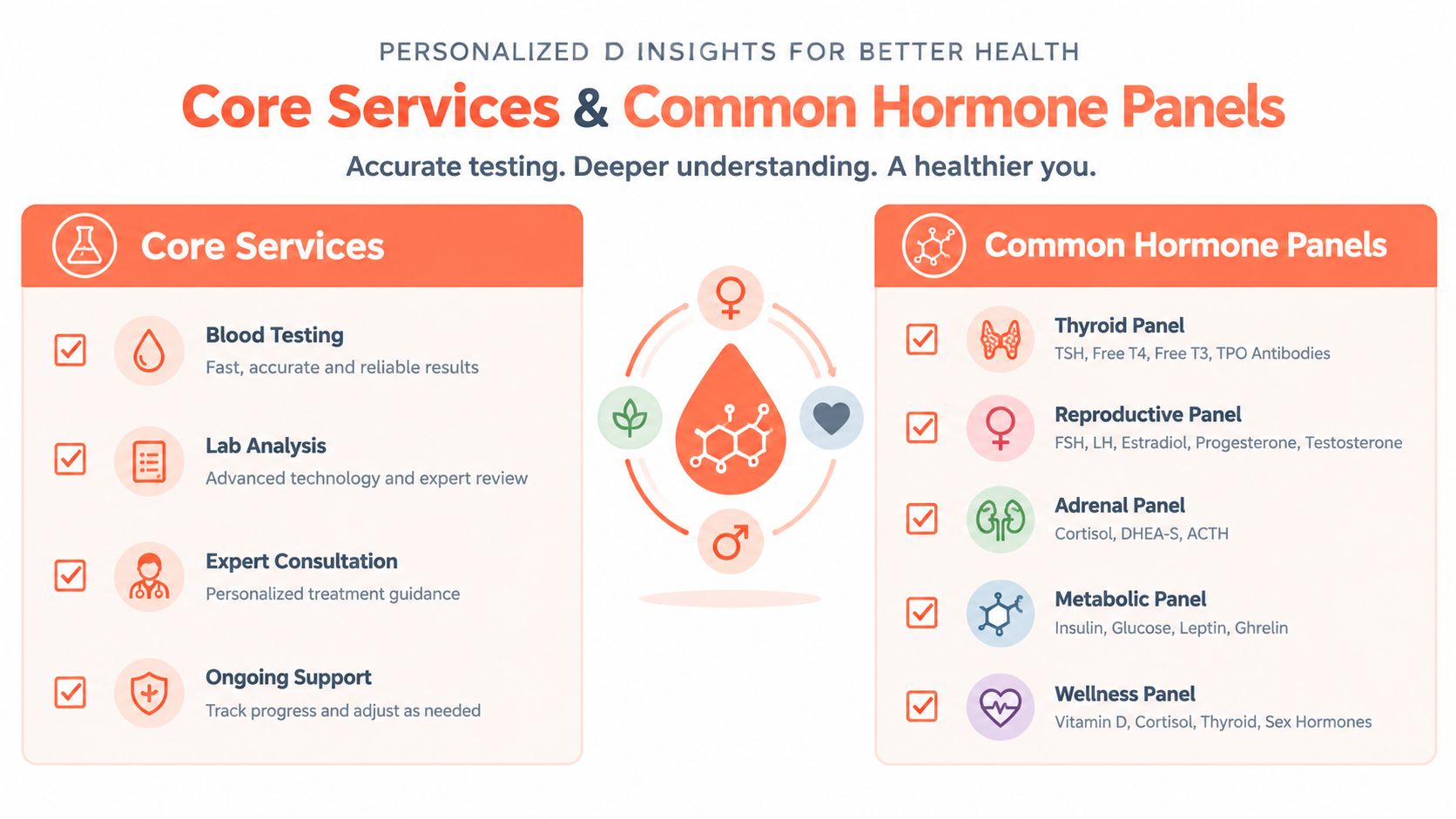
What a defensible requisition should show
For suspected male hypogonadism, the core record should make clear:
- Total testosterone: Collected at an appropriate time and repeated when the first result is low or inconsistent with symptoms.
- Free testosterone and SHBG: Used when the available fraction could alter interpretation, with the assay or calculation method documented.
- LH and FSH: Helpful for distinguishing a testicular problem from a pituitary or hypothalamic signal problem.
- Hematocrit and related safety markers: Established before treatment and followed after initiation or dose changes.
- Clinical context: Symptoms, relevant medical history, medications, fertility intentions, sleep concerns, and examination findings.
A women’s evaluation requires different reasoning. Menstrual status, symptoms, age, pregnancy possibility, medication exposure, and the reason for testing determine whether a hormone result is meaningful. A clinic that orders the same “female optimization panel” for every patient may be demonstrating operational convenience rather than individualized medicine.
The difference between breadth and relevance
Thyroid, metabolic, cardiovascular, and blood-count testing can matter because fatigue and sexual symptoms don’t belong exclusively to reproductive endocrinology. But every added test should have a clinical purpose, a defined interpretation, and a follow-up action. Patients should ask, “What decision will this result change?” If the answer is unclear, the test may be functioning as a sales feature.
A useful comparison is available through this concierge-care discussion, but readers should still request the actual requisition and treatment policy from the clinic. Marketing language about personalized care isn’t a substitute for seeing which measurements are ordered, who reviews them, and whether an independent physician can reassess the plan.
The strongest programs also document laboratory quality. They identify the laboratory, assay type when clinically relevant, collection timing, reference interval, and the circumstances requiring a repeat. A result without timing and method is incomplete evidence.
Minimum Diagnostic Standards for Men and Women
A hormone clinic’s credibility is visible before treatment begins. The relevant question is not how many biomarkers it can sell, but whether its clinicians can connect each test to a diagnostic decision, document uncertainty, and justify withholding therapy. Men and women require different assessment pathways, and a universal “optimization panel” signals convenience more readily than individualized care.
For men, symptoms and laboratory findings must support each other. Fatigue, reduced sexual function, or another complaint does not establish testosterone deficiency on its own, and an isolated low result should not automatically lead to replacement. The usual diagnostic checkpoint is two separate early-morning testosterone measurements, obtained under comparable conditions. Illness, poor sleep, collection time, and assay variation can all distort a single reading.
The clinic should document the patient’s complaints, their duration, medications, sleep pattern, fertility plans, and relevant comorbidities. It should identify the laboratory method and explain how free testosterone is assessed when that measurement could change interpretation. LH and FSH may help distinguish primary gonadal failure from secondary causes, while a fatigue-led presentation may warrant investigation of non-hormonal explanations.
A credible plan also states its limits: the intended treatment range, follow-up schedule, criteria for dose changes, and circumstances that require discontinuation. These details show whether monitoring is part of care or merely a promise made during consultation. The minimum credible diagnostic framework can help patients request the clinic’s requisition, interpretation policy, and treatment documentation rather than accepting verbal assurances.
Menopause isn’t diagnosed by a routine panel alone
For women over 45 with a typical perimenopausal presentation, diagnosis is generally clinical. Hormone levels fluctuate, so a single result may not correspond reliably with symptoms. The menopause management guidance describes a symptom-led approach and cautions against treating routine FSH or testosterone panels as substitutes for clinical judgment.
Testing still has a role when the presentation is unusual, symptoms are atypical, another condition is possible, or the result will answer a defined clinical question. The clinician should therefore record symptom history, bleeding pattern, pregnancy possibility where relevant, medication exposure, age, and risk factors before ordering tests. A typical presentation may be better assessed through that history and subsequent treatment response than through a broad panel.
Practical rule: A promise to identify the exact hormone value behind every menopause symptom should prompt questions about normal fluctuation, conflicting results, and the action attached to each measurement.
The strongest workup is not the largest one. It establishes a defensible baseline, separates likely deficiency from normal biological variation, and gives the clinician a documented reason to modify or withhold treatment. Patients should also ask who reviews abnormal results and whether financial interests are disclosed.
FDA-Approved Therapies Versus Compounded Bioidenticals
“Bioidentical” describes a formulation and marketing concept. It does not establish superior safety or effectiveness. The clinically relevant question is whether the product is an FDA-approved medicine or a compounded preparation made outside the same review pathway.
FDA-approved hormone products undergo the regulatory process applicable to those products. Compounded bioidentical hormones are not reviewed by the FDA for safety, effectiveness, quality, or sterility in the same way. That difference limits certainty about product consistency, manufacturing controls, and the strength of the supporting evidence.
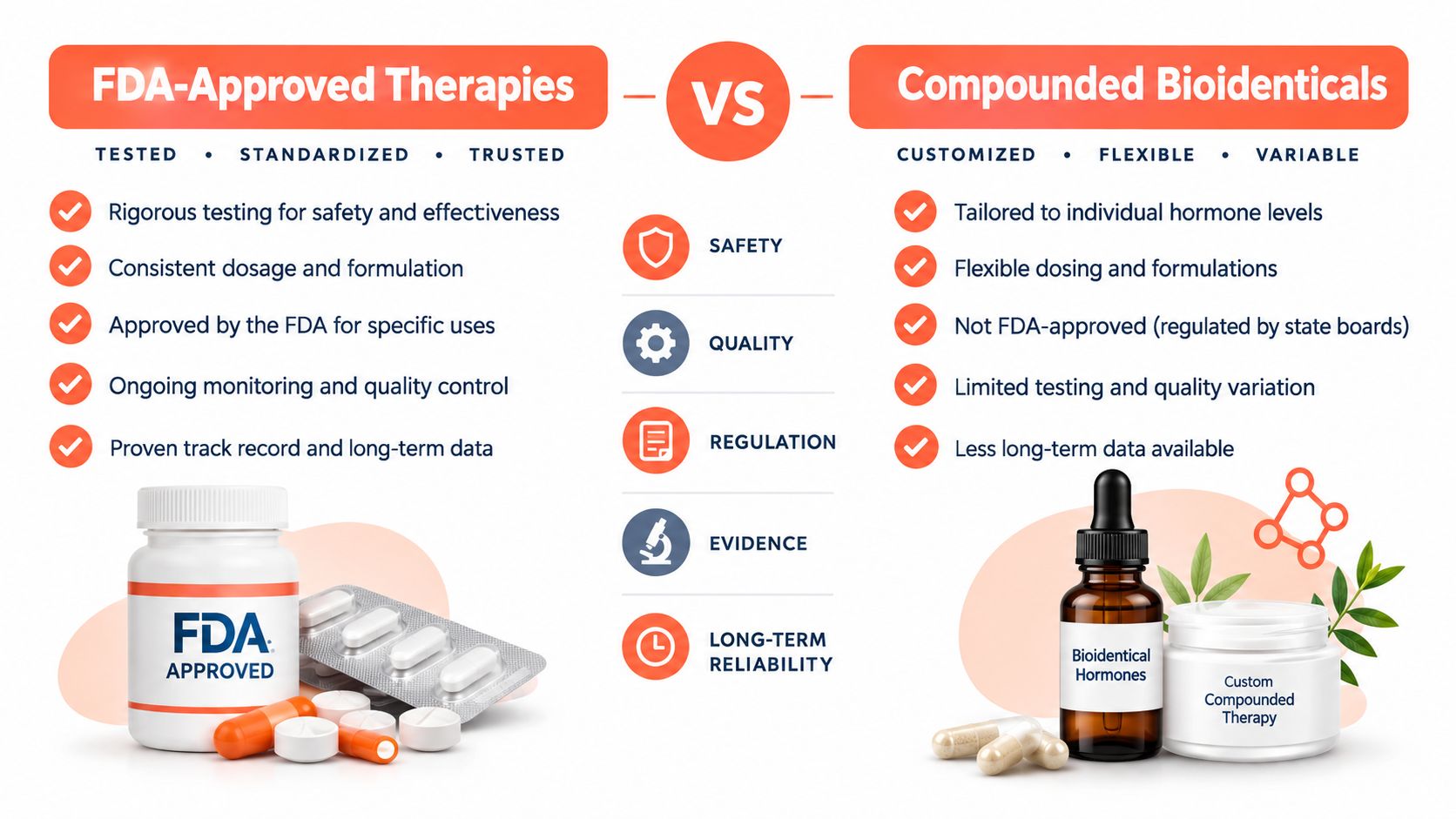
The prescription needs an audit trail
A clinic should document why a compounded product was chosen when an FDA-approved alternative exists. Labels such as “natural” and “custom” do not answer the questions that determine whether the choice is defensible:
- Why is an approved formulation unsuitable?
- What evidence supports the compounded formulation and dose?
- How is potency verified?
- Which pharmacy prepares it, and what quality controls apply?
- Who benefits financially from the prescription?
- What alternative can the patient use if the preparation is unavailable or inconsistent?
The American College of Obstetricians and Gynecologists stated in 2023 that compounded bioidentical menopausal hormone therapy should not be prescribed routinely when FDA-approved formulations are available. Earlier endocrine guidance also identified differences in oversight, including the contents, concentration, quality, and sterility of compounded products. The regulatory comparison summarized in professional guidance supports a narrower conclusion: customization alone does not demonstrate better care.
Follow the incentive trail
A clinic that owns or controls dispensing may have a financial interest in maintaining a particular preparation. That arrangement does not make every prescription inappropriate, though it raises the disclosure standard. Patients should receive a written explanation of prescribing relationships, pharmacy ownership, consultation fees, product costs, and whether the clinician can prescribe an approved alternative without penalty.
The audit standard is the exception should be justified, disclosed, and documented rather than presented as the default premium option. Some patients may have a clinical reason to consider compounding, but the rationale should remain visible in the record and open to independent review.
Safety Protocols and Mandatory Monitoring Thresholds
The safety of hormone therapy depends less on the initial prescription than on what happens after it. Dose, formulation, comorbidities, and time can change the risk profile. A clinic that cannot show its follow-up pathway has not demonstrated a controlled treatment process.
For testosterone-based care, the minimum record should include serum testosterone and hematocrit before treatment, repeat testing around 3 to 6 months after initiation or a dose change, and at least annual checks after stabilization. The Endocrine Society testosterone guidance supports targeting the mid-normal physiologic range, rather than treating a higher result as evidence of better care.
The protocol should answer six operational questions:
- Which labs are required before prescribing
- When repeat testing occurs after initiation or adjustment
- How timing relates to the formulation
- What result triggers a pause, reduction, or referral
- Who reviews abnormal findings
- How missed monitoring affects refills
These details expose whether monitoring is clinically managed or treated as a membership feature. The patient should also know whether testing must occur at a particular laboratory, whether the clinician reviews raw results instead of a summary, and how urgent abnormalities are escalated. “Your numbers look good” is a conclusion, not an adequate monitoring record.
The stop rule matters more than the sales promise
A hematocrit at or above 54% is a widely used intervention threshold. The appropriate response may include stopping or reducing therapy and evaluating possible hypoxia or sleep apnea. Some clinical pathways withhold treatment when baseline hematocrit exceeds 50%. These thresholds create a boundary against indefinite dose escalation, provided the clinic records the result, decision, responsible reviewer, and follow-up plan.
A credible clinic should disclose who can authorize refills and whether abnormal results are reviewed before medication is released. That disclosure matters when the same organization coordinates consultations, laboratory testing, and dispensing. Patients need a traceable record of decisions, not only access to another shipment.
Menopause protocols need restraint too
Menopause-oriented care is generally guided by symptoms, with conservative use of blood testing in typical presentations. If a clinician uses testosterone, expert guidance supports keeping serum testosterone within the pre-menopausal reference range, rather than pursuing supra-physiologic levels. Some pathways repeat testing around 8 to 12 weeks and then at 6-month intervals. The schedule should match the treatment, formulation, and patient response, rather than a generic calendar.
The clearest safety test is the response to treatment failure. A responsible plan may reassess the diagnosis, confirm adherence and dosing timing, investigate another cause, or discontinue therapy. Dose escalation should be one considered option, not the automatic answer.
Telehealth Expansion and Geographic Access Realities
Telehealth can solve a genuine access problem, but convenience doesn’t remove the need for physical assessment, reliable labs, or longitudinal responsibility. Recent coverage describes telehealth companies moving from GLP-1 programs into hormone replacement therapy in 2025, while a 2026 analysis described large U.S. areas with limited hormone-care access and specialist waits of at least two weeks in some major cities. Those developments make remote care relevant, but they don’t lower the clinical standard. The analysis of access and telehealth risks illustrates why delivery format needs to be evaluated alongside medical supervision.

Choose the care model around the monitoring burden
A remote consultation may be reasonable when the patient can obtain dependable local laboratory testing, the clinician has access to complete results, and the program can arrange an examination or referral when needed. It becomes weaker when the platform relies on self-reported symptoms, ships medication before reviewing confirmatory results, or treats the absence of an in-person exam as a permanent feature rather than a limitation to manage.
An in-person clinic has its own weaknesses. A physical address doesn’t prove diagnostic rigor, and a luxury setting can still use superficial panels or unclear prescribing incentives. The relevant comparison is operational:
| Care model | What to verify |
|---|---|
| Remote-first | Local lab access, identity verification, examination pathways, result review, emergency contact, and refill rules |
| In-person | Who performs the examination, which clinician signs the prescription, laboratory quality, and follow-up ownership |
| Hybrid | Whether in-person visits are clinically meaningful or merely an onboarding formality |
Recent FDA labeling changes for testosterone products, including changes discussed after TRAVERSE and coverage of cardiovascular boxed-warning removal in 2025 and 2026, don’t turn treatment into a low-risk consumer service. They make patient selection and monitoring more important because patients and clinicians may interpret regulatory changes as broader permission to prescribe.
The best format is the one that can maintain continuity when results are abnormal. Before paying, ask where you’ll be examined, who will interpret repeat labs, and whether the clinic will coordinate with your primary physician. If the answers depend on a support inbox or an unnamed medical director, the convenience may conceal a gap in accountability.
How to Evaluate a Clinic Using a Four-Axis Rubric
A clinic can be assessed without accepting its preferred definition of “optimal.” Score it across four axes: diagnostic depth, medical supervision, conflict freedom, and evidence base. The framework is useful because a program can be strong in one area and weak in another. Attractive facilities and fast access don’t compensate for unclear diagnostic criteria.
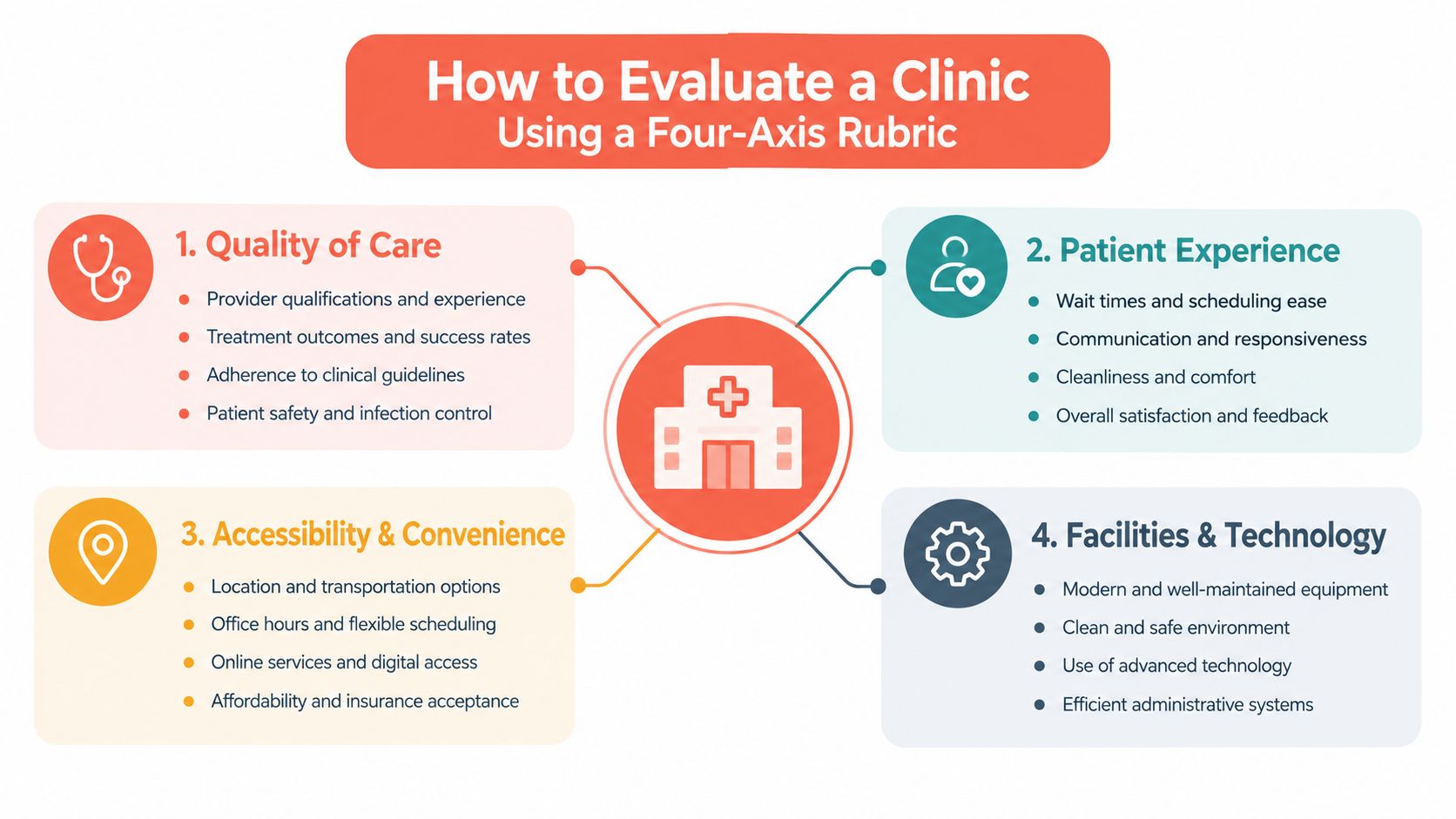
Axis one, diagnostic depth
Request the intake form, laboratory requisition, collection instructions, repeat-testing policy, and referral criteria. Look for symptoms plus appropriate confirmation, not a one-visit interpretation of a borderline number. The clinic should show how it distinguishes menopause assessment from male hypogonadism and how it investigates alternative explanations.
Axis two, medical supervision
Identify the licensed prescriber, the person who reviews results, and the clinician responsible for abnormal findings. Check whether the program has written stop-and-adjust rules, formulation-specific timing, and a process for missed monitoring. A recurring fee should purchase continuity of medical responsibility, not merely access to refills.
Axis three, conflict freedom
Ask who owns the pharmacy, whether the clinic profits from product volume, whether supplements are mandatory, and whether treatment tiers bundle services that aren’t medically necessary. A disclosure should cover ownership, referral income, dispensing arrangements, and any financial relationship that could influence product selection.
Axis four, evidence base
Separate approved indications from off-label use, established monitoring from clinic preference, and published evidence from testimonials. The U.S. market context helps explain the commercial pressure: hormone replacement therapy was valued at USD 10.2 billion in 2019 and projected to grow at a 6.1% CAGR from 2020 to 2027, according to this market and bioidentical hormone therapy reference. A large market makes transparency more important, not less.
For comparison research, Longevity Clinics publishes evaluations using axes that include diagnostic depth, medical supervision, conflict freedom, and evidence base. Treat any directory as a starting point, then verify the underlying documents yourself.
Decision rule: Don’t commit to a high-cost program until the clinic shows its diagnostic minimum, monitoring calendar, escalation limits, and financial disclosures in writing.
The strongest hormone optimization clinic may not promise the most dramatic transformation. It will explain uncertainty, use treatment conservatively, and make it easy to see when the program should stop.
Before enrolling, request the clinic’s written diagnostic criteria, raw laboratory report, medication and pharmacy disclosures, monitoring schedule, and stop-treatment rules. Compare those documents against the four-axis rubric, ask an independent physician to review any unclear plan, and choose a program that can prove its clinical safeguards before it asks for a long-term commitment.