Preventive Health Screening by Age and Risk Profile
A complete guide to preventive health screening across ages and risk profiles, including minimum-credible workups, screening harms, and how
Feeling healthy is not proof that every available test is useful. The most popular advice about preventive health screening asks, “What else should I add?” The more important question is often, “Should I take this test at all?”
A screening test can find disease before symptoms appear, when treatment may prevent serious harm. It can also produce a false alarm, trigger invasive follow-up, label a harmless finding as disease, and turn an otherwise healthy person into a patient. The right plan is therefore not the largest package. It’s the plan that matches your age, risk profile, preferences, and ability to follow up.
Table of Contents
- Why More Screening Is Not Always Better
- How Preventive Health Screening Actually Works
- Recommended Screenings by Age and Risk Profile
- The Hidden Costs of Overdiagnosis and False Positives
- What a Minimum-Credible Screening Workup Looks Like
- How to Evaluate Commercial Screening Packages
- Building Your Personal Screening Plan
Why More Screening Is Not Always Better
Consider two people buying the same “complete” health assessment. One has a strong family history of colorectal cancer and a previous abnormal result. The other has no symptoms, no relevant family history, and a low baseline risk. Giving both people the same panel may look thorough, but it doesn’t give them the same value. A result that deserves prompt investigation in the first person may be an ambiguous finding in the second.
Preventive screening became a formal part of modern primary care in the mid-20th century. It expanded rapidly during the 1950s and 1960s, as screening tests and preventive advice became more widely available. By 2015, more than 8 out of 10 insured adults in the United States had their blood pressure checked during the previous year, and nearly three out of four insured women aged 50 to 74 had breast cancer screening within the previous two years, according to this history of screening in primary care.
That progress matters. Blood pressure, glucose, cholesterol, and selected cancer screening can identify problems that don’t announce themselves clearly. But the existence of a test doesn’t establish that everyone should take it, or that repeating it more frequently will improve health.
The two edges of a screening test
A useful screening programme does three things:
- Finds meaningful disease early: The condition has a detectable phase before symptoms, and earlier action can improve the outcome.
- Limits false alarms: The test performs well in the population being screened, rather than being applied indiscriminately.
- Provides responsible follow-up: A clinician explains the result and defines what happens next before the test is ordered.
Without the third element, screening becomes information collection rather than preventive care. A scan or blood panel may reveal something that requires another scan, a biopsy, or months of uncertainty. The test itself may be quick. The consequences may not be.
Practical rule: A screening test is only as useful as the decision it enables and the follow-up pathway behind it.
This article uses that rule to examine screening by age and risk, explain why false positives matter, define a credible minimum workup, and assess commercial longevity packages. The aim isn’t to discourage appropriate prevention. It’s to help you choose targeted testing over maximal testing.
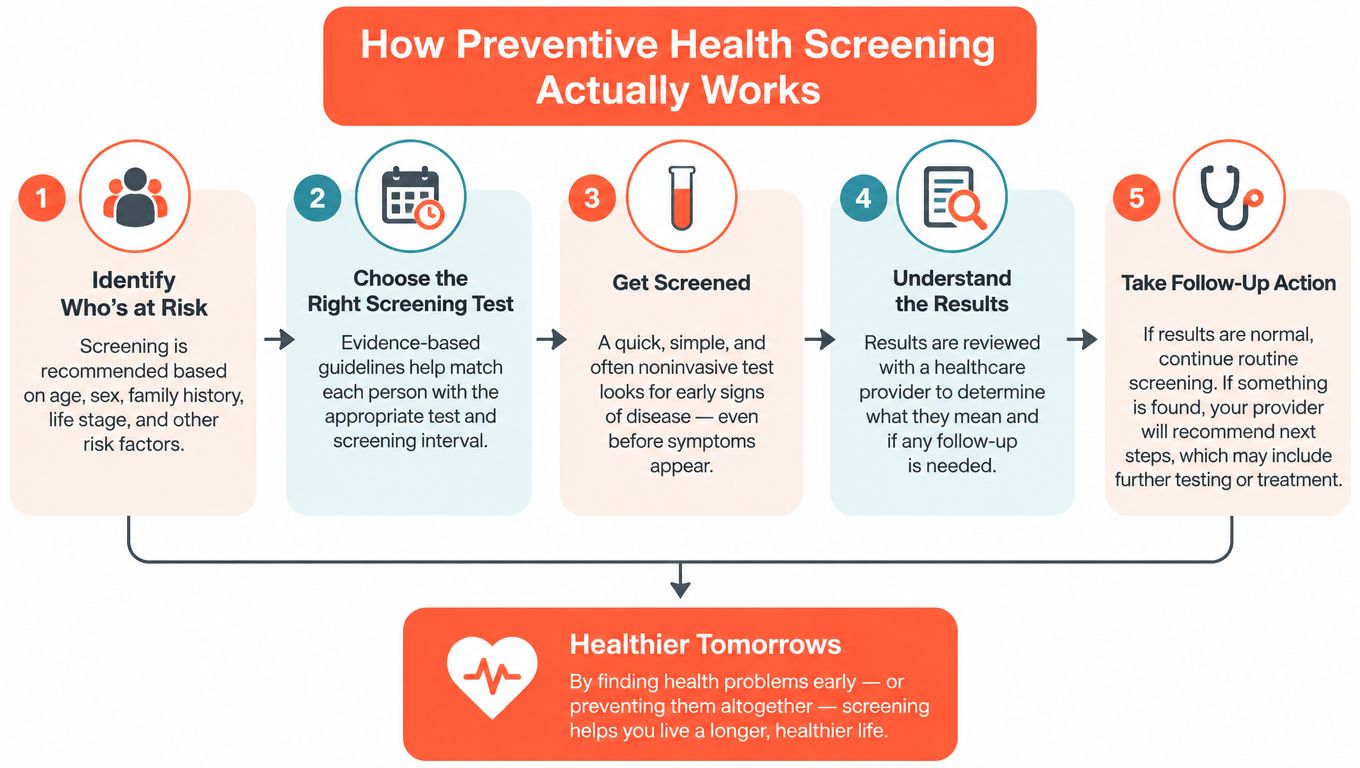
How Preventive Health Screening Actually Works
Screening is a search for disease in people who don’t yet have symptoms. Think of it as checking a building’s foundations before visible cracks appear. The inspection is worthwhile when the weakness is common enough to find, the inspection can identify it reliably, and repair would make a meaningful difference.
Three variables shape the result.
Start with the population
Prevalence means how common the condition is in the group being tested. A 65-year-old with a strong family history may have a different starting probability from a healthy 40-year-old with no relevant history. The same test can therefore produce a more useful result in one person than in another.
Sensitivity describes how often a test detects the condition when it is present. A highly sensitive test misses fewer cases. Specificity describes how often it remains negative when the condition is absent. A test with imperfect specificity will sometimes flag healthy people.
Then ask what a positive result means
The key practical concept is positive predictive value. It asks, “When this test is positive, how likely is it that the person has the disease?”
Suppose a hypothetical test is used in a group where the disease is uncommon. Even if the test detects most genuine cases, its imperfect specificity can create many positive results among people who are healthy. Those people may then undergo repeat imaging, specialist consultations, biopsies, or treatment discussions.
You don’t need complex mathematics to understand the direction of the effect. Lower prevalence plus imperfect specificity means a positive result is less trustworthy. Preventive-medicine guidance explains that this combination lowers positive predictive value and can lead to extra imaging, biopsy, labelling, and anxiety, with the consequences becoming more important in older adults. The USPSTF methods guidance on screening decisions sets out this relationship.
A clinician should therefore ask four questions before ordering a test:
- What condition are we looking for?
- Why is my baseline risk high enough to justify looking now?
- What will we do if the result is positive, borderline, or repeatedly unclear?
- Would finding the condition earlier change my choices or outcome?
A broad longevity assessment can be useful when it answers those questions. Readers comparing programmes can also review longevity medicine and its diagnostic approach as part of their background research. The central principle remains simple: a test needs a decision context, not just technical sophistication.
Recommended Screenings by Age and Risk Profile
Age is a starting point, not a complete medical plan. A person in their 40s with tobacco exposure, obesity, a strong family history, or a previous abnormal result may need earlier or more intensive assessment than a low-risk peer. Conversely, a person in their 70s may reasonably reconsider a test if life expectancy, frailty, competing conditions, or the likely burden of follow-up changes the balance.
The baseline programme usually begins with routine measures that influence common long-term conditions. Blood pressure, cholesterol, and blood glucose assessment can identify cardiovascular and metabolic risk. Cancer screening should be matched to the person’s age, sex, previous results, family history, and relevant exposures.
Use age bands as prompts
| Age band | Baseline screenings | Risk factors that accelerate testing |
|---|---|---|
| 40s | Blood pressure, cholesterol and glucose assessment, review of cancer screening eligibility, risk and family history review | Strong family history, smoking, obesity, previous abnormal results, symptoms, or known metabolic risk |
| 50s | Continued cardiovascular and metabolic assessment, breast, cervical, and colorectal screening when applicable | Earlier-onset cancer in the family, inherited risk, tobacco exposure, prior polyps or abnormal screens, persistent metabolic abnormalities |
| 60s | Ongoing monitoring of cardiovascular and metabolic risk, completion of age-appropriate cancer screening, review of whether each test still changes management | Frailty, multiple conditions, medication burden, prior abnormal findings, or a history that increases cancer risk |
| 70s | Individualised continuation or adjustment of established screening, with attention to symptoms, function, life expectancy, and follow-up burden | New symptoms, high-risk history, previous abnormal results, or a clear likelihood that treatment would improve meaningful health outcomes |
These are planning prompts, not a substitute for local guidelines or a clinician’s assessment. A family history of colorectal cancer may shift the conversation earlier. A smoking history may change the discussion about lung cancer screening. Prior abnormal cervical, breast, or colorectal findings can make a standard population schedule inappropriate.
The prevention gap is not mainly a lack of tests
Many people already know they should be screened but haven’t completed the basics. In 2023, 80.0% of women aged 50 to 74 were up to date with breast cancer screening, 75.4% with cervical cancer screening, and 63.5% of adults aged 45 to 75 with colorectal cancer screening, according to CDC data on screening completion. In other words, roughly one in four adults of screening age still missed recommended testing in these measures.
That observation changes the priority for many health-conscious consumers. Before purchasing a broad biomarker panel, confirm that the evidence-based core is complete and that abnormal results from previous tests have been followed through.
Risk changes the schedule
A useful appointment begins with an inventory:
- Family history: Record which relatives had which conditions and at what age.
- Personal history: Include previous polyps, abnormal smears, high glucose, high blood pressure, or suspicious imaging.
- Exposures: Smoking, occupational hazards, and other relevant exposures can alter screening decisions.
- Current health: Symptoms require diagnostic evaluation, not a routine screening label.
- Treatment horizon: Screening is most useful when the person could benefit from acting on the result.
The objective isn’t to test every organ each year. It’s to identify the conditions for which earlier detection is plausible, useful, and actionable.
The Hidden Costs of Overdiagnosis and False Positives
A positive screening result isn’t the same as a diagnosis. It’s an invitation to investigate, and that investigation can carry its own risks. Overdiagnosis occurs when screening identifies a condition that would never have caused symptoms or threatened the person’s life. The label may still lead to surveillance, procedures, treatment, and worry.
Prostate screening illustrates the trade-off clearly. For men aged 55 to 69, randomized trial evidence estimates that PSA-based screening prevents about 1.3 prostate cancer deaths per 1,000 men screened over roughly 13 years, along with about three metastatic cases per 1,000 screened. The same evidence base highlights false-positive results, overdiagnosis, overtreatment, biopsy complications, and psychological distress. The USPSTF discussion of individualising cancer screening in older adults therefore describes the net benefit as small and preference-sensitive.
What preference-sensitive means
It doesn’t mean that the decision is arbitrary. It means reasonable people may choose differently after understanding the likely benefit and possible harm.
One person may place a high value on reducing the chance of a metastatic diagnosis, even while accepting biopsies and treatment risks. Another may place greater weight on avoiding a chain of interventions for a slow-growing cancer. A clinician’s job is to explain the trade-off, not to present screening as an automatic sign of responsible behaviour.
The same reasoning applies beyond PSA. The National Cancer Institute overview of false positives and overdiagnosis notes that commonly used tests such as mammography and PSA have false-positive rates of about 5% to 10% per screen, with cumulative false positives increasing over repeated rounds. That makes repeated testing especially important to discuss before choosing a broad, recurring package.
Why longevity packages need extra scrutiny
Whole-body imaging, broad biomarker panels, and tests applied to low-prevalence populations can uncover incidental findings. Some will be harmless. Others will be real but clinically unimportant. The difficulty is that a test may detect an abnormality without telling you whether intervention will improve your life.
Before agreeing to an additional test, ask:
- What harm does this test aim to prevent?
- What is the next step after an abnormal result?
- How often will the finding be incidental or inconclusive?
- Would you choose treatment if the condition were confirmed?
A test earns its place when its likely benefit outweighs the full chain of consequences, not when it adds another line to a report.
What a Minimum-Credible Screening Workup Looks Like
Price and test count don’t define quality. A credible programme can be relatively focused if it connects each test to a risk assessment, a clinical decision, and a follow-up pathway. A large package can be medically weak if it offers numerous measurements without explaining what they mean.
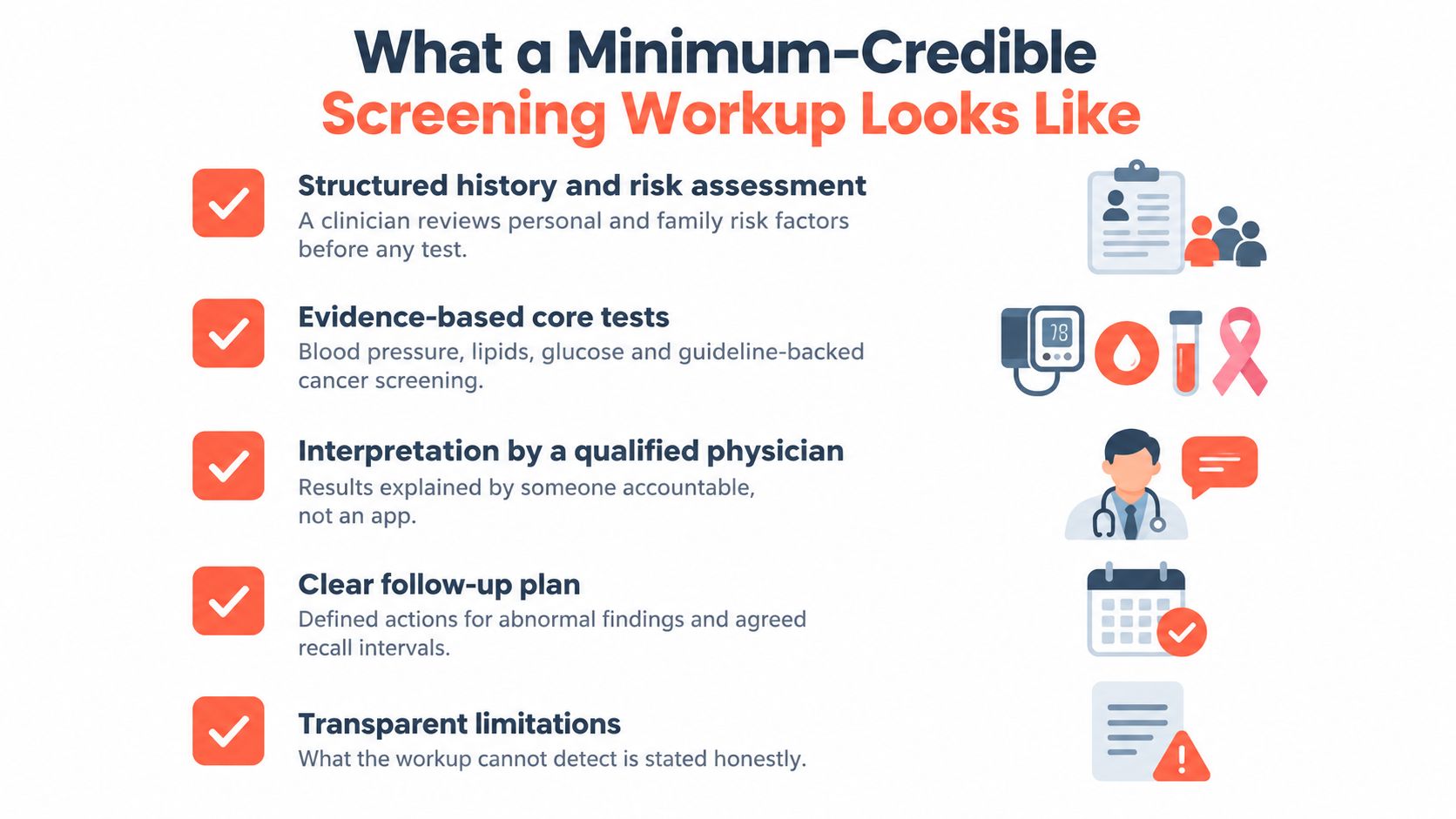
The minimum should include five elements.
The essential floor
Structured history and risk assessment come first. A clinician should review personal and family history, medications, symptoms, lifestyle factors, prior results, and relevant exposures before selecting tests. Without that step, the package is effectively treating the average customer as the patient.
Evidence-based core testing should follow. Depending on the individual, this may include blood pressure, lipids, glucose, and guideline-backed cancer screening. The exact selection should reflect age, sex, risk, previous findings, and local recommendations.
Qualified interpretation is not a decorative add-on. Someone medically accountable should explain which results are normal, which are uncertain, and which require action. An app can display a value, but it can’t replace clinical judgment about context and consequences.
Documented follow-up should be agreed before testing. The report should identify who contacts the patient, when repeat testing is appropriate, which specialist receives a referral, and what happens if the result remains unclear.
Transparent limitations protect the patient from false reassurance. A programme should state what it doesn’t assess, which tests are experimental or weakly supported, and where a normal result can’t exclude disease.
Depth is not the same as breadth
An advanced protocol may add meaningful cardiovascular or metabolic characterisation when a patient’s history, examination, or initial results justify it. For example, a clinician might investigate a persistent abnormality in more detail rather than ordering every available marker at the outset.
Filler has a different pattern. It adds tests because they are technically available, presents borderline results without context, or encourages treatment through the same organisation that sells the assessment. More data can make decisions harder when the programme hasn’t defined thresholds for action.
Readers comparing formal diagnostic standards can consult this minimum-credible diagnostic framework. The useful question isn’t, “How many tests are included?” It’s, “Does each test have a defensible reason, an accountable interpreter, and a safe next step?”
How to Evaluate Commercial Screening Packages
Treat a commercial screening package as a clinical service, not a shopping bundle. Start by asking who supervises the medical work and whether that person is named, qualified, and accountable for the protocol. A polished website doesn’t answer those questions.
The clinic’s financial structure also matters. If the provider profits from scans, therapies, supplements, or procedures recommended after its own screening, the arrangement creates a potential conflict. That doesn’t automatically invalidate the findings, but it means you should demand clearer evidence, independent interpretation, and transparent disclosure.
Compare the package before you compare the price
| Package type | Potential value | Red flags | Green flags |
|---|---|---|---|
| Core primary-care assessment | Establishes a risk-based baseline and identifies overdue screening | Generic checklist with no history review | Named clinician, relevant core tests, clear recall plan |
| Expanded longevity assessment | May characterise selected cardiovascular, metabolic, bone, or functional risks more deeply | Broad panels with no action thresholds | Each added test has a stated rationale and evidence label |
| Premium diagnostic day | Can coordinate multiple services for complex or high-risk patients | Scan volume presented as proof of quality, unclear downstream costs | Independent review, defined referrals, transparent limitations |
Ask whether the clinic distinguishes established screening from experimental or exploratory testing. Regulatory context can also help, although approval or registration alone doesn’t prove that a test improves outcomes. Depending on the country, you may need to verify relevant records or professional standards with authorities such as Swissmedic, the GMC, or the Bundesärztekammer.
Score accountability, not spectacle
A useful review can separate diagnostic depth, medical supervision, conflict freedom, and evidence base rather than collapsing everything into a marketing impression. An independent publication such as Longevity Clinics uses a composite 0 to 100 framework across those four axes to compare programmes. That kind of scoring can support due diligence, but it shouldn’t replace questions about your own history and follow-up needs.
Before payment, request written answers to these questions:
- Who reviews my results? Ask for the clinician’s name and role.
- What happens after an abnormal result? Look for defined referral and repeat-testing pathways.
- Which tests are established? Require evidence strength to be labelled by modality.
- Who pays for the next step? Clarify whether referrals, scans, therapies, or consultations create additional obligations.
- Can I take my records elsewhere? You should receive complete results and interpretation in a usable format.
For readers assessing the wider value of concierge arrangements, this guide to concierge benefits can provide additional comparison criteria. Convenience can be valuable, but it shouldn’t conceal uncertainty or weaken independent medical oversight.
Building Your Personal Screening Plan
You can create a sensible starting plan without ordering a maximal panel. Write down your age, current symptoms, medications, smoking history, family history, previous abnormal results, and conditions already under treatment. Bring that record to a clinician and ask which findings change your screening schedule.
Then work through this sequence:
- Confirm the core: Check whether your blood pressure, cholesterol, glucose, and applicable cancer screening are current.
- Identify the exceptions: Ask whether family history, prior findings, tobacco exposure, weight, or other risks justify earlier or more frequent testing.
- Discuss preference-sensitive choices: For tests with modest benefit or meaningful downstream harms, decide with a clinician rather than accepting a default package.
- Plan the aftermath: Before any test, identify who will interpret an abnormal result and where follow-up will occur.
- Audit commercial claims: Look for named supervision, evidence labels, transparent conflicts, and honest limitations.
Don’t use a normal result as permission to ignore new symptoms. Screening is for people without symptoms. New or concerning changes need appropriate diagnostic care, even if a recent package reported reassuring numbers.
A targeted, evidence-weighted screening plan usually beats a maximal one because it concentrates attention on conditions that are plausible, actionable, and worth detecting early. Before you spend money on a premium assessment, ask your primary-care clinician to review your risk inventory and the package’s test list, then buy only what has a clear purpose and a defined next step.
Schedule a preventive appointment this week, bring your family history and previous results, and ask for a written screening plan matched to your age and risk profile. If you’re considering a commercial package, request its supervising clinician, evidence labels, conflict disclosures, and follow-up pathway before you pay.