Residential vs Outpatient Treatment: How to Choose
Compare residential vs outpatient treatment for longevity programmes: supervision, cost, travel and outcome evidence to choose the right format.
The most popular advice about residential versus outpatient care is often too simple: choose residential if you want better care, or outpatient if you want convenience. For longevity programmes, that framing can hide the more important question: who supervises you between tests, and who acts when a result needs attention? A bed on site doesn’t guarantee close medical oversight, just as a clinic visit doesn’t automatically mean limited diagnostics or follow-up.
Residential and outpatient programmes differ mainly in where patients stay and how supervision is arranged. The right choice depends on the care you need, how the clinic handles results, and the cost of attending, not just the label on its website.
Table of Contents
- The Short Answer on Residential or Outpatient Care
- How Each Format Is Structured Day to Day
- Setting Versus Treatment Intensity
- Medical Supervision and Diagnostic Depth Compared
- Cost, Travel and Time Away From Work
- Outcomes, Evidence and What to Ask For
- Which Format Fits Which Patient
- Choose Your Format and Confirm Before You Book
The Short Answer on Residential or Outpatient Care
A residential programme concentrates diagnostics, supervision and recovery time into an on-site stay, while an outpatient or membership model spreads care across scheduled visits while you remain at home.
| Factor | Residential programme | Outpatient programme |
|---|---|---|
| Where care happens | On-site, for a fixed stay | Clinic visits on set days, at home between visits |
| Clinician access between visits | Continuous while on site, if the programme provides it | Scheduled reviews, plus messaging if offered |
| Diagnostic workup | Compressed into the stay | Spread across several appointments |
| Time away from work | Full time for the stay | A few hours per visit |
| Travel | Often required | Usually local |
| Typical programme cost | Single package or fee; stay costs may be extra | Per-visit or membership fee; bundled tests vary |
| Best suited to | Patients needing close supervision or a full reset | Patients who can keep work and home routines |
The table describes logistics, not quality. Two residential clinics may differ more from each other in physician access, diagnostic follow-through and aftercare than one residential clinic differs from an outpatient service. A membership model is usually outpatient in structure, though it may bundle more tests or offer faster access to a physician.
The rows that usually decide the choice are supervision between visits, time away from work and the plan after the programme ends. A residential stay can make it easier to coordinate appointments and respond quickly while you’re on site. But if you leave without a named clinician, clear results review and continuing care, the stay alone doesn’t resolve the most important questions.
Outpatient care may fit someone who can attend appointments and return to a safe, practical home routine. Its weakness isn’t necessarily the tests; it may be the gap between appointments, especially if nobody is responsible for monitoring results or answering questions.
People comparing substance-use programmes can also compare inpatient and outpatient rehab to see how differences in setting and supervision affect a distinct type of care. For any longevity clinic, start with three questions: Who supervises me between visits? How much work will I miss? What follow-up continues after the programme ends?
How Each Format Is Structured Day to Day
A residential visit often follows a compact sequence. After arrival and intake, the team may schedule a diagnostic block over the first days, with blood tests, imaging, cardiovascular and metabolic assessments, and a fitness evaluation. The clinic then organizes daily sessions, meals and check-ins around the stay, before a physician reviews results and a team prepares a discharge plan.
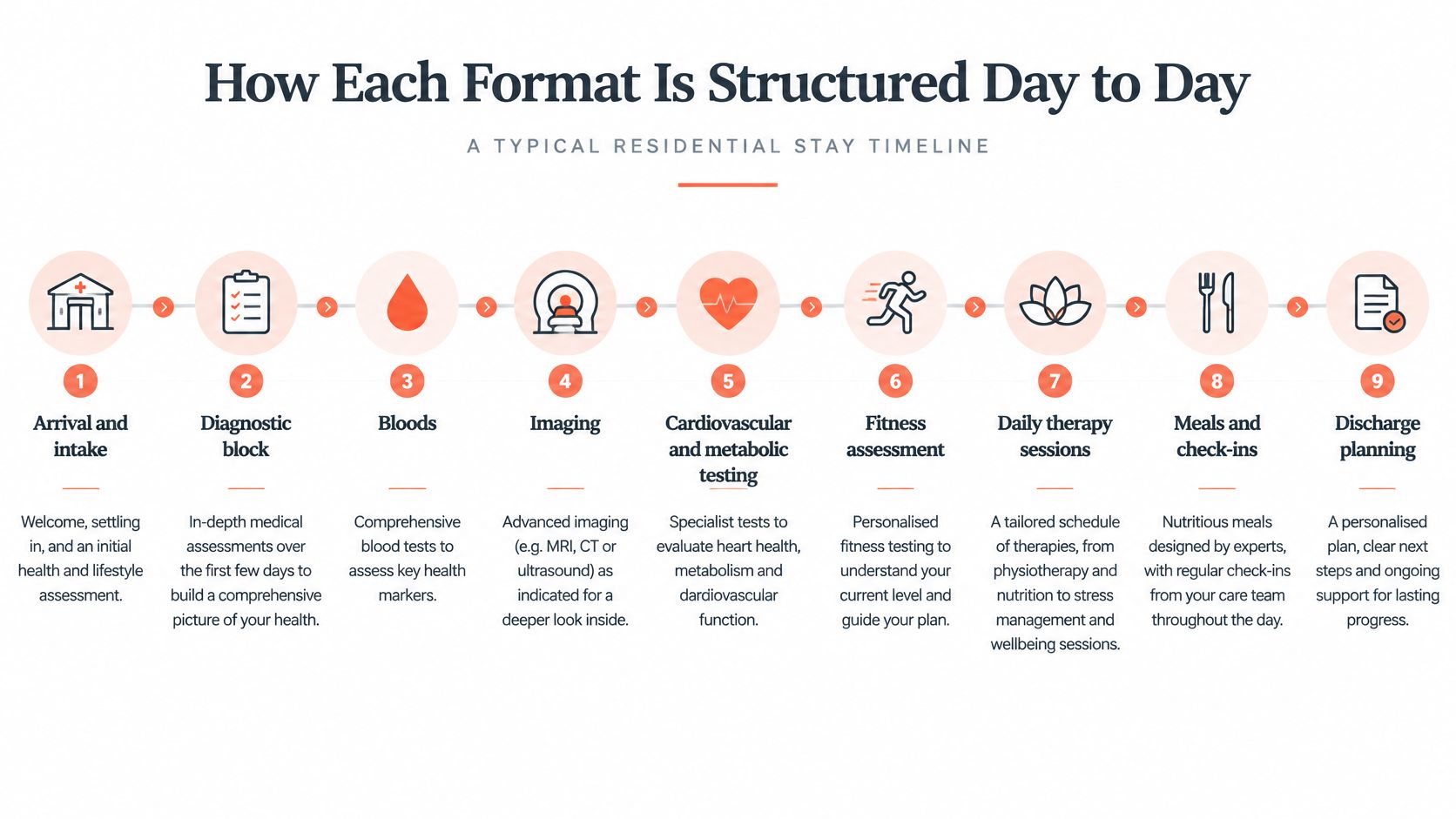
That sequence can be convenient, but it doesn’t prove that a physician is available throughout the day or that every test result will be reviewed before you leave. Responsibility may shift between intake staff, testing teams, physicians and discharge coordinators. Ask who owns the complete plan, not only who performs each appointment.
An outpatient cycle spreads those steps out. You might complete an initial assessment, attend separate appointments for testing, meet a physician to discuss findings, then follow a home plan with scheduled check-ins. A membership version may add messaging or telehealth access between visits and repeat reviews on a fixed calendar.
The trade-off is timing. A test result may arrive after you’ve left the clinic, and the next scheduled appointment may not be soon enough to answer a question that needs prompt attention. Outpatient care can still be well coordinated, but the clinic needs a defined process for reviewing results and contacting you.
A useful comparison of a retreat’s programme and the responsibilities that continue at home can be found in this guide to a medical wellness retreat. Use it as a prompt to ask how each clinic assigns responsibility between visits, rather than assuming that access to a portal or message service amounts to active monitoring.
Ask any clinic: “Who answers my questions on day three, and who owns my plan once I leave?”
Setting Versus Treatment Intensity
“Outpatient” describes a location, not a consistent amount of care. One membership might include a panel of tests and a results call; another outpatient programme might coordinate consultations, medication review and monitoring across multiple visits. Residential care isn’t automatically intensive either. A comfortable stay built around testing and leisure may provide less clinical contact than a closely staffed outpatient day programme.
The first comparison should be the level of contact the patient needs, not the bed versus the commute. The American Society of Addiction Medicine framework illustrates this broader principle in substance-use treatment: it distinguishes care levels by intensity and uses multidimensional assessment to match patients with the least intensive setting that can provide safe, effective care. Its guidance also notes that residential levels themselves can differ in clinical hours and support (ASAM’s level-of-care summary).
For a longevity programme, work through four questions:
- Identify the risks being assessed and any active conditions.
- Estimate how often the patient needs clinical contact.
- Compare that need with each programme’s stated contact hours and named clinician.
- Then weigh location, travel and time away from work.
A stable patient seeking periodic screening may find a low-intensity membership sufficient. Someone starting a new medication or following up an abnormal finding may need more frequent contact, whether that care is residential or outpatient. The programme’s actual schedule and clinical responsibility matter more than its marketing label.
Medical Supervision and Diagnostic Depth Compared
The biggest practical difference may be the time between a result and a clinical decision. A residential programme can keep the patient and care team in the same place while tests are completed. An outpatient programme can order equally detailed tests, but the patient may be home when results arrive. The key is whether the clinic has a reliable process for reviewing findings, explaining them and arranging next steps.
Four measures of supervision
Ask the clinic to describe its coverage in concrete terms:
- Who is on site, and when? “Medical team available” doesn’t tell you whether a physician is present, on call or only scheduled for consultations.
- Who reviews abnormal results, and how quickly? Find out whether a named clinician reviews each result and contacts the patient, or whether follow-up waits for the next appointment.
- How are medication changes managed? Ask who assesses a proposed change, checks for interactions and handles follow-up.
- What happens out of hours? Clarify who receives urgent calls, what advice they can give and when they arrange emergency care or transfer.
These questions separate diagnostic depth from supervision. A residential stay might compress imaging, cardiovascular testing, metabolic panels and fitness assessment into a short period. An outpatient clinic may provide the same tests over several appointments. Neither arrangement, by itself, establishes how well results are interpreted or acted on.
Consider an incidental cardiac finding. If it appears during the second day of a residential stay, the important question is whether the clinic has a physician who can assess it and coordinate appropriate next steps before discharge. The fact that the patient is on site may make that coordination easier, but it doesn’t prove that the programme can manage the finding.
Now consider a result that arrives during the third week of an outpatient cycle. The patient may need to wait for a booked review unless the clinic has a named clinician and an escalation route. A well-run outpatient service can close that gap; a residential programme can leave a similar gap if the result arrives after discharge.
The number of tests matters less than who acts on each result and how quickly.
Before booking, ask who is responsible for the complete record, what triggers urgent review, how emergency transfer is arranged and whether the responsible physician is named in writing. If the clinic can’t explain what happens when a result falls outside the expected range, a long test list won’t answer the safety question.
Cost, Travel and Time Away From Work
A programme fee is only one line in the total. Residential costs may include accommodation and meals, travel, transfers, time away from work and follow-up after discharge. Outpatient care can avoid a long stay, but repeated visits, membership fees and separate tests still add up.
| Cost driver | Residential | Outpatient |
|---|---|---|
| Programme fee | Request the full quoted fee and inclusions | Request per-visit or membership fee and test inclusions |
| Accommodation and meals | Check whether included | Not applicable |
| Lost income | Full working days for the whole stay | Lost time for each visit |
| Travel and transfers | Often needed, including airfare or transfers | Local travel to each visit |
| Follow-up care after discharge | Ongoing outpatient or membership care | Built into the plan, if stated |
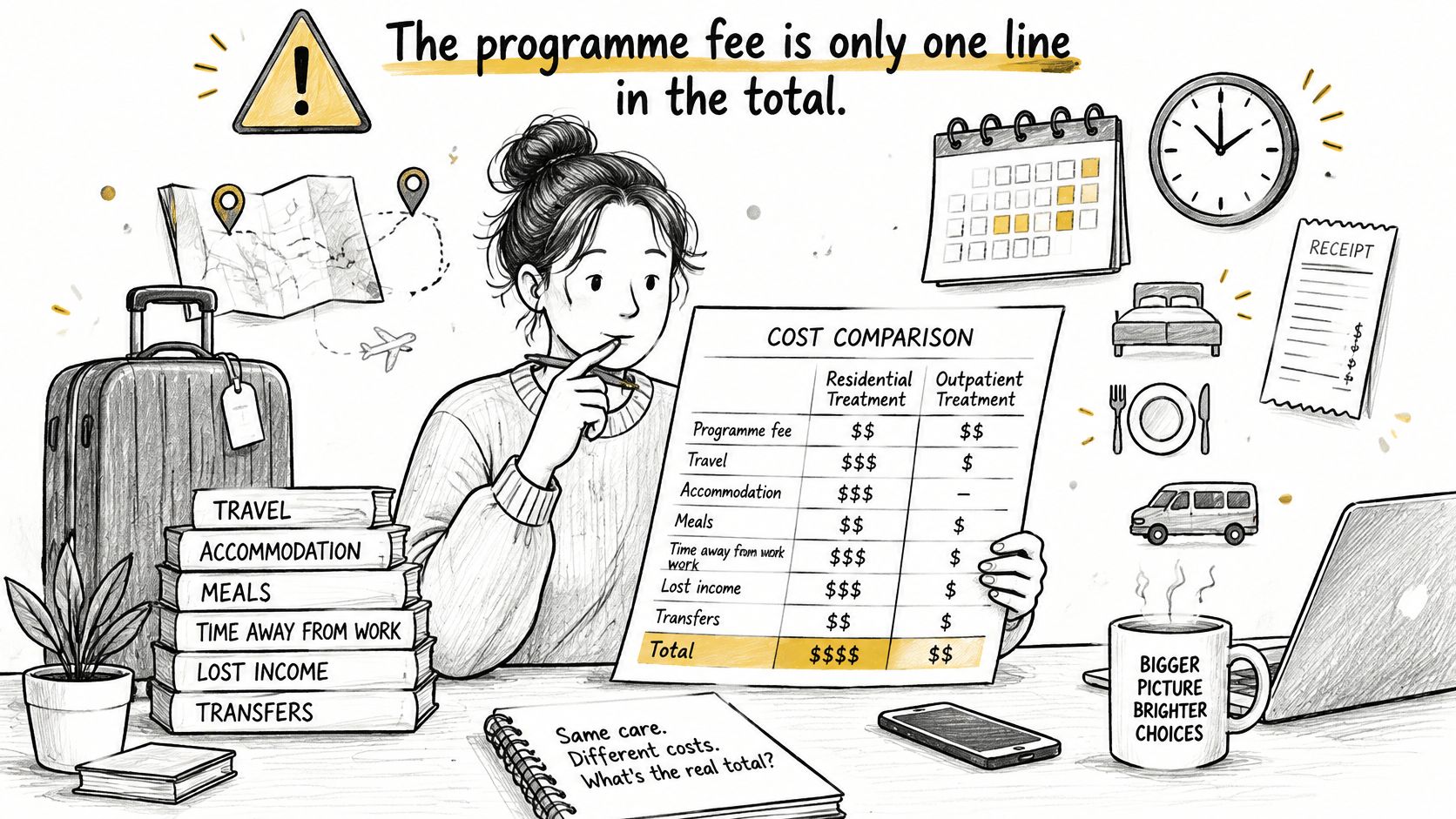
To compare options, add the programme fee, travel and accommodation for the full stay, the value of working days missed, and follow-up costs over the next year. Use the same time horizon for each clinic. Otherwise, a one-time residential quote may look less expensive because it leaves out the continuing care an outpatient membership includes.
Here’s an illustrative example, not a typical price estimate. Suppose a residential package costs $8,000, travel and accommodation not included add $2,000, and five missed workdays are valued at $400 each. If follow-up care costs $1,200, the total is $13,200. For an outpatient option, suppose a $5,000 membership includes testing, three visits each cost $400 in travel and time, and additional follow-up costs $1,200. The total is $7,400. These hypothetical figures show how to do the arithmetic; actual costs must come from the clinic and the patient’s own circumstances.
Membership shifts some costs into a recurring fee. It may be cheaper over a year if the included access replaces visits you would otherwise pay for, or more expensive if you don’t use the services. Residential programmes also differ in whether accommodation and meals are included or billed separately.
Before comparing totals, request written confirmation of what the price includes, cancellation terms, transfer costs and follow-up pricing. Ask whether tests, physician consultations and any recommended treatment are included or charged separately. A low headline price isn’t a meaningful comparison unless the scope of care is clear.
Outcomes, Evidence and What to Ask For
Longevity programmes rarely report outcomes in a way that supports a fair comparison between residential and outpatient care. Patients may differ in health, motivation and baseline risk, while clinics may define success as completing visits, changing a biomarker or reporting improved energy. Without comparable patient groups and follow-up methods, a claim that one format works better is difficult to verify.
A short stay with a high completion rate isn’t the same thing as a durable health result. Ask which biomarkers were measured, when they were measured, how long patients were followed, and whether results were adjusted for patient risk. Also ask whether the clinic includes people who dropped out. A report that shows only programme completers may give an incomplete picture of outcomes.
The difficulty of comparing retention figures is clear in a NIH review of treatment outcomes. It describes programmes using different diagnoses, completion definitions, treatment durations and follow-up windows, making the reported percentages unsuitable as a direct head-to-head benchmark. That evidence concerns substance-use treatment rather than longevity clinics, but the methodological lesson applies: don’t compare outcome claims unless the groups, measures and observation periods are comparable.
Longevity Clinics scores clinics across four axes, each worth 25 points: diagnostic depth, medical supervision, conflict freedom and evidence base. A score or rating can help organize questions, but it doesn’t replace checking what a clinic measures or how it reports follow-up. This guide to rating evidence can help readers assess whether a claim is supported by evidence that matches its scope.
Ask every provider three questions:
- How do you define success, and which measurements support that definition?
- What outcomes do you report at 90 and 180 days, including for patients who stop attending?
- Are the results independently verified, or are they based only on the clinic’s own reporting?
No format wins on outcomes just because it has more contact hours or a more polished testing schedule. The useful comparison is whether the clinic can show how it measures change, follows patients over time and accounts for missing results.
Which Format Fits Which Patient
For a healthy adult who can manage appointments around work and home life, outpatient care or a membership often makes the practical starting point. It allows screening and follow-up without requiring a stay away from home. That default changes when a patient needs a concentrated diagnostic visit, closer supervision or a practical break from daily responsibilities.
| Patient situation | Better fit | Main reason |
|---|---|---|
| Working professional with a full schedule | Outpatient or membership | Keeps work and home routines intact |
| Executive wanting a full diagnostic reset in one block | Residential | Compresses testing and review into a fixed stay |
| Caregiver or patient with family dependants | Outpatient | Stays close to home responsibilities |
| Patient living far from any clinic | Compare travel cost first | Travel can outweigh the benefit of local visits |
Adults aged 40 to 70 with existing conditions may need closer monitoring than a periodic screening appointment provides. The deciding factor isn’t their age alone; it’s whether the programme can coordinate with their treating clinician, review findings promptly and manage any changes safely. A residential stay may suit someone seeking a concentrated assessment, but outpatient care may be the better fit if reliable follow-up is available near home.
An executive who wants testing and consultation in one block may value residential care if they can take time away and the clinic explains who remains responsible after discharge. By contrast, a health-conscious adult under 50 who wants screening repeated over time may prefer outpatient care or a membership that fits an ongoing routine. The value lies in a usable follow-up plan, not in the number of tests performed during one visit.
Caregivers and people with dependants may find it difficult to leave home for an extended stay. Outpatient appointments preserve proximity to family responsibilities, though the patient still needs a workable schedule and transport. For someone living far from a clinic, calculate the cost and time of travel before deciding that an in-person programme is worthwhile.
Some choices are close. A patient who wants a concentrated workup but can’t easily leave home may need to decide which constraint is harder to change: travel, work absence, appointment frequency or the need for contact between visits. A known health risk should be discussed with the patient’s own physician before choosing. A longevity programme doesn’t replace medical care.
Choose Your Format and Confirm Before You Book
Choose outpatient or membership care when you’re medically stable, can attend reliably, and want screening that fits around ordinary routines. Choose residential care when a focused diagnostic reset, closer supervision, or distance from the home environment is clearly useful, and the full cost is manageable. In either case, book the level of clinical contact you need, not just the setting that sounds more thorough.
Use this sequence before committing:
- Shortlist two or three clinics whose format and level of contact fit your circumstances.
- Compare what each includes, including clinician access, escalation arrangements, tests and total cost.
- Request written answers about who handles results, what happens in an emergency and what follow-up is planned at 90 and 180 days.
- Share the shortlist and responses with your own physician before making a decision.
The Longevity Clinics clinic reviews and directory can help readers compare published programme details side by side. The publication doesn’t recommend individual clinics. Booking and pricing questions must go directly to the clinic; Longevity Clinics can’t provide personal medical advice or handle clinic recommendations.
This content isn’t medical advice. Consult a qualified medical professional before booking a clinic or starting, changing or stopping any treatment. Before you pay a deposit, ask the clinic to confirm the inclusions, supervision arrangements and follow-up plan in writing, then review those details with your physician.