Advanced Health Screening Tests to Know Before You Book
Explore advanced health screening tests, who may benefit, key limitations, and the credible follow-up pathways worth asking a longevity clinic about.
The most popular advice on preventive care is simple: test more, catch more, live longer. It’s also incomplete. A longer list of scans and blood panels can produce more findings without producing better health, and it can leave you with bills, biopsies, and uncertainty that a narrower programme would’ve avoided. Advanced health screening deserves a harder test than breadth. Judge it as a pathway, from who qualifies to who confirms a result, who acts, and who pays.
Table of Contents
- Why More Screening Is Not Always Better
- How Advanced Screening Fits Together
- Imaging Genomics and Biomarker Panels Compared
- Who May Benefit From Advanced Screening
- What a Credible Longevity Clinic Should Provide
- How Advanced Screening Results Shape Decisions
- Make an Evidence Based Screening Decision
Why More Screening Is Not Always Better
You’re healthy, you have no symptoms, and a clinic offers a single diagnostic day built around whole-body imaging, extensive bloodwork, and genetic testing. The menu looks thorough. The question you should ask first isn’t what’s included. It’s what happens on day two.
The World Health Organization’s definition of screening as presumptive identification in an apparently healthy population draws a line most marketing blurs. Screening isn’t diagnosis. A scan, biomarker, or genetic result flags people who may have disease. Diagnostic testing determines whether disease is present. That distinction matters because an abnormal result starts a process rather than finishing one.
Think of a dashboard warning light. It tells you something needs attention, not which component is failing, how urgent it is, or what the repair costs. A programme that generates warning lights without a repair plan hasn’t given you clarity. It’s given you homework.
The Downside Is Built Into the Math
Every additional test raises the chance of an incidental finding, an abnormality unrelated to the reason you tested. Some incidental findings matter. Many don’t, but you can’t know which is which without further work, and that work carries its own risks.
- False positives: A result suggests disease that confirmatory testing later rules out, after repeat imaging, consultations, or a biopsy.
- Overdiagnosis: A real abnormality is found that would never have caused symptoms or harm in your lifetime, yet now invites treatment.
- Anxiety and cost: Weeks of uncertainty, time away from work, and out-of-pocket spending that the original package price didn’t include.
A programme that produces many findings without reliable confirmation or treatment may increase anxiety, invasive procedures, and cost without improving outcomes.
None of this means screening lacks value. It means value lives in the full pathway. Appropriate selection, validated tests, confirmatory testing, referral, treatment, and follow-up determine whether early detection helps you. Count the pathway, not the abnormalities.
How Advanced Screening Fits Together
A well-run diagnostic day doesn’t start in a scanner. It starts with a clinician reviewing your history and deciding which questions are worth asking. Testing follows, then interpretation, confirmation of anything unexpected, referral where needed, and a follow-up plan with dates attached. If a clinic can’t describe that sequence before you book, you’re buying measurements, not a programme.
The three main test families answer different questions. Treating them as interchangeable badges of sophistication misses the point of combining them.
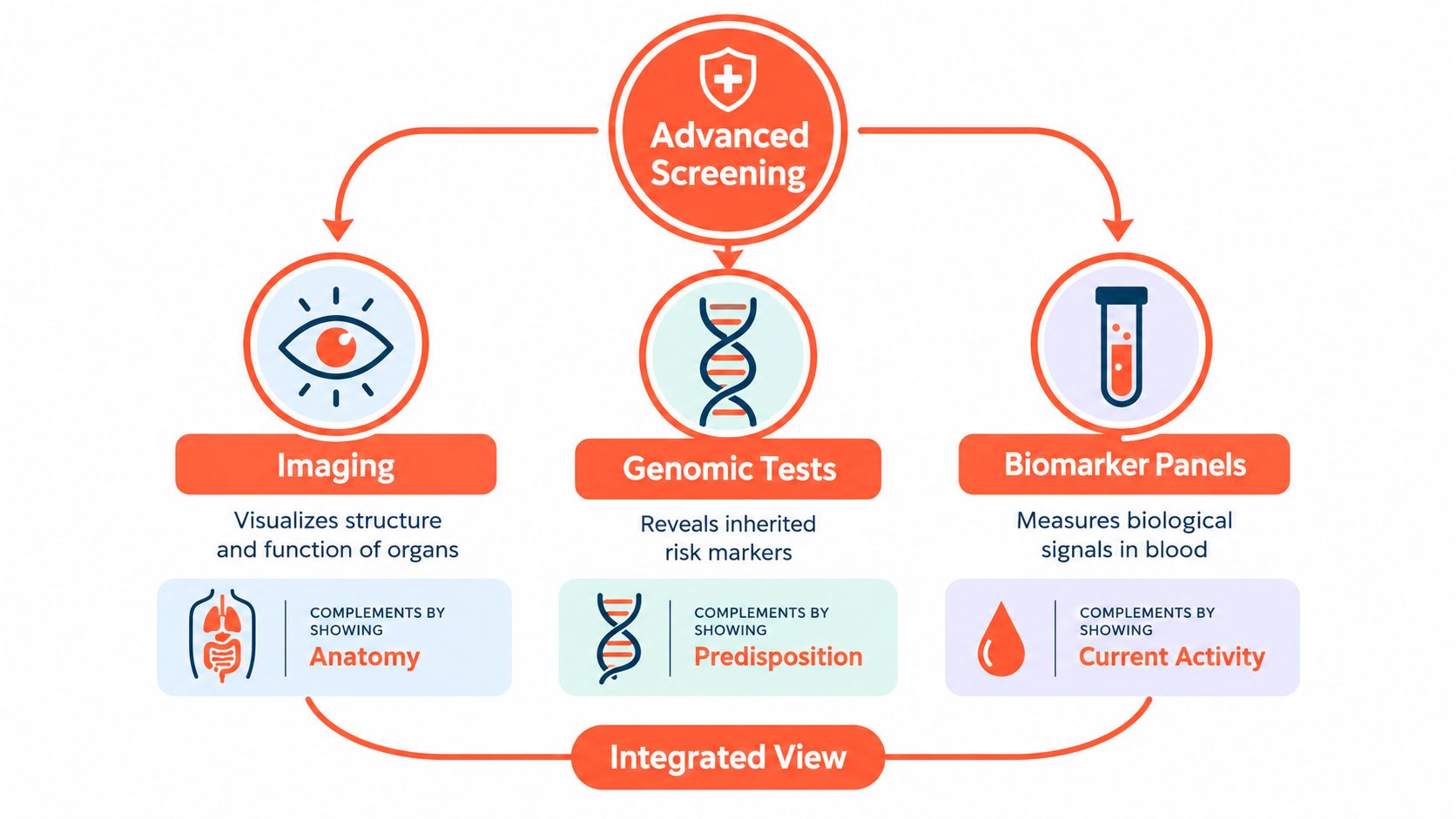
Imaging depicts structure. It shows anatomy and, in some cases, function, such as calcified plaque in coronary arteries or a mass that shouldn’t be there. Biomarker panels quantify physiological signals in blood, reflecting current activity in systems like metabolism or inflammation. Genomic tests estimate inherited susceptibility, or identify rare inherited disease in appropriate circumstances. Anatomy, current activity, predisposition. Three lenses, three time horizons.
Sequence Matters More Than Stacking
Because the lenses differ, order matters. A biomarker abnormality might justify targeted imaging. A strong family history might justify genetic counselling before any scan. An imaging finding might need a blood test, a specialist review, or a repeat scan at a defined interval to see whether it changes.
A credible clinic states the purpose of each test before offering it. It defines what counts as abnormal, explains which thresholds trigger action and which trigger watchful waiting, and shows how the next decision follows from the result. Ask for that logic in writing.
Practical rule: If nobody can tell you what decision a test result would change, the test is decoration, whatever it costs.
Breadth doesn’t guarantee net benefit. Integration does the work, and integration is a clinical discipline, not a shopping cart.
Imaging Genomics and Biomarker Panels Compared
Each modality family contains tests with very different evidence behind them. Lumping them together under one premium label hides exactly the distinctions you need.
Imaging From Whole-Body MRI to Calcium Scoring
Whole-body MRI is the headline act in many packages, and the evidence is sobering. A review of whole-body MRI findings in asymptomatic people found that 95% of asymptomatic people had at least one abnormal finding, while 91% of those findings were clinically irrelevant. Up to 30% may require additional investigations, only about 1.1-1.6% receive a pathologically confirmed cancer diagnosis, and no mortality benefit has been demonstrated. If you’re weighing this option, a detailed examination of full-body MRI screening evidence and limitations is worth reading before you commit.
Coronary artery calcium (CAC) scoring is narrower and better anchored. It’s a non-contrast, ECG-gated CT measurement of calcified coronary plaque. In the Multi-Ethnic Study of Atherosclerosis analysis of CAC and 10-year risk, CAC above 100 generally corresponded to at least 7.5% 10-year risk, while CAC of 0 identified a substantially lower-risk group. For borderline- to intermediate-risk adults, typically 5% to below 20% estimated 10-year risk, that result can support a shared decision about starting or deferring a statin. A score of 0 doesn’t exclude non-calcified plaque, so it isn’t a universal clearance.
Genomics and Polygenic Risk Scores
A polygenic risk score (PRS) aggregates many genetic variants into an estimate of inherited susceptibility. It is not a diagnosis. Current cardiovascular consensus guidance on polygenic risk scores doesn’t support routine population-wide use, because predictive performance, calibration, ancestry transferability, and downstream benefit remain unresolved. A high score alone shouldn’t trigger medication or imaging without corroborating clinical evidence.
Ask which population validated the assay, which disease endpoint and time horizon it predicts, and what management changes if your score is high. The stratified-screening rationale is currently stronger in selected breast- and prostate-cancer applications than in universal cardiovascular screening.
Biomarker Panels
Conventional markers can refine a risk estimate when they’re tied to a specific clinical question. Bundling large numbers of markers into a panel doesn’t automatically sharpen that estimate. Each added marker is another chance for a borderline value that demands explanation, repeat testing, or referral, sometimes for a signal with no validated intervention attached.
Advanced Screening Modalities at a Glance
| Modality | Main information provided | Potential clinical role | Key limitation |
|---|---|---|---|
| Whole-body MRI | Structural findings across organ systems | Selected hereditary-risk surveillance | Very high incidental-finding rate, no demonstrated mortality benefit |
| CAC scoring | Calcified coronary plaque burden | Reclassifying borderline cardiovascular risk | Misses non-calcified plaque, not for universal use |
| Polygenic risk score | Inherited susceptibility estimate | Refining uncertain conventional risk | Ancestry and calibration limits, not diagnostic |
| Biomarker panel | Current physiological signals | Refining risk for a defined question | Broad bundles generate unexplained borderline results |
The fit-for-purpose question is consistent across all four rows. What does this measure, in whom was it validated, and what action follows?
Who May Benefit From Advanced Screening
Eligibility comes before technology. A clinic that starts with a scan menu has the sequence backwards. Your personal information determines whether a test is likely to help, likely to waste money, or likely to cause harm.
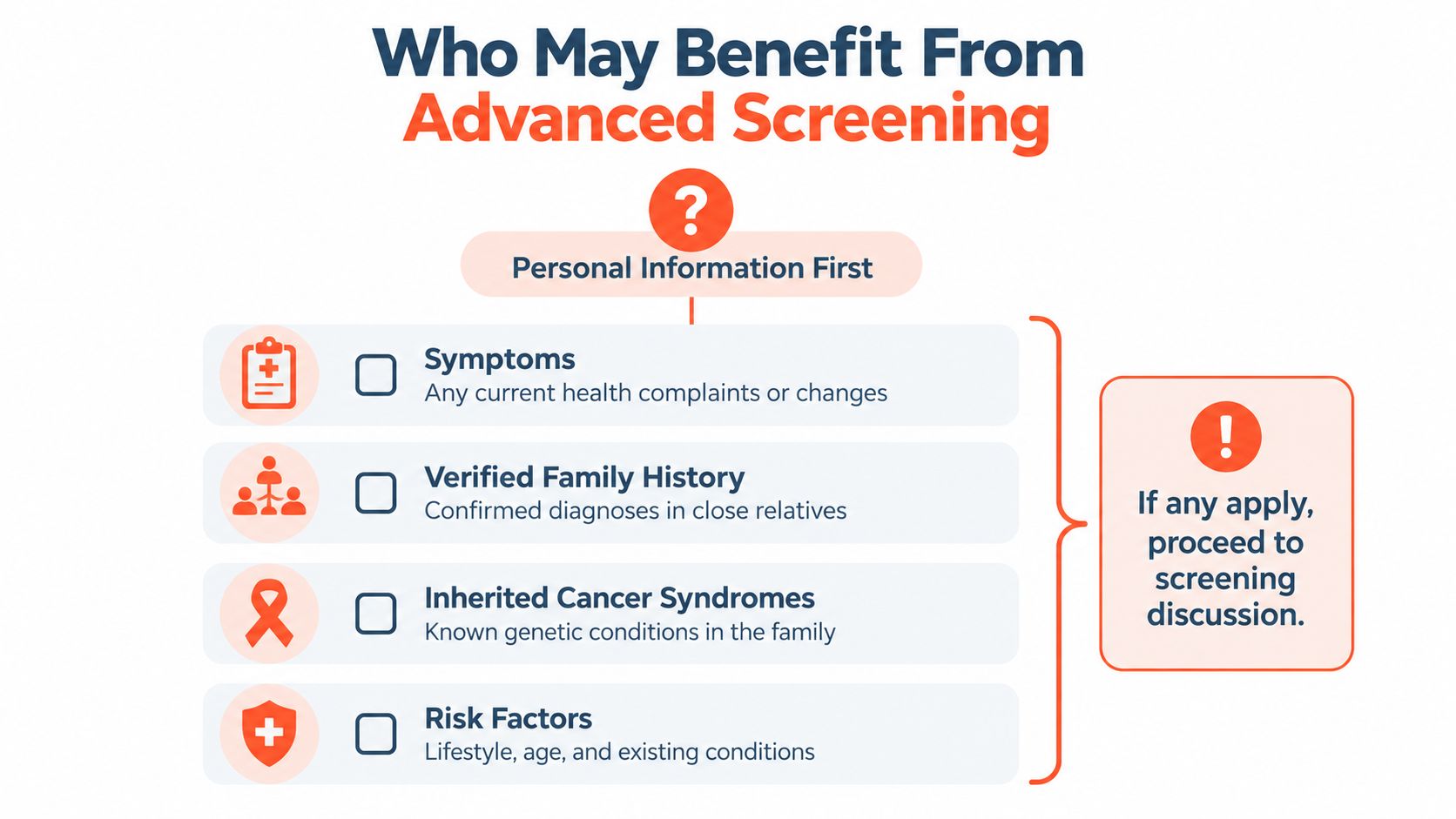
Start with symptoms. Screening, by definition, targets people without them. If you have a symptom, you need a diagnostic workup aimed at that symptom, not a general screening package that might incidentally look in the wrong place.
Next comes verified family history, meaning confirmed diagnoses in close relatives, with ages at diagnosis where possible. Vague recollections don’t calibrate risk well. Known inherited cancer syndromes change the calculation further, because intensive surveillance that makes sense for a high-risk family can be low-value care for someone at average risk.
What Else Changes the Answer
- Ancestry: It affects how well some genetic risk estimates transfer to you, and it belongs in the record before genomic testing.
- Prior diagnoses and medications: Existing conditions and current drugs alter both baseline risk and how results should be interpreted.
- Occupational exposures: Sustained exposure histories can justify targeted surveillance that a generic panel wouldn’t include.
- Established cardiovascular risk factors: These determine whether a test like calcium scoring can reclassify your risk or merely restate it.
Guideline thresholds show how specific this gets. The US Preventive Services Task Force colorectal cancer screening recommendation assigns an A recommendation to adults aged 50-75 and a B recommendation to adults aged 45-49, reflecting different certainty about net benefit by age. Its cited modeling estimated that colonoscopy every 10 years in 1,000 adults aged 50-74 could avert 27 colorectal-cancer deaths while causing 14 serious complications. Benefit and harm, quantified side by side.
For prostate cancer, the same task force concluded that men aged 55-69 should make an individual informed choice, and routine screening isn’t supported at 70 or older. One test does not fit every profile. Ask any clinic to document your eligibility, the evidence threshold it applied, the repeat interval, and the stopping rules that would end surveillance.
What a Credible Longevity Clinic Should Provide
Separate diagnostic breadth from governance. A clinic can own impressive equipment and still run a weak programme if nobody owns the result after you’ve flown home.
Minimum Credible Workup Checklist
| Checkpoint | Credible evidence | Warning sign |
|---|---|---|
| Eligibility | Written criteria tied to age, risk, and guidelines | Same package offered to everyone |
| Medical supervision | Named clinician interprets results with you | Results delivered as a raw report or app notification |
| Confirmation pathway | Predefined thresholds and confirmatory tests | Vague advice to see your own doctor |
| Referral and follow-up | Arranged referrals, primary-care coordination, review dates | No follow-up beyond an optional paid add-on |
| Financial exposure | Written estimate of likely downstream costs | Package price presented as the total cost |
| Evidence disclosure | Test validation and limitations stated upfront | Marketing claims without named evidence |
Follow-Up and Who Pays
The downstream question deserves its own line in any contract. False positives can trigger repeat imaging, specialist consultations, biopsies, and substantial out-of-pocket costs. If you’re an international patient, your insurance may exclude screening-related investigations or treatment outside your home country, which means an incidental finding abroad can become an uninsured expense at home.
Ask who’s responsible for coordinating with your primary physician, how quickly a radiologist reviews ambiguous findings, and what protection exists against unnecessary invasive procedures. A narrower, guideline-based programme may create more net benefit than a larger package when follow-up capacity or clinical thresholds are weak.
Conflicts and Independent Benchmarks
Incentives shape test menus. A clinic that profits from both screening and the treatments that follow has a structural reason to find things. Understanding how conflicts of interest operate in healthcare decisions helps you read a package critically.
One external reference point is Longevity Clinics, a reader-funded editorial directory that scores programmes on four axes, namely diagnostic depth, medical supervision, conflict freedom, and evidence base, without paid placements. Treat any such benchmark as editorial context, not medical advice. Your eligibility and follow-up plan still need a clinician who knows your history.
How Advanced Screening Results Shape Decisions
Abstract evidence gets clearer through representative scenarios. These are illustrative, not prescriptions, and each one turns on corroboration before treatment.
Scenario One Borderline Cardiovascular Risk
Consider an asymptomatic person whose conventional risk estimate sits in the borderline to intermediate range, where the statin decision could go either way. Calcium scoring can reclassify that estimate. CAC above 100 generally strengthens the case for preventive pharmacotherapy, while in carefully selected asymptomatic patients without major risk enhancers, CAC of 0 may justify postponing statin treatment and repeating assessment after approximately 3-5 years. A structured cardiometabolic risk assessment places that score alongside the rest of the risk picture rather than letting one number decide.
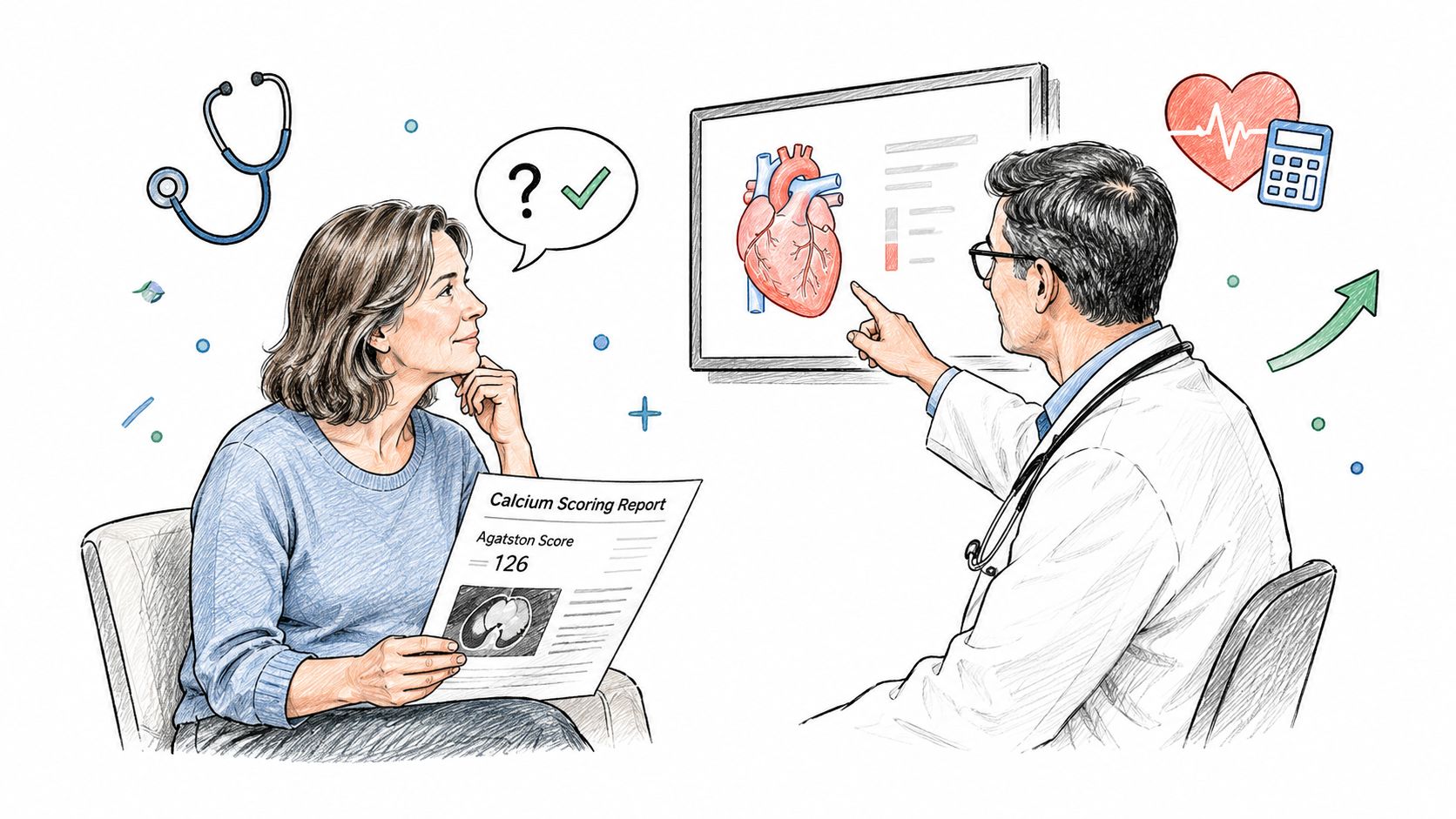
The scan didn’t diagnose disease. It refined a probability enough to change a specific, predefined decision. That’s the standard every test should meet.
Scenario Two an Inherited-Risk Result
Now consider someone whose polygenic score comes back high for a condition where their conventional assessment was uncertain. The score adds context. It doesn’t overrule family history, clinical risk models, biomarkers, or guideline-based screening, and it shouldn’t start medication or imaging on its own. The corroboration step is a clinician integrating the score with everything else, checking the assay’s validation population against the person’s ancestry, and deciding whether any change in prevention intensity is justified.
Scenario Three an Incidental Finding on MRI
A third person chooses whole-body MRI at average risk. Abnormal or incidental findings appear in roughly 94-97% of asymptomatic participants, while confirmed cancer detection is approximately 1-2% and mortality evidence remains absent, according to the whole-body MRI evidence review and policy summary. The American College of Radiology has stated that evidence is insufficient to recommend total-body screening for people without symptoms, relevant risk factors, or significant family history. This person may now face repeat imaging, consultations, possibly a biopsy, plus anxiety and unbudgeted cost, for a finding that was never going to harm them. The scan also isn’t a guarantee in the other direction, since whole-body MRI can miss certain cancers, particularly in the brain and some rare tumour types.
Run every result through the same sequence: What question was asked, what does this finding mean in context, what confirms it, what burden comes next, and who acts and who pays?
Make an Evidence Based Screening Decision
Start with the clinical question, not the technology list. If you can’t state the concern in one sentence, you’re not ready to choose tests.
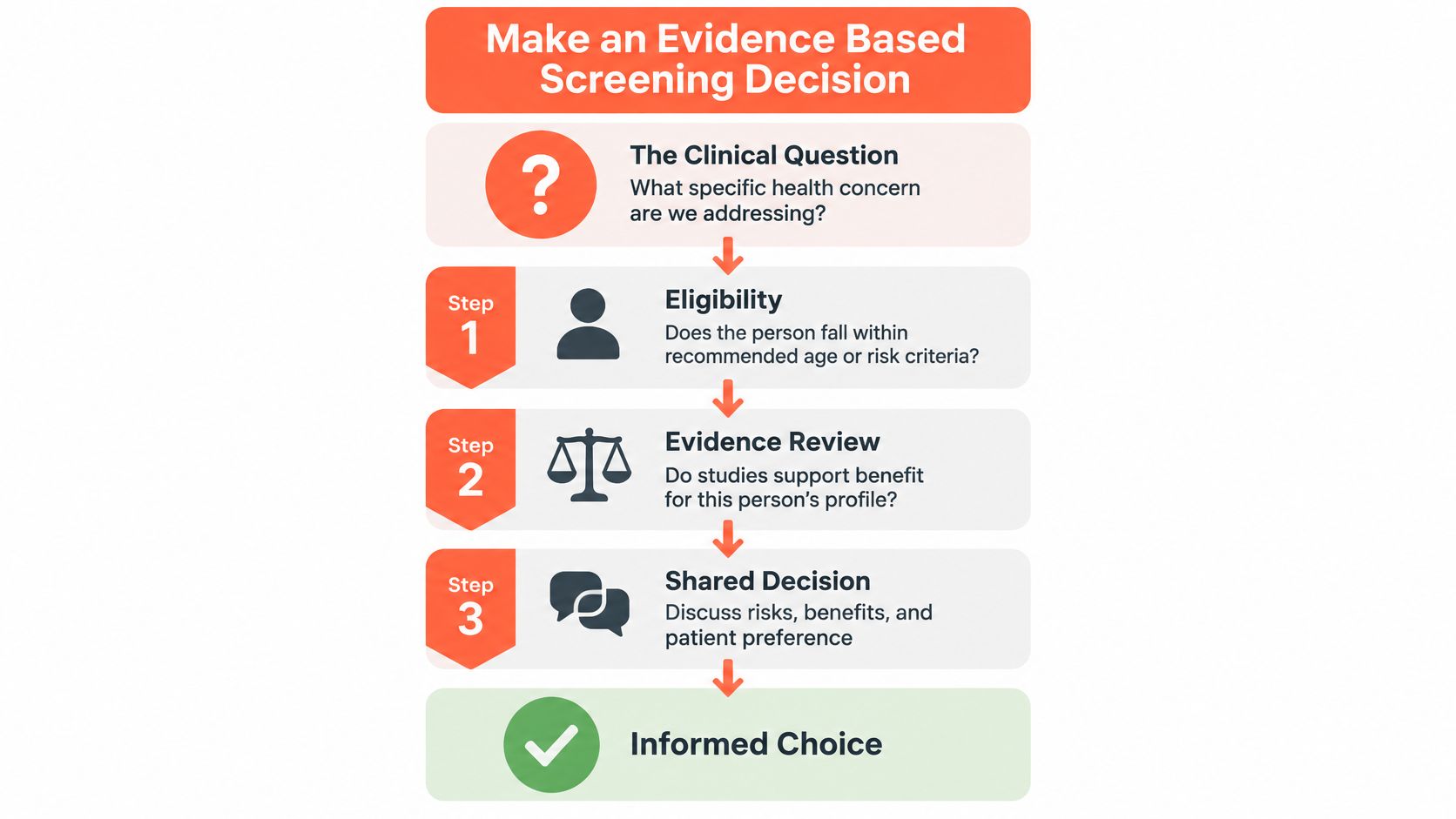
Then work through a short framework before any money changes hands.
- Confirm eligibility: Do you fall within an established screening recommendation or a justified high-risk pathway, based on documented personal risk data?
- Check validation: Was the test validated in a population like yours, for the endpoint and time horizon the clinic claims?
- Require an interpretation plan: Who explains the result, what thresholds trigger confirmation, and what are the explicit stopping rules?
- Identify follow-up ownership: Which named clinician manages referrals, coordinates with your primary physician, and sets review dates?
- Establish financial responsibility: What are the likely downstream costs, and does your insurance cover screening-related investigations where you’ll receive them?
A sound programme may recommend fewer tests than you expected. That’s a feature. When guidelines, evidence, or downstream capacity don’t support a test, declining it is proportionate care, not a lesser package. Screening should also connect with ordinary preventive care rather than replace it, because the guideline-based tests you’re already due for carry the strongest evidence of benefit.
Advanced health screening is better targeted and better governed. It isn’t broader, more expensive, or more technologically intensive.
Before you book any diagnostic day, take the five questions above to the clinic and ask for the answers in writing, including eligibility criteria, confirmation thresholds, a named follow-up clinician, and a downstream cost estimate. If a programme can’t provide them, choose one that can, and discuss the plan with your own primary physician before testing begins.