Cardiometabolic Risk Assessment: A Complete Guide
Learn how cardiometabolic risk assessment helps detect early signs of heart disease, diabetes, and stroke — and what your results mean for your health.
Nine measurable factors accounted for approximately 90% of the population-attributable risk of a first heart attack in men and 94% in women in the global INTERHEART study. That finding reframes prevention: a useful assessment starts with a coherent picture of familiar exposures, not an impressive catalogue of advanced tests.
It doesn’t mean an individual can eliminate that proportion of their personal risk. It means clinicians need to combine the right information, interpret it properly, and connect the findings to decisions. For someone considering a longevity programme, that distinction separates meaningful preventive care from an expensive collection of results.
Table of Contents
- What Cardiometabolic Risk Assessment Actually Means
- How Risk Scoring Evolved Into Today’s Models
- Key Biomarkers and Tests Behind a Credible Workup
- Comparing the Major Risk Scoring Tools
- Interpreting Results When the Numbers Disagree
- How Longevity Clinics Implement and Report Results
- Key Takeaways for Your Next Assessment
What Cardiometabolic Risk Assessment Actually Means
Cardiometabolic risk assessment is a structured evaluation of cardiovascular and metabolic health. Clinicians combine medical history, measurements, blood results, and sometimes imaging to estimate future risk and decide what prevention should involve.
The cardiovascular component concerns the heart and blood vessels. The metabolic component includes glycaemic health, blood lipids, and central adiposity. These aren’t separate compartments in a useful assessment: the INTERHEART framework supports considering them together, alongside smoking, diet, activity, and psychosocial factors.
Assessment Is Different From Testing
A test produces a result. An assessment explains what that result means for you.
For example, a cholesterol result may sit within a laboratory’s reference range. That alone doesn’t establish whether it is appropriate for someone with diabetes, kidney impairment, a strong family history, or existing cardiovascular disease. The clinician must interpret the measurement in its clinical setting.
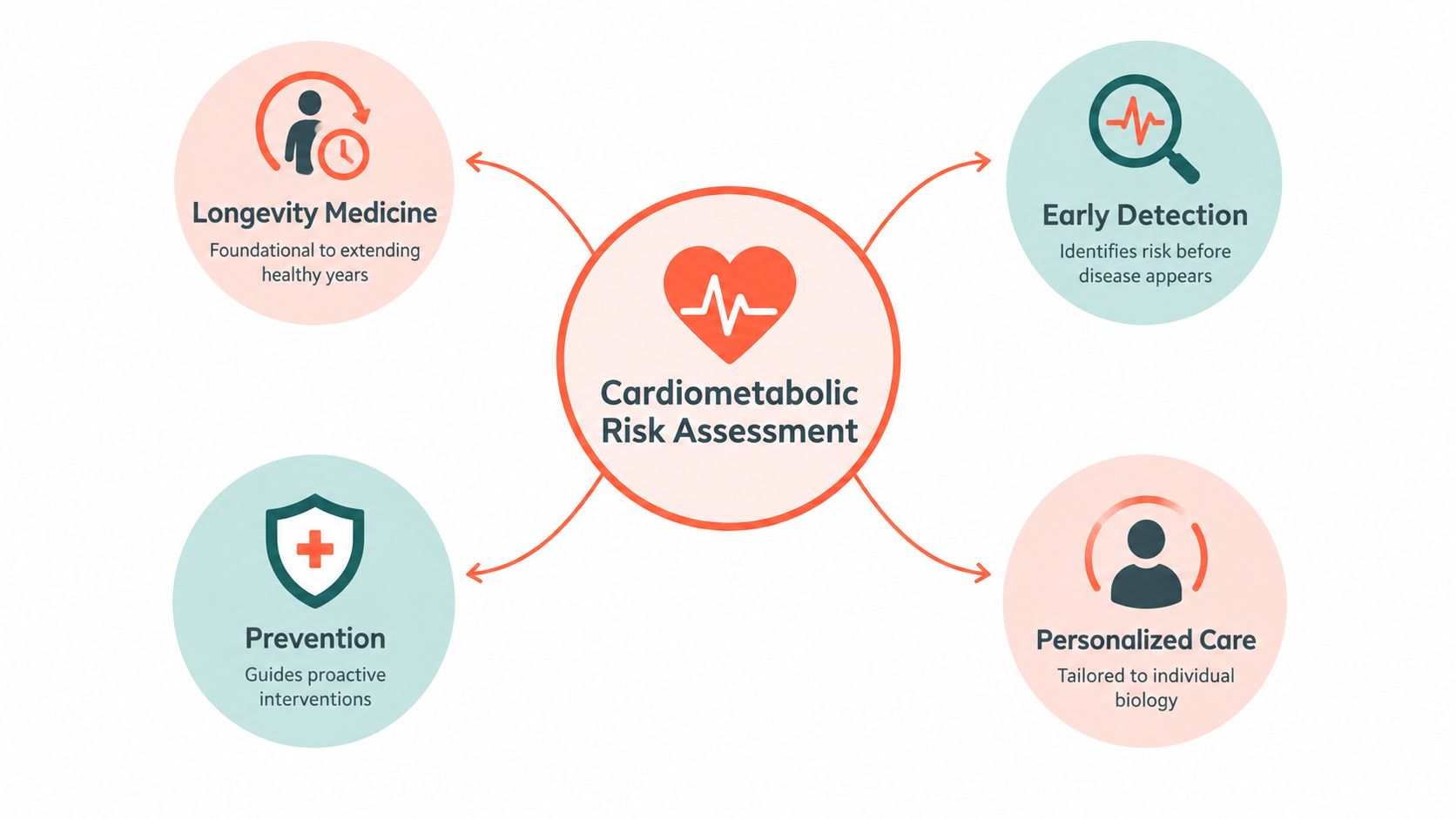
A useful assessment should answer distinct questions:
- Current status: What abnormalities or established conditions need attention now?
- Future probability: What outcomes could occur over the prediction period?
- Uncertainty: What important information is absent or poorly represented?
- Action: What should the patient and clinician do with the findings?
That last question matters particularly in longevity medicine. Identifying an abnormality isn’t the same as demonstrating that another test or intervention will help. A clinician should explain the reasoning between detection and recommendation rather than assume that more information automatically produces better care.
A Hypothetical Executive’s Assessment
Consider an executive whose lipid results appear reassuring but whose blood pressure, smoking history, and waist measurements raise concerns. A checklist report might label each result separately and leave the patient to reconcile the contradictions. An integrated assessment would consider the combined pattern before recommending a prevention plan.
The reverse also matters. A flagged laboratory result shouldn’t automatically trigger an extensive diagnostic package without a clinical explanation.
Practical distinction: The value of an assessment lies in the decisions it supports, not the volume of results it generates.
Your work schedule, treatment preferences, previous diagnoses, and existing medications belong in that conversation. Personalised care means interpreting your biology in context, not just ordering a customised panel.
How Risk Scoring Evolved Into Today’s Models
An isolated risk factor tells a clinician that something deserves attention. An absolute-risk model asks a different question: given this person’s combination of characteristics, how likely is a specified cardiovascular outcome over a defined period?
That change explains why a lipid result and a risk score aren’t interchangeable. A scoring tool combines selected predictors rather than interpreting cholesterol alone. Age, sex, blood pressure, lipid values, diabetes status, smoking, treatment history, and relevant comorbidities may all influence the estimate.
Why Models Added More Context
QRISK developed in UK primary care as an alternative to an earlier US-derived algorithm. Its development illustrates an important methodological issue: a model built in one population may not describe another population equally well.
Later QRISK approaches incorporated longer-term risk and competing mortality considerations. QRISK3 also broadened the clinical information represented, including serious mental illness, atypical antipsychotic treatment, migraine, corticosteroid use, and blood-pressure variability. The practical lesson isn’t to memorise every predictor, but to ask whether the tool represents the conditions and treatments relevant to you.
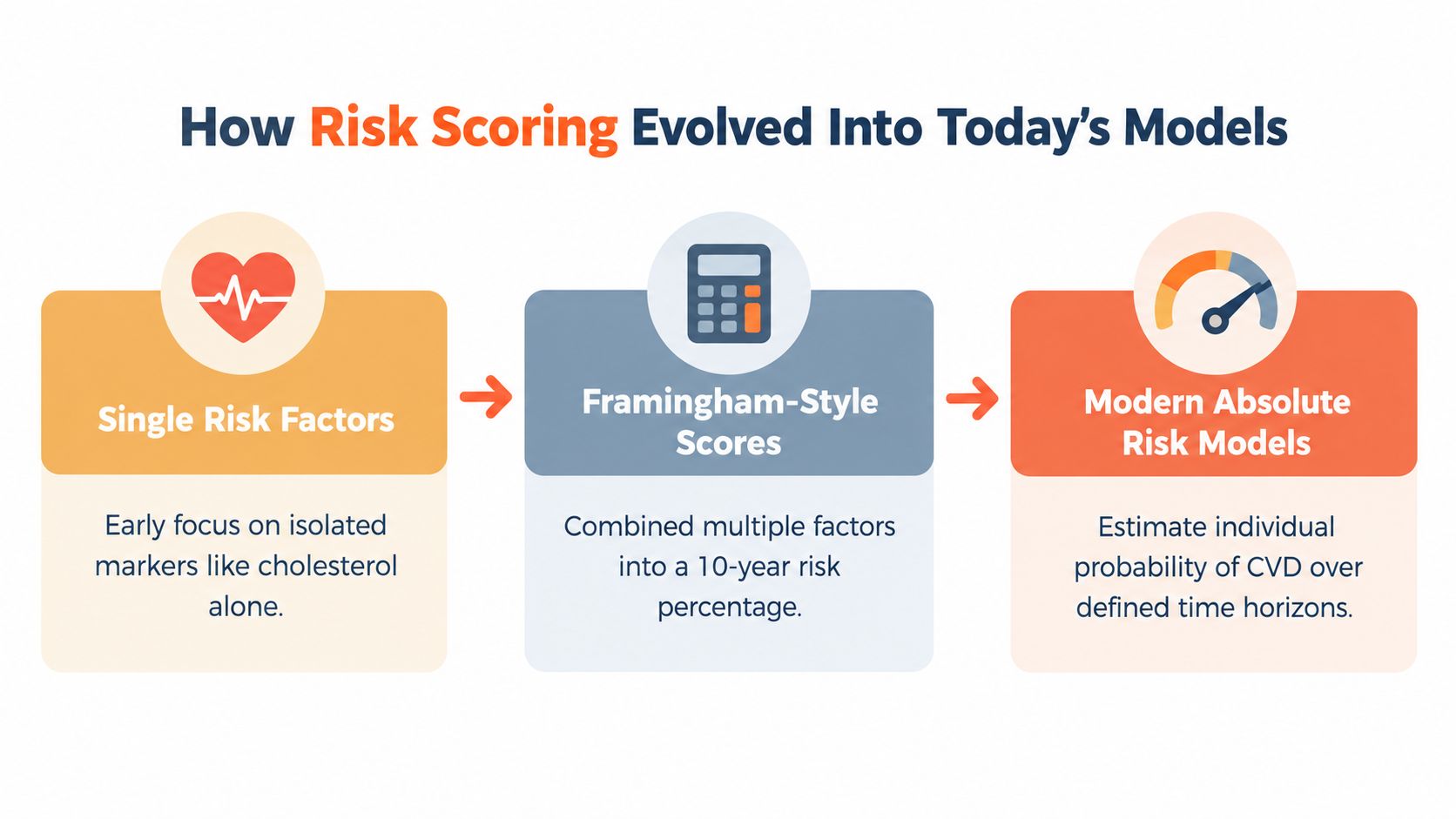
Population calibration means checking whether predicted risks align with observed outcomes in the population where a model will be used. A technically advanced calculator still needs that grounding. An imported algorithm isn’t automatically unsuitable, but the clinic should explain its choice rather than treat every calculator as equivalent.
Read the Label Before the Number
A risk estimate needs a clear label:
- Outcome: Is the model estimating atherosclerotic cardiovascular disease, broader cardiovascular disease, or heart failure?
- Horizon: Does the estimate concern near-term events or longer-term exposure?
- Population: Where was the model developed, validated, or calibrated?
- Inputs: Which clinical variables were included, omitted, or unavailable?
These details change interpretation. A younger adult can have a modest short-term estimate while still accumulating substantial long-term exposure. Conversely, a longer-horizon estimate isn’t interchangeable with a prediction used to guide an immediate treatment discussion.
Don’t interpret a score as a diagnosis or a forecast of your individual destiny. It is a probability estimate based on patterns in populations. Nor does a decimal place establish clinical certainty: incomplete inputs, imperfect population fit, and unrepresented risk factors can all limit its usefulness.
A credible clinician can explain those limitations without dismissing the model. The score provides structure; clinical interpretation determines how to use it.
Key Biomarkers and Tests Behind a Credible Workup
A credible workup needs a foundation and a reason for each refinement. Blood pressure, lipids, glycaemic status, smoking, central adiposity, diet, activity, and psychosocial history establish the basic picture described by INTERHEART.
Organise the results by the question they answer rather than by whether a clinic calls them standard or advanced. The practical considerations in choosing a metabolic health clinic should include that distinction.
Establish the Clinical Foundation
The standard lipid panel and blood-pressure measurements provide core scoring inputs. Glycaemic assessment addresses metabolic status, while waist measurements add information that body weight alone can miss. Kidney assessment becomes especially important when interpreting diabetes-related risk.
- Lipids and blood pressure: Review actual values alongside treatment history, rather than relying only on laboratory flags.
- Glycaemic information: HbA1c belongs in diabetes-specific assessment; additional metabolic testing should have a stated purpose.
- Central adiposity: Waist circumference and waist-to-hip ratio address a different question from general body size.
- Kidney and inflammatory context: eGFR, urine albumin-to-creatinine ratio, and selected risk-enhancing markers can refine interpretation when clinically appropriate.
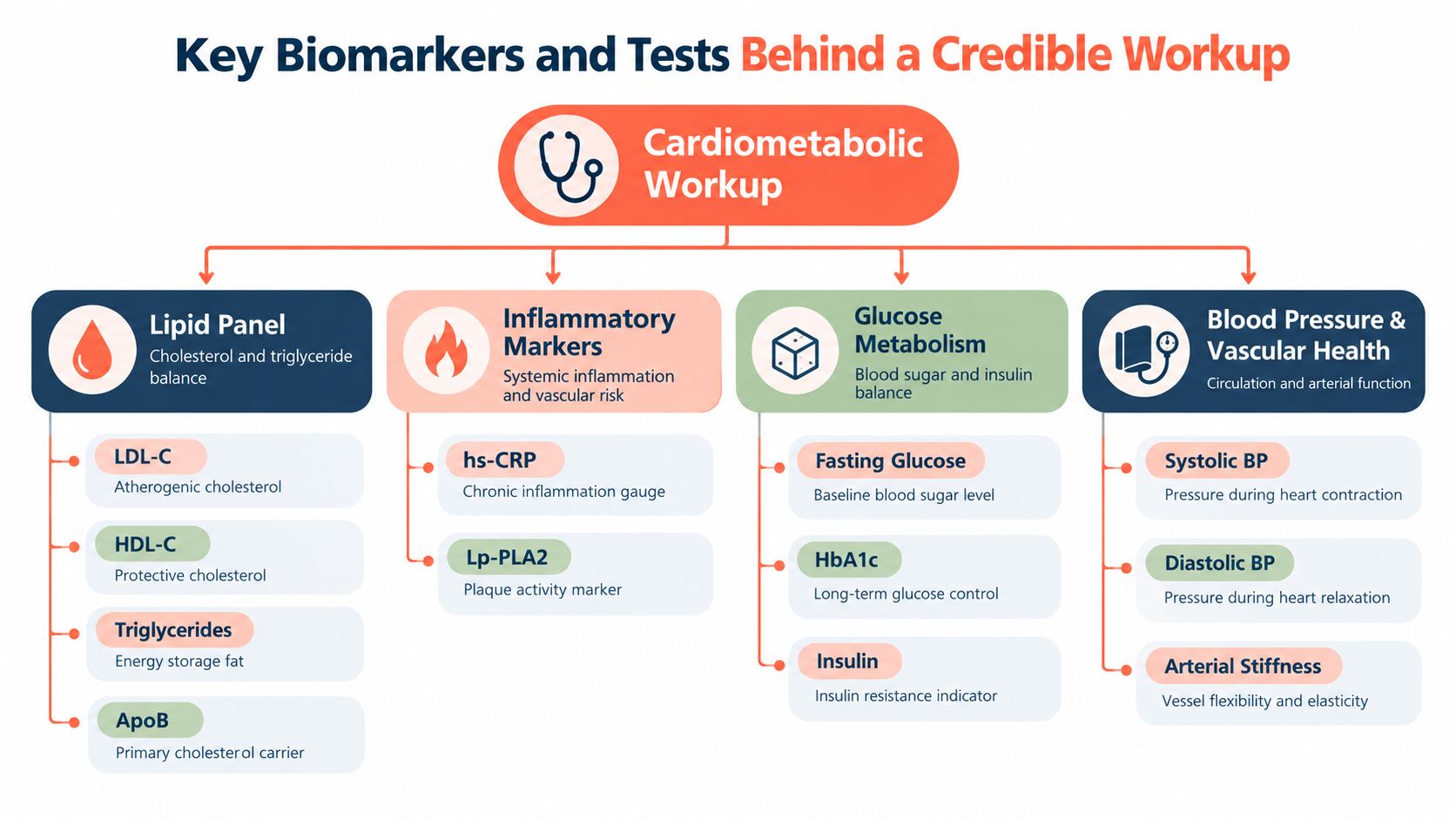
The diagram is a category map, not a prescription to order every listed test. Fasting insulin, specialist inflammatory tests, and vascular measurements shouldn’t become mandatory just because they appear in a package. Ask what uncertainty each would resolve.
Understand What Lipid Refinements Add
Lipoprotein(a), or Lp(a), adds information about a largely genetically determined, relatively stable risk factor. Apolipoprotein B, or apoB, helps assess atherogenic particle burden when LDL cholesterol may understate it, particularly in hypertriglyceridaemia, metabolic syndrome, and diabetes.
The ACC/AHA lipid-guideline summary identifies Lp(a) of at least 125 nmol/L or 50 mg/dL and, in selected primary-prevention contexts, apoB of at least 130 mg/dL as risk-enhancing thresholds; it also describes CAC of at least 100 Agatston units or above the 75th age-, sex-, and race-specific percentile as supporting upward risk reclassification.
Those aren’t interchangeable findings. Lp(a) addresses a particular inherited exposure, apoB helps resolve particle-burden questions, and coronary artery calcium, or CAC, provides anatomical information about subclinical coronary atherosclerosis.
A threshold isn’t a standalone treatment order. The clinician still needs to integrate the finding with absolute risk, family history, kidney function, diabetes status, and patient preferences. The report should explain what the result contributes, not merely mark it red.
Comparing the Major Risk Scoring Tools
Choosing a calculator is a clinical decision, not a software preference. The appropriate tool depends on the patient’s population, diagnoses, intended outcome, and prediction horizon.
General-population tools, diabetes-specific models, and longer-term estimators serve different purposes. If a clinic offers several scores, ask why each is needed rather than assuming that agreement between calculators proves accuracy.
Risk Scoring Tools at a Glance
| Tool | Population | Key Variables | Time Horizon | Best Use |
|---|---|---|---|---|
| QRISK and QRISK3 | UK primary-care populations | Conventional factors, treatment history, and selected comorbidities | Defined cardiovascular prediction period; lifetime approaches also exist | Assessment where UK calibration and clinical inputs fit |
| SCORE2 | General-population assessment | Conventional cardiovascular predictors | Model-defined horizon | Ask the clinic to document eligibility and geographic fit |
| SCORE2-Diabetes | Adults with type 2 diabetes | Conventional predictors plus HbA1c, age at diagnosis, and eGFR | Defined cardiovascular prediction period | Representing diabetes-specific exposure and kidney risk |
| PREVENT | Patients assessed within the framework’s intended setting | Traditional predictors plus BMI, kidney function, and statin use; optional additional inputs | Shorter- and longer-term estimates | Broader cardiovascular and heart-failure assessment |
| Lifetime-risk estimators | People needing a longer-term perspective | Tool-dependent clinical inputs | Lifetime or extended horizon | Discussing cumulative exposure when near-term estimates appear reassuring |
Why Diabetes Needs Its Own Assessment
SCORE2-Diabetes doesn’t treat diabetes as a binary present-or-absent condition. It includes HbA1c, age at diagnosis, and eGFR, allowing the clinician to represent glycaemic exposure, disease duration, and kidney-related vascular risk more explicitly.
The ACC review of cardiovascular risk assessment describes commonly used European SCORE2-Diabetes categories for 10-year risk as moderate at 5–10%, high at 10–20%, and very high at ≥20%, while established cardiovascular disease or target-organ damage can independently establish very-high-risk status.
In plain language, the percentage is an estimated event probability during the stated period, not a severity score for diabetes. The category helps structure preventive intensity, but it doesn’t replace the clinician’s review of established disease, organ damage, or treatment suitability.
For a hypothetical comparison, consider patients with similar conventional inputs but different ages at diabetes diagnosis and different kidney function. A diabetes-specific model can distinguish their predicted risks in a way that a binary diabetes field cannot.
Ask for the model that fits your clinical situation, not the calculator that produces the most reassuring result.
When evaluating preventive health screening, request the clinic’s eligibility rules for each tool. The meaningful comparison is whether the chosen model supports the decision at hand, not which programme displays the largest collection of scores.
Interpreting Results When the Numbers Disagree
Discordant results aren’t necessarily errors. They may reflect different kinds of information: a population-based probability, an inherited exposure, a particle-burden measurement, or anatomical evidence.
Consider a hypothetical patient with a borderline headline score and risk-enhancing lipid findings. The clinician shouldn’t average those results into an improvised composite. They should identify what the calculator doesn’t capture and determine whether the additional information changes the prevention discussion.
Resolve Uncertainty Before Ordering Imaging
The cardiovascular risk-assessment policy summarising ACC guidance describes reviewing risk-enhancing factors before considering CAC in borderline or intermediate ASCVD risk, including raised triglycerides, Lp(a), apoB, hs-CRP, and reduced ankle–brachial index; it also describes PREVENT’s 10-year and 30-year ASCVD estimates and its inclusion of heart-failure risk.
Multiple risk enhancers may support a statin discussion without CAC. Imaging becomes most useful when a genuine treatment decision remains unresolved. Its role is to help settle that decision, not to provide routine reassurance after every blood panel.
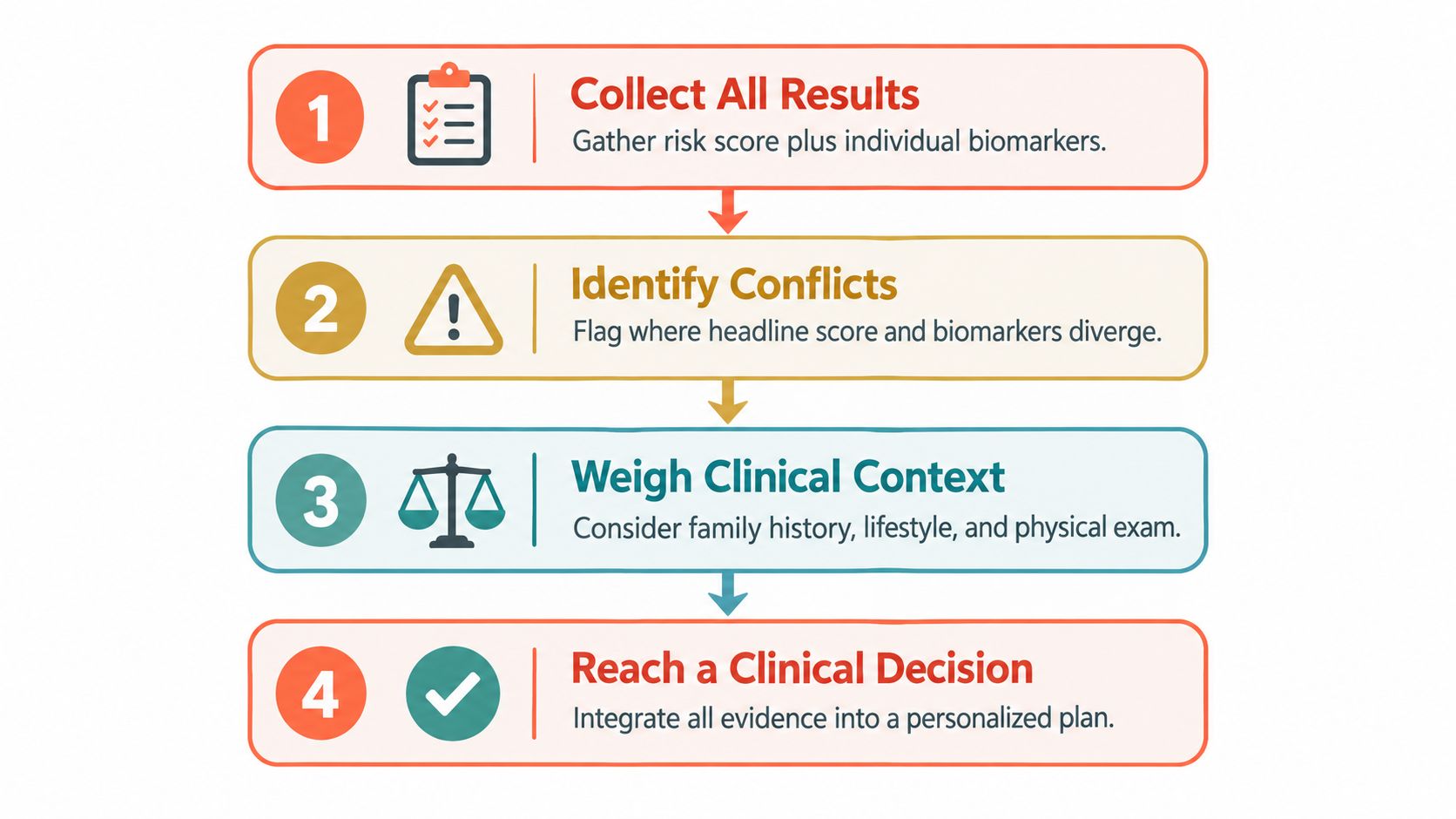
A CAC result showing no detectable calcium can support downward reclassification in appropriate patients. It doesn’t erase diabetes, smoking, a strong family history, or high Lp(a). The clinician must explain what the finding does and doesn’t resolve.
Define the Possible Decisions in Advance
Before additional testing, ask the clinician to outline the branches:
- If the result is reassuring: Would treatment change, or would existing risk factors still justify the same plan?
- If the result is concerning: What specific recommendation would follow?
- If it remains ambiguous: Would another test help, or would shared decision-making be more useful?
Testing rule: An additional test should have a plausible route to changing care, not merely adding another page to the report.
PREVENT also broadens the discussion through BMI, kidney function, and statin use, with optional HbA1c, urine albumin-to-creatinine ratio, and neighbourhood deprivation inputs. That broader perspective can help clinicians discuss risks beyond the immediate lipid-treatment question.
However, adding variables doesn’t remove uncertainty. A careful interpretation distinguishes information already represented in the calculator from separate clinical modifiers. That helps avoid counting the same concern repeatedly or presenting an adjusted probability with unjustified precision.
How Longevity Clinics Implement and Report Results
Before booking a diagnostic day or membership, request an anonymised sample report. It’s a practical way to assess whether the clinic delivers integrated clinical reasoning or just assembles results.
A transparent workflow should begin before blood collection. The clinician should review existing diagnoses, medication use, smoking, family history, previous measurements, and relevant lifestyle information, then select tests that address the patient’s clinical questions.
What the Report Should Contain
A high-quality report should make its reasoning auditable:
- Measurement provenance: Dates, units, treatment status, and relevant circumstances for the results used.
- Model identity: Algorithm name and version, intended population, geographic calibration, predicted outcome, and horizon.
- Data completeness: Missing variables, substituted values, and important factors outside the model.
- Integrated interpretation: An explanation of how clinical history, scoring, biomarkers, and any imaging fit together.
- Management plan: Recommended actions, alternatives, reasons for escalation or restraint, and responsibility for follow-up.
For diabetes-specific assessment, the earlier model discussion makes clear why HbA1c timing, age at diagnosis, kidney function, and evidence of organ damage deserve explicit documentation. A generic diabetes label isn’t enough.
The clinic should also state when reassessment is appropriate after meaningful changes in glycaemic control, renal function, blood pressure, or lipid treatment. Avoid a fixed testing schedule presented as suitable for everyone without a clinical rationale.
Evaluate the Service, Not Just the Test Menu
Use separate criteria for diagnostic depth, medical supervision, conflicts of interest, and evidence quality. A broad menu doesn’t compensate for unclear clinical responsibility. Nor does polished presentation establish that every proposed intervention is evidence-based.
Longevity Clinics is one editorial option for comparing programmes across those criteria; you can also examine professional registries, regulator information, clinic disclosures, and the proposed medical protocol directly. Its directory evaluation should complement, not replace, a consultation with the clinician responsible for your care.
Report warning: A proprietary wellness score without its inputs, method, or clinical meaning shouldn’t substitute for a recognised cardiovascular risk assessment.
When reviewing an executive health-screening programme, ask who explains discordant findings, who communicates with your existing doctor, and who manages follow-up. These operational details determine whether a diagnostic day becomes an ongoing prevention plan or ends with a PDF you must interpret alone.
Key Takeaways for Your Next Assessment
Treat your next assessment as a decision-making appointment, not a shopping list of investigations. The clinician should be able to explain the connection between the information collected and the care recommended.
Carry these questions into the consultation:
- Algorithm: Which recognised model did you use, and why does it fit my situation?
- Population: How appropriate is its calibration for me?
- Horizon: Which outcome and prediction period does this estimate describe?
- Completeness: What information is missing or outside the calculator?
- Refinement: What unresolved question would another biomarker or scan answer?
- Action: Which recommendation changes because of these findings?
- Follow-up: Who owns the plan, and what would prompt reassessment?
Keep the distinctions clear: probability isn’t diagnosis, a laboratory flag isn’t a treatment decision, and a longer-term estimate isn’t interchangeable with a near-term one. You don’t need to become a scoring expert. You need enough understanding to ask for a defensible explanation.
Before committing to a longevity programme, request its sample cardiometabolic report, proposed testing rationale, and follow-up protocol. Bring those documents, your medication list, and your existing results to the responsible clinician, and ask them to identify the next decision the assessment will help you make.