Anti Aging Clinic Guide: What's Proven and What's Not
Anti aging clinic services explained: what each treatment has been shown to do, what regulators allow, and how to vet a clinic before you pay.
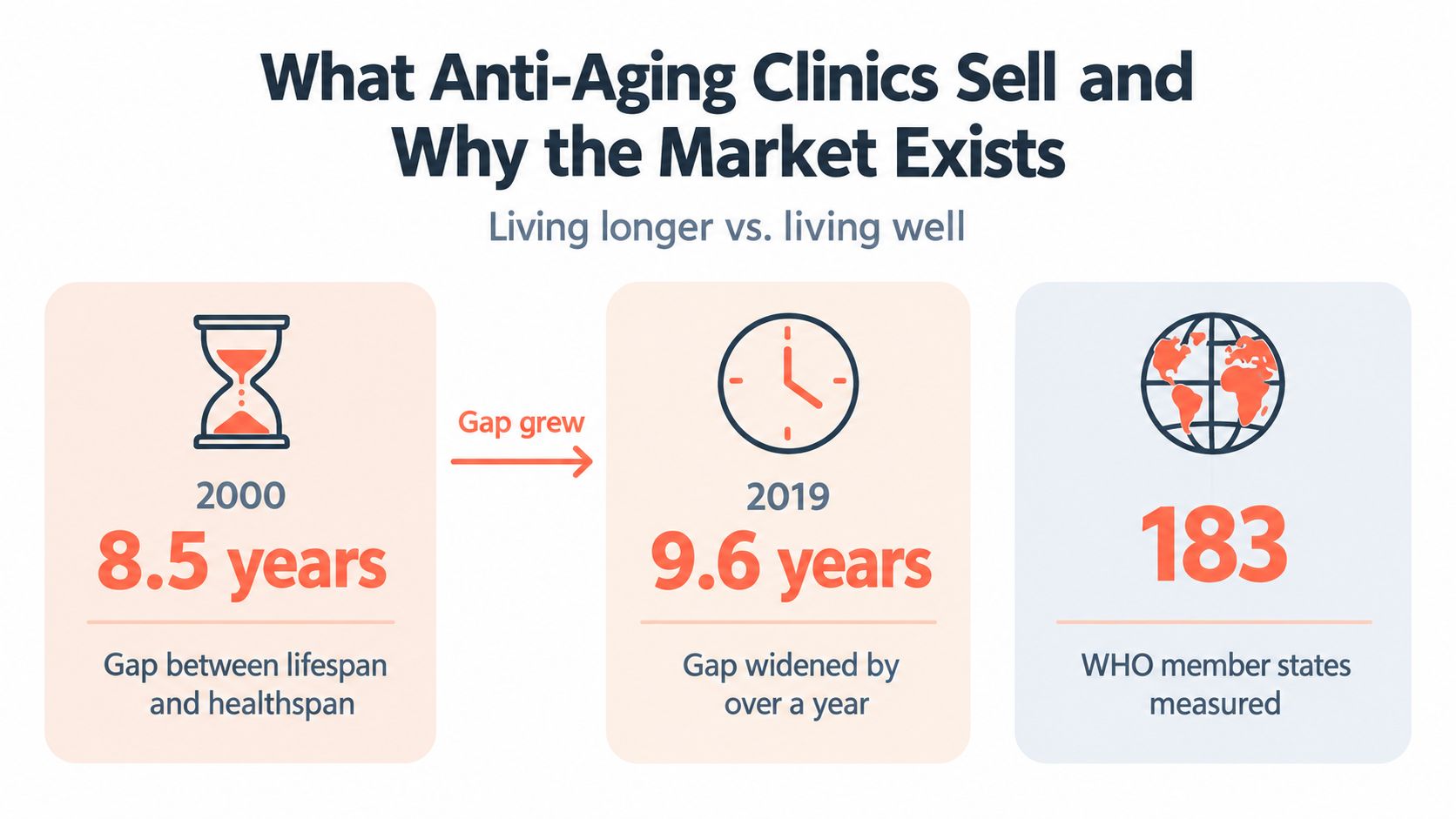
Across 183 World Health Organization member states, the gap between life expectancy and health-adjusted life expectancy widened from 8.5 years in 2000 to 9.6 years in 2019, according to a global analysis of healthspan and lifespan. That gap is a useful way to judge an anti aging clinic: does its programme aim to improve health and function, or does it mainly produce attractive test results and confident promises?
Living longer and living well aren’t the same goal. A careful clinic should be able to explain what each test or treatment is intended to change, what evidence supports that claim, and how it will tell whether you benefited.
Table of Contents
- What Anti-Aging Clinics Sell and Why the Market Exists
- Evidence Tiers for Common Anti-Aging Treatments
- Regulation, Grey Areas and Ethical Limits
- Baseline Measures That Track Real Function Over Time
- Preventive Care a Clinic Must Not Replace
- Credibility Checklist and Pre-Booking Routine
What Anti-Aging Clinics Sell and Why the Market Exists
People are living longer, but added years do not automatically mean more years in good health. In the analysis above, life expectancy rose faster than health-adjusted life expectancy between 2000 and 2019. That difference explains why clinics market services intended to preserve function, manage health risks, and improve appearance. It also sets a practical standard: judge each offer by the health outcome it claims to change, using the gap between lifespan and healthspan as the yardstick rather than a clinic’s own biological-age score.
The audience for these services is growing as the number of people aged 60 and older rises worldwide. More late-life years mean more chances for chronic disease, disability, and concern about losing independence, which makes preventive and age-related care easier to sell. The global longevity-clinic market was valued at $7.2 billion in 2024, according to Research Intelo’s market report. Market size shows that businesses see demand. It does not show that a particular treatment changes how long, or how well, a person lives.
Four parts of a typical clinic menu
At a first consultation, the options can look like a restaurant menu with eighty dishes. A long list says little about the kitchen. The offerings usually fit into four groups:
- Diagnostic packages: Blood panels, imaging, genetic tests, and biological-age tests. These may identify risks or create a starting point, but a result is useful only if a clinician can explain what it means and what action could follow.
- Hormone and metabolic therapy: Prescriptions or plans involving hormones or medicines such as metformin. Some may be appropriate for a diagnosed condition, while using them to slow aging in a healthy person is a different claim.
- Injections and infusions: IV nutrient drips, peptides, and regenerative products such as stem-cell treatments. Their presence on a clinic menu does not establish that they improve lifespan or everyday function.
- Membership plans: Bundles that combine consultations, tests, and treatments. A membership can make follow-up easier, but it can also blur what each item costs and why you need it.
The useful question is not how impressive the menu looks. It is how well the clinic assesses your needs, chooses appropriate care, and follows outcomes over time. A common misunderstanding is that an anti-aging clinic can promise indefinite lifespan. In practice, clinics may be selling a mix of healthspan, energy, performance, or appearance claims. Ask which claim applies to each item, then ask for a meaningful way to measure whether it worked.
Evidence Tiers for Common Anti-Aging Treatments
Four tiers are enough to sort most of what appears on a clinic menu. Tier 1 means an intervention is supported for a health outcome by strong trial evidence or established guidance. Tier 2 means it is useful for a named condition but not proven as a treatment for aging. Tier 3 means the idea is plausible yet human evidence remains incomplete. Tier 4 means the proposed use is unproven or unapproved.
The table separates regulatory status from human-outcome evidence. A drug can be approved for one use without being approved or proven for slowing aging, and the tier reflects only the second question. Read the third column as the verdict.
| Intervention | Regulatory status for aging | Human-outcome evidence | Evidence tier |
|---|---|---|---|
| Blood pressure control with medication when indicated | Drugs are approved for hypertension, not aging | Reduces stroke, heart, and kidney events | Tier 1: proven |
| Structured exercise and strength training | Not a drug; standard public-health guidance | Improves physical capacity and disease risk | Tier 1: proven |
| Menopausal hormone therapy | Approved for menopausal symptoms, not aging | Relieves symptoms; risks depend on age and timing | Tier 2: established for a condition |
| Metformin for healthy adults | Approved for type 2 diabetes; off-label for aging | No long-term randomized trials in healthy adults | Tier 3: plausible, unproven |
| Low-dose rapamycin | Approved for transplant and other uses; off-label for aging | Animal and small human data; no long-term trials in healthy adults | Tier 3: plausible, unproven |
| Plasma exchange | Experimental for aging | Small studies; no lifespan data | Tier 4: unproven |
| Peptide injections, such as BPC-157 | Mostly unapproved; some compounded | Limited human data | Tier 4: unproven |
| Stem-cell injections for rejuvenation | Unapproved for aging | No evidence of human lifespan extension | Tier 4: unproven |
Why off-label drugs and stem cells need extra scrutiny
Metformin and rapamycin are off-label for aging, and long-term randomized-trial evidence in healthy adults is lacking. Off-label prescribing can be appropriate for a patient’s medical circumstances, but a possible biological mechanism is not the same as proof that taking a drug will extend healthy life. Ask what condition the prescriber is treating, what risks require monitoring, and which outcome the plan is expected to improve. If the answer is a biomarker, ask how that marker connects to a change in disease risk or daily function.
Stem-cell injections for rejuvenation deserve particular caution. Many longevity clinics now offer these treatments even though no study has shown they extend human lifespan, and FDA warnings about unapproved regenerative products describe risks that include blindness, tumors, neurological events, and severe infection. Patients comparing clinic claims with descriptions of stem cell treatments for ageing should separate a proposed mechanism from a demonstrated benefit in people.
Before agreeing to any treatment, ask two questions. First, is it approved for this proposed use, and what alternatives, monitoring requirements, and opportunity costs come with it? Second, what human endpoint was measured? Lifespan, disease incidence, and daily function are outcomes a patient can count or feel. A biomarker shift is a proxy that still has to prove it predicts those outcomes. A published evidence-rating framework can help organize these questions.
A tier describes the strength of evidence, not a clinic’s honesty or skill. A Tier 1 intervention can still be delivered poorly, and a cautious clinician may discuss an uncertain treatment without claiming it is proven.
Ask for the outcome, not the label: What changed in people who received this treatment, and how was that change measured?
Regulation, Grey Areas and Ethical Limits
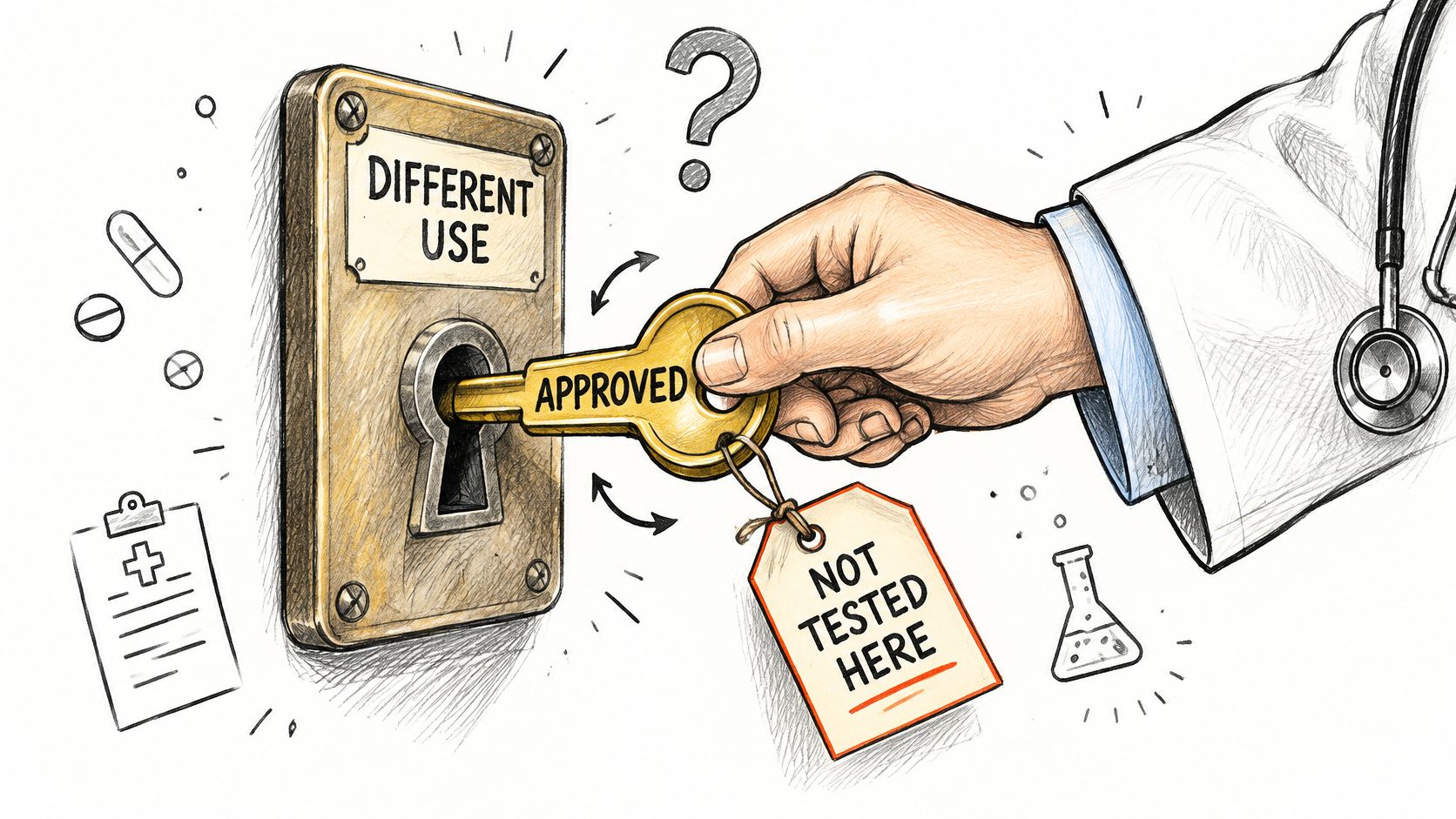
An approved drug used off-label is like a key used on a different lock. The doctor may legally prescribe it, but the manufacturer hasn’t necessarily tested it for that purpose. Legal prescribing, regulatory approval, and proof of benefit are separate questions.
Three grey areas often come up in longevity care:
- Off-label prescribing: A clinician uses an approved medicine outside the condition or purpose for which it was approved. That doesn’t by itself show the treatment is wrong, but it does mean you should ask why it’s being recommended and what evidence supports the specific use.
- Compounded products: Specialist pharmacies prepare products for individual prescriptions. The product may not have the same testing for potency, purity, dosing, or outcomes that people expect from an approved medicine.
- Products sold across borders: Regenerative and peptide treatments can be difficult to assess when patients travel for care. It may not be clear where a product was made, what standards apply, or whether it has marketing authorisation for the intended use.
Licensing doesn’t settle the evidence question
The relevant regulator depends on where care is provided. In the United States, the FDA regulates drugs, biologics, and medical devices, while state medical boards license physicians locally. Swissmedic regulates therapeutic products in Switzerland. The General Medical Council licenses doctors in the UK, and Germany’s Bundesärztekammer sets professional rules for physicians.
Ethics matter alongside regulation. Written informed consent should explain risks, alternatives, and total cost before treatment. If a clinic sells its own supplements or injections, ask how it separates medical recommendations from product revenue. A membership model can also create pressure to commit to a large package before you’ve had time to review the plan.
A licensed doctor is necessary, but not sufficient. Check that the clinician is qualified to oversee the proposed care, that claims match the available evidence, and that you can decline individual items without losing access to ordinary medical care.
Baseline Measures That Track Real Function Over Time
One measurement is a snapshot. Repeated measurements, collected with the same method, are closer to a film: they show direction, not just position. That distinction matters because the useful question is whether care changes an outcome you value, such as staying independent, thinking clearly, or delaying the years lived with disability. A clinic’s biological-age score deserves attention only when it connects to one of those outcomes.
The World Health Organization describes intrinsic capacity as the physical and mental capacities a person can draw on, and its framework for healthy ageing recommends repeated assessment because reserves change over time. The same framework describes a deficit-accumulation score from 0, meaning no measured deficits, to 1, meaning all measured deficits, as a possible marker of biological aging. Read that kind of score as context, not as a verdict.
| Domain | Example instrument | Change that warrants review |
|---|---|---|
| Physical capacity, walking speed | Timed 4-metre walk | Slower speed confirmed on repeat testing, or new difficulty with ordinary walking |
| Physical capacity, strength | Handheld grip dynamometer | Sustained decline confirmed on repeat testing |
| Cognition | MoCA or MMSE screen | Drop larger than repeat-test variation, then formal referral |
| Mood and wellbeing | PHQ-9 or WHO-5 | Persistently low scores over repeated visits |
| Daily function | Katz ADL index | Any loss of independence in bathing, dressing, or continence |
| Sensory function | Hearing screen; visual acuity test | New loss confirmed on repeat test, then specialist referral |
How to make follow-up useful
Ask which validated instruments the clinic uses and whether it will repeat the same ones at follow-up. A walking test is comparable only when distance, instructions, and timing stay consistent; the same discipline applies to cognition, mood, strength, and daily function. A confirmed decline should lead to medical evaluation, medication review, or referral, not an automatic recommendation to buy a supplement.
Use the table as a prompt for a conversation, not as a do-it-yourself diagnosis. Your clinician should define what counts as meaningful change for you, taking account of health conditions, medications, and the limits of each test. Two people can receive the same score and need different next steps.
A biological-age result may be interesting as one data point, but it should not stand alone as proof of disease, improvement, or treatment success. Ask what a result changes in your care. If the clinic cannot connect it to a clinical decision or an outcome you value, its practical meaning may be limited.
Healthspan measures also need context. Average gaps between living longer and living well hide wide differences between individuals, including differences between women and men. A credible programme names which gap it is trying to narrow and which repeated measure would show progress.
Preventive Care a Clinic Must Not Replace
Blood-pressure screening shows the difference clearly. The U.S. Preventive Services Task Force concludes with high certainty that screening adults for hypertension has substantial net benefit. It suggests annual screening for adults aged 40 or older, or for adults at increased risk, and screening every 3 to 5 years for lower-risk adults aged 18 to 39 whose previous readings were normal, according to the USPSTF recommendation on hypertension screening.
High blood pressure is a modifiable cause of cardiovascular, cerebrovascular, and kidney disease. The minimum standard is accurate measurement, confirmation of abnormal readings outside the clinic when appropriate, cardiovascular-risk assessment, medication review, and a clear path to treatment or referral.
Follow-through matters more than test volume
Cancer screening belongs in the same conversation. USPSTF guidance recommends lung-cancer screening for certain long-term smokers and recent quitters, and a clinic should help you keep up screening that fits your age and smoking history rather than suggesting extra lab panels take its place.
If you’re reviewing a broad blood-test package, use resources about blood markers linked to longevity as a prompt to ask what each result can and can’t tell you. A biomarker is not a diagnosis by itself, and ordering a test isn’t the same as acting on an abnormal result. A preventive-health screening guide can help you compare a clinic’s plan with routine prevention you may already need.
Ask the clinic three questions:
- Which screenings are due for me, based on my age and risk?
- Who follows up if a result is abnormal, and how will I be referred?
- Will you review my medicines and coordinate with my regular clinician?
A clinic that orders many panels but leaves abnormal results without a named pathway is selling activity. The useful test is whether the programme completes due screening, confirms abnormal readings, treats or refers when needed, and coordinates with your regular clinician so added years are healthier years.
Credibility Checklist and Pre-Booking Routine
Use the table as a scoring sheet during a phone call or first consultation. For each of the eight signals, note whether the clinic’s answer sounds credible or raises concern. One concern doesn’t automatically make a clinic unsuitable: for example, a clinic can sell supplements if it discloses that financial interest and makes appropriate referrals. But three or more warning signs are a reason to walk away, rather than letting a polished presentation outweigh repeated problems.
| Signal | Credible sign | Warning sign |
|---|---|---|
| Pricing | Itemised, with what each test is for and refund terms | Lifetime or bundled packages with no breakdown |
| Physician oversight | Licensed doctor delivers the consultation and can be checked on a national register | Consultations run by unlicensed staff |
| Claims | Uses cautious language such as “may support” or “is associated with,” and cites human trials | Claims to reverse aging or guarantee a biological-age reduction |
| Conflicts of interest | Discloses product revenue and refers out | Sells its own supplements or injections at each visit |
| Preventive care | Refers for abnormal readings and maintains cancer screening | Replaces screening with extra laboratory panels |
| Outcome tracking | Repeats validated instruments and shows change over time | Uses one biological-age score as the verdict |
| Refusal criteria | Declines interventions without adequate evidence | Says everyone qualifies for the full package |
| Consent | Provides written risks, alternatives, and costs before treatment | Pressures you to decide on the same day |
Take these steps before paying
-
Shortlist three clinics. Check each physician’s licence on the relevant national or local register. Confirm who will assess you and who will oversee treatment, not just who appears on the website.
-
Request an itemised plan. For every test and treatment, ask what it is intended to change, what evidence tier it falls into, what it costs, and what follow-up it requires. If the clinic can’t explain why an item is included, don’t assume it belongs in your plan.
-
Ask your regular clinician to review it. Share the proposed plan with your GP and ask whether it leaves out needed screening, duplicates existing care, or creates a medication or treatment concern. This is especially important when a clinic recommends stopping or changing existing treatment.
-
Agree on a functional baseline. Ask which measures will be repeated and how the clinician will interpret change. Confirm that follow-up uses the same validated instruments, and agree on a review interval that fits your health plan.
-
Ask what the clinic would refuse to offer. A clinician should be able to explain why they’d decline an intervention for a particular patient, or why the evidence doesn’t support it. If everyone is told they qualify for the same package, ask how the plan is actually personalized.
-
Get the financial terms in writing. Request a breakdown of fees, what’s included, cancellation conditions, and refund terms. Take time to review the documents rather than paying during the consultation.
Look closely at how the clinic handles incentives. A provider that sells tests, supplements, or injections may have a financial interest in what it recommends. A clear guide to conflicts of interest in healthcare can help you frame questions about disclosure, referrals, and independent medical advice.
Independent directories can help compare clinics when they publish their scoring methods and disclose their business interests. Longevity Clinics, for example, publishes comparative clinic reviews using a stated rubric covering diagnostic depth, medical supervision, conflict freedom, and evidence base. Treat any directory as one source of information, and check its methodology and ownership disclosures before relying on its scores.
Your final decision can be straightforward: consider Tier 1 or Tier 2 care when there’s a clear indication; treat Tier 3 options as research participation, with uncertainty and consent documented in writing; and decline Tier 4 interventions offered for aging. Choose the clinic that can explain not only what it sells, but also what it won’t sell and how it will measure whether your health or function improves.
If you’re considering an anti aging clinic, take its proposed plan to your regular clinician before you pay. Ask for itemised costs, evidence for each intervention, and a clear follow-up plan that measures outcomes you care about.