Benefits of Exercise on Health by Dose and Type
See the benefits of exercise on health by type and dose, with WHO risk cuts, weekly targets, and a plan for adults over 40.
Adults who are insufficiently active have a 20% to 30% higher risk of death than adults who are sufficiently active, the World Health Organization fact sheet on physical activity reports. The same summary estimates that raising activity across the global population could avert approximately 4 to 5 million deaths each year. That is the scale behind the benefits of exercise on health. It is a population dose that moves several diseases at once, not a personality upgrade and not a promise about the scale.
The averages do not forecast your next decade. They do show why a weekly plan belongs in any serious health programme for adults over 40, before anyone sells a harder protocol.
Table of Contents
- Risk Cuts From Regular Activity
- How Weekly Minutes Change the Payoff
- What Each Exercise Type Mainly Changes
- Plans When 150 Minutes Is Out of Reach
- A Weekly Plan for Adults Over 40
- Where More Training Stops Helping
- Judge the Exercise Plan Before You Enrol
Risk Cuts From Regular Activity
Place the size of the effect before the advice. On the WHO summary, regular physical activity lines up with about a 19% lower risk of heart disease and stroke, about a 17% lower risk of diabetes, an 8% to 28% lower risk of several cancers, and a 28% to 32% lower risk of depression and dementia. The same body of evidence points the same way for all-cause mortality, cardiovascular mortality, hypertension, sleep, cognitive health, and mental well-being, across adulthood and older age.
These are group differences from broad international evidence. A 19% lower risk means fewer events among people who stay active than among people who do not. It does not mean zero events, and it does not mean a set number of pounds lost.
| Outcome | Reported difference | How to read it |
|---|---|---|
| Premature death | 20–30% higher risk if insufficiently active | Compared with adults who are sufficiently active |
| Deaths potentially averted | About 4–5 million each year | If activity rose across the global population |
| Heart disease and stroke | About 19% lower risk | With regular physical activity |
| Type 2 diabetes | About 17% lower risk | With regular physical activity |
| Several cancers | 8–28% lower risk | Range across cancers in the WHO summary |
| Depression and dementia | 28–32% lower risk | With regular physical activity |
| Blood pressure, sleep, mood, insulin | Can shift after a single session | Acute effects, not the same as long-term risk cuts |
Averages are not a personal forecast
Read each row as fewer cases in active groups, spread across cardiometabolic, neurological, and psychological pathways. Body weight can change with activity, but weight is not what these percentages measure. If a clinic dashboard only shows calories and a scale, you are missing the outcomes that moved in the evidence. A plain guide to health indicators beyond calorie tracking is a useful companion when you want blood pressure, sleep, mood, and strength on the same page as weight.
Practical rule: Treat a lower population risk as fewer events in active groups, not as a guarantee that you personally will avoid disease.
The same logic belongs in a paid workup. A cardiometabolic risk assessment should sit next to a movement plan, because the risk cuts above are about heart disease, stroke, diabetes, and blood pressure, not about a single lab panel. The minutes that sit under these averages are a weekly target with a shape, not a moral pass mark.
How Weekly Minutes Change the Payoff
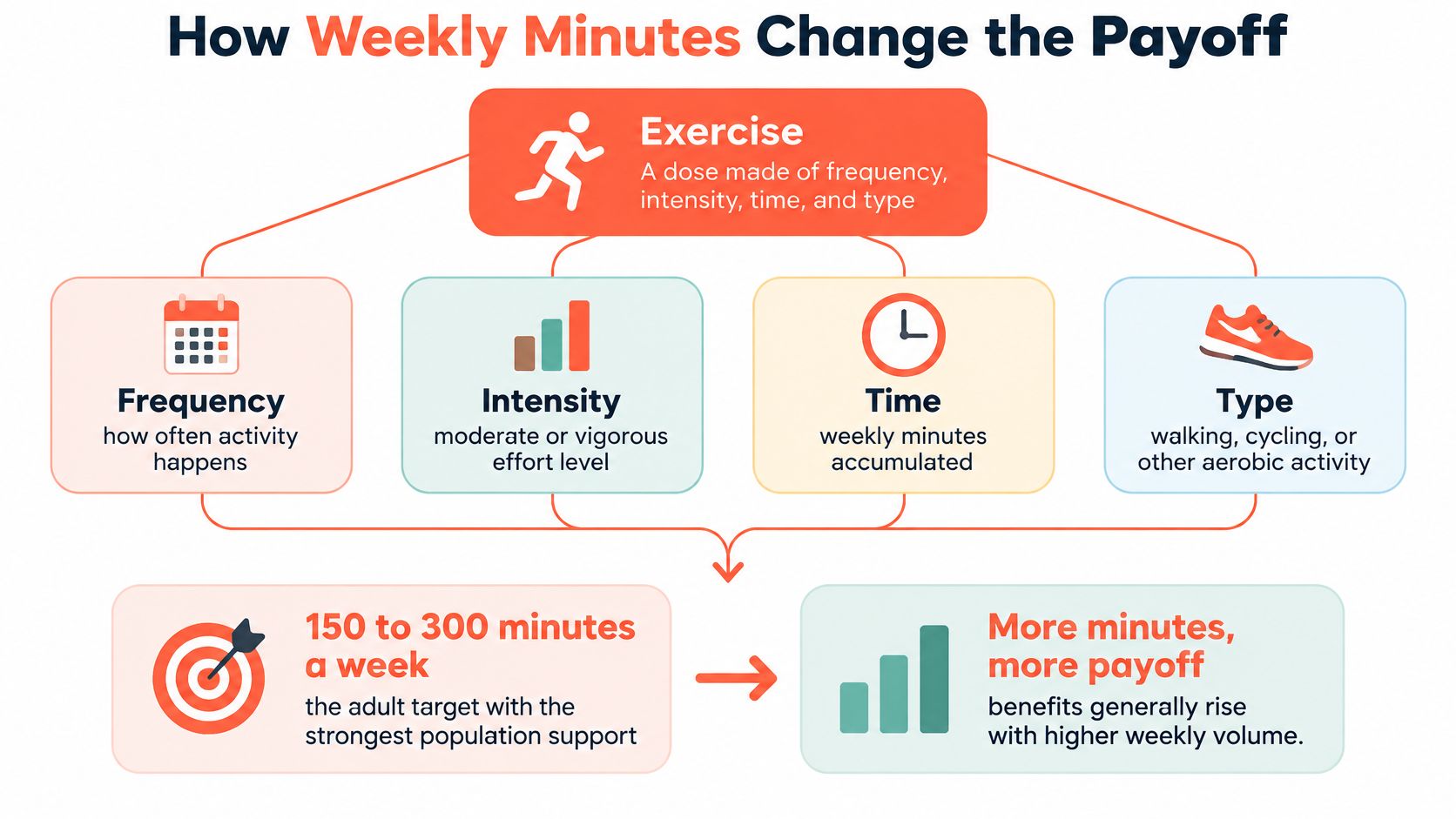
Write the dose as frequency, intensity, time, and type. “Move more” is not a prescription.
For adults, the target with the strongest population support is 150 to 300 minutes a week of moderate-intensity aerobic activity, 75 to 150 minutes of vigorous activity, or an equivalent mix, as set out in the WHO 2020 guidelines review. A useful clinic baseline is 30 to 60 minutes of moderate work on most days.
The short causal chain
Repeat the effort and the body adapts along one chain. Cardiac output and the oxygen demand of skeletal muscle rise during the session, and cardiorespiratory fitness improves over weeks. Alongside that, glucose uptake, blood-vessel function, and energy use get better, which is the cardiometabolic half of the same dose. You do not need a separate theory for blood pressure and another for diabetes risk. Both sit on that chain.
The dose curve is curvilinear. Benefits show up below the recommended range. They generally rise as weekly volume rises. At higher volumes the extra gain gets smaller. Minutes above 300 of moderate activity may still add something, but that advice is conditional, because nobody can name the exact minute where returns flatten.
A mix that hits the lower target
Say you walk at a brisk pace for 30 minutes on three days (90 moderate minutes) and add one 30-minute vigorous session, such as a hill walk or a hard cycle. Count the vigorous block toward the lower combined target rather than treating it as a separate sport. You are at the bottom of the adult range without stacking seven long workouts.
If you are sedentary, start inside a volume you can repeat. Some activity is consistently better than none. Build by symptoms, functional capacity, injury risk, and other conditions. Do not jump to 300 minutes because the top of the range looks more serious. This weekly range is the population dose tied to lower all-cause and cardiovascular mortality and to lower rates of some cancers and type 2 diabetes. A goal-specific dose, for glucose, falls, or muscle, is a different decision.
What Each Exercise Type Mainly Changes
Think of activity as a toolkit. The tools are not interchangeable, and buying a sharper one does not retire the others.
Brisk walking, cycling, or swimming is the daily maintenance tool. You should be able to talk, but singing should be hard. That moderate aerobic work is what drives cardiorespiratory fitness and blood pressure, and it is the volume behind the mortality and diabetes associations. Vigorous aerobic work spends fewer minutes for a similar fitness effect, once moderate sessions already feel tolerable.
Lifting keeps the frame from rusting. Two or more days a week for the major muscle groups is the pattern aimed at muscle mass, strength, bone loading, and glucose disposal. After midlife, the readouts that matter are grip and the ability to rise from a chair, not a mirror. Balance practice, often three or more days when you are older or unsteady, targets falls and confidence. It will not move a fitness score. Intervals are the sharp tool. Short hard efforts and easy recoveries, often 10 to 20 minutes, can raise fitness and insulin sensitivity quickly, but they spend the vigorous-minute budget and they ask more of recovery.
| Type | Weekly pattern | Primary markers | Best fit | Main watch-out |
|---|---|---|---|---|
| Moderate aerobic | 150–300 min, or part of a mix with vigorous minutes | Cardiorespiratory fitness, blood pressure, mortality and diabetes risk | Most adults, including beginners | Too little weekly time if walks stay very slow |
| Vigorous aerobic | 75–150 min, or an equivalent mix | Fitness and cardiometabolic risk in less time | People already tolerating moderate work | Needs a base and symptom checks |
| Resistance | 2 or more days, major muscle groups | Muscle mass, strength, bone load, glucose disposal, chair-rise ability | Adults keeping muscle for daily tasks after 40 | Poor form or loads jumped too fast |
| Balance | 3 or more days when unsteady or older | Fall risk and confidence | Adults 65 and over, or anyone who feels unsteady | Does not replace aerobic or strength work |
| HIIT | Short intervals inside the vigorous budget, often 10–20 min | Fitness and insulin sensitivity per minute | Time-poor adults who recover well | Higher strain; not the first step from sedentary |
| Combined plan | Aerobic base plus 2 strength days, balance if needed | Broad disease risk plus function | Most adults wanting broad disease risk and function | Treating one modality as the whole programme |
Where a lab test fits
A VO2 max test tells you whether the aerobic tool is changing fitness. It does not replace the two strength days, and a high score does not mean your balance work is done. Most adults who want both disease risk and function need the combined row: an aerobic base, strength twice a week, and balance when a fall is plausible.
If the full aerobic target is unrealistic this month, the plan shrinks. It does not disappear.
Plans When 150 Minutes Is Out of Reach
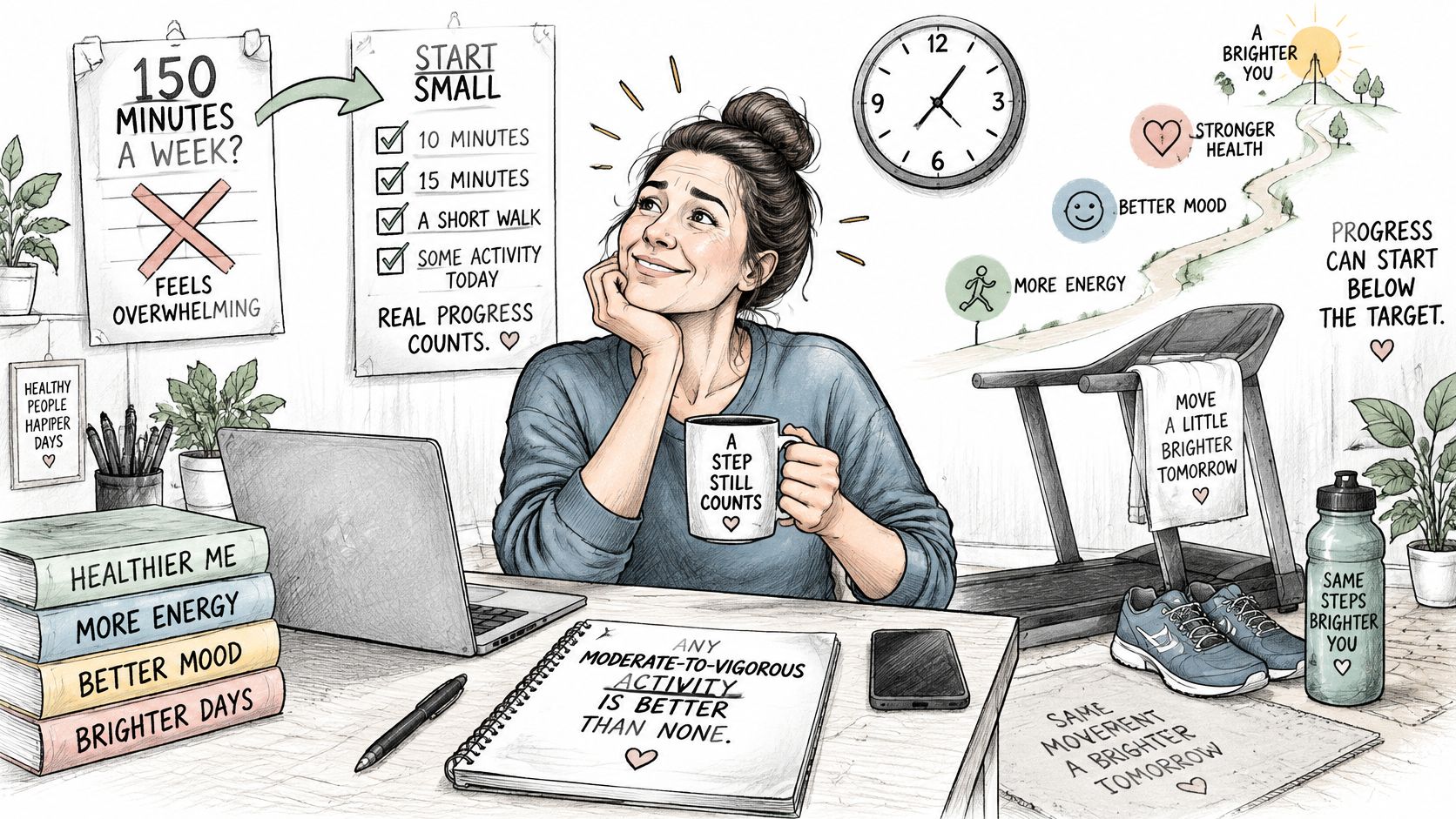
How much exercise is enough if 150 minutes will not happen? Measurable benefits begin below that line. Any moderate-to-vigorous activity is better than none, the American Heart Association review of activity and outcomes indicates. Updated U.S. guidance also states that even a single session can lower anxiety and blood pressure and improve sleep and insulin sensitivity. Benefits are incremental. They are not an all-or-nothing ticket.
Minutes no longer have to arrive in 10-minute bouts. They can add up across the day. That is why a short walk still counts.
Three people who are not failing
A sedentary 58-year-old. Two 10-minute walks after meals, five days a week, plus one sit-to-stand set. That is about 100 minutes before any extra errand. If the joints stay quiet, add five minutes every one to two weeks. Logging those walks the way you log meals, as in this look at tracking walks alongside daily health habits, keeps the dose visible when it still feels small.
A person in a pain flare. Keep daily range of motion and short flat walks. Drop intervals. Return toward the prior week only after pain is back at its usual baseline. The goal for that week is not to “catch up.”
A caregiver. Two 8-minute brisk walks and one 12-minute band session is about 28 minutes. Call it a real dose. Calling it a failure is how the week goes to zero.
Match the tool to the goal
Separate the population dose from a goal dose.
- Glucose control and fitness lean on aerobic minutes, even when they are short.
- Fall prevention leans on balance plus leg strength.
- Keeping muscle leans on resistance, including on weeks when walks are brief.
At the end of a bad week, protect the smallest session you can repeat, then rebuild frequency before intensity. These starts are for health. They are not a substitute for urgent care if you have chest pain, new breathlessness, or fainting.
A Weekly Plan for Adults Over 40
Here is one default week for a generally well adult from 40 to 70. Two swaps sit underneath it for travel, illness, or a joint flare.
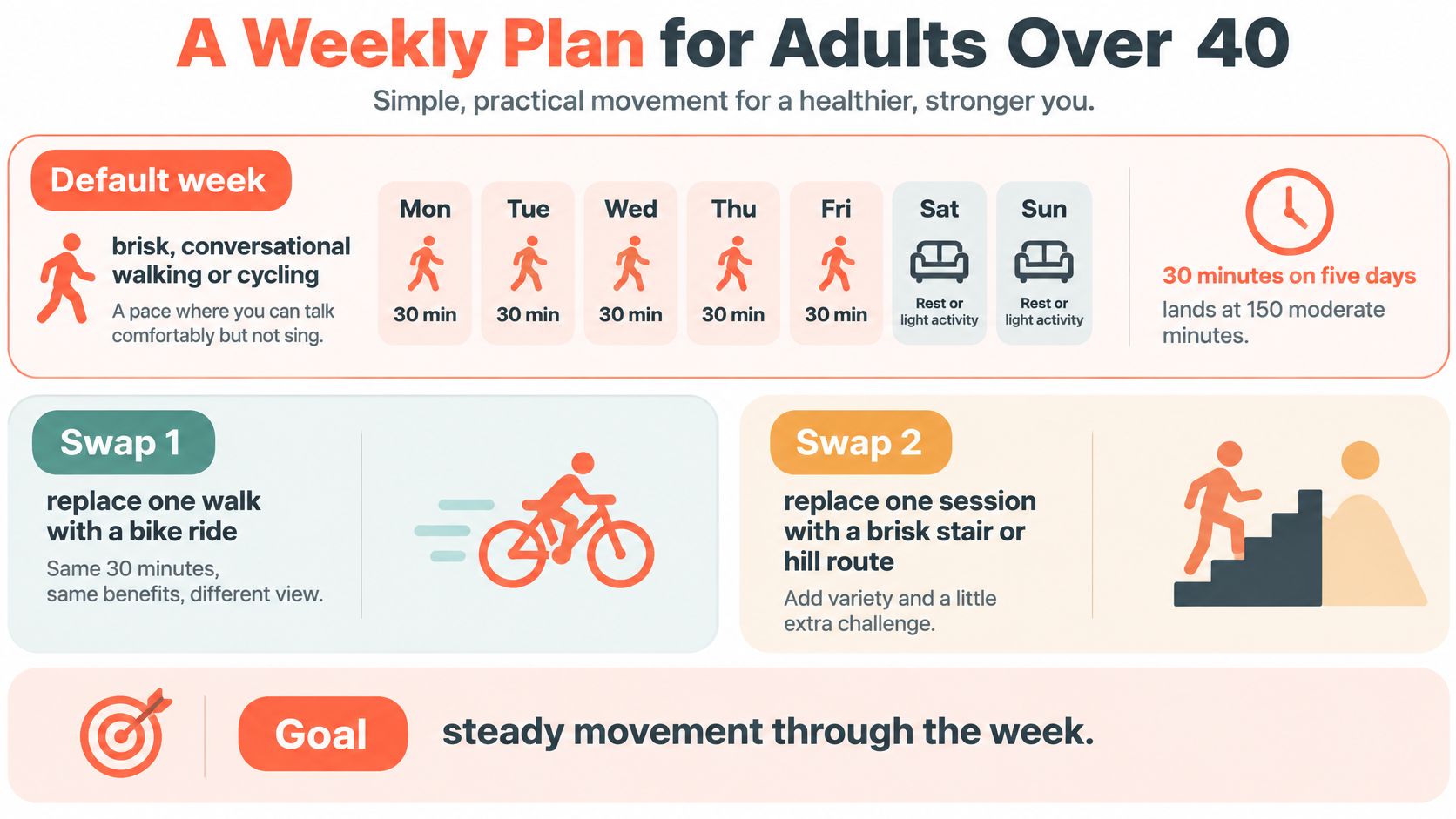
- Walk or cycle at a brisk, conversational pace for 30 minutes on five days. That lands on 150 moderate minutes, the floor of the population range.
- On two non-consecutive days, do a full-body strength session of about 30 to 40 minutes. Use a sit-to-stand or squat, a push, a pull, and a carry or hip hinge. Do two to three sets and stop with reps in reserve.
- If you are 65 or older, or you have had a near-fall, add balance on three days. Single-leg stands near a counter are enough.
- Only after two to four easy weeks, you can optionally replace one moderate session with short intervals that use part of the 75-minute vigorous budget.
- Keep at least one easier day. Do not raise both volume and intensity in the same week.
Progress by adding five minutes to the walks or one set to the lifts, not both at once. If the calendar is the constraint, a template for smarter workouts for busy schedules can hold the five walks and two lifts in one view so the easier day stays protected.
How you know the week is working
Judge the plan by function, not by soreness.
- Stairs feel easier at your usual pace.
- Your usual walk covers the same route a little faster.
- Chair rises take less effort, and you need less of a push from the arms.
- Sleep stays stable or improves. If sleep or resting heart rate worsens, take the optional intervals off.
Swap down to short bouts during travel, illness, or a joint flare. Stop the session and get clinical advice for chest pain, new severe breathlessness, fainting, or calf pain with swelling. This week is the credible baseline a longevity programme should be able to write down before it offers anything more exotic.
Where More Training Stops Helping
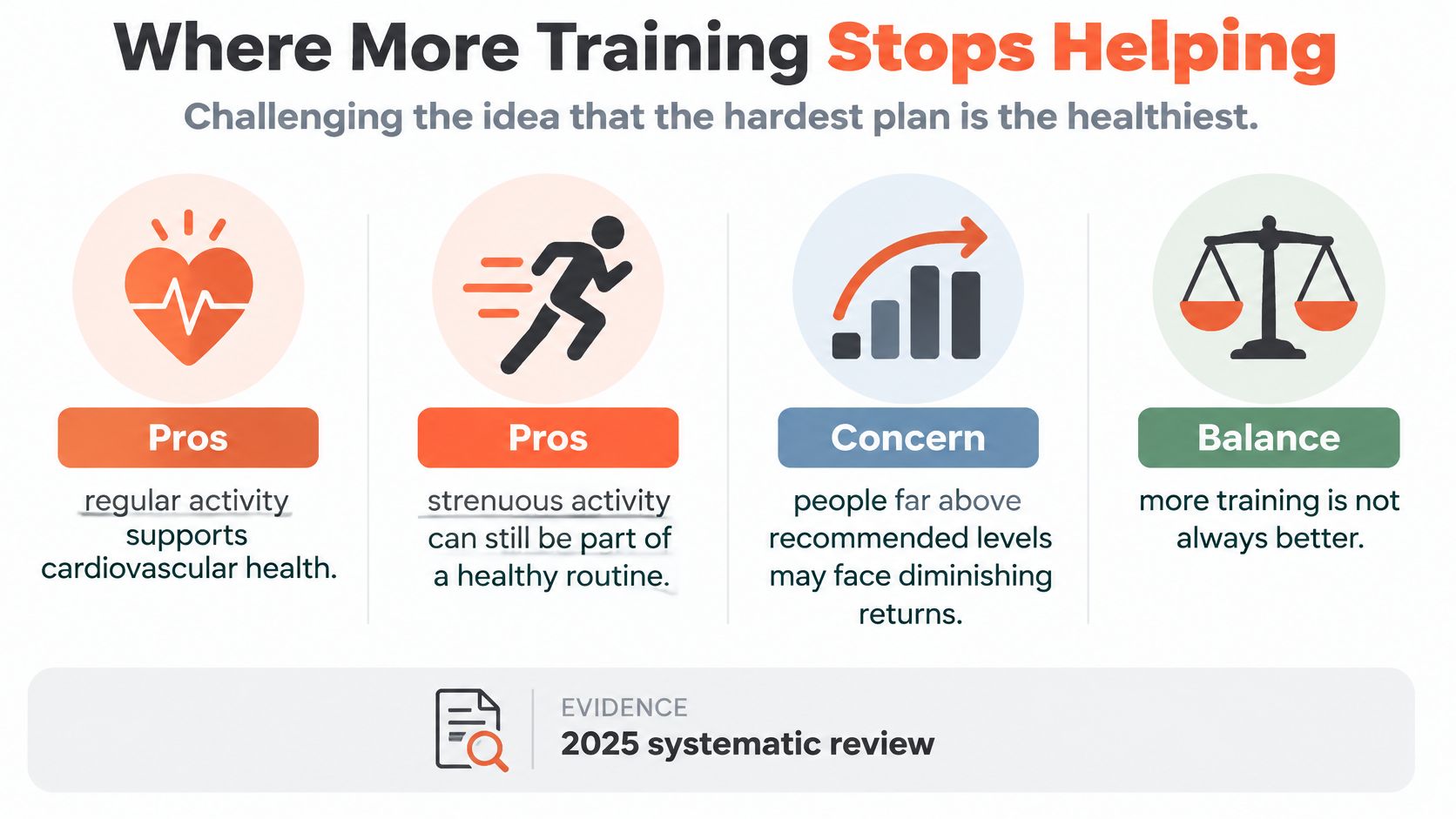
The hardest plan is not automatically the healthiest. A 2025 systematic review reports that regular physical activity, including strenuous activity, supports cardiovascular health, but people greatly exceeding guideline levels showed little additional benefit compared with people meeting lower levels.
What the plateau does not prove
That finding does not show that high volume is naturally harmful. It also does not cancel gains in performance, mood, or function. It does mean health advice should split athletic aims from longevity aims. Guideline targets are population recommendations, not an automatic prescription for every person.
Generic “exercise extends life” claims skip the trades. Incomplete recovery, overuse injury, poor sleep, illness after a sudden jump in load, and, where relevant, menstrual or other endocrine disruption all sit on the high-volume side of the ledger. Medical supervision matters more when you have symptoms, known cardiovascular disease, substantial other illness, or an abrupt rise in training load.
If resting performance is flat, sleep is worse, niggles are piling up, and you are already inside 150 to 300 moderate minutes or the vigorous equivalent, extra sessions have left the health zone.
For a reader tempted by a marketed extreme protocol, the better question is which marker is still unmoved: strength, balance, or basic aerobic fitness. Exercise is a dose-response problem, not a competition.
Judge the Exercise Plan Before You Enrol
Before you pay a residential stay or a membership, mark each line yes, partly, or no.
- The written plan names frequency, intensity, time, and type for each activity.
- It aims first at a 150-minute moderate aerobic base plus two strength days, and it treats 150 minutes as a population guide rather than a pass mark.
- It adds balance when falls are plausible, and it scales down for pain or a bad week.
- It screens before vigorous work when there are symptoms, known heart disease, or a sudden jump in load.
- It tracks function, such as walking capacity, chair rises, strength, and falls, not only blood panels.
- A named clinician adjusts the load and says when to stop.
Treat any protocol that equates extreme volume, daily intervals, or deprivation-style training with slower ageing with caution. Volume past the guideline range has shown little added health benefit. Experimental add-ons should be labelled as experimental, and they must not replace the activity dose already tied to cardiometabolic, cancer, and mood risk.
A published way to grade evidence ratings helps you see whether a claim is established care or an early idea. Directories such as Longevity Clinics score private programmes on diagnostic depth, supervision, conflicts, and evidence, which is one way to put a marketed week next to this scorecard before you enrol. Match the protocol to the six lines and to the default week above, then decide.
Pull the week you can repeat, write the minutes and the two strength days on a calendar, and score any paid programme against the six lines before you transfer a fee. If chest pain, fainting, or new severe breathlessness shows up, stop and get clinical care the same day rather than adjusting the plan yourself.