VO2 Max Test: What Your Results Actually Mean
Learn what a VO2 max test measures, how to prepare, and what your results say about your aerobic fitness and endurance.
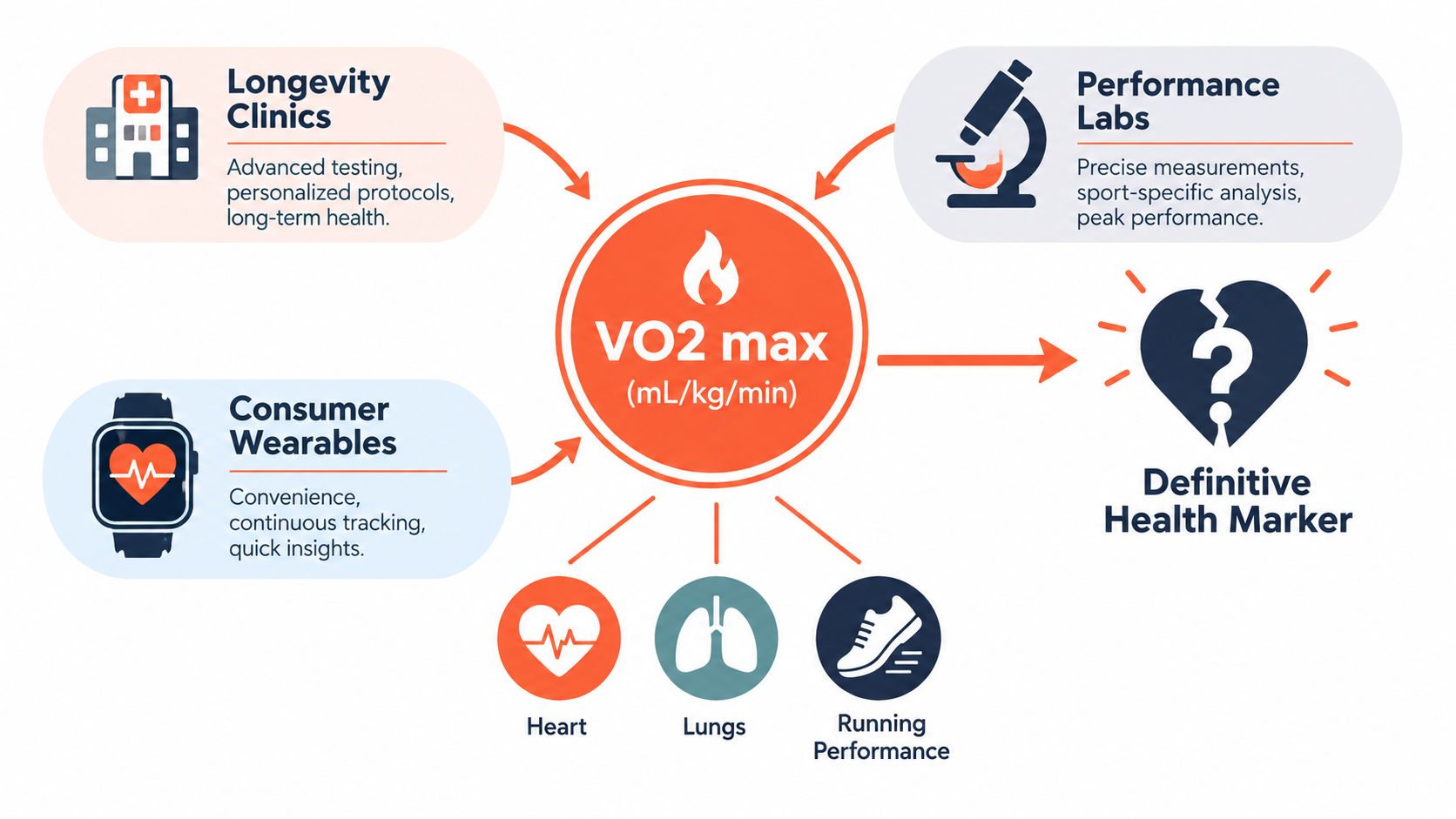
A high VO2 max is often presented as a verdict: proof of cardiovascular fitness, protection against disease, and perhaps even evidence of healthy aging. That interpretation is too broad. A VO2 max test measures the upper limit of oxygen use during strenuous exercise, but it doesn’t directly measure insulin sensitivity, arterial plaque, mitochondrial function, or every factor that shapes long-term health.
The measurement is valuable precisely because it captures an integrated physiological process. The problem begins when a laboratory result, a field estimate, or a smartwatch score is treated as interchangeable with the others. The number only becomes clinically meaningful when you know how it was produced, whether the test reached a true maximum, and what question you’re trying to answer.
Table of Contents
- Why One Number Won’t Tell You Everything
- What the VO2 Max Test Actually Measures
- Lab Versus Field and Wearable Methods
- How a Valid Lab Test Is Run
- VO2 Max, Cardiovascular Risk, and Longevity
- How Clinics Report and Act on Results
- Choosing the Right Test and Using the Result
Why One Number Won’t Tell You Everything
A high VO2 max is not a universal health score. It reflects the body’s capacity to move and use oxygen during maximal exercise, which makes it relevant to cardiorespiratory performance and cardiovascular risk. It doesn’t certify that every other system is working well.
A person can have strong aerobic capacity and still need evaluation of glucose regulation, blood lipids, blood pressure, body composition, or symptoms during exertion. A recent review argues that VO2 max is strongly prognostic for cardiovascular risk and mortality, while also cautioning that it may be less specific and less sensitive for metabolic health, mitochondrial function, and the broader concept of longevity. That review of VO2 max and metabolic health supports a narrower interpretation: the score is important, but it isn’t a complete biological summary.
The same caution applies in the opposite direction. A modest relative score may reflect age, body mass, test modality, or limited exercise exposure without revealing the full state of a person’s health. Normative interpretation must account for age and sex, rather than applying one universal threshold to every subject. A result also changes meaning depending on whether the goal is athletic programming, clinical risk assessment, or general self-monitoring.
The number depends on the question
A performance laboratory may ask how much oxygen an athlete can use at exhaustion. A clinician may be more interested in exercise tolerance, symptom reproduction, ventilatory behavior, or whether the test reached a defensible maximum. A consumer may want to know whether a training block is moving the estimate in the right direction.
Those are different questions. They don’t require the same level of precision.
For example, a wearable trend can be useful when the same person exercises under broadly comparable conditions. It becomes much less reassuring when someone uses the value to rule out disease or to compare themselves with another person tested on a different device. The strongest result still needs context, and the weakest result still needs verification before it becomes a diagnosis.
Analytical rule: Treat VO2 max as one high-value signal, not as a substitute for a broader clinical assessment.
The metric has a distinguished history. Scientific VO2 max testing became grounded in the 1920s, when Archibald Vivian Hill and colleagues measured inhaled and exhaled air during exercise, establishing the link between exercise intensity and oxygen consumption. The extreme end of the scale is illustrated by documented values of 96.0 ml/kg/min for Bjørn Dæhlie in 1991 and 96.7 ml/kg/min for Oskar Svendsen on August 27, 2012, as described in this history of VO2 max physiology. Those values demonstrate the range of human endurance capacity, not a health threshold that everyone should pursue.
For readers comparing VO2 max with other assessments, even a detailed body-composition scan answers a different question. A DEXA scan for body composition can add context about lean mass and fat distribution, but it doesn’t replace a direct exercise measurement. The useful interpretation comes from combining complementary signals without pretending they measure the same thing.
What the VO2 Max Test Actually Measures
VO2 is the volume of oxygen the body consumes during exercise. In practical terms, it describes the rate at which oxygen moves from the air into the lungs, travels through the bloodstream, reaches active muscle, and is used to support energy production.
A helpful analogy is a fuel-delivery system. VO2 max is the maximum delivery rate, not the size of the fuel tank. The lungs bring oxygen into the body, the heart and blood vessels deliver it, and working muscles extract and use it. A limitation anywhere in that chain can constrain the final value.
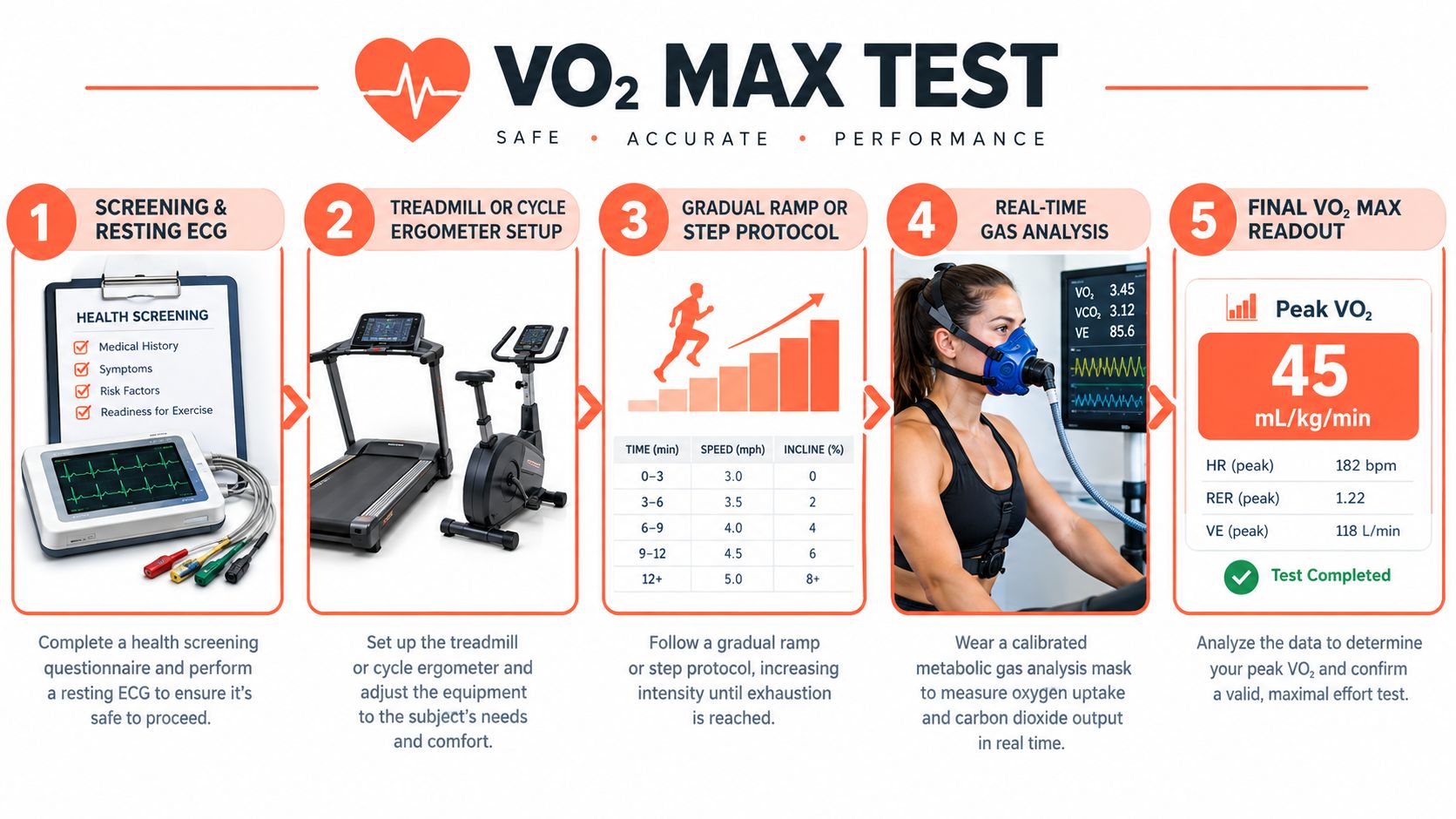
A laboratory VO2 max test measures the process directly. The subject exercises on a treadmill or cycle ergometer while breathing through a mask connected to a calibrated metabolic cart. The equipment analyzes inhaled and exhaled gases breath by breath, including oxygen uptake and carbon-dioxide output, while the workload rises progressively. The overview of VO2 max assessment methods describes direct testing as the reference approach in clinical and sports-medicine settings.
What the report usually contains
The headline value is commonly expressed as relative VO2, in milliliters of oxygen per kilogram of body mass per minute. This format helps compare people with different body sizes, but it also means body mass affects the reported score.
A report may also include:
- Absolute VO2, usually expressed as oxygen consumed per minute without dividing by body mass.
- Heart-rate response, which shows how pulse changes as workload rises.
- Respiratory exchange ratio, calculated from oxygen uptake and carbon-dioxide output.
- Ventilatory thresholds, which help identify transitions between exercise intensities.
- Peak workload and test duration, useful for judging whether the protocol was appropriate.
- The evidence that maximal effort was reached, rather than assuming the final recorded value was automatically VO2 max.
The distinction between VO2 peak and VO2 max matters. If oxygen consumption plateaus despite an increasing workload, the result has stronger evidence of a true maximum. If the subject stops before a plateau, the laboratory may report a peak value, then use additional criteria or a verification phase to assess whether the measured capacity was close to the maximum.
What the mask captures, and what software estimates
The metabolic cart measures gas exchange. It doesn’t directly measure mitochondrial density, arterial plaque, or insulin action. Software may derive thresholds and summary metrics from the measured signals, but those outputs remain dependent on calibration, signal quality, protocol design, and effort.
That is why a report should be read as a chain of evidence. Start with the raw testing conditions, then examine the workload progression, gas data, heart-rate response, and maximality criteria. The final number is the endpoint of that chain, not an independent fact detached from it.
The result can be clinically useful without being all-encompassing. It tells you how the integrated oxygen-transport system performed under a specific stress, on a specific day, with a specific protocol.
Lab Versus Field and Wearable Methods
A high VO2 max score is not automatically a precise measurement, and a precise measurement is not a complete health assessment. The phrase “VO2 max test” covers methods that differ in what they measure directly, how much they infer, and how much individual error they introduce. A metabolic cart measures respiratory gases during graded exercise. A field test infers capacity from a performance task. A wearable estimates the value from signals such as heart rate, pace, workload, and user characteristics.
These methods can serve different purposes. A laboratory test is the reference standard when precision matters, while field and wearable methods are more practical for screening and tracking change. None of them, including a lab test, establishes mitochondrial health or rules out metabolic disease from the VO2 max value alone.
| Method | Typical Error | Equipment Needed | Best Use Case |
|---|---|---|---|
| Laboratory graded exercise test | Reference measurement, with validity dependent on calibration, protocol, and maximality | Treadmill or cycle ergometer, metabolic cart, mask, heart-rate monitoring, trained supervision | Clinical assessment and precise performance testing |
| Field performance test | Typical error of roughly 5-10% versus laboratory measurement, varying by protocol and population | Running route, track, step, or shuttle-test setup, plus timing and heart-rate tools | Accessible baseline screening and practical training assessment |
| Wearable-derived estimate | Agreement varies by training status, with larger individual error in highly trained users | Smartwatch or fitness device with heart-rate and activity sensors | Directional trend tracking under consistent conditions |
Laboratory testing measures oxygen uptake directly
In a graded laboratory test, oxygen uptake and carbon-dioxide output are measured breath by breath as exercise intensity increases. The result therefore does not depend solely on an equation predicting oxygen use from pace, heart rate, or demographic data.
The equipment does not remove every source of uncertainty. A poor mask seal, incorrect calibration, unsuitable workload progression, or early termination can weaken interpretation. Laboratory status describes the measurement setting and instruments. It does not guarantee that the reported value represents a defensible maximum.
Field tests trade precision for access
A timed run, shuttle test, or step test shows how someone performs under a defined challenge. That result can establish a baseline or show broad change when laboratory access is impractical.
The limitation is inference. Field testing does not analyze inspired and expired gases. It applies a performance equation or comparison framework, so the estimate depends on pacing, motivation, terrain, weather, technical skill, and the population used to create the equation. A field value should be labeled an estimate rather than presented as equivalent to gas analysis.
Wearables are strongest as repeated signals
Wearables provide frequent observations under ordinary training conditions. A 2025 review found that estimates based on exercise data are generally more accurate than estimates based on resting data, while another validation study found smartwatch estimates were valid in moderately trained athletes but less valid in highly trained individuals. The wearable VO2 max evidence review supports a restrained interpretation: a device can show a useful direction over time while still being meaningfully wrong for one person on one day.
Use the watch to ask whether the estimate is moving under similar conditions. Do not treat a strong score as proof of normal insulin action, healthy mitochondria, or the absence of cardiovascular risk. A wearable is most informative when its trend is consistent with training history and, where the decision matters, checked against a laboratory result.
How a Valid Lab Test Is Run
A defensible laboratory test begins before the subject starts exercising. The operator reviews health history, current symptoms, medications, recent training, and contraindications. Depending on the setting and clinical purpose, the assessment may include resting measurements and an ECG before exertion.
The treadmill or cycle ergometer should match the subject’s experience and the question being asked. A runner may produce a more representative result on a treadmill, while a cyclist may tolerate and express maximal effort better on a cycle ergometer. The choice affects local muscular fatigue, familiarity, balance, and the ability to sustain the protocol.
The workload must rise for a reason
Incremental protocols commonly increase workload every 1 to 3 minutes, with the overall intense portion designed to reach exhaustion in roughly 8 to 12 minutes. This duration balances cardiovascular strain against local muscular fatigue, according to the review of graded exercise and verification protocols.
A progression that is too aggressive can stop the test because of local discomfort before the cardiovascular system reaches its ceiling. A progression that is too slow can create unnecessary fatigue or make the subject stop for reasons unrelated to maximal oxygen delivery. Protocol design isn’t a minor technical detail. It shapes the value being measured.
The subject breathes through a fitted mask while the metabolic cart records gas exchange continuously. The operator watches the signals in real time, checks equipment calibration, monitors heart rate and symptoms, and documents the workload at each stage.
Maximality requires more than exhaustion
A subject saying “I can’t continue” is important, but it isn’t the only evidence. A valid interpretation usually considers a combination of:
- A VO2 plateau, meaning oxygen uptake stops rising meaningfully despite additional workload.
- A respiratory exchange ratio around 1.10 or higher, indicating substantial exercise intensity.
- Heart rate close to the age-predicted maximum, interpreted with caution because prediction equations vary and medication can alter response.
- A very high perceived exertion, recorded alongside the objective data rather than used alone.
No single marker should carry the entire conclusion. A subject can reach a high respiratory exchange ratio without showing a clear plateau, or stop because of leg fatigue before the cardiovascular response is fully expressed. A review of maximality criteria notes that relying on criterion combinations can underestimate measured maximum by up to 26% when a plateau is absent. The detailed discussion of VO2 max verification criteria explains why the report should state how maximality was judged.
Some laboratories add a verification phase after the incremental test. This additional bout can help determine whether the initial test ended below the true maximum, particularly when the plateau criterion is unclear.
Practical reading rule: A number without the protocol, calibration information, workload profile, and maximality evidence is an incomplete test report.
VO2 Max, Cardiovascular Risk, and Longevity
VO2 max earns its reputation because it captures an integrated response from the heart, lungs, circulation, and active muscle. People who can sustain higher oxygen use generally demonstrate greater exercise capacity, and the measure has a strong relationship with cardiovascular outcomes and mortality in the evidence summarized above.
That relationship is clinically meaningful, but it isn’t the same as proof of causation for every individual. A high score identifies strong performance in one physiological domain. It doesn’t show that a person has no atherosclerosis, normal glucose handling, favorable lipids, or healthy mitochondrial function.
What the measure can support
A properly measured result can help clinicians and coaches assess aerobic capacity, compare performance with appropriate reference groups, identify a baseline, and observe change after an intervention. It may also contribute to cardiovascular risk discussions when interpreted alongside symptoms, medical history, blood pressure, medication, and other established measures.
The strongest interpretation is comparative and contextual. A value should be considered against age and sex norms, body mass, training history, protocol type, and whether the test reached a defensible maximum. The same numerical result can imply something different in a young endurance athlete, an older adult, and a patient taking medication that affects heart-rate response.
| Study / Cohort | Population | Risk Metric | Key Finding |
|---|---|---|---|
| Recent review of VO2 max and health outcomes | People assessed through exercise capacity and health-outcome research | Cardiovascular risk and mortality | VO2 max is strongly prognostic for cardiovascular risk and mortality, but isn’t a complete measure of metabolic or mitochondrial health |
| Clinical and sports-medicine reference testing | People completing graded exercise tests | Measured aerobic capacity | Direct gas analysis is the reference approach when precise oxygen-uptake measurement is required |
| Wearable validation research | Moderately and highly trained individuals | Agreement between device estimates and laboratory measurement | Wearable validity can vary by training status, so individual interpretation requires caution |
Where the longevity interpretation breaks
A strong endurance athlete can have an impressive VO2 max while still requiring ordinary medical evaluation. Aerobic capacity doesn’t directly quantify insulin sensitivity, lipid metabolism, mitochondrial density, or the presence of coronary disease. It also doesn’t establish that a person has a favorable overall risk profile.
The reverse is true as well. A lower value may reflect age, body mass, protocol familiarity, or a test that ended before a true maximum. It should prompt interpretation, not an automatic label.
This is the contrarian point that many longevity discussions miss: VO2 max is a powerful cardiovascular signal, but it is not a full-body health score. A responsible assessment pairs it with the clinical measures relevant to the person’s risk and goals. The score can strengthen a decision, but it shouldn’t be allowed to erase contradictory evidence.
How Clinics Report and Act on Results
A useful clinic report does not present VO2 max as a self-explanatory score. It identifies whether the value came from direct gas analysis, a field protocol, or a wearable estimate, then records the reference population, workload progression, heart-rate response, and evidence that the subject reached maximal effort. Those details determine how much confidence the number deserves.
Relative VO2 is typically reported in ml/kg/min. Absolute oxygen uptake is reported without dividing by body mass, so it can reveal a different pattern when weight or body composition changes. A report that includes both values gives clinicians more context than a relative score alone.
Reference ranges need context
Normative charts vary by age and sex, so one universal cutoff can misclassify performance. For men aged 20 to 29, values above 52.4 ml/kg/min are typically placed in the excellent or superior range. For women in that age group, the corresponding threshold is above 49.6 ml/kg/min. Among adults aged 60 and older, the top category begins around 31.4 ml/kg/min for men and 36.7 ml/kg/min for women, as summarized in the clinical guide to VO2 max assessment.
| Age Group | Men: Excellent or Superior | Women: Excellent or Superior |
|---|---|---|
| 20 to 29 | Above 52.4 ml/kg/min | Above 49.6 ml/kg/min |
| 60 and older | Around 31.4 ml/kg/min and above | Around 36.7 ml/kg/min and above |
This compact table shows the age and sex differences directly. These are reference bands, not diagnoses. The clinic should name the reference system used and avoid combining thresholds from unrelated populations.
The method also affects interpretation. A laboratory result based on gas exchange can support a more precise clinical discussion than a wearable estimate, even when both display the same unit. If a wearable-derived value changes sharply without a comparable change in test conditions or performance, the report should treat that shift as a signal to verify, not as proof of physiological change.
The useful report is longitudinal
A single test is a snapshot. Comparable tests over time can show whether aerobic capacity is stable, rising, or falling, provided the protocol, preparation, and measurement method remain reasonably consistent.
A useful report may include:
- A trend view, using the same modality and comparable preparation when possible.
- Ventilatory thresholds, which can guide training intensity.
- Heart-rate behavior and recovery, interpreted with the test conditions.
- A maximality statement, clarifying whether the result is VO2 max or only a peak value.
- A clinical interpretation, separating cardiovascular capacity from broader metabolic questions.
People reviewing broader longevity medicine approaches should be cautious with reports that use promotional language without showing protocol details. A percentile cannot compensate for an unclear test method.
Choosing the Right Test and Using the Result
Choose the method based on the decision you need to make, not on which device produces the highest number. If a clinician needs precise exercise physiology, symptoms assessed under supervision, or a defensible measure for risk discussion, a laboratory cardiopulmonary exercise test is the appropriate level of measurement.
If the goal is an accessible baseline for a generally healthy person, a field protocol may be adequate. It can show how someone performs under repeatable conditions and provide a starting point for training. The result should remain labeled as an estimate.
A wearable serves a narrower purpose. It can show a directional trend when the same device, activity type, terrain, and measurement conditions are used repeatedly. It shouldn’t be treated as a diagnostic reading or as a replacement for gas analysis when individual precision matters.
Match the error to the decision
A decision matrix makes the distinction clearer:
| Modality | Best For | Typical Accuracy vs Lab | Setting | Relative Cost |
|---|---|---|---|---|
| Laboratory CPET with metabolic cart | Clinical assessment, precise training-zone work, and investigation requiring direct gas analysis | Reference standard when validly conducted | Medical, sports-medicine, or specialist laboratory | Highest |
| Field performance test | Accessible screening and repeatable training baseline | Less direct, with error dependent on protocol and population | Track, road, gym, or supervised field setting | Low |
| Wearable estimate | Directional monitoring across repeated exercise sessions | Individual agreement can be limited, especially in highly trained users | Daily life and routine training | Low to moderate |
The most useful rule is simple: the higher the consequence of the decision, the more direct the measurement should be. A wearable trend may guide a training conversation. It shouldn’t settle a clinical question. A field estimate may help identify a change in performance. It shouldn’t be compared directly with a laboratory value as though both came from the same instrument.
Interpret a low or high result carefully
A low result can justify clinical follow-up when it appears alongside exertional chest discomfort, unusual breathlessness, fainting, abnormal heart-rate behavior, or a clear decline from a previously comparable test. Symptoms and medical history determine urgency, not the number alone.
When no warning signs are present, a low result may instead support a structured training response, followed by repeat assessment under comparable conditions. The test should be reviewed first for protocol quality, maximality, device limitations, and body-mass effects.
A high result doesn’t end the assessment. If the person’s broader health question concerns metabolic or mitochondrial function, the VO2 max result needs to sit beside the relevant clinical data. A strong aerobic score can coexist with risks that the exercise test wasn’t designed to measure.
Decision principle: Repeat the same question with the same level of measurement. Don’t use a precise laboratory test once, then judge progress with an unvalidated wearable estimate.
For readers considering a broader concierge medical model, the important standard isn’t the number of tests offered. It’s whether each test has a defined purpose, a credible method, transparent limitations, and a plan for acting on the result. Before booking a VO2 max test, ask which device will measure gas exchange, how maximal effort will be verified, which reference standards will be used, and what decision the result is expected to change.
If you want to compare how private longevity programmes handle exercise testing, metabolic assessment, supervision, and follow-up, review the independent evaluations published by Longevity Clinics at longevity-clinics.co. Use the directory to compare diagnostic depth and programme structure, then ask each provider to show exactly how a VO2 max result will influence your care.