Biological Age Test Cost 2026: Prices, Drivers and Value
Biological age test cost ranges from about $50 to over $1,000. See what each price includes, what drives it up, and when retesting pays off.
Biological-age tests span distinct price bands: roughly $50–$200 for a blood-panel estimate, $229–$499 for a direct-to-consumer kit, and $400–$850 for some epigenetic or glycan-based tests. Advanced or clinically bundled offerings can exceed $1,000, according to a published comparison of biological-age test options. These figures describe what providers charge, not what the tests have proved.
Market reporting also describes products priced around $30 at the lower end and above $1,000 for advanced or clinically bundled offerings. Direct-to-consumer kits were commonly priced at approximately US$229 to US$499. A low-cost panel and a high-priced programme can both report a biological-age score, while including different assays and levels of clinical support. Medscape’s review of epigenetic clocks examines the methods and limitations behind those scores.
Price alone does not establish accuracy or clinical value. The relevant comparison is what the test measures, who interprets the result, and whether repeating it would change a care decision. A biological-age test’s total cost may combine a laboratory method with clinical services, but providers do not always itemise those parts separately.
Table of Contents
- Biological Age Test Prices at a Glance
- Compare What Each Test Type Measures and Proves
- Why One Price Never Covers the Test
- Price Ranges by Region and Provider Type
- Retesting Costs and When a Repeat Is Worth It
- Matching Test Spend to Your Situation
- Confirm the Value Before You Pay
Biological Age Test Prices at a Glance
Prices cluster by test type far more than by brand, which is why any single “typical” figure misleads. Consumer pricing splits into four bands, from about $50–$200 for a conventional blood panel to $400–$850 for some epigenetic or glycan-based tests, with direct-to-consumer biological-age products at roughly $229–$499, according to a published comparison of biological-age test options. The same comparison notes that one low-cost panel lists $59.99 plus a processing fee, while other offerings fold specialist consultation or bundled follow-up testing into the headline figure.
Biological age test price ranges by test type
| Test type | Typical price | What it measures | Often billed separately |
|---|---|---|---|
| Blood-panel age estimate | $50–$200 | Age estimate from routine biomarkers | Blood collection and clinician interpretation |
| Direct-to-consumer kit | $229–$499 | Biological-age score from a mail-in sample | Shipping, physician review, consultation |
| Epigenetic or glycan-based test | $400–$850 (provider-dependent) | DNA-methylation or glycan signal | Repeat testing and bundled follow-up |
| Advanced or clinically bundled offering | More than $1,000 | Several clocks, organ-age reporting, physician interpretation | Follow-up services and memberships |
Read the last column before the second. The $50–$200 panel buys an assay; the blood draw and the read are frequently extra. A $229–$499 kit adds home collection, and the shipping or physician review usually arrives as a separate line. At $400–$850, repeat testing and bundles are where the total climbs, and above $1,000 you’re paying for multiple clocks, organ-age reporting and a clinician’s interpretation, with follow-up services and memberships stacked on top.
The sources don’t fully agree on the middle of that range. Dataintelo’s epigenetic clocks market report put commercial direct-to-consumer epigenetic age tests at approximately $129–$399 per test cycle in 2025, below the $400–$850 band above, so treat that row as provider-dependent rather than fixed and expect quotes to diverge between sellers.
We’ve compared 232 tests across the programmes we track, and the pattern is consistent: the assay type explains most of the price gap, and the brand explains very little. Match the price to the test type first, then compare what’s included. Comparing stickers across providers before those two steps is how buyers end up paying $499 for a score built on the same signal a cheaper kit reports.
Compare What Each Test Type Measures and Proves
The bands above only make sense once you know what each assay reads, because two tests at the same price can measure unrelated biology. A blood-panel estimate, a methylation clock and a glycan score all produce a number labelled biological age, and those numbers aren’t interchangeable.
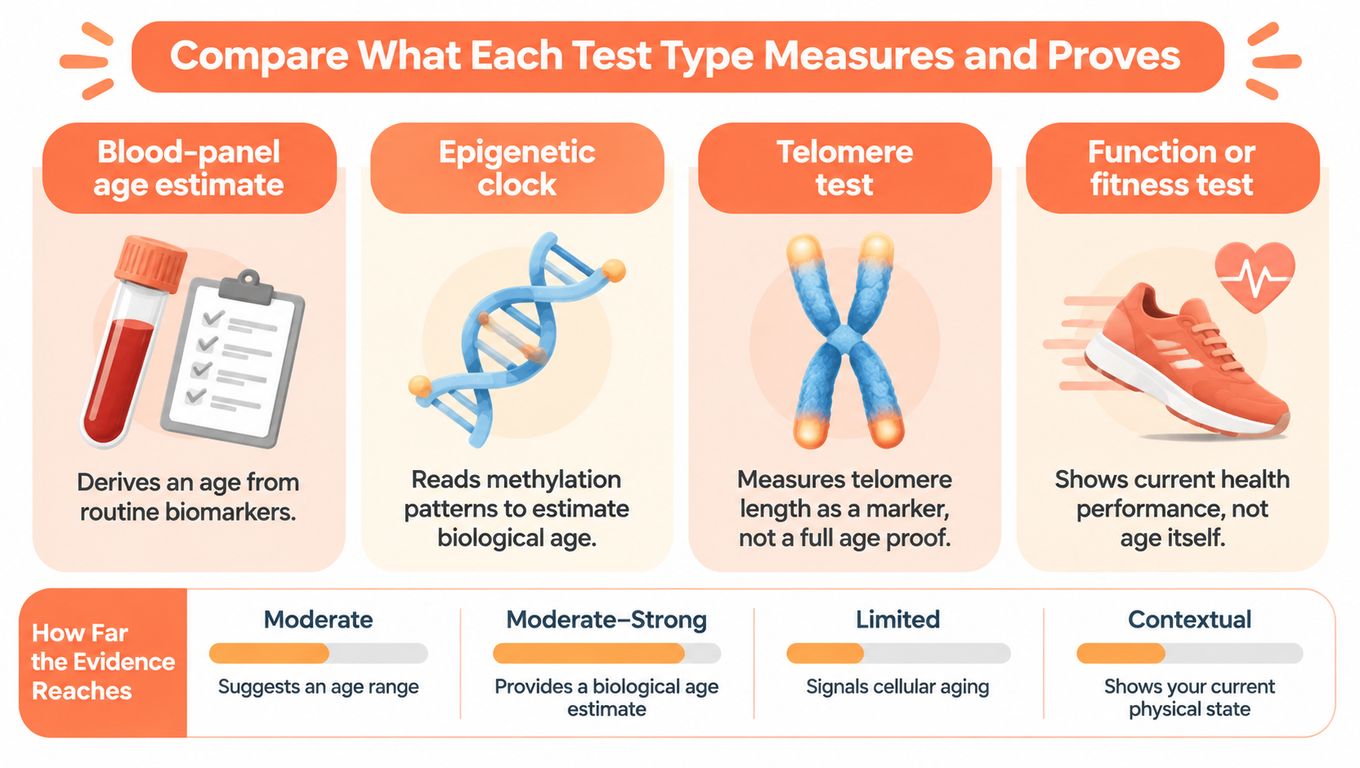
Here’s how the four main categories compare on signal, price and evidence.
What each test type measures and how well it is validated
| Test type | What it measures | Typical price | Evidence status and limits |
|---|---|---|---|
| Blood-panel age estimate | Age estimate from routine biomarkers | $50–$200 | Familiar data, but no dedicated aging signal |
| DNA-methylation (epigenetic clock) test | Methylation patterns, several clocks per sample | $229–$499 direct-to-consumer; $400–$850 for some tests | Longest research history; clinical validation still debated |
| Glycan-based test | Glycan signal | $400–$850 | Scores not directly comparable with other methods |
| Multi-omic panel | Several combined data layers | Priced as a package above a single-clock test | Evidence varies by panel and provider |
A biological-age score is a measurement, not a diagnosis. No row in this table changes that.
What a blood-panel age estimate actually reads
Routine blood chemistry, mostly. A cheap panel takes lipids, glucose, a complete blood count and a few inflammatory markers, then applies an algorithm to produce an age estimate. It costs what it costs because it reuses data a standard physical already generates and adds no dedicated aging assay. The markers are still worth understanding on their own terms, and key metabolic biomarkers explained is a clear reference for what each one tracks.
Where DNA-methylation clocks sit
Methylation testing measures chemical tags attached to DNA at hundreds of thousands of sites, then runs those patterns through a clock algorithm. One sample can be pushed through several published clocks and return several different ages, and the gap between those numbers is the most honest precision estimate most buyers will ever see. Clinical validation is still debated, which is a different claim from invalid.
Why glycan and multi-omic scores don’t translate
Glycan tests read complex sugars attached to antibodies, a signal tied to inflammatory biology rather than to methylation. A glycan score and a methylation score can’t be lined up against each other, and a drop in one doesn’t predict a drop in the other. Multi-omic panels stack several layers into a single report, which raises both the price and the interpretation burden in the same step.
The practical consequence is simple. Ask which clock or method produced the score before you compare two quotes, and treat a number from one method as unrelated to a number from another. Our explainer on longevity testing shows how clinic programmes assemble these panels into a wider workup, which is where most of the money in a bundled programme sits.
Why One Price Never Covers the Test
In 2025, KMBC reported direct-to-consumer biological-age tests at $200 to $500, and AgeFinder put mail-in epigenetic kits at $299–$499. Both figures are defensible, and neither is a quote you can act on, because each answers a different question about the same purchase.
What changes the final bill
| Cost driver | Typical price effect | What it adds | What to check |
|---|---|---|---|
| Sample type | Saliva and blood run through different lab pipelines at different fees | A different assay and sample-handling step | Whether the cheaper product covers the same clocks |
| Number of aging clocks | More clocks inside one fee, rarely a separate line item | Several estimates from one sample | Whether each clock is validated for your purpose |
| Physician interpretation | A consultation charge on top of the lab fee | Clinician review of the result | Whether the review is in the quoted total |
| Repeat testing | A full test fee at each interval | Trend tracking across visits | Whether the bundle price is total or per test, and the 24-month cost |
| Volume pricing | A lower price per kit when you buy two or more | Cheaper cost per result | Whether you will actually retest |
| Mail-in kit | A home-collection premium over a clinic draw | Home sample collection | Shipping and processing charges |
Sample type and clock count
Saliva collection and a venous draw run through different lab pipelines, so the sample isn’t a preference, it’s a different assay with a different fee attached. Before you take the cheaper option, confirm it covers the same clocks rather than a reduced panel. Adding clocks to a report adds estimates, not validated information, and a provider who runs five clocks and averages them is selling breadth rather than certainty.
Interpretation and the 24-month total
A physician review is a consultation charge stacked on a laboratory charge, and it’s also the only part of the purchase that can convert a score into a clinical decision. Volume pricing works the same way: a second kit priced below the first saves money only if you were going to retest regardless. Private-clinic pricing in neighbouring categories follows an identical structure, quoting consultation, product and follow-up as separate lines, and ProMD Health Easton’s peptide therapy pricing guide shows how those components get split apart in practice.
We take no payment, gift or commission from any clinic, which is why we can say plainly that the most expensive line items are often the least clinical. Each profile we publish is built from publicly available data such as websites, regulator records, peer-reviewed literature and professional registries, scored against a four-axis rubric, and validated by physicians and editors.
Compare the 12-month total, not the headline. If two quotes both say “$399” and you can’t tell which one includes the draw, the review and a retest, neither number is comparable to the other.
Price Ranges by Region and Provider Type
In the US market, biological-age testing ranges from about $50–$200 for blood panels to $229–$499 for direct-to-consumer kits. Epigenetic or glycan tests typically cost $400–$850, while clinically bundled programmes can exceed $1,000. These bands reflect different products: a lab result, a mail-in kit, or a programme that may include clinician time and follow-up.
The figures are in US dollars, and the available prices do not establish reliable differences by country or city. Outside the United States, ask for a written quote in your currency and check whether shipping and sample handling are included.
Ask for the quote in writing. Request itemised fees for the test, collection and interpretation so you can see what the price covers.
Provider type helps explain the gap. A mail-in kit may deliver a laboratory result through a dashboard; a clinic programme can add a clinician’s time and a care plan. Longevity Clinics’ independent reviews of longevity programmes compare programme formats and regions, rather than treating unlike services as equivalent based on headline prices.
Ask each provider for the retest price as well as the initial total. A biological-age score does not, by itself, establish that repeating the test would change care.
Retesting Costs and When a Repeat Is Worth It
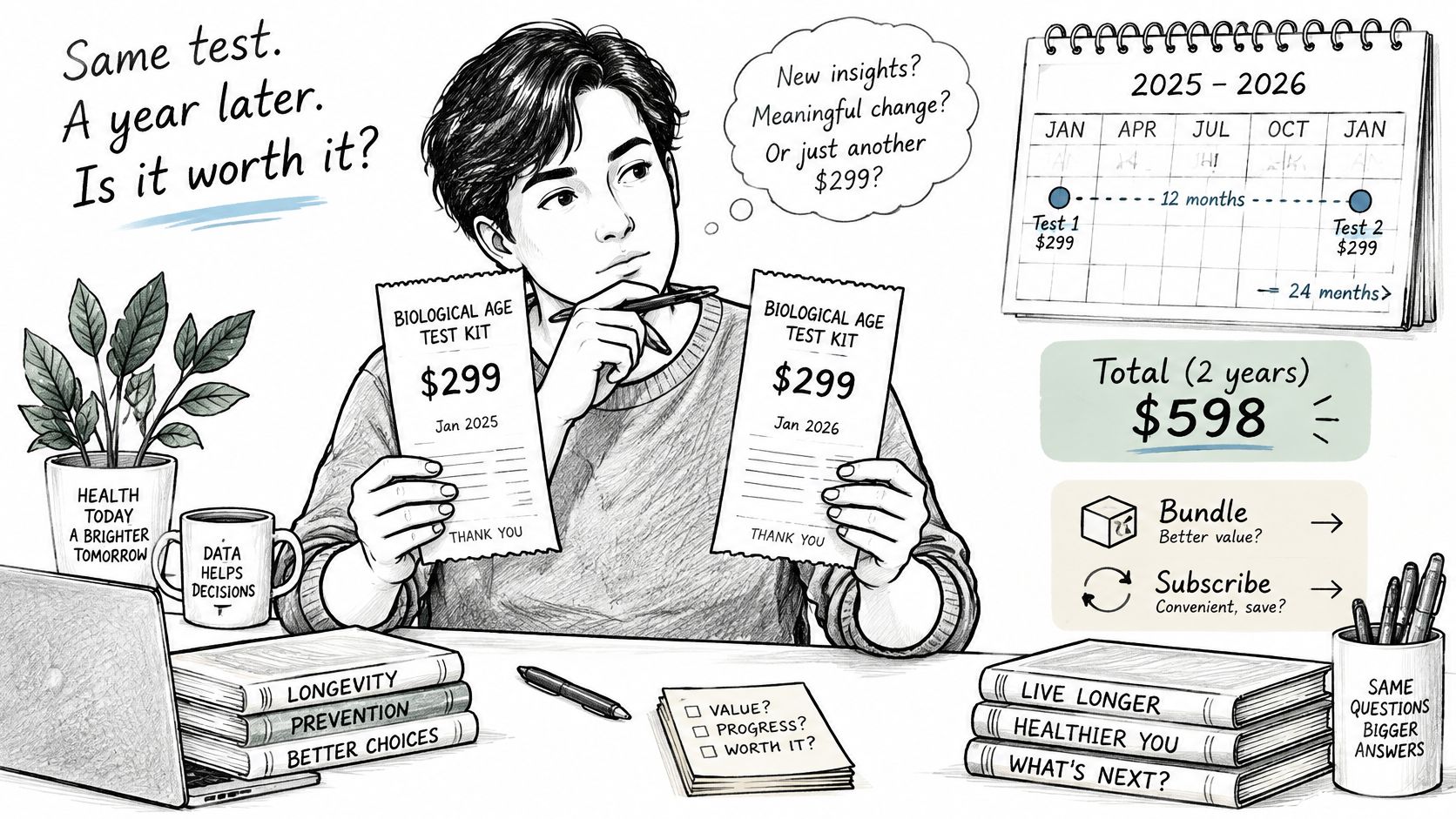
A repeat test adds value only if the result could change a decision. The recurring cost can exceed the first purchase, especially when interpretation is billed separately or testing is repeated on a fixed schedule.
Some providers price multi-test bundles below the cost of buying tests one at a time. Ask for the per-test price in writing before assuming a saving, and check whether the bundle sets an expiry date or retest schedule.
Build the 24-month number first
Multiply the test fee by the number of planned tests, then add any interpretation charge billed per visit. A yearly schedule means two tests over 24 months; a twice-yearly schedule means four. Compare that total with the cost of a single test, and check whether each repeat includes clinician review or only a new score.
Why a lower score isn’t proof of slower aging
Biological variation, sampling differences, illness and assay noise can all shift results between draws. Unless the specific clock has published test-retest reliability, a five-point drop is a data point, not a verdict. Research on these measures continues to emphasise validation before using them for risk stratification or intervention decisions. A lower follow-up score alone does not establish a health benefit.
Write the rule before you buy the retest. Name the result that would change your treatment plan. If no result would alter what you do, the repeat test has little decision value.
What the money could buy instead
Several hundred dollars spent on repeat scores cannot also fund blood pressure checks, lipid testing or standard screening, which have established clinical uses. The trade-off matters particularly for readers already paying for a clinic programme: the test may be a small invoice item, while the membership is the larger recurring cost.
Retest when the result could change your care, not because another year has passed.
Matching Test Spend to Your Situation
Set the spend ceiling before you compare providers, not after. A price list is designed to be read from the top down. A budget is set from the bottom up, and the two should meet at a number you decided in advance.
Test spend by reader situation
| Situation | Sensible first test | Retest rule | Spend ceiling |
|---|---|---|---|
| Health-conscious reader under 50 | One blood-panel estimate or one direct-to-consumer kit | Retest only after a planned change | One test, about $50–$499 |
| Adult aged 40–70 considering a clinic programme | Physician-reviewed workup | Pre-agreed change threshold | Set from a 12–24 month quote, not the sticker price |
| Executive considering a concierge membership | Full bundle with interpretation | Only if the clinician acts on the results | Membership fees on top of test prices |
| Researcher or clinic operator | Validated epigenetic clock with method notes | Protocol-defined intervals | Laboratory fees and sample volume |
Two situations where the cheap option is right
If you’re under 50, symptom-free and curious, one blood-panel estimate or one direct-to-consumer kit answers the question you asked. An advanced bundle buys interpretation of a result you weren’t going to act on, and interpretation of an unused number is the most expensive thing in this market.
If you’re a researcher or a clinic operator, the logic flips completely. You need a validated clock with documented method notes, intervals defined by protocol rather than by marketing, and a budget for laboratory fees and sample volume. A consumer kit is the wrong instrument because you need reproducibility, not reassurance.
Where a clinic programme earns its fee
For the 40 to 70 reader weighing a clinic programme, the deliverable isn’t the score, it’s the physician review and the written follow-up plan. Get the 12 to 24 month total before you agree to any ceiling, and check whether the retest is included or billed again. Executives considering a concierge membership should judge it by the clinical follow-up it includes, not the access perks, and buy repeat tests only if a clinician will act on them.
“The question isn’t whether the test is good. It’s whether the result changes the next appointment.”
We can’t advise on an individual case or point you toward a particular clinic, and booking or pricing enquiries belong with the provider directly. What we can do is make the structure of the purchase visible, which is usually enough to separate a diagnostic decision from an expensive ritual.
Confirm the Value Before You Pay
Six questions, asked before money changes hands, do more work than any comparison table. Put them to the provider in writing and keep the answers.
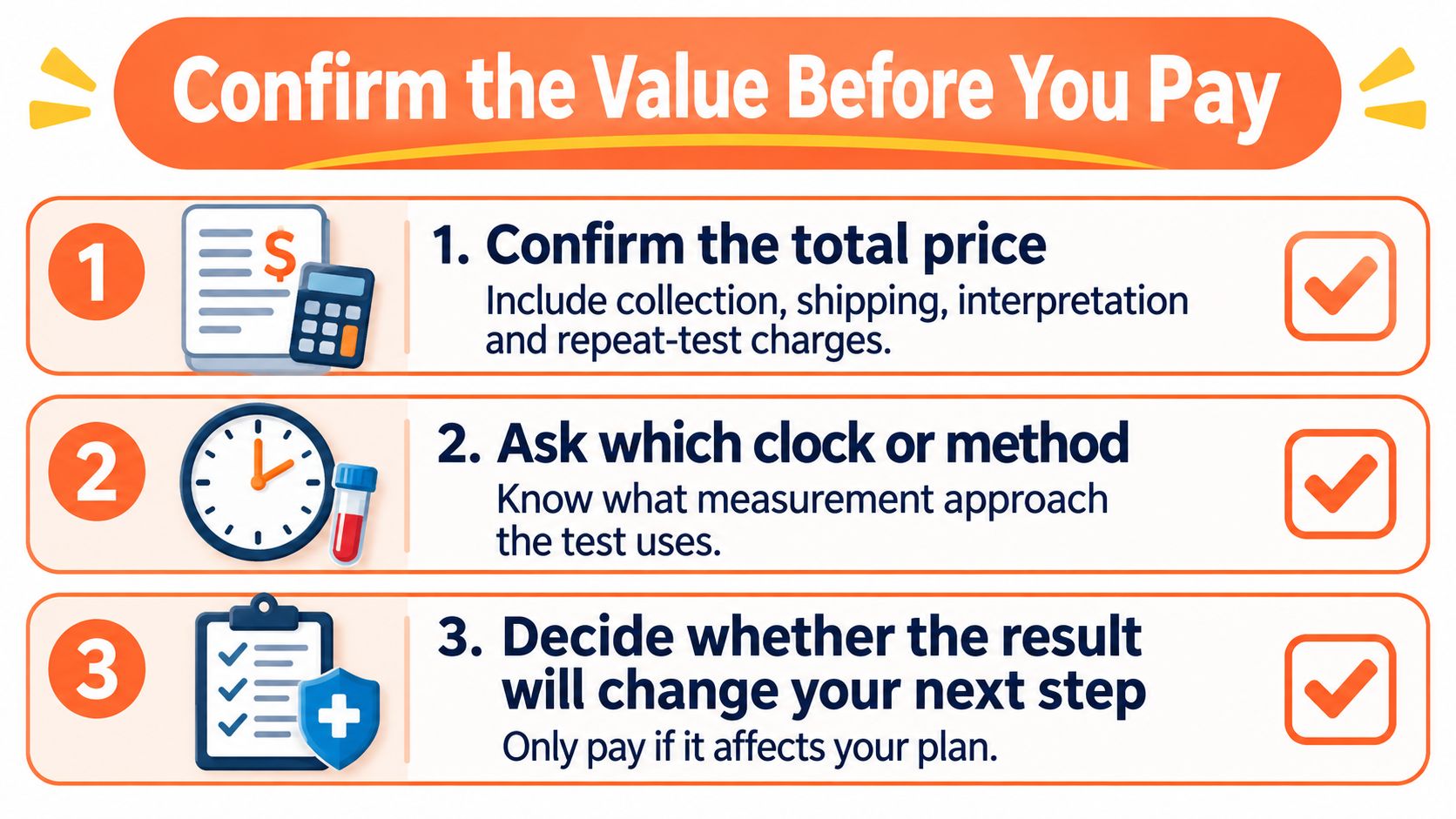
- Confirm the total price. Collection, shipping, interpretation and repeat-test charges all inside one figure, or listed separately with a sum at the bottom.
- Ask which clock or method produced the score. A named clock can be checked against published literature. “Our proprietary algorithm” cannot.
- Get the retest schedule in writing. Including the specific change that would trigger it and what that retest costs.
- Check whether a physician reviews results. And what follow-up is included when the number comes back high.
- Ask how unexpected results are handled. A concerning score with no referral pathway is an anxiety delivery mechanism with a receipt.
- Ask for refund and cancellation terms. Particularly for memberships and subscriptions, where the recurring charge outlives the enthusiasm.
Preventing a problem is cheaper than measuring it repeatedly, and this preventive wellness guide from ProMD Health Bethesda sets out which checks change outcomes. Pair it with our comparison of health checkup packages and you’ll see how much standard screening a single advanced bundle would fund instead.
Our content is editorial only and doesn’t constitute medical advice, so a doctor should interpret any result you receive. Pricing and booking questions go to the clinic.
Take these six questions to your next appointment, or paste them into an email to the provider before you pay. A written answer to each one is the difference between a measurement and a purchase, and any vague answer is a signal to hold the money. If the answers hold up and you can name the decision the result would change, book the test with confidence.