Longevity Testing Explained: What Each Test Can Prove
Longevity testing explained: which biomarkers, imaging and functional tests have solid evidence, and how to judge a test panel before you pay.
“Biological age” sounds like a number that can tell you how quickly you’re ageing and what to do about it. But longevity testing doesn’t deliver a single verdict. It combines different measurements, each with its own purpose and limits. The useful question isn’t how precise a score looks. It’s whether the result changes a sensible clinical decision or improves an outcome.
Think of the tests as a car dashboard. A warning light can signal that something needs attention, but it can’t explain the cause on its own. A careful inspection, and a clinician who can interpret what they find, are what turn signals into a plan.
Table of Contents
- What Longevity Testing Covers and Where It Stops
- How Strong the Evidence Is for Each Test
- How Clinics Build a Testing Care Pathway
- Reading Repeat Results Without Overreacting
- Imaging Findings That Lead to Unneeded Care
- Judging a Test Panel Before You Book
What Longevity Testing Covers and Where It Stops
Longevity testing is a bundle of measurements that estimate how the body is ageing, not a single verdict. It can reveal patterns in health, but no one result diagnoses “ageing” or proves how long you’ll live. Like a dashboard, it may flag something to investigate without showing why it’s happening.
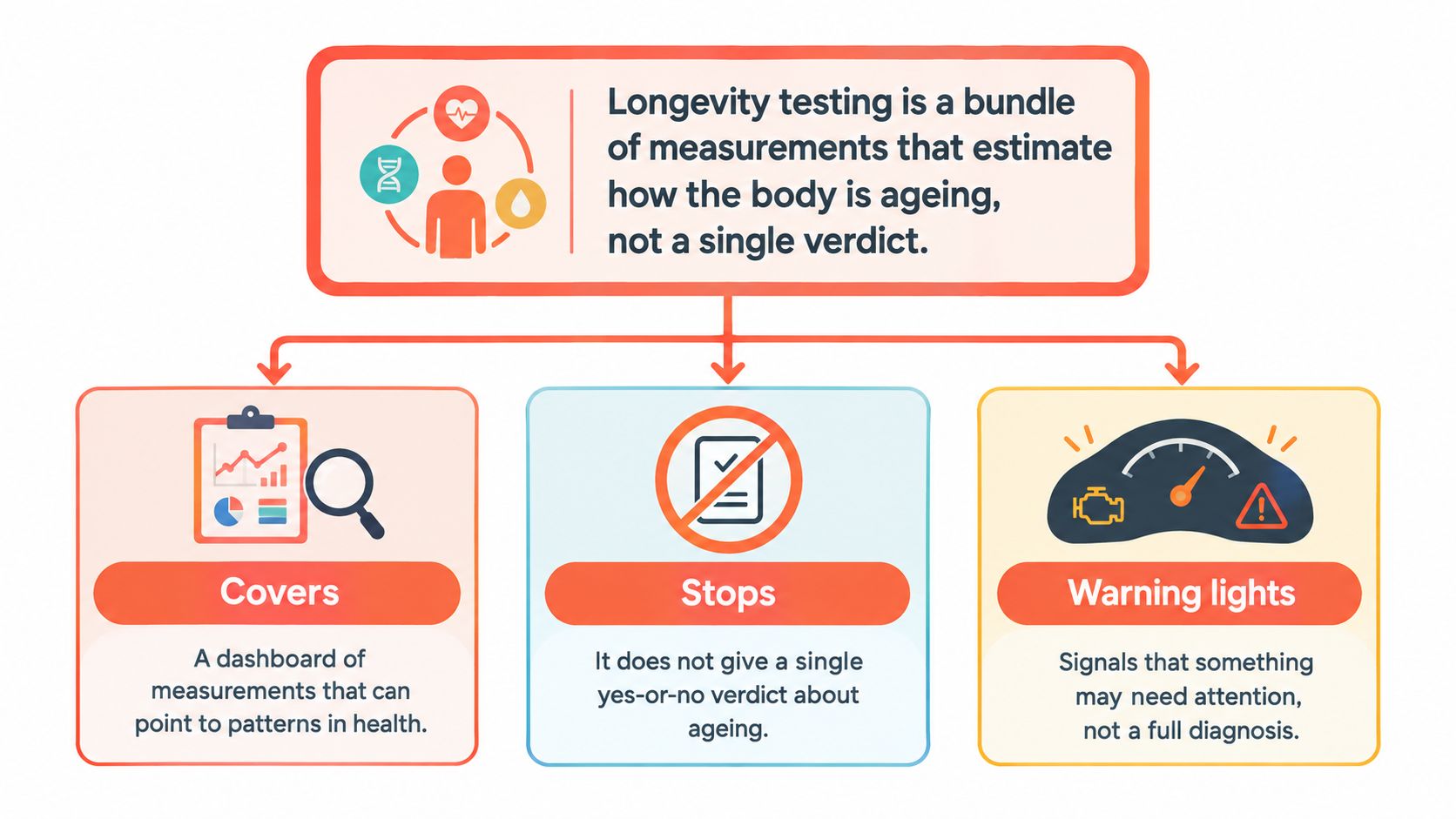
The tests generally fall into four families. Blood biomarkers include hsCRP and IL-6, which relate to inflammation; IGF-1 and GDF-15, which reflect growth and cellular-stress pathways; and routine measures such as HbA1c and cholesterol. Biological-age clocks use patterns in DNA methylation or plasma proteins to estimate biological age or risk. Imaging may include whole-body MRI, coronary artery calcium scoring, or DEXA body-composition scans. Functional tests measure capabilities such as grip strength, walking speed, balance, and VO₂max.
| Family | Typical tests | What it tells you | Usual setting |
|---|---|---|---|
| Blood biomarkers | hsCRP, IL-6, IGF-1, GDF-15, HbA1c, lipids | Inflammation, metabolic and hormonal state | Laboratory blood draw |
| Biological-age clocks | DNA methylation clocks, plasma proteomic clocks | Estimated biological age and mortality-linked risk | Specialist laboratory or clinic |
| Imaging | Whole-body MRI, coronary artery calcium score, DEXA | Plaque, organ structure and body composition | Imaging centre |
| Functional capacity | Grip strength, gait speed, standing balance, VO₂max | Physical reserve linked to later outcomes | Clinic or exercise laboratory |
The breadth matters. A 2025 international Delphi consensus study invited 460 experts, with 116, 87, and 60 completing its successive rounds. Across those rounds, 14 candidate biomarkers reached consensus, spanning growth factors, inflammation, function, and epigenetic clocks. The Delphi consensus study on biomarkers of ageing concluded that researchers still need to determine which combination has the greatest practical and predictive value.
A marker can be scientifically relevant without being validated enough to guide treatment or prove that an intervention extends life. A precise-looking biological-age score doesn’t change that. The scope of longevity testing is broad, but validation is uneven.
How Strong the Evidence Is for Each Test
A longevity test earns its place when its result can change a decision or improve an outcome. A precise number alone is not enough. The key question is whether the finding guides a useful next step, and whether that benefit justifies the costs and possible follow-up, including further imaging or investigations.
Three broad evidence tiers
Established for specific decisions: High-sensitivity C-reactive protein (hsCRP) can contribute to cardiovascular risk assessment, and a coronary artery calcium score can help stratify risk in appropriate patients. Grip strength and VO₂max provide information about physical capacity associated with later health outcomes. These measures answer narrower questions, not whether someone is ageing well overall.
Moderate or emerging: IL-6 and GDF-15 have been associated with frailty, mortality, or disease in cohorts. Proteomic clocks are also being studied as risk markers. Associations can make a test scientifically interesting, but they do not show that changing the result will reduce risk. Results may also differ by assay and laboratory.
Weak for routine screening: Whole-body MRI has not been shown to improve outcomes in asymptomatic adults. It may reveal abnormalities, but a finding can lead to additional tests and clinical decisions without helping someone live longer or stay healthier. That downstream burden belongs in the value calculation.
| Test | What it measures | Evidence strength | Main limitation |
|---|---|---|---|
| High-sensitivity CRP | Systemic inflammation | Established for cardiovascular risk | Not specific to ageing; raised by infection |
| Interleukin-6 | Inflammatory signalling | Moderate; linked to frailty and mortality in cohorts | Varies between assays and across days |
| GDF-15 | Cellular stress response | Moderate; associated with mortality and disease in cohorts | Rises with many conditions, so not specific |
| DNA methylation clocks, such as GrimAge | Mortality-linked epigenetic risk | Associated with all-cause mortality in cohorts | Not a diagnosis; test-to-test variation |
| Proteomic ageing clock | Plasma protein pattern | Promising in large cohorts; little intervention validation | Costly; developed on limited cohort data |
| Grip strength | Muscle strength | Strong association with mortality and disability | Needs age- and sex-specific reference values |
| Gait speed | Mobility | Established frailty marker | Short test; weak when used alone |
| VO₂max | Cardiorespiratory fitness | Strong association with mortality | Needs laboratory protocol and equipment |
| Coronary artery calcium score | Calcified coronary plaque | Established for cardiovascular risk stratification | Radiation exposure; not useful for every patient |
| Whole-body MRI | Full-body structure | Weak; no proven benefit in asymptomatic adults | High rate of incidental findings |
Epigenetic clocks have shown promise in predicting particular diseases. A 2023 longitudinal study of blood-based DNA-methylation biomarkers reported that three biomarkers showed predictive ability for Alzheimer’s disease, on average 8 years before clinical onset. This does not establish a clock score as a treatment target or show that lowering it extends lifespan. Prediction and prevention are different claims.
Interpretation also depends on the person and the conditions around testing. Grip strength and gait speed need age- and sex-appropriate reference values, since the same raw score can mean different things for different people. Inflammatory markers may shift with short-term circumstances, so a single result may not reflect a stable pattern. The guide to rating evidence explains how to distinguish promising findings from evidence that can support clinical decisions.
For a separate discussion of B12 testing and treatment, see the Aspire for Wellness Together B12 guide.
Use the table as a practical check: what does the test measure, what decision could its result change, and what can it not answer? The answer should include not only the test itself, but also the likely follow-up and its costs.
How Clinics Build a Testing Care Pathway
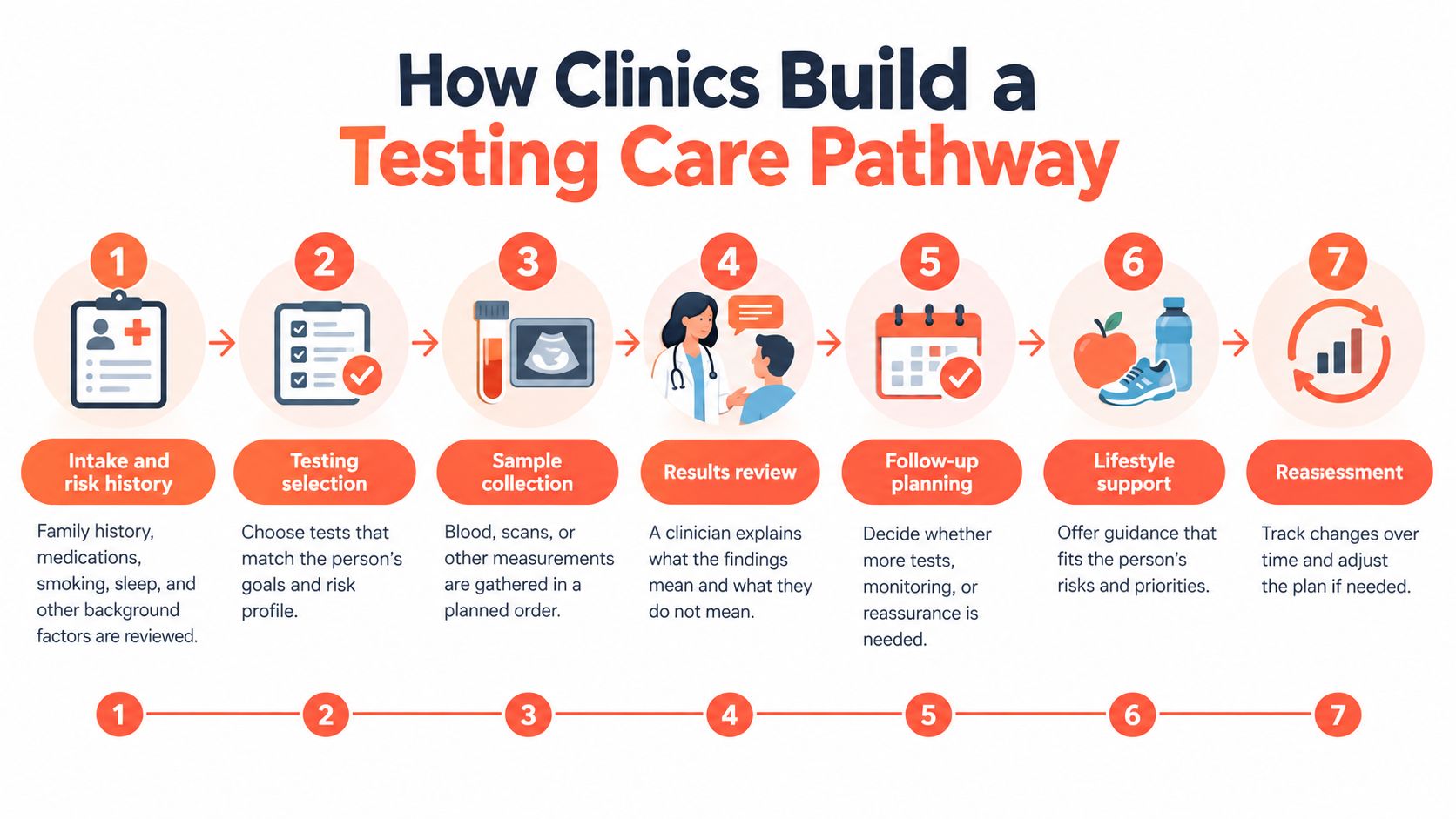
A well-run programme is a sequence of decisions, not a shopping list. Each step should clarify what to measure next and what the result will be used for. If a test has no effect on the plan, it may not belong in the panel.
-
Start with intake and risk history. Review family history, medications, smoking, sleep, alcohol, symptoms, and the person’s goals. This establishes what risks or questions should shape the assessment.
-
Set a clinical baseline. Measure blood pressure and review routine markers such as lipids, HbA1c, and kidney function. These familiar measures may already identify issues that need attention, narrowing what further testing is useful.
-
Choose targeted biomarkers. Add tests to answer a specific question left open by the baseline, rather than ordering every available marker. The clinician should be able to explain what a high or low result would change.
-
Measure function where relevant. Grip strength, gait speed, and VO₂max can add information about physical capacity. The results help determine whether the plan should include a closer look at fitness, mobility, or strength.
-
Use imaging to answer a defined question. Symptoms or particular risk factors may justify a scan. Without a clear reason and follow-up plan, imaging can create findings that demand more tests without resolving a health concern.
-
Have a physician reconcile the results. The clinician should interpret the findings together, explain uncertainty, and produce an action plan focused on modifiable risks. A set of separate reports isn’t a care plan.
-
Set a retest schedule and decision rule. Agree on what will be repeated, when, and what degree of change would matter. This turns follow-up into a planned assessment rather than an open-ended cycle of testing.
Hypothetical example: A 58-year-old has raised LDL cholesterol and low grip strength. The pathway could lead to targeted lipid management and a strength-training plan, followed by a planned reassessment. A full-body scan wouldn’t automatically add value if no symptom or risk factor calls for it.
Practical rule: Before agreeing to a test, ask what decision its result will inform. If nobody can name one, pause.
Reading Repeat Results Without Overreacting
A biological-age score can fall while a person’s health stays the same. For example, a 52-year-old receives a result estimating her biological age at four years above her chronological age. After a supplement and lifestyle plan, the score is two years lower six months later. That shift may be encouraging, but it does not show by itself that her health has improved.
Start by separating analytical validity from clinical utility. Analytical validity asks whether a test measures consistently; clinical utility asks whether the result changes a care decision or health outcome. A precise, repeatable number can still have little practical value if it leads to no useful action.
Three checks before interpreting a change
- Was the change larger than expected measurement error? A small shift may reflect assay noise rather than a genuine change.
- Were the testing conditions comparable? Check the sample type, laboratory, and collection conditions, and whether laboratory batches were accounted for.
- Did relevant health measures change too? Compare the score with outcomes such as blood pressure, fitness, or functional status.
Biomarkers still need validation across health states, tissues, laboratories, and datasets, as well as standardised assays and reference ranges. A biomarker improvement alone does not establish improved healthspan. The same caution applies when a result follows changes in sleep: lab interpretation for sleep-deprived executives can help explain why test conditions matter.
| Pattern | Likely explanation | Next step |
|---|---|---|
| One high biological-age score | Technical variation, acute illness, or inflammation | Repeat under comparable conditions before changing treatment |
| Clock improves while blood pressure is unchanged | The surrogate marker changed without a patient-relevant change | Do not treat it as proof of benefit; track clinical outcomes |
| hsCRP high on a single draw | Recent infection, injury, or intense exercise | Retest after recovery, usually several weeks later |
| Change smaller than measurement error | Normal assay noise | Keep the plan; check the batch and allow a wider interval |
| Change beyond expected error and confirmed on retest | Possible real shift in the measured marker | Review it with a physician alongside clinical risk factors |
A result matters most when it changes a decision or points to an outcome worth improving. Retesting has less value if the plan would stay the same regardless of the number. When follow-up might prompt imaging or additional tests, consider those downstream costs too, not just the accuracy of the original measurement.
A practical rule is to act only when a change exceeds expected measurement error, is confirmed on retest, and connects to relevant clinical measures or a clear care decision. If those conditions are not met, treat the result as uncertain rather than as proof that a programme worked.
Imaging Findings That Lead to Unneeded Care
In an evidence summary, 95% of asymptomatic people in a review had at least one abnormal whole-body MRI finding, and 91% of those findings weren’t clinically relevant, according to a 2025 evidence summary on whole-body MRI. The scan may seem thorough, but the result can be a trail of uncertainty rather than a useful answer.
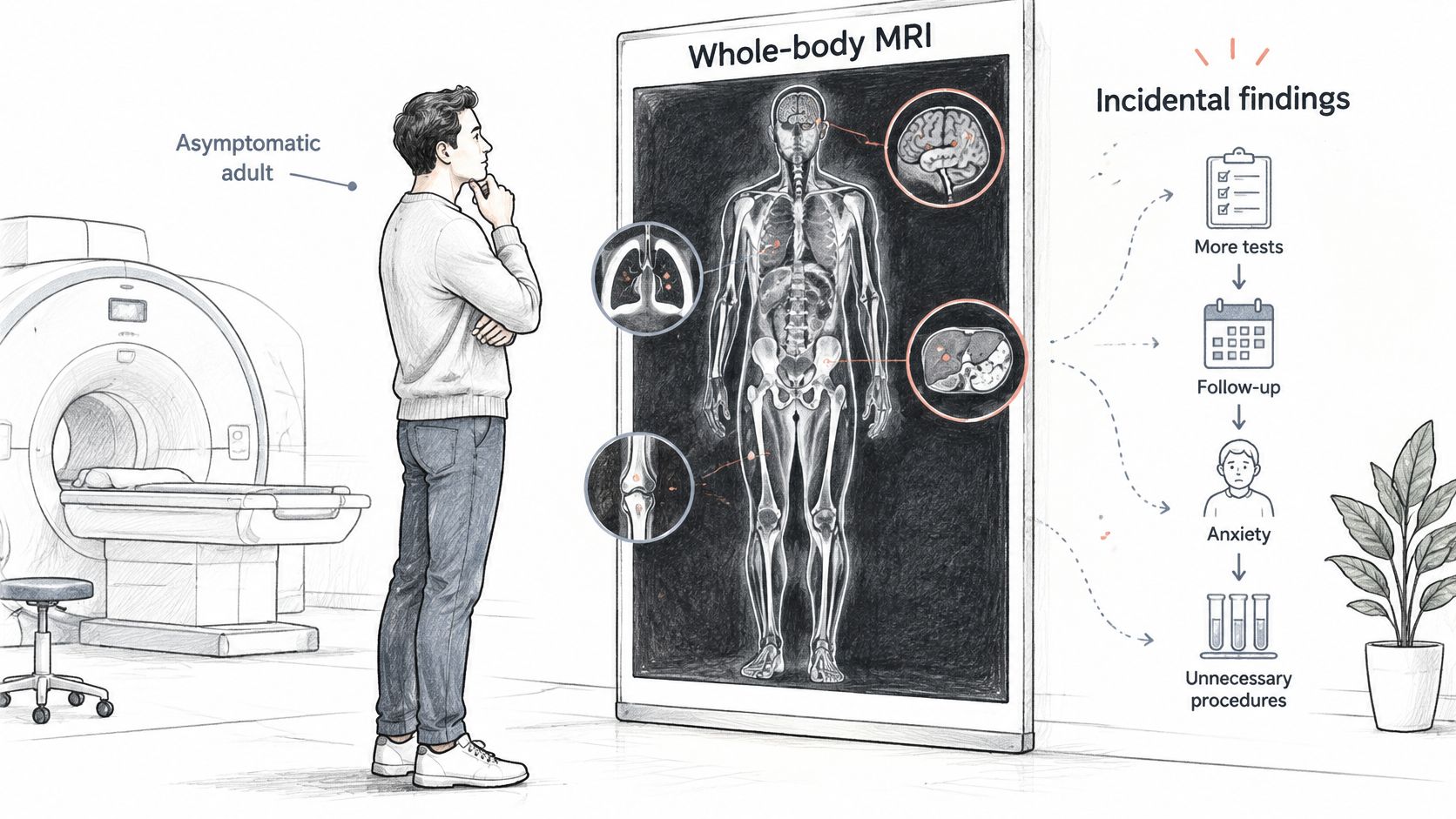
An incidental finding can lead to a specialist appointment, repeat imaging, or possibly a biopsy. It can also bring anxiety and expense, even when follow-up never identifies a problem that needs treatment. The same evidence summary says there’s no current evidence that whole-body MRI improves health outcomes in asymptomatic people; it isn’t recommended for low-risk individuals without cancer or a predisposition syndrome.
That doesn’t mean imaging is never useful. A scan can be appropriate when symptoms or risk factors give the clinician a specific question to answer. The important distinction is between targeted imaging that addresses a clinical concern and elective screening in a person without symptoms.
Before booking a scan, get clear answers to four questions:
- Who reviews the images? Know whether a radiologist reviews them and who explains the report.
- Who owns follow-up? Confirm who will arrange any additional assessment if a finding needs attention.
- What might you have to pay? Ask for the maximum likely out-of-pocket exposure, including follow-up care.
- When will the investigation stop? Ask how the programme distinguishes a finding worth pursuing from one that can be left alone.
The follow-up pathway matters as much as the image. Referral thresholds, insurance coverage, access to specialists, and professional incentives differ across countries. A guide to whole-body MRI screening can help frame the questions to ask, but your clinician should explain whether imaging fits your individual situation.
Judging a Test Panel Before You Book
A long panel isn’t automatically a good panel. Judge it by whether its tests are validated for people like you, answer defined clinical questions, and come with a realistic plan for interpreting findings and following them up. A highly precise score is of little use if it doesn’t change what happens next.
| Criterion | Strong sign | Red flag |
|---|---|---|
| Validation evidence | Peer-reviewed validation in the same age group | Proprietary biological-age score with no published validation |
| Retesting design | Pre-specified interval and consistent assay | One-off test sold as an ongoing programme |
| Outcome linkage | Tests tied to mortality, function, or disease | Score improvement presented as rejuvenation |
| Physician oversight | Physician interprets results and owns follow-up | Results sent without a clinical conversation |
| Abnormal-result plan | Written triage and follow-up pathway | No plan for findings that need action |
| Cost transparency | Itemised prices and out-of-pocket caps | Bundled packages with unclear add-ons |
| Conflicts of interest | Incentives disclosed; no referral revenue | Upselling of treatments within the same programme |
Look closely at what a clinic means by “validated.” A score tested in one population may not perform the same way in a person of a different age or background. Ask whether the clinic can explain the test’s intended use, the population it was evaluated in, the uncertainty around the result, and how the result compares with ordinary clinical information.
Retesting should also be designed in advance. The clinic should be able to state which test will be repeated, under what conditions, and what finding would prompt a change in care. A score improving on its own isn’t evidence of rejuvenation; stronger evidence links a test to outcomes that matter, such as disease, function, or survival.
The follow-up plan needs the same scrutiny as the test panel. Before imaging, find out who reviews an abnormal result, who arranges any additional assessment, and who pays for it. Get the costs itemised, including likely add-ons, and understand whether the clinic earns revenue from referring you to other services or selling treatments based on its own findings.
We collect publicly available information about clinics, including their websites, regulator records, peer-reviewed literature, and professional registries. Our team scores programmes algorithmically against a four-axis rubric, then has physicians and editors validate each result. Our independent programme reviews are scored from 0 to 100, which can help readers compare how clinics approach testing and follow-up without treating a score as personal medical advice.
Use a booking filter
Before paying for a panel, work through three questions:
- Name the decision each test would inform. If the clinic can’t say what a result might change, consider dropping that test.
- Confirm a written follow-up plan before imaging. Ask who reviews findings, who contacts you, and how the clinic handles results that don’t need further action.
- Set the retest date and decision rule. Agree on what will be repeated, how results will be compared, and what size of change would matter.
No single criterion settles whether a programme is worthwhile. But if a panel fails two or more of these checks, question its value before booking. Longevity Clinics’ content is editorial and doesn’t constitute medical advice; discuss your results and treatment decisions with a qualified physician, and direct questions about a clinic’s pricing to the clinic itself.
Before committing to a longevity-testing programme, ask for its test list, validation details, follow-up pathway, and full cost breakdown in writing. Then take those materials to a physician who can help you decide which measurements are likely to change your care.