Health Checkup Packages Compared: How to Judge Value
Compare basic, diagnostic and concierge health checkup packages by tests, evidence and follow-up. Learn how to judge value across clinics.
The most common advice about health checkup packages is simple: buy the longest list you can afford. More biomarkers, more scans, more specialists in one morning. That advice treats volume as safety. It isn’t. A longer menu can find more labels without changing the chance you stay well, and it can start a chain of extra tests you never needed.
A package is worth paying for only when an abnormal result has a named owner, a verification step, and a treatment or lifestyle route that is already written down. The rest of this piece compares three formats on that standard, sets one baseline list you can mark up against any clinic, and shows how to score yield and follow-up instead of brochure length.
Table of Contents
- Why a Longer Test List Is Not a Better Checkup
- The Three Main Types of Checkup Packages
- What Each Package Format Actually Includes
- Building a Standard Test List by Age and Risk
- Scoring Value and Quality Across Clinics
- Matching a Package to Your Situation
- Choosing a Package and Taking the Next Step
Why a Longer Test List Is Not a Better Checkup
A pooled analysis of 14 trials involving 182,880 people found that general health checks did not reduce total, cardiovascular, or cancer mortality. They did increase the detection of risk factors and the total number of diagnoses, which is exactly how false positives, overdiagnosis, anxiety, and unnecessary follow-up start (Cochrane review of general health checks).
Detection is not the same thing as benefit. A clinic can hand you twelve “out of range” lines and still have no plan that changes blood pressure treatment, statin use, or cancer screening at the right age. The test count hides that gap.
Ask three questions before you compare prices.
- Purpose: Which tests have shown benefit for your age, sex, symptoms, and risk factors, and which are optional add-ons?
- Abnormal result: If a value is high or an image is unclear, who repeats it, and what threshold triggers a referral?
- Ownership: Does the clinic book the next visit, or do you leave with a PDF and a suggestion to “see your doctor”?
Those questions expose why two packages with the same headline, such as “cardiovascular screening,” can be nothing alike. One records a single blood pressure. The other calculates a reproducible ten-year risk and writes the referral. Broader screening days are covered in more detail in this look at advanced health screening.
Practical rule: If the clinic cannot say what happens after an abnormal result, the extra tests are not a higher standard of care. They are an unfinished investigation.
The formats below, the baseline list, and the scoring points are tools for that comparison. Use them on any offer, including an expensive executive day.
The Three Main Types of Checkup Packages
Clinics sell health checkup packages under dozens of brand names. Most of them collapse into three delivery models. The label on the invoice does not tell you whether follow-up exists.
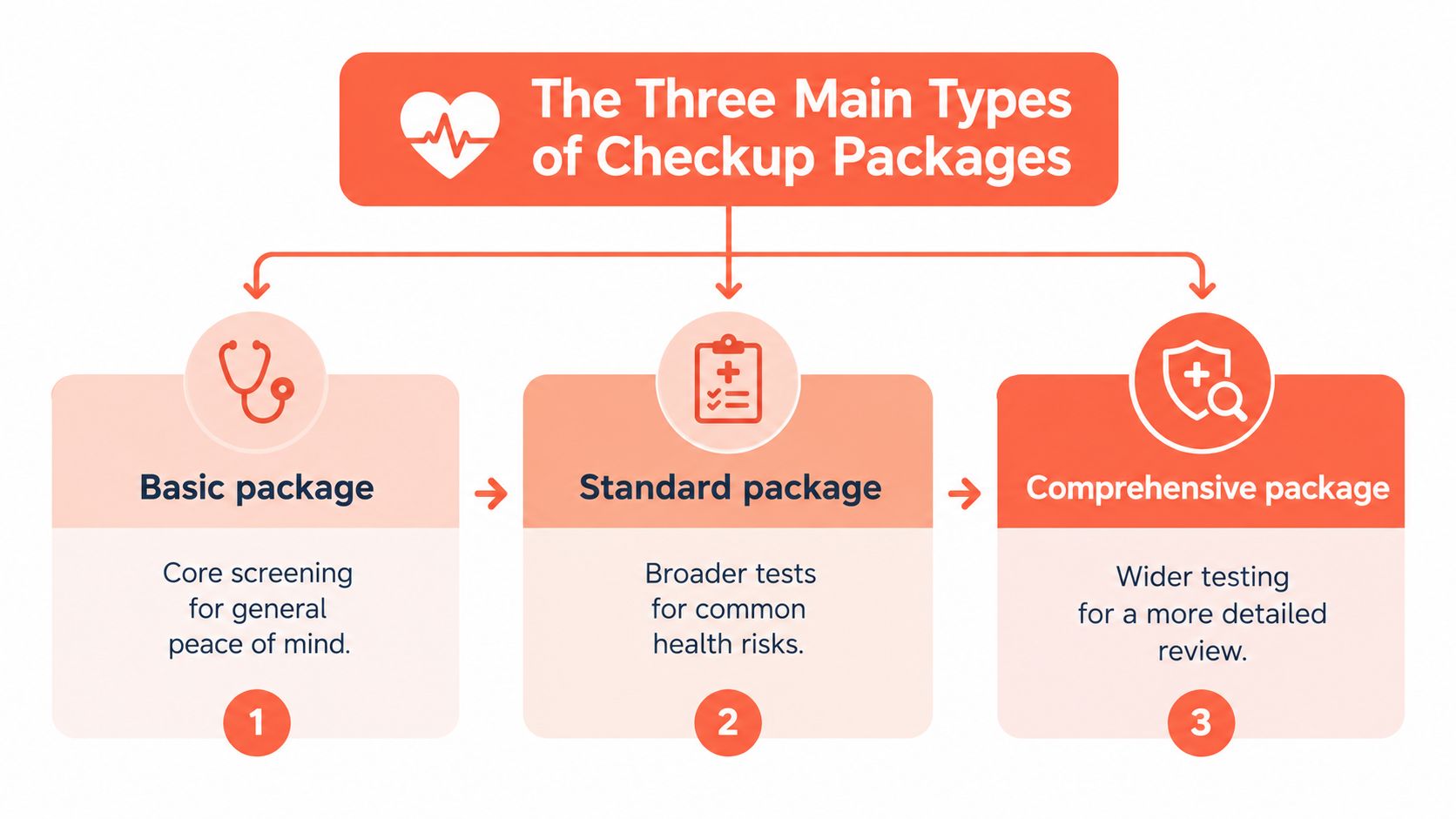
Basic packages
A basic package is a short core panel, usually blood work, blood pressure, weight, and a brief physician review, sold as a one-off fee. Employers, insurers, and high-volume screening centres push it toward people who want reassurance and a same-year snapshot. It is often repeated yearly because the price is easy to approve. The promise is speed and a clean report. The weakness is interpretation: many basic days stop at “discuss with your physician” and never name who that physician is.
Advanced diagnostic days
An advanced diagnostic day compresses imaging, a longer lab panel, and one or more specialist slots into a single visit. Hospitals and private diagnostic centres sell it to travellers, executives, and under-50 readers who want “everything checked” without joining a programme. You pay once, you fast, and you leave the same day with preliminary comments. Full reports often arrive later. The promise is breadth in one building. The risk is incidental findings with no booked pathway back to a doctor who will live with the result.
Concierge memberships
A concierge membership is a year of repeated measures, a named physician, and scheduled reviews. Longevity practices and private medical groups sell it to people who want continuity more than a single marathon morning. The fee is recurring, not a day rate. The promise is that abnormal results land with someone who already knows the history. The failure mode is familiar: the membership adds scans and biomarker bundles while the referral still depends on you.
Format is not quality. A basic panel with a written hypertension pathway can beat a day of imaging that nobody acts on. The next comparison looks at what each format measures.
What Each Package Format Actually Includes
Same words hide different work. “Lipids” might mean a single cholesterol number, or a full panel plus a ten-year risk score and a statin discussion. “Imaging” might mean a chest X-ray, or a CT that was never indicated for your smoking history.
The World Health Organization’s essential diagnostics list names 113 products, including 58 tests aimed at detecting and diagnosing common conditions. That is a useful ceiling on marketing claims: a package should be judged against a core set for prevalent, actionable disease, not against how many biomarkers it can print (WHO list of essential diagnostic tests). A 150-test panel without validity checks and a referral route is not automatically better than a smaller, guideline-aligned set.
For cardiovascular prevention, a credible baseline at least documents validated blood pressure measurement, lipid assessment, diabetes-risk evaluation, kidney-risk assessment, smoking status, and a reproducible 10-year risk calculation. The same guidance sets screening intervals by risk: adults aged 40 or older, or adults at increased risk, are recommended for annual hypertension screening, while lower-risk adults aged 18–39 with a previous normal reading may be screened every 3–5 years.
| Test Category | Basic Package | Advanced Diagnostic Day | Concierge Membership |
|---|---|---|---|
| Core measures | Height, weight, blood pressure, glucose, lipids, basic blood and urine | Core measures plus extended chemistry and sometimes thyroid | Core measures repeated on a set interval, with trend review |
| Risk calculation | Often omitted, or a verbal comment only | Sometimes calculated once, rarely filed as a plan | More likely if a named physician owns the record |
| Imaging | Chest X-ray or none | Ultrasound, ECG, and optional CT or MRI | Selected imaging on a schedule, not every visit |
| Specialist layer | General review, sometimes brief | Same-day specialty slots, variable depth | Named physician plus referred specialists |
| Abnormal-result path | Patient is told to follow up elsewhere | In-house referral if the site is a hospital | Depends on whether the contract names the next step |
| Repeat interval | Annual by habit | One-off, repeat only if you rebook | Built into the membership year |
Where the label lies
Cardiovascular screening is the clearest example. A basic package may record one cuff reading and stop. An advanced day may add an ECG and a stress test without calculating ten-year risk or confirming a high reading on a second visit. A membership may track the number over months and still never start treatment if the contract excludes prescribing.
False positives and incidental findings sit on the imaging row. A scan can be technically excellent and still create avoidable harm when a small nodule triggers more radiation, biopsy, or anxiety without a pre-agreed rule for what is actionable. Depth should be scored with test validity and a documented pathway, not with the size of the panel.
Building a Standard Test List by Age and Risk
Do not accept a clinic’s bundle as the comparison unit. Build your own baseline, then mark every advertised item as core, conditional, optional, or unsupported. Two clinics become comparable only after you do that.
A 2025 Chinese national adult checkup guide shows the shape of a structured list. The core assessment covers height, weight, waist or hip measurement, blood pressure, pulse, physical examination, blood and urine tests, glucose, lipids, liver and kidney measures, thyroid testing, ECG, and selected imaging. People aged 40 and older may add lung-function and bone-density testing. Deeper chronic-disease screening is tied to identified risk, not applied to everyone. Major-market preventive guidance is similarly conditional: diabetes screening is directed at asymptomatic adults aged 35–70 with overweight or obesity, colorectal cancer screening generally begins at 45, and lung CT is reserved for defined age and smoking-risk groups (Chinese national adult checkup guide).
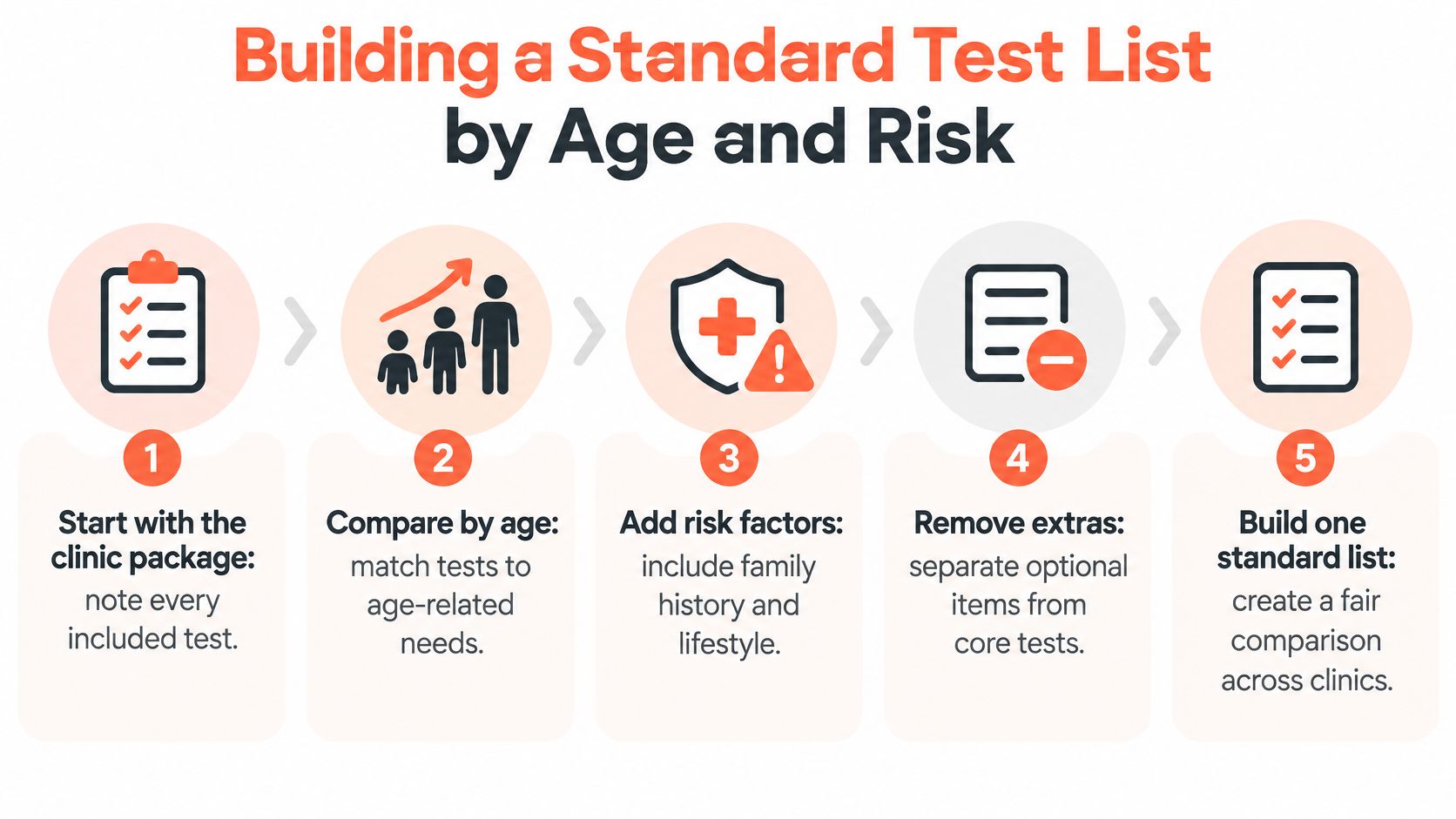
How to mark the list
- Write the clinic’s inventory. Copy every included test, including imaging and consults, before you look at the price.
- Sort by person, not by package name. Core items are the measures almost every adult baseline should hold. Conditional items appear only when age, sex, symptoms, or risk match a stated rule.
- Park the rest. Optional items are preference or research tools. Unsupported items have no clear benefit for an asymptomatic person like you.
- Name the owner. Next to each conditional item, write who repeats an abnormal result and who starts treatment.
If a test would not change a decision this year, defer it. Paying to “have it on file” is how incidental findings multiply.
Two questions finish the list. What should this package omit, defer, or replace for someone with your history? Who owns follow-up if a result is abnormal? A cardiometabolic baseline is one place those questions get concrete, including how risk is calculated rather than merely measured, as set out in this guide to cardiometabolic risk assessment.
Sex-specific items belong on the same sheet. Breast, cervical, and prostate decisions follow age and risk rules. They are not proof that a “female over 40” bundle is automatically complete, and they are not a reason to add tumour-marker panels that no guideline asked for.
Scoring Value and Quality Across Clinics
Clinics describe packages in incompatible language. Normalise them with separate measures: diagnostic yield per attendee, absolute change in risk, medication initiation, and follow-up completion. A brochure that claims “broad detection” without a denominator, a baseline risk, or a completion rate cannot be lined up against a real programme.
An Imperial College evaluation of England’s NHS Health Check found an average reduction of 0.21 percentage points in modelled 10-year cardiovascular risk, systolic blood pressure by 2.51 mmHg, diastolic blood pressure by 1.46 mmHg, BMI by 0.27 kg/m², and total cholesterol by 0.15 mmol/L. Statin prescribing rose by 3.83 percentage points. The effects were statistically significant and clinically modest. The same evidence summary reported about one new hypertension diagnosis per 27 checks, one new type 2 diabetes diagnosis per 110 checks, and one newly identified familial hypercholesterolemia case per 265 checks (NHS Health Check evidence summary).
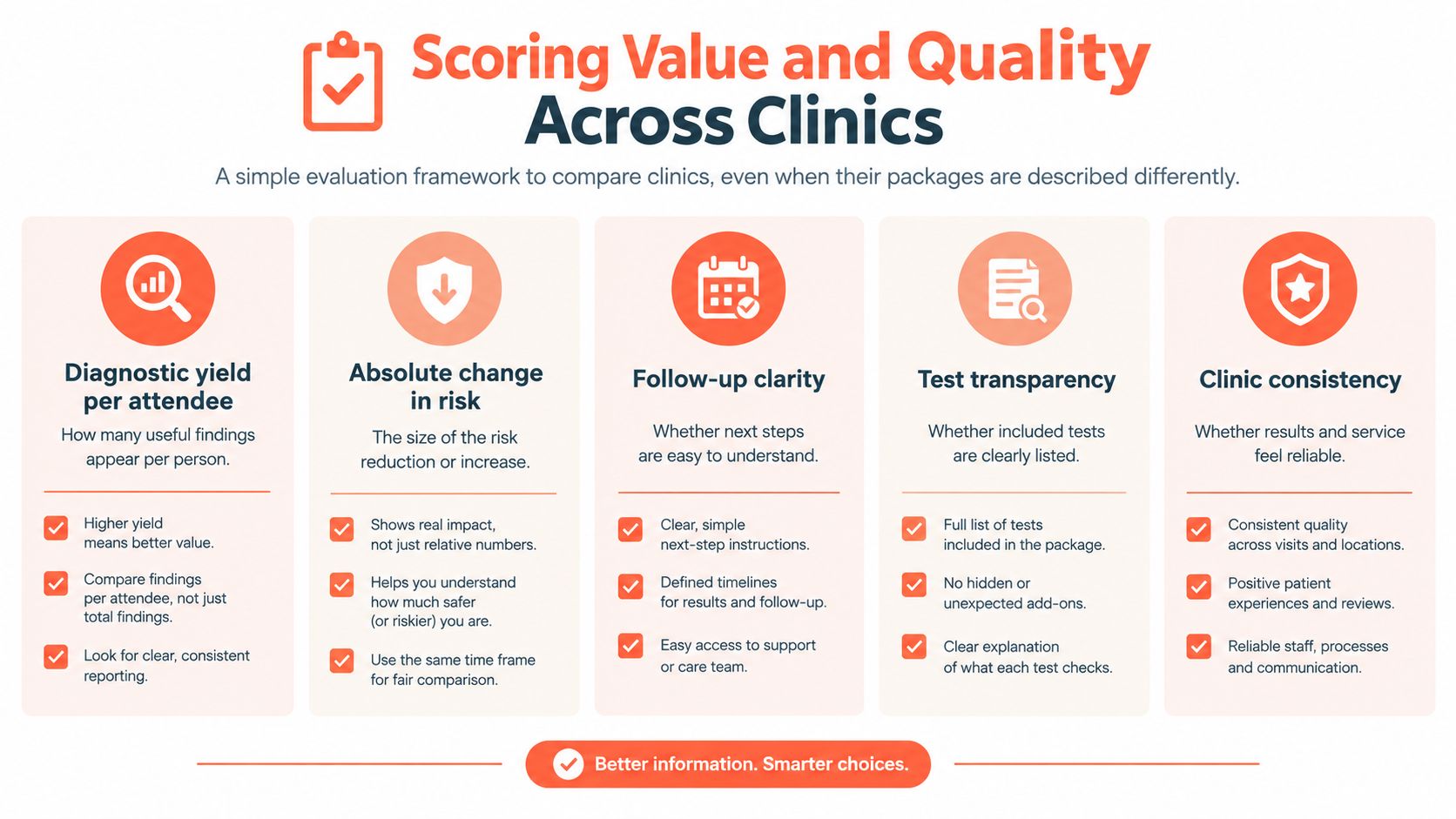
What a national pathway actually did
Between April 2013 and March 2018, more than 15 million people were eligible, over 10.1 million were offered a check, and 4.9 million completed one, with national uptake at 48.4%. About 1.5 million checks were delivered each year by the late 2010s. 14% of attendees were referred to lifestyle support for obesity, smoking, alcohol, or blood pressure, compared with 6% through standard care. Modelled cardiovascular risk fell from 6.7% to 6.2% among people identified as having a check, and from 5.1% to 4.9% among comparison patients (NHS Health Check cardiovascular prevention summary).
Read those figures as a plausibility check. A private clinic promising large risk reversals from a single day, with no repeat measurement, is selling a different product from the one these numbers describe. High volume can reveal risk. Sustained change needs treatment and a second reading.
Conflict and the composite score
Grade conflict freedom separately. Ask whether the clinic earns referral fees, procedure revenue, or equity from the treatments it recommends after the checkup. A high diagnostic-depth score does not cancel a weak conflict score. How those incentives show up in private programmes is discussed in this note on conflict of interest in healthcare.
A composite score is a summary of axes, not a verdict on any single test. If follow-up completion is missing, do not let a glossy imaging list fill the blank.
Matching a Package to Your Situation
The same format is a fit for one reader and a poor purchase for the next. Match the pathway to the decision you need to make.
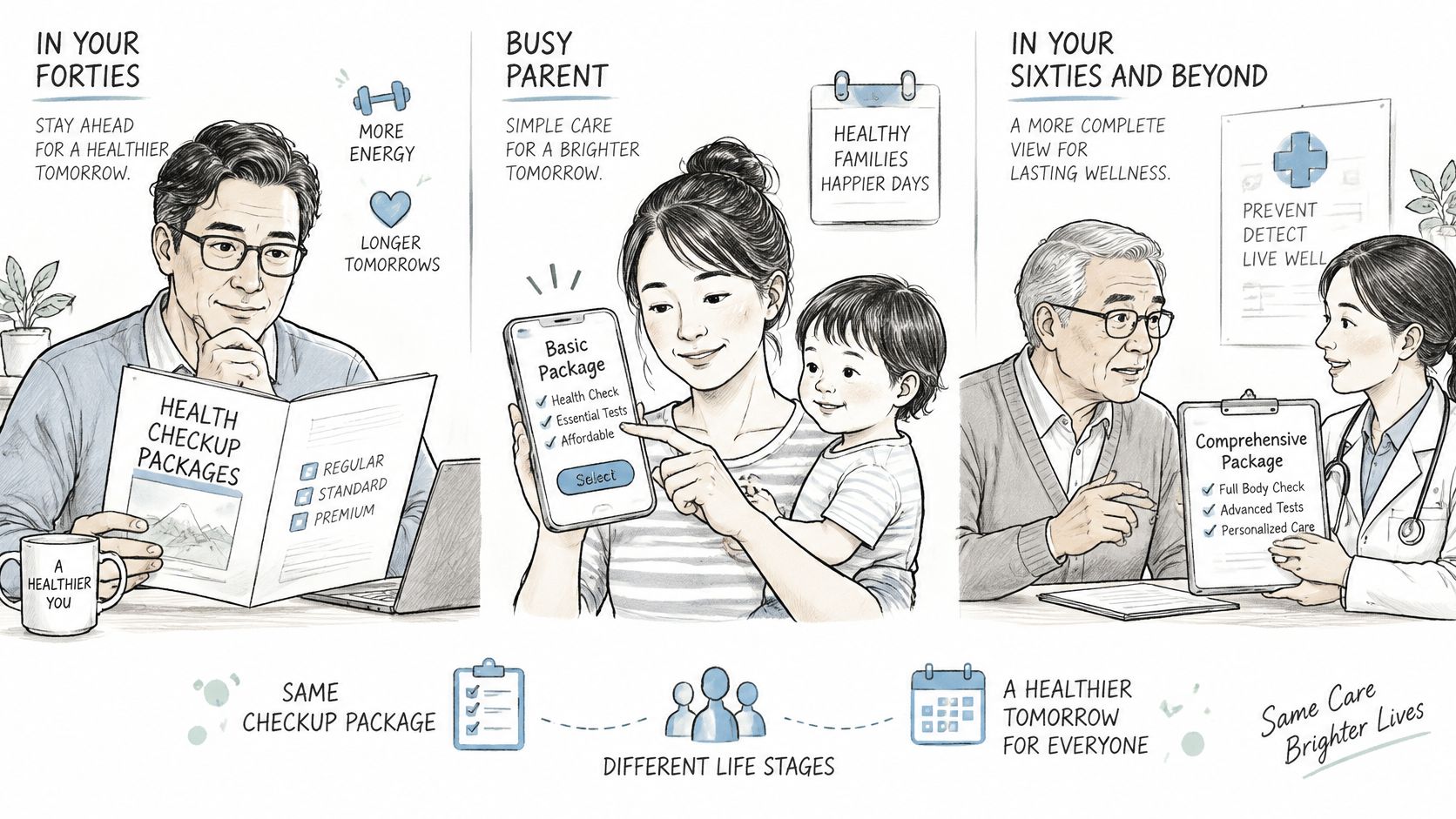
A structured baseline in your forties or fifties
You want blood pressure, lipids, glucose, kidney measures, smoking status, and a ten-year risk number you can act on. A basic package can do this if the clinic confirms abnormal readings and writes who starts treatment. An advanced day is justified when a specific conditional test is already on your list, not when the menu is longer.
Ask the clinic to justify any imaging that is not tied to a symptom or a defined risk group. Bone density or lung function may belong after 40. A whole-body scan usually does not, unless a clinician can name the decision it changes.
Under 50 and tempted by a full diagnostic day
You are asymptomatic, you have time for one long visit, and the package label is appealing. Most of the value is still the core panel plus the few conditional screens your age and history support. Vitamin panels, tumour markers, and biological-age scores are optional until someone shows they alter a treatment you would accept.
A same-day specialist corridor is convenient. It is not a reason to add tests that create findings without a pre-agreed stop rule.
If the clinic’s follow-up is “we will email a PDF,” the day is a measurement service. Budget for a separate clinician who will own the abnormal lines, or do not buy the extras.
A membership when continuity is the scarce item
Executives and other high-cost buyers often already have access to labs. What they lack is a named physician, repeat intervals, and a referral route that does not depend on a personal assistant chasing records. A concierge year fits that problem when the contract states who prescribes, who is called when a result is critical, and which treatments the clinic does not sell.
It does not fit if the membership’s main addition is another imaging tier. Pay for the person and the pathway. Decline add-ons that fail the omit-or-defer test on your own list. Compare at least one basic offer and one day-package against the membership using the same marked list, so the recurring fee has to earn its place.
Choosing a Package and Taking the Next Step
The right package is the one whose baseline matches your age, risk, and symptoms, whose abnormal results have a written pathway, and whose price you can tie to tests you have already classified. A longer list that fails those tests is a more expensive unfinished investigation.
Longevity Clinics (https://longevity-clinics.co) is an independent editorial publication that evaluates private longevity-medicine programmes worldwide. It is funded by reader subscriptions, with no paid placements, sponsored sections, or affiliate links. Profiles use a published four-axis rubric: diagnostic depth, medical supervision, conflict freedom, and evidence base. The directory and Compare tools standardise tests, treatments, and follow-up models so listings can be read side by side. The published methodology shows how scores are produced. Treat that as one reference among regulator records, your own clinician, and the clinic’s written pathway. It is not a substitute for a personal medical plan.
Before you book, do three things.
- Write the baseline. Mark each item core, conditional, optional, or unsupported.
- Request the pathway in writing. Ask who verifies an abnormal result, who is referred, and what is remeasured.
- Compare at least three options on yield reporting, follow-up completion, and conflict disclosure, not on test count.
Pick one decision you need this year, such as blood pressure treatment or a cancer screen that matches your age, and refuse any package that cannot show how that decision will be made after the visit. Then run the three offers through the same marked list before you pay.