Diagnostic Lab Requirements: What to Verify Before Booking
Learn which diagnostic lab requirements matter for longevity clinic testing: accreditation, assay evidence, comparability and how to verify them.
Which laboratory would you rather have running your blood panel: the one whose menu runs to several pages, or the one that can prove each test on that menu is measured the same way, in the same place, with the same method, two years from now?
Most buying advice for longevity programmes answers a simpler question: is the lab accredited? That question matters, and it’s the beginning of the assessment rather than the end of it. Accreditation is granted against a defined list of tests. A menu is a list of things a clinic is willing to sell you. Neither document, on its own, tells you whether the numbers that come back will be trustworthy, comparable and clinically meaningful.
The checks that separate a marketing claim from a defensible process are small, specific and requestable. Here’s how to work through them in the order you’ll meet them.
Table of Contents
- The Lab Requirements Checklist to Verify First
- What ISO 15189 Accreditation Covers and Misses
- Accreditation Systems by Region Compared
- Tracing a Sample From Collection to Report
- Why Assay Evidence Matters More Than Test Count
- Keeping Results Comparable Across Labs and Years
- Your Next Step Before You Book a Panel
The Lab Requirements Checklist to Verify First
A pre-flight inspection is boring by design. Nobody applauds when the fuel gauge is checked or the tyre pressure confirmed. Its value comes from the fact that each item is small on its own, and one missed item can ground the aircraft.
Diagnostic lab requirements behave the same way. No single document proves a clinic’s laboratory is trustworthy, and a set of checkable items does. Each one is verified separately, because strength in one area says nothing about the next. A laboratory can hold a spotless accreditation certificate and still sell a proprietary panel for which nobody has written down a clinical purpose.
| Area | What to verify | Evidence to request |
|---|---|---|
| Accreditation | ISO 15189 or CLIA certification covers the performing lab | Accreditation certificate and scope list |
| Pre-analytical controls | Patient preparation, sample acceptance and rejection, transport times | Written procedures and rejection log |
| Analytical method | Validated assay with calibration and internal quality control | Validation summary and QC records |
| External quality | Participation in proficiency testing with acceptable results | External quality assessment reports |
| Reference intervals | Population, units and sample type stated for each result | Reference interval sheet |
| Result reporting | Critical-value escalation and amended-report process | Reporting and amendment policy |
| Intended use | Clinical purpose stated for each test, including wellness or risk-score use | Intended-use statement per test |
| Comparability | Same method over time, or a documented bridging study | Method comparison data |
| Accountability | A named clinician reconciles discordant results | Written escalation process |
Work down the rows in this order.
- Name the performing laboratory. Ask which laboratory runs each test, including the ones run on site during your visit. “Our lab partner” is not an answer.
- Take the rows in sequence. Accreditation first, accountability last, because each row changes what the next one means.
- Request the listed document for each row. Ask for the file, not a summary paragraph.
- Record the gaps. If a clinic can’t name the lab or supply a row’s evidence, note it and keep going. A gap is information, not a dead end.
The same logic applies to materials rather than samples. Laboratories that take quality seriously verify what arrives at the loading dock before it’s used, and the incoming inspection advice from Herbilabs Labware shows how that check is structured for reagents and consumables. A lab that audits reagent lots on arrival is likelier to hold a genuine chain of custody for the lot numbers printed next to your result.
When our editors score a clinic, that scatter of evidence becomes a number. Each clinic is scored across four axes, each worth 25 points: diagnostic depth, medical supervision, conflict freedom and evidence base. Depth is only a quarter of the total, which is deliberate: a deep menu can be bought, while supervision, independence and evidence are harder to fake. The first axis is defined in our explainer on what a diagnostic workup actually includes.
What ISO 15189 Accreditation Covers and Misses
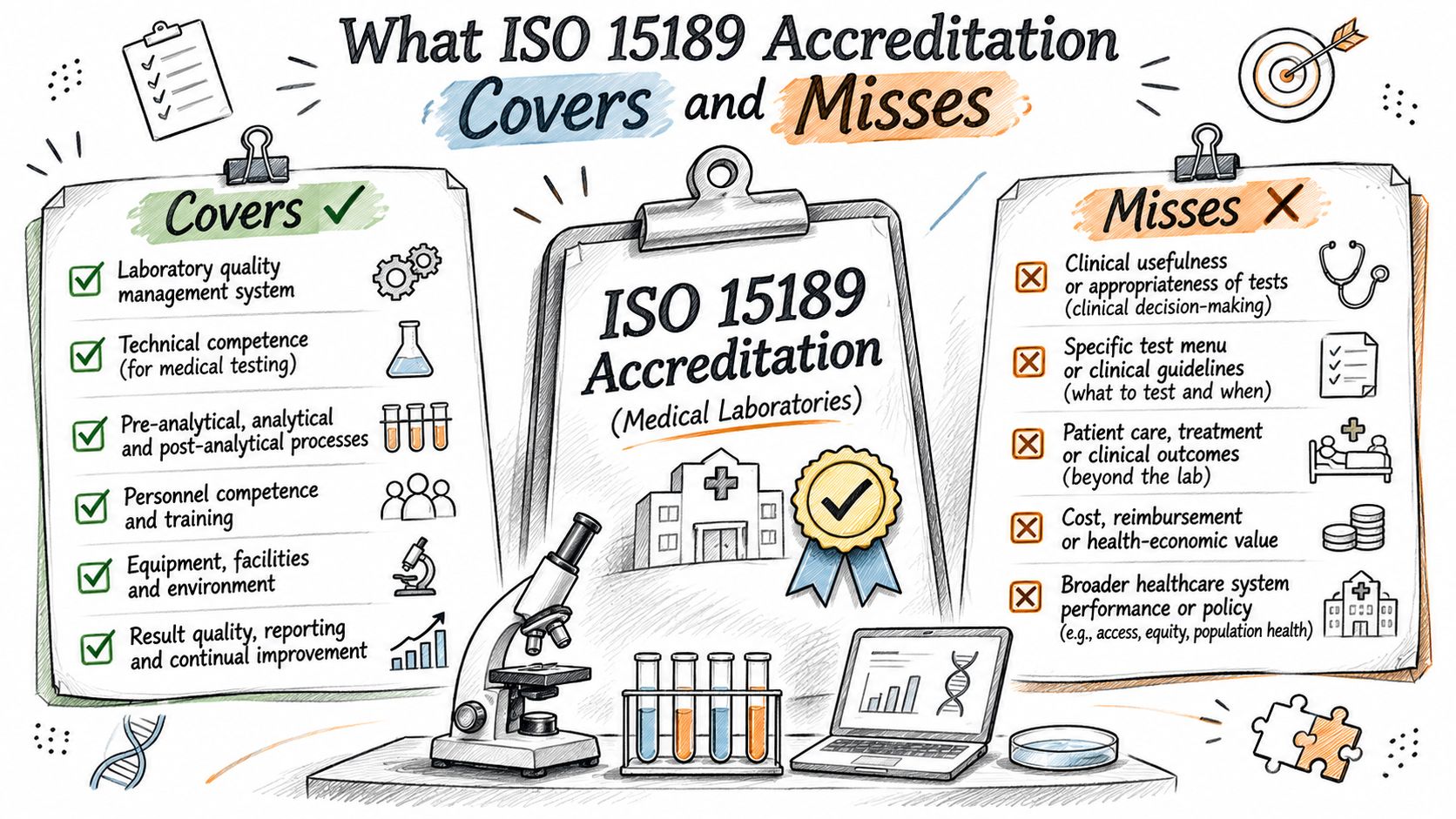
What does an accreditation certificate guarantee about the number printed next to your biomarker? Less than the logo suggests, and more than nothing. ISO 15189 is the international framework written specifically for medical laboratories, and it combines quality-management requirements with requirements for technical competence. That mix is why it reads differently from a manufacturing quality standard or an instrument calibration certificate.
The first edition was published in 2003, after ISO/TC 212 developed a standard for medical testing rather than relying only on generic quality or calibration standards. Revisions followed in 2007 and 2012, and a fourth edition appeared in December 2022. Adoption spread quickly, from 23 countries within a year of the 2003 first edition to 44 by 2009 and more than 60 by 2013, as a review of ISO 15189’s past, present and future documents.
That history explains the spread of requirements in your report.
What the Standard Actually Controls
An accredited laboratory is assessed on competence, documented processes, quality indicators, information management and the reliability of results across the pre-analytical, analytical and post-analytical phases. Specimen handling, method competence, result reporting, corrective action and ongoing quality monitoring all fall inside that assessment. The standard was recognised by the International Laboratory Accreditation Cooperation as an international standard for accrediting medical laboratories, which is why regulators in many countries accept it as evidence of laboratory governance.
What It Doesn’t Tell You
Two limits matter to anyone choosing a clinic.
The scope is defined. A laboratory accredited for routine chemistry may not be accredited for a specialised molecular assay or an on-site point-of-care device. The certificate lists what was assessed. Anything outside that list sits outside the assurance, however long the clinic’s test menu looks.
Usefulness is not assessed. Accreditation doesn’t prove that a biomarker predicts anything, or that acting on it improves an outcome. It establishes a governance expectation for how the specimen was handled, how the method was verified, how the result was reported and what happens when something goes wrong.
The driving licence: it confirms the holder passed a defined test on a defined day. It says nothing about the roads they’ll drive next year, and it doesn’t cover a motorcycle unless that category is printed on it.
The method follows from that. Request the accreditation schedule, find the specific assay you’re paying for, and confirm it appears within scope. If it doesn’t, ask who validated it and against what.
Accreditation is the floor for laboratory governance, not the ceiling for trust. A laboratory can hold a clean certificate and still run an assay whose supporting evidence is thin, which is the gap the certificate was never designed to close.
Accreditation Systems by Region Compared
Which certificate counts depends on where the laboratory sits. Regions don’t use one framework, and the names on a brochure rarely match the names on a certificate. Use this lookup to find the region where the laboratory operates, then check the framework named against the clinic’s own documentation.
| Region | Main framework | What it covers | What to check |
|---|---|---|---|
| United States | CLIA certification | Federal certification of laboratories testing human specimens | CLIA number and test complexity category |
| United Kingdom | UKAS accreditation to ISO 15189 | Accredited medical laboratories | UKAS schedule listing the specific test |
| Germany | DIN EN ISO 15189 accreditation | Accredited medical laboratories across a large, well-documented sector | Certificate scope and quality-assurance guideline requirements |
| Switzerland | ISO 15189 through the Swiss Accreditation Service | Accredited medical laboratories | Swissmedic status for any device used |
| European Union | ISO 15189 with the In Vitro Diagnostic Regulation | Accreditation recognised as evidence of laboratory quality | Device class and intended use |
| Gulf states | National licensing, with ISO 15189 accreditation used by larger referral laboratories | Licensing of the laboratory and its staff | Which authority licenses the lab and which body issued the certificate |
| Asia | National accreditation schemes, many built on ISO 15189 | Accreditation against a national or international standard | The accreditation body, the certificate’s scope and whether the report names the performing lab |
Germany is a useful reference point because its laboratory sector is large and well documented. A 2025 status report by German medical laboratory specialists stated that Germany had approximately 450 accreditation certificates for medical laboratories as of 2024, primarily under DIN EN ISO 15189 (German Medical Science status report). That volume matters for a practical reason. A large accredited sector still contains laboratories accredited for narrow scopes, so a count of certificates says nothing about whether your particular assay sits inside one of them.
Two Registers, Not One
Patients routinely confuse laboratory accreditation with clinician registration. They’re separate systems run by separate bodies. The General Medical Council registers doctors in the UK, and in Germany physicians are registered by the state medical chambers. Neither register tells you anything about the laboratory that ran your assay, and an accreditation certificate tells you nothing about the qualifications of the doctor reading the result. Check both.
It works like a kitchen inspection and a chef’s licence. One covers the premises, the other covers the person holding the knife. Neither one vouches for the recipe.
The regional table answers a narrow question: which body should hold a record of this laboratory. It does not grade the menu. A laboratory can carry a clean certificate and still run an assay whose supporting evidence is thin, which is why the individual test you are paying for needs its own scrutiny rather than a borrowed halo from the institution’s paperwork. Two clinics with identical accreditation can hand you results that are not comparable, and the menu length tells you nothing about either.
The final step is currency. Look up each certificate on the accreditor’s public directory and confirm it is active and lists the test you’re buying. Accreditation can be suspended, narrowed or allowed to lapse, and a scope list printed on a brochure is not proof of any of those things. Check each certificate’s scope against the register, not against the clinic’s marketing page.
Tracing a Sample From Collection to Report
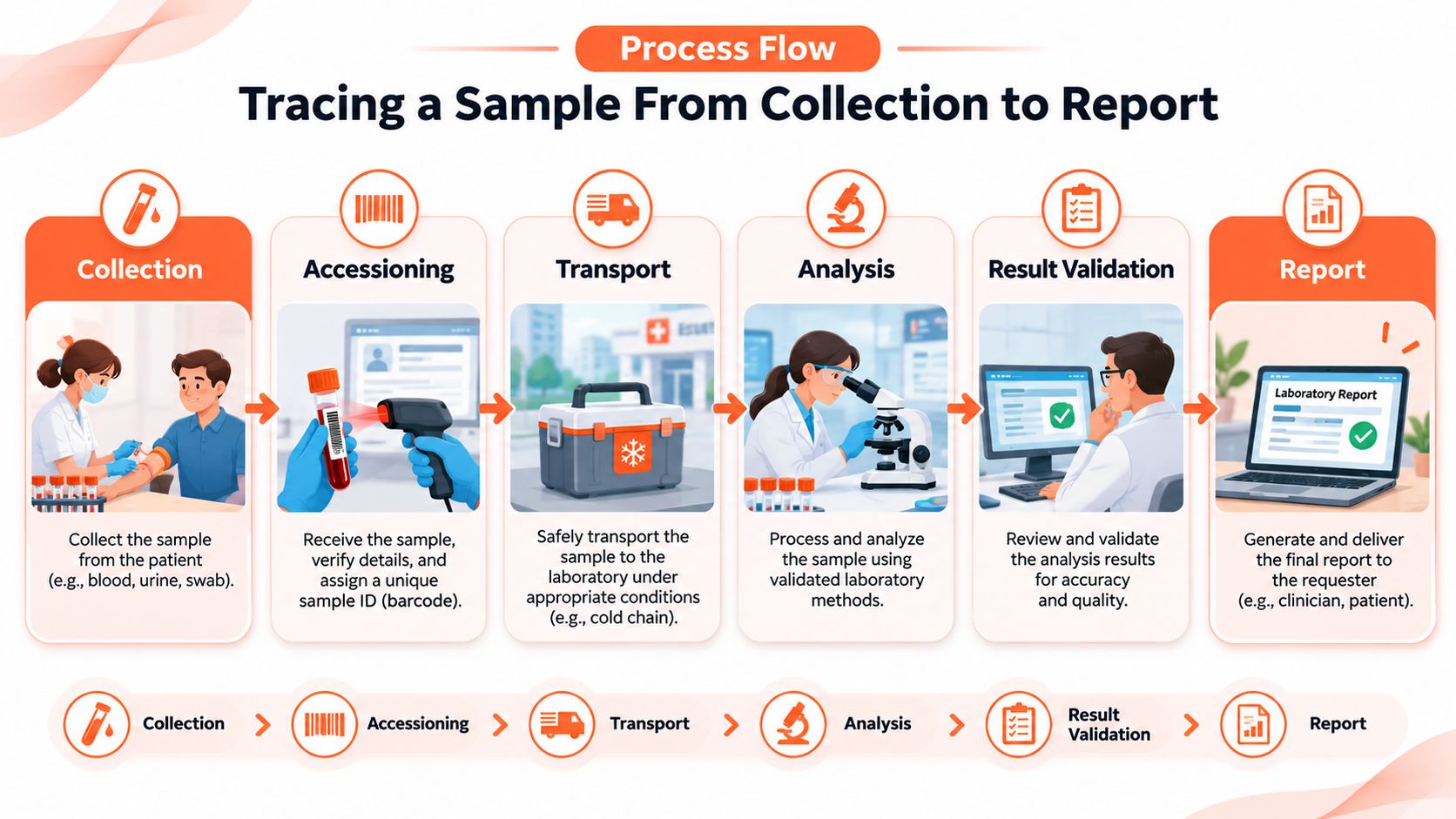
Take one tube of blood. Between your arm and the number on your screen sits a chain of steps, and a failure at almost any of them can produce a result that looks like a disease rather than an error.
Here’s the sequence a controlled laboratory runs, with the usual failure at each step.
Seven Steps and Seven Places to Lose a Result
- Identification and preparation. Confirm identity, fasting status, timing and medication before the needle goes in. A missed fast or a sample drawn from an arm with an infusion running shifts the value before any analyser sees the specimen.
- Collection and acceptance. Tube type, fill volume and handling all matter. The laboratory should hold written acceptance and rejection criteria plus a log showing which samples it turned away and why.
- Transport and processing. Record times and temperatures. Delays and heat change analyte stability, and a value that drifts in transit gets read as a change in the patient.
- Examination. The assay runs on a calibrated instrument, with reagent lot numbers traceable to your report. That traceability is what lets a laboratory explain a step change six months later.
- Quality review before release. Internal quality control is checked before patient results leave the building. A run that fails control shouldn’t be reported as though nothing happened.
- Verification and reporting. Results carry units and the reference interval that belongs to that method and population. Critical findings escalate to a named clinician instead of waiting in a portal.
- Amendments and records. A corrected result should arrive as an amended report with an audit trail, and records are kept for the required period. Silent edits are the thing to ask about directly.
A diagnostic laboratory should implement a quality-management system aligned with ISO 15189:2022, which specifies requirements for both laboratory quality and technical competence and can be used by regulators and accreditation bodies to assess competence, as the ISO 15189:2022 standard sets out. The WHO quality-management framework spreads these controls across personnel, equipment, purchasing and inventory, process control, information management, occurrence management, assessment and continual improvement.
What good looks like: every step has a written procedure, a record, and a person whose name sits next to it. If you ask for the sample-handling record and get a policy document instead, you’ve learned something.
The controls that matter most are unglamorous: sample acceptance and rejection, instrument maintenance, reagent lot traceability, internal quality-control review, critical-result escalation, amended reports and record retention. Accreditation is a sound threshold for that governance, but confirm the specific assays you’re buying sit inside the accredited scope, especially where a programme mixes central-lab testing with on-site devices.
Why Assay Evidence Matters More Than Test Count
A clinic can look impressive and offer weaker assurance than a modest competitor. Long menus, polished PDFs and a glossy portal are cheap to produce. The question that cuts through all of it is narrower: for each test that will change a decision, what evidence exists that it measures what it claims, in the population you belong to?
Sort the tests you’ve been offered into five categories, then demand the matching evidence.
| Test category | Regulatory status | Evidence to demand | Red flag |
|---|---|---|---|
| Established clinical test (glucose, lipid panel) | Routinely approved in vitro diagnostic | Accreditation scope, reference intervals | Missing units or reference ranges |
| Laboratory-developed test (proprietary panel) | Designed and run by the lab; oversight has shifted | Validation summary and intended-use statement | No published validation |
| Multi-analyte or risk score | Often marketed as wellness or risk tool | Performance data and clinical validity evidence | Score presented as a diagnosis |
| Genomic, epigenetic or microbiome score | Regulated differently from country to country | Independent performance evidence | Only proprietary white papers |
| Point-of-care device | Device-specific clearance or listing | Confirmation the device is within accredited scope | Scope not stated |
The middle row deserves attention because its rules have moved. In the United States, the FDA’s May 2024 rule explicitly treated in-vitro diagnostics as medical devices even when manufactured by a laboratory, with staged requirements for reporting, quality systems and premarket review. A federal district court vacated that rule on 31 March 2025, and the FDA reverted the regulatory text on 19 September 2025, according to the Federal Register text of the reversion.
That leaves a practical question most patient-facing material skips. When a clinic sells a proprietary panel, who is legally responsible for validation, adverse-event reporting, clinical interpretation and continuity if the framework shifts again? Ask. The answer is usually a named laboratory director, and you can request that the clinic name them.
We’ve been through this at scale. Longevity Clinics has compared 232 tests, and the pattern is consistent: the tests that drive decisions usually have clear intended uses, and the ones that fill out a brochure often don’t. If you want to see how the wider screening menu is assessed, our journal covers advanced health screening in more detail.
Start with the two or three tests that will change what you do next. Request the intended-use statement, the validation summary and the reference intervals for those, not for all forty.
The rule: judge a test by its evidence, not by its label or its position on the menu.
Keeping Results Comparable Across Labs and Years
Your baseline was drawn in one country in January. Your follow-up is drawn in another in July, at a clinic that uses a different partner laboratory. The two numbers sit side by side in a portal, and one of them looks better than the other.
Is it better? Only if the measurements are comparable, and comparability isn’t automatic.
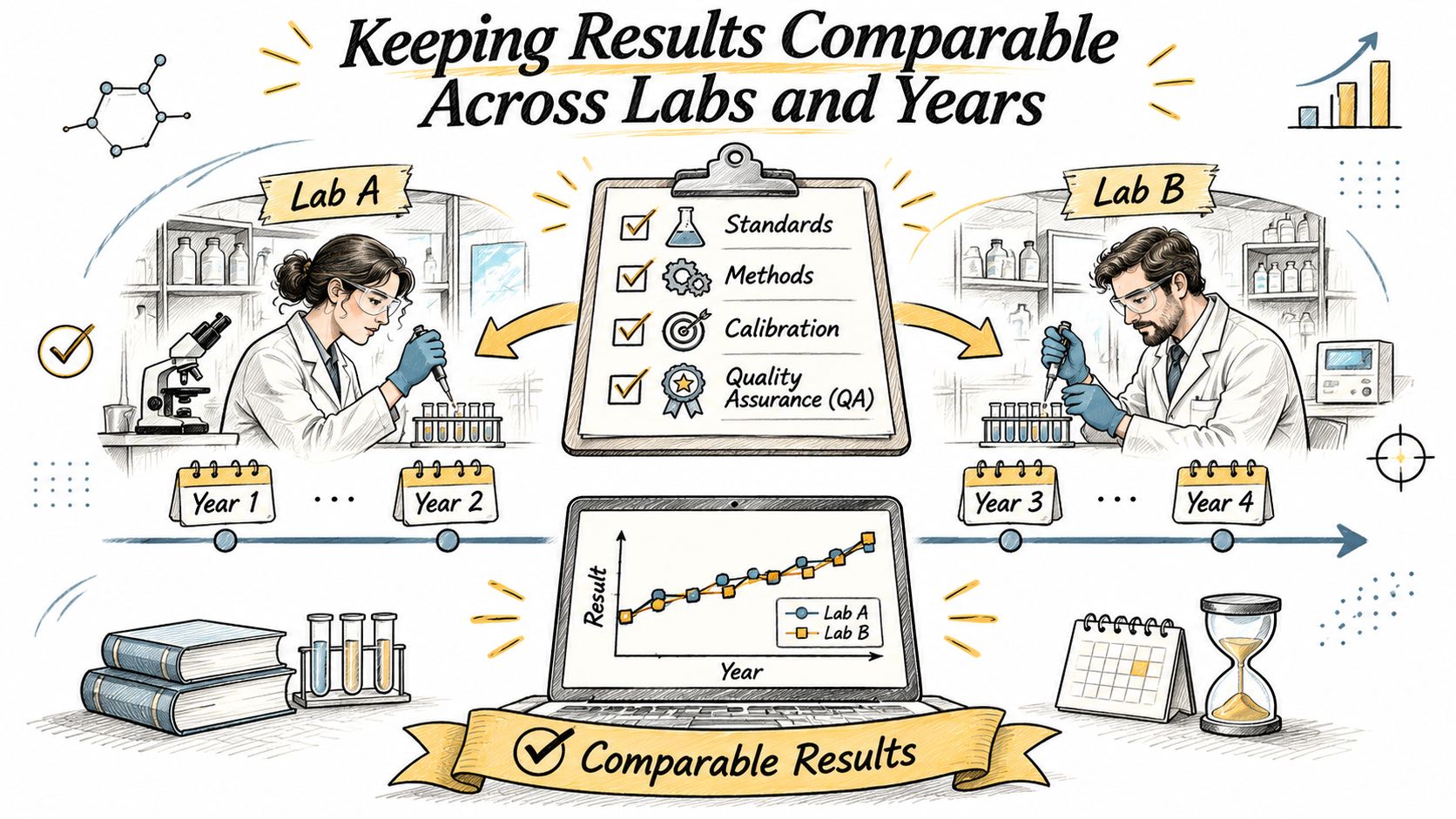
Accreditation alone doesn’t prove that results from different countries, laboratories, platforms or collection settings are interchangeable. Recent European policy material recognises ISO 15189 accreditation as evidence of laboratory quality and traceability and proposes reducing duplicative documentation for accredited laboratories under the In Vitro Diagnostic Regulation, yet it doesn’t answer the operational question: can a baseline from one country be validly compared with a six-month result from somewhere else? The Federal Register text on the reverted in-vitro diagnostic definition shows how quickly even the regulatory backdrop can move.
The Questions That Decide Whether a Comparison Is Valid
- Same units and reference population? A value with no units, or with a range borrowed from a different population, can’t be tracked over time.
- Same fasting and timing instructions? A non-fasting lipid panel compared with a fasting one measures two different things.
- Same specimen handling? Processing times and temperatures change some analytes measurably.
- Same analytical platform, or a bridging study? A reagent lot change can shift a value while the patient hasn’t changed at all.
- Who reconciles a discrepancy? There should be a named clinician, not a support inbox.
Measurement uncertainty sits behind all of this. Two results can differ because the patient changed or because the method did, and only the laboratory can tell you which. That’s why external quality-assessment performance, internal quality-control records and specimen handling records matter when you’re comparing a January number with a July one.
The conclusion is counterintuitive for anyone buying a premium programme. A larger test menu can reduce decision quality when longitudinal measurements aren’t analytically harmonised, because hundreds of non-comparable numbers look like more information than they are. Fewer biomarkers, measured consistently on one method, usually tell you more over two years than a broad panel run at three different laboratories. The same reasoning sits behind biological age testing, where a single score is only useful if the inputs stay stable.
Before you book, ask one question: will follow-up testing use the same laboratory and the same method as the baseline, and if not, what bridging evidence exists?
Your Next Step Before You Book a Panel
Send one written message before the consultation, and keep the answer. It takes the clinic ten minutes and it tells you more than an hour of sales conversation.
I’m considering your programme and would like to confirm the laboratory arrangements. Please provide the name of the performing laboratory for each test, its accreditation certificate and the scope list showing those tests. For the tests most likely to change my plan, please send the validation summary, the intended-use statement, reference intervals with units, sample stability rules, your policy for amended results, and the name of the clinician who reconciles discordant results.
How to read the reply. A clear, sourced response that names the laboratory and supplies documents is a good sign, even if some rows come back with a caveat. A vague answer is itself an answer. A refusal to name the performing laboratory is a reason to pause, and so is a promise to “send it after booking”.
Set the documents next to the checklist table from the start of this article and mark each row as answered, partial or missing. Partial is common and not automatically disqualifying: a small programme may not run external quality assessment for a niche score it licenses from a third party, but it should say so plainly rather than deflect.
A note on what this resource does and doesn’t do. Longevity Clinics can help with factual corrections to a clinic profile when you include sources, story tips, questions about the four-axis scoring methodology, editorial enquiries from journalists and researchers, and suggestions for clinics to add to the directory. We can’t help with personal medical advice, clinic recommendations, pre-publication review requests from clinics, or affiliate and sponsorship pitches, and booking or pricing enquiries must go directly to the clinic. Our content is editorial and not medical advice, so take any result to a qualified clinician before starting, changing or stopping any treatment.
Book only when every row of the checklist has an answer, and treat a missing answer as the most useful thing you learned that day. Send the message above this week, while you’re still comparing programmes and before price enters the conversation. The clinic that replies with a certificate, a scope list and a named clinician has told you something a longer test menu never will.