Diagnostic Workup Definition: What Clinics Must Include
Diagnostic workup definition explained: the components of a credible workup, how workups vary by programme, and how to judge one.
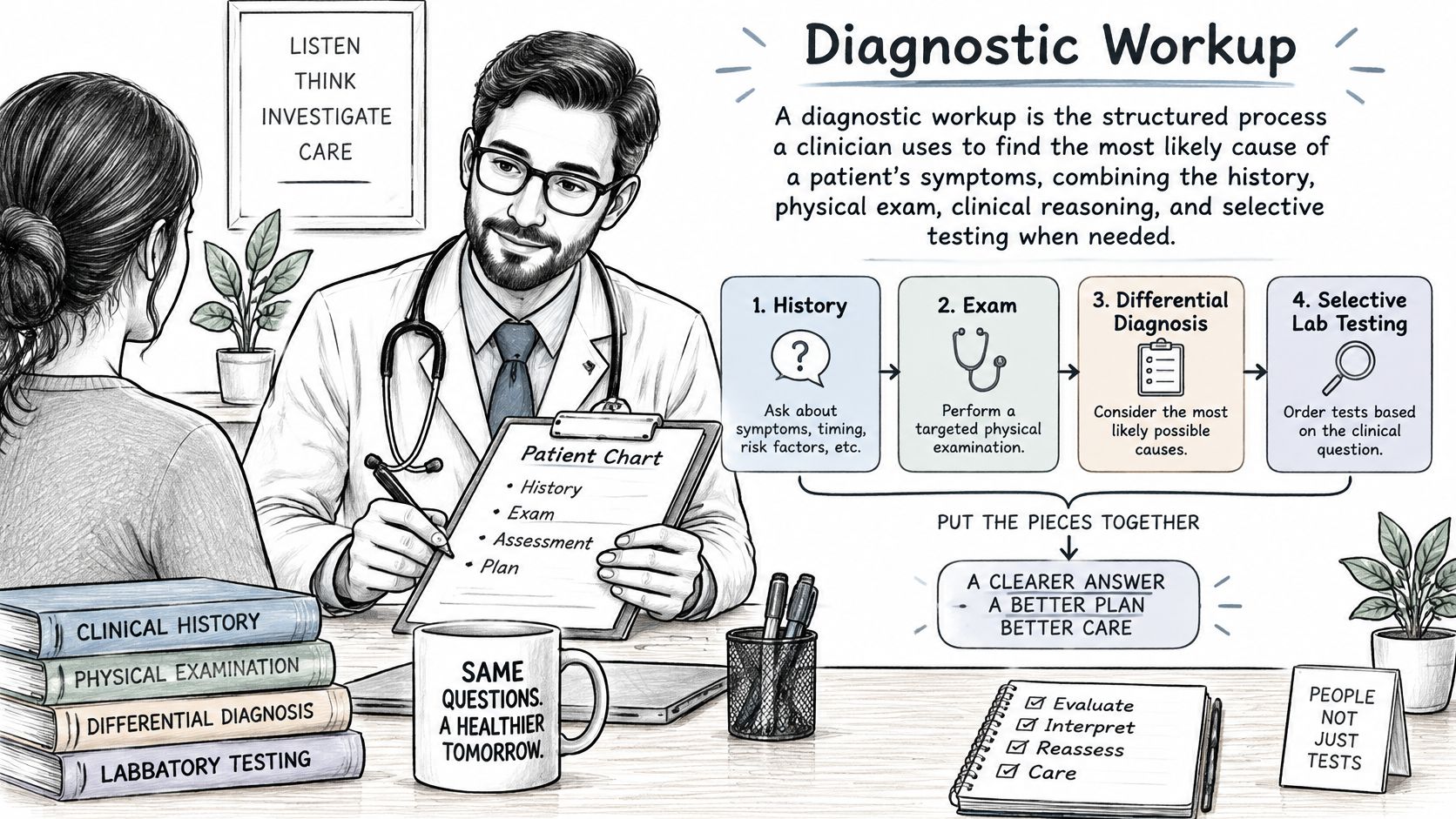
A diagnostic workup is a structured process that combines history, physical examination, differential diagnosis and selectively ordered tests to reach an accurate, timely explanation of a health problem and a justified next step.
That makes the familiar advice to choose the clinic with the most tests a poor starting point. A long menu of scans and biomarkers tells you what a programme can measure, but not whether a clinician can turn those measurements into a useful decision. For anyone considering a longevity programme, the better question is whether the clinic can explain its reasoning and take responsibility for what remains unresolved.
Table of Contents
- What a Diagnostic Workup Means in Plain Terms
- The Stages a Credible Workup Passes Through
- Which Test Types Answer Which Questions
- How Workups Change Across Programme Formats
- The Minimum Credible Workup for a Longevity Programme
- Check the Workup Before You Commit to a Clinic
What a Diagnostic Workup Means in Plain Terms
A clinician works like a detective building a case. The patient’s account establishes what happened, the examination adds observations, and each test acts like a witness: it can support a suspect, challenge one or point somewhere new. A pile of witness statements without a question is no investigation.
A workup is the reasoning chain that connects a person’s concern to a working or confirmed diagnosis, followed by treatment, further evaluation or a justified decision to monitor. The chain counts as complete only when it ends in a documented decision and a named clinician who owns what happens next.
Correctness and timeliness both matter
The World Health Organization’s diagnostic safety guidance defines diagnostic error as failing to provide an accurate and timely explanation of a patient’s health problem, or failing to communicate that explanation to the patient. That gives a workup three distinct quality dimensions: the answer must be right, it must arrive in time to be useful, and the patient must receive it.
A conclusion can be medically plausible and still arrive too late. Equally, a clinician might identify the right condition but leave the patient unaware that treatment or specialist review is needed.
Missed, delayed and wrong diagnoses aren’t always separate events. Say someone’s persistent symptoms are initially attributed to a benign explanation. If that conclusion prevents reassessment when the symptoms change, the wrong diagnosis can also delay recognition of the actual problem.
A useful report tells you what the clinician thinks, what remains uncertain and what happens next.
Screening and workup aren’t interchangeable
Screening looks for disease in people without a specific complaint. A diagnostic workup addresses a question about an individual’s symptoms, an abnormal finding or a particular risk. Screening can start a workup, but it doesn’t complete one by itself.
An unexpected blood-test result during a wellness assessment illustrates the gap. That result creates a new question, and the clinician still needs to decide whether it fits the patient’s history, needs confirmation or warrants further investigation. An abnormal flag alone isn’t a diagnosis.
Diagnostic errors in outpatient care are common enough to be studied as a distinct patient-safety problem in their own right, which is why the reasoning behind a result matters as much as the result itself.
A practical diagnostic workup definition therefore needs more than the word thorough. Because a workup is a chain, each link can be checked:
- A clinical question: What concern is the clinician trying to explain?
- A decision pathway: What decision will each result inform?
- An accountable owner: Who makes sure the question is resolved or safely monitored?
A programme that can’t answer all three can still produce a thick report while leaving the original question unresolved.
The Stages a Credible Workup Passes Through
A credible workup has a sequence, although clinicians may revisit earlier steps when new information appears. A result that contradicts the leading explanation should prompt reconsideration, not be squeezed into the original story.
The MedlinePlus explanation of differential diagnosis describes how clinicians use history, examination and testing to distinguish between conditions that could explain similar symptoms. The key activity is comparison: a clinician considers competing explanations and selects evidence that helps separate them.
From the patient’s account to an accountable plan
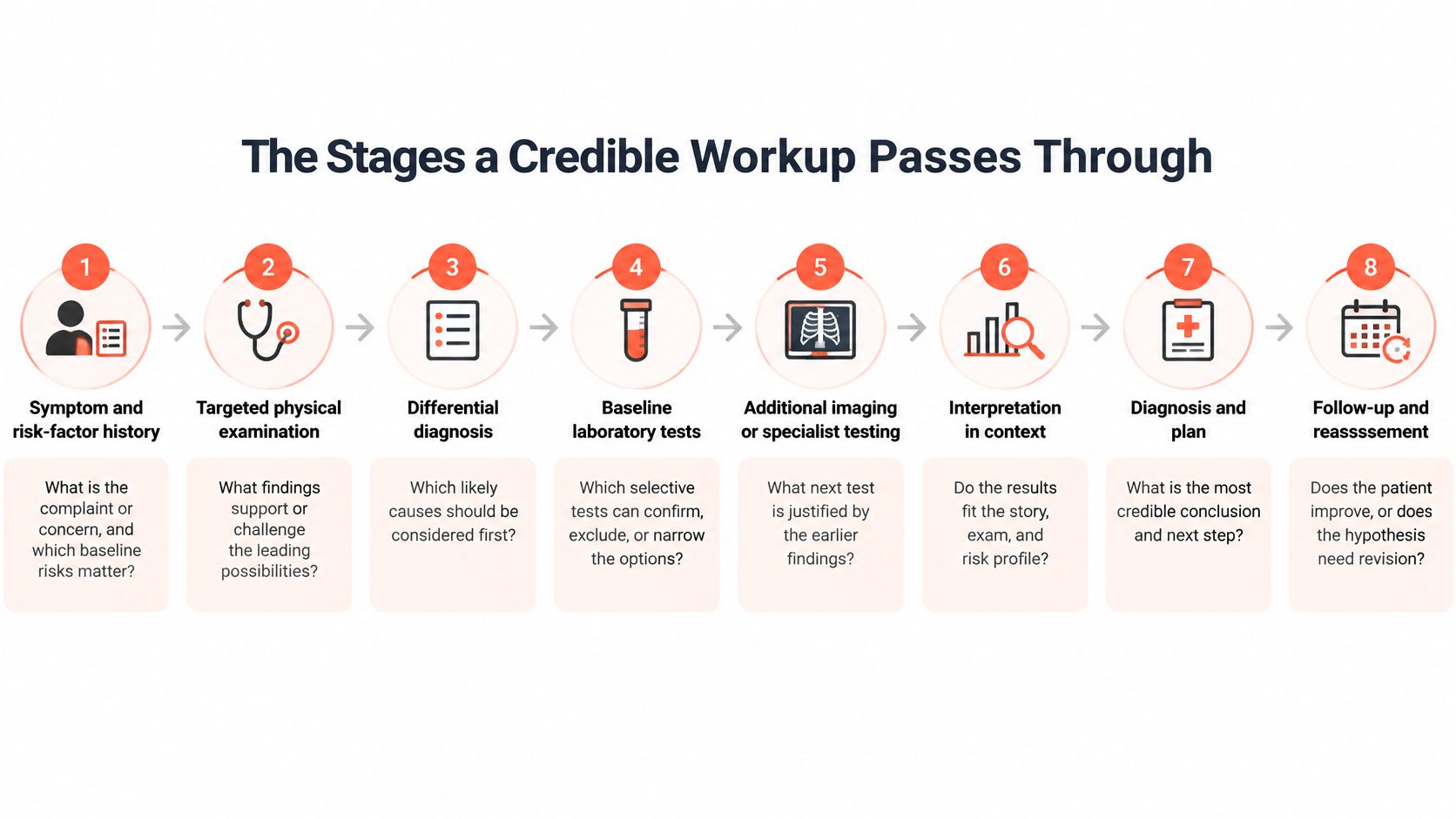
- Symptom and risk-factor history: Establish the concern, its timing, relevant exposures and baseline risks rather than starting with a preselected panel.
- Review of existing records: Examine previous results, scans, diagnoses and medications to identify what’s already known and what has changed.
- Focused physical examination: Check for findings that support or challenge the possible explanations.
- Differential diagnosis: Name the plausible causes and explain which deserve priority.
- Targeted testing: Select investigations whose results could confirm, exclude or meaningfully re-rank those possibilities.
- Interpretation in context: Reconcile the results with the history and examination rather than reading abnormal flags in isolation.
- Closure or escalation: Decide whether the evidence supports management, observation or specialist assessment.
- Owned follow-up: Assign responsibility and a review interval for anything unresolved.
Components of a credible diagnostic workup
Use the report, not just the brochure, to assess whether the reasoning is visible.
| Stage | Question it answers | Sign of a sound version |
|---|---|---|
| Symptom and risk history | What is the concern and which baseline risks apply? | Named complaint, risk factors and family history recorded |
| Review of existing records | What is already known from prior results or scans? | Earlier results compared, not repeated by default |
| Focused physical examination | What can the clinician check that tests cannot show? | Examination findings written into the plan |
| Differential diagnosis | Which explanations are still live? | Competing hypotheses named with the reasoning |
| Targeted testing | Which result would confirm, exclude or re-rank a hypothesis? | Each test linked to a stated question |
| Interpretation | What does each result mean alongside the presentation? | Abnormal values interpreted by a qualified clinician in context |
| Closure or escalation | Is the uncertainty low enough to stop? | Written threshold for closing or referring |
| Follow-up owner | Who tracks anything unresolved, and when? | Named owner and review interval |
Consider someone seeking help for fatigue. A useful history distinguishes recent fatigue from a longstanding pattern, explores sleep and medications, and establishes whether other symptoms require attention. Existing records may already answer part of the question, while the examination may change which explanation deserves investigation.
The final report should explain why the selected tests were appropriate and how their results affected the plan. It shouldn’t place a fatigue questionnaire beside a laboratory spreadsheet and expect the patient to connect them.
Not every stage needs a separate appointment or page. What matters is that the reasoning can be found. If a report contains extensive measurements but no explanation of the concern, competing causes or next decision, important parts of the workup are only implied.
Which Test Types Answer Which Questions
Clinicians begin with pretest probability, their estimate of how likely a condition is before testing, based on factors such as prevalence, demographics, history and examination. The result changes that estimate into a post-test probability. The Agency for Healthcare Research and Quality’s guidance on probabilistic thinking explains why test interpretation depends on that starting context.
A highly sensitive test is particularly useful when a clinician wants a negative result to reduce concern about a serious possibility. A highly specific test is particularly useful when a positive result could support a suspected diagnosis. Neither property means that a result is infallible or that the test belongs in everyone’s assessment.
Test families and what each can and cannot show
| Test family | Question it answers best | Main limitation |
|---|---|---|
| Blood panels | Whether an organ or metabolic system appears to be functioning abnormally | Single values can fluctuate, and some proposed wellness markers lack validated action thresholds for healthy adults |
| Imaging such as ultrasound, CT and MRI | Whether there’s a structural change or lesion, and where it sits | Incidental findings and false positives; CT also involves radiation exposure |
| Functional tests such as ECG, exercise testing and lung function | How a system behaves at rest or during a defined challenge | A normal resting result doesn’t necessarily exclude a problem during activity |
| Specialist review | What the combined findings mean for diagnosis and treatment | Its usefulness relies on a clear handover and follow-up plan |
Blood tests can address questions about glucose regulation, lipids, organ function or selected inflammatory markers. But a reference range isn’t a personal guarantee of health, and an out-of-range result isn’t automatically disease. The clinician must distinguish a finding that changes care from one that needs context or confirmation.
Imaging answers a different kind of question. Showing anatomy doesn’t necessarily explain how a person feels or how an organ performs during exertion. Conversely, a functional assessment may reveal a problem that a structural image cannot explain.
Practical rule: Before adding a test, establish what the clinician would do differently after a reassuring, abnormal or indeterminate result.
Match the conditions of testing to the complaint
Suppose a person describes symptoms that occur when standing but feels well while lying down. The circumstances of measurement matter, not just the sophistication of the equipment. Cardiogram’s explanation of how clinicians test for POTS is a condition-specific resource for readers exploring that diagnostic pathway.
For broader programme comparisons, our guide to longevity testing helps distinguish the investigations readers may encounter. A test catalogue is useful for identifying available tools, but availability alone doesn’t establish suitability.
Each investigation should earn its place through a clinical question and a possible management consequence. If every possible result leads to the same recommendation, the clinician should be able to explain why collecting that information is worthwhile.
How Workups Change Across Programme Formats
The definition stays constant across residential, outpatient and membership programmes. What changes is the opportunity to gather information, interpret it and maintain responsibility when the patient isn’t physically present.
Treat the formats below as organisational patterns to examine, not promises about what a particular clinic delivers. A programme’s advertised schedule may describe the testing window without describing the full diagnostic pathway.
Typical workup shape by programme format
| Format | Typical duration | Usual components | Gap to check |
|---|---|---|---|
| Residential programme | A defined stay, with later review if needed | Consultations, panels, imaging and functional tests during the stay | Results may arrive after discharge without a named owner |
| Outpatient clinic | Separate appointments through assessment and review | Scheduled laboratory tests, referred imaging and follow-up consultation | Whether referral letters reach the right specialist |
| Membership or concierge model | Ongoing through the membership period | Repeat panels, trend review and access to a specialist network | Who owns abnormal results between review cycles |
| One-day executive health check | The advertised assessment day, plus any subsequent review | Panels, selected imaging and cardiac screening | Whether interpretation and a written plan follow the assessment |
A residential programme can make coordination convenient while you’re on site. The critical handover occurs when you leave: a result that requires confirmation must still have an owner, even if the original clinician is no longer nearby.
Outpatient care allows a clinician to use an earlier result to shape the next appointment. That advantage disappears if appointments are booked without reviewing previous findings, or if a referral is sent but nobody checks whether the specialist received it.
Continuity is different from repeated testing
A membership model may make it easier to compare measurements over time. However, repeated access isn’t the same as continuous clinical responsibility. Your regular physician, the membership clinician and an outside specialist need an explicit division of roles when a finding requires action.
An executive assessment concentrates activity into a short visit. That can suit a busy schedule, but the programme still needs protected time for history-taking and a separate route for discussing results that aren’t ready before departure.
- Before departure: Establish which results remain outstanding and how you’ll receive them.
- At handover: Confirm who receives the clinical summary and who acts on its recommendations.
- After the programme: Identify the route for reassessment, including when you’re back in another country.
Our comparison of residential and outpatient treatment provides context for choosing a format. The clinically important distinction isn’t staying overnight versus attending appointments. It’s whether the programme’s staffing and communication arrangements support the complete assessment, including the work that happens after testing ends.
The Minimum Credible Workup for a Longevity Programme
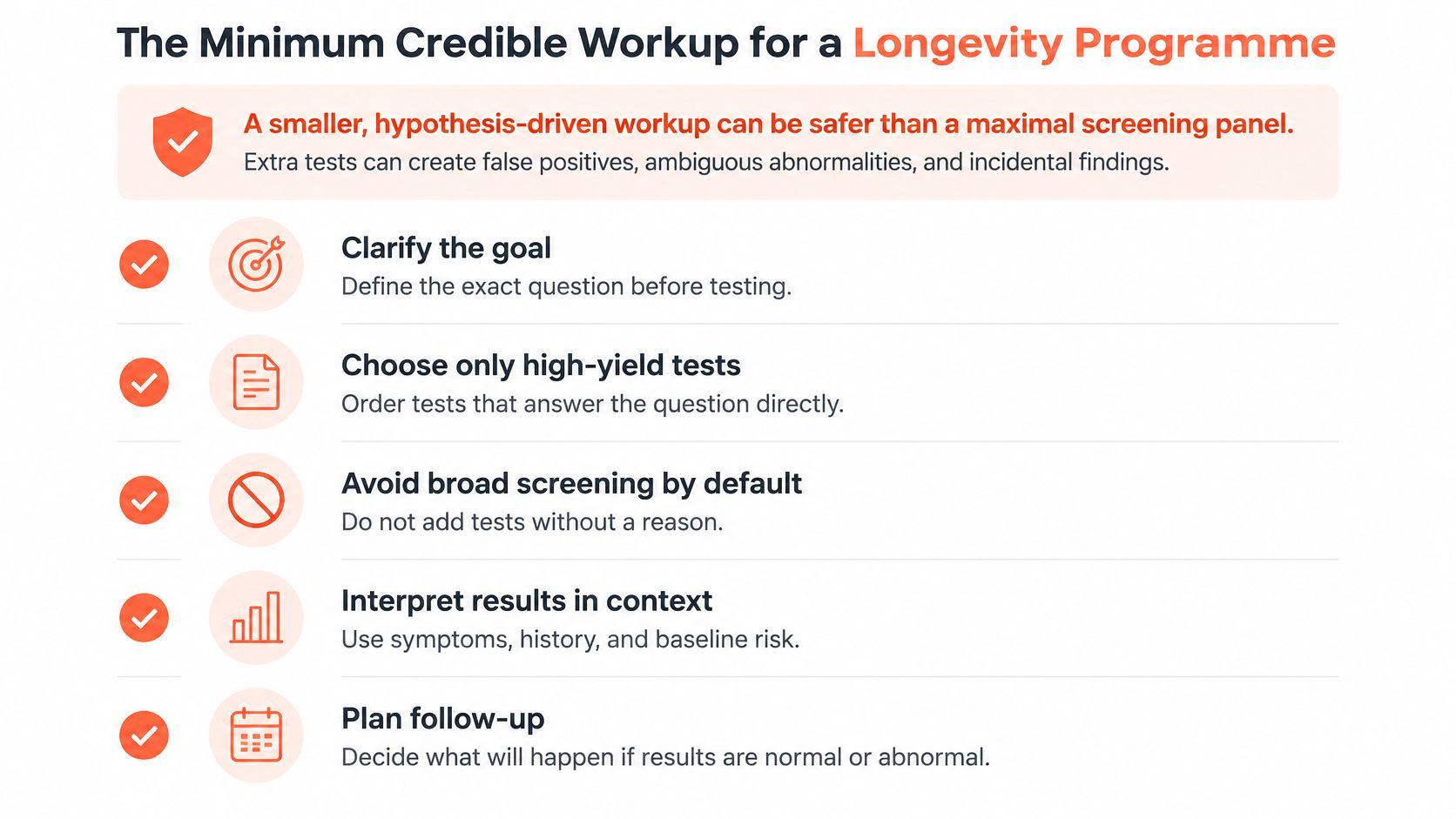
A smaller, hypothesis-driven workup can be safer than a maximal screening panel. Extra investigations can generate false positives, ambiguous abnormalities and incidental findings, followed by procedures that wouldn’t otherwise have been considered. Diagnostic thoroughness means reducing meaningful uncertainty, not collecting every available measurement.
The European Medicines Agency’s guideline on diagnostic agents describes a diagnostic work-up as a set of procedures that includes history-taking and physical examination, with tests used to reduce uncertainty about diagnosis or disease extent. That is a useful standard for judging a programme marketed around advanced testing: the measurements should serve the assessment, not replace it.
A minimum standard of reasoning and documentation
The minimum isn’t a universal shopping list. It’s a set of requirements that allows another clinician, and the patient, to understand why the assessment was done and how to act on it.
- A defined goal: Record the concern or preventive objective, with a stated purpose for each proposed test.
- Relevant baseline risks: Explain which personal, family or medical factors justify the selected investigations.
- History and focused examination: Include findings that shape the assessment, rather than treating consultation as an introduction to the test package.
- Selective blood testing: Tie the panel to the person’s risks and clinical questions instead of ordering it solely because it’s bundled.
- Justified imaging or functional assessment: State what additional uncertainty the investigation could resolve.
- Written action thresholds: Explain which findings require confirmation, treatment, monitoring or referral.
- A specialist pathway: Identify how findings beyond the programme’s competence will be assessed.
- Tracked unresolved findings: Give each outstanding issue an accountable clinician and a review date.
- A reassessment trigger: Explain what should happen if symptoms persist, change or worsen despite reassuring results.
For readers trying to understand the purpose of blood testing, Venus Health Co.’s guide to understanding metabolic health markers offers background terminology. Such education can help you follow a consultation, but it doesn’t determine which markers are appropriate for you.
Know what a justified stopping point looks like
A programme can be thorough without eliminating every conceivable diagnosis. The clinician needs enough evidence to support the next decision, together with a safe plan for the uncertainty that remains.
Say an assessment finds a borderline value that doesn’t fit the rest of the clinical picture. A reasoned response might be to review relevant circumstances and confirm the finding before recommending treatment. Immediately adding unrelated investigations would not necessarily improve the assessment.
Thorough care can include deciding not to order another test, provided the clinician explains the decision and documents a safe next step.
The useful balance lies between under-investigation and unselective testing. A clinic demonstrates sophistication when it can justify both what it includes and what it leaves out. A reassuring conclusion should therefore explain its limits, not imply that a broad panel has guaranteed future health.
Check the Workup Before You Commit to a Clinic
A completed test package isn’t proof of diagnostic safety. Clinicians can miss an important detail during the initial assessment, misinterpret a result, fail to communicate an action or lose track of a referral. Some of the most consequential work happens outside the scanner or laboratory.
A 2025 analysis of approximately 90,000 patient-compensation cases found diagnostic errors involved in 14.5% of settled cases, with follow-up and coordination contributing in 33% of diagnostic-error cases. These are compensation-case findings, not estimates of a longevity clinic patient’s risk, but they show why coordination deserves scrutiny alongside testing.
Put these questions in writing
- What clinical question does each test answer? Seek an explanation tied to your assessment, not only a general description of what the technology measures.
- Who reviews an abnormal result, and how quickly? The answer should identify the responsible clinician or clinical role and the review timeframe.
- What triggers action? Look for a written approach to abnormal and indeterminate results, including confirmation and escalation.
- Who owns the result after you leave? Clarify responsibility if your membership ends, you return home or care crosses a border.
- When is the assessment reopened? Establish how persistent symptoms are reassessed when the initial results are reassuring.
Short diagnostic visits and cross-border care deserve particular attention because the testing organisation may not become the treating organisation. Concierge access can also obscure responsibility if several professionals are available but none is explicitly accountable for closing an issue.
Our guide to health checkup packages helps readers examine what a package includes. For diagnostic safety, distinguish access to a consultation from a commitment to review and act on a particular finding.
Use editorial scores without mistaking them for guarantees
At Longevity Clinics, we score each clinic across four axes, each worth 25 points: diagnostic depth, medical supervision, conflict freedom and evidence base. Diagnostic depth belongs alongside those other dimensions because advanced investigations don’t, by themselves, establish appropriate supervision or well-supported treatment.
We collect publicly available material from clinic websites, regulator records, peer-reviewed literature and professional registries. We score it algorithmically against our rubric, and an expert team of physicians and editors validates every result. Our reviews assess what can be established publicly; they don’t replace an individual clinical assessment or confirm how an unpublished handover will work.
Before booking, choose two candidate clinics using our directory or comparison tool and request each clinic’s written workup plan. Compare the answers side by side, marking whether unresolved findings have a named owner, an action and a review date. If those details are missing, resolve that gap before committing to the programme.