Industry Benchmarking Analysis for Longevity Care
Industry benchmarking analysis for longevity clinics: metrics, peer sets, scoring and how operators and buyers should read the result.
Choosing the highest-ranked longevity clinic sounds sensible. It isn’t, unless the ranking first establishes what those clinics deliver, who they treat, and what their scores measure. A programme can look impressive because it generates extensive testing records, while another documents fewer measures but makes clearer clinical decisions. More measurement isn’t automatically better care. Treat the league table as a claim to investigate, not a decision already made.
Table of Contents
- What an Industry Benchmarking Analysis Is
- Metrics Sampling and Scoring in One Framework
- Comparing Residential Outpatient and Membership Care
- Evidence Regulation and Marketing as Separate Scores
- Risk Adjustment Before You Rank Outcomes
- Worked Gaps Operators and Buyers Can Act On
- Run and Audit a Benchmark in Five Steps
What an Industry Benchmarking Analysis Is
An industry benchmarking analysis compares like operating units using shared definitions and investigates the operating practices behind performance gaps. A list of clinic names, prices and scores doesn’t meet that standard by itself. The analysis must explain what was compared and why the differences matter.
Say you’re comparing an outpatient diagnostic centre with a residential programme. The centre publishes detailed laboratory panels; the residential programme describes supervised care and an onward treatment plan. Counting available tests would produce a winner, but it wouldn’t establish which programme provides better care for your objective.
Benchmarking’s origins help explain the distinction. A documented Xerox case study describes how Xerox formalised its modern approach in 1979, moving beyond output, defects and processing speed to systematic investigation of best practices; by 1983, it had benchmarked approximately 230 processes.
Ask how the result was achieved
Xerox’s framework asked what should be benchmarked, who performed best, how the organisation performed, and how the leading organisation achieved its results. Applied to longevity care, those questions become practical tests:
- Define the work: Is the clinic providing diagnosis, supervised treatment, continuing management or a combination?
- Identify suitable peers: Do the reference programmes deliver comparable services?
- Measure performance: Are the same definitions and observation periods used?
- Investigate the difference: Does stronger performance reflect better supervision, clearer follow-up or more recorded activity?
The shift is from identifying a leader to understanding a process worth adopting. A clinic’s brand visibility can’t explain how clinicians review abnormal findings, decide which tests are appropriate or manage competing commercial incentives.
Reading rule: A composite score without comparable units is a ranking, not yet a benchmarking analysis.
A useful benchmark therefore lets readers inspect the sample, distinguish its scoring dimensions and understand whose outcomes are being measured. Operators need an actionable explanation of a gap. Purchasers need to know whether that gap matters for their intended care.
Metrics Sampling and Scoring in One Framework
What a defensible clinic benchmark must publish
| Component | Question it answers | Minimum disclosure |
|---|---|---|
| Metrics | Are units measuring the same work? | Shared definitions for inputs, outputs and time horizon |
| Peer sample | Who counts as a fair comparison? | Format stratum, inclusion rule and minimum data |
| Scoring | How does a difference become a number? | Separate axes, weights and who validates the result |
| Sensitivity | Would the rank survive another model? | Effect of alternate weights and scale assumptions |
Start with metrics. Record inputs such as clinician hours, diagnostic capacity, testing expenditure and programme duration. Then distinguish those resources from outputs such as completed diagnostic domains, follow-up adherence, documented clinical actions and adverse-event monitoring.
A booked consultation isn’t necessarily a completed clinician review. A laboratory result isn’t necessarily a clinical action. The measurement dictionary should specify what qualifies, what documentation supports it and which observation period applies.
Next, inspect the peer sample. Residential, outpatient and membership programmes should enter separate comparison groups before analysts calculate averages or identify leaders. Publish the inclusion rule, identify the clinics admitted to the sample and specify the minimum information required for assessment.
Missing information needs an explicit treatment rule. Otherwise, an analyst can inadvertently reward a clinic for disclosure in one category while treating silence as satisfactory performance in another.
Make the scoring rule inspectable
Scoring converts observations into a judgement. Readers should see both the component marks and the rules used to combine them, rather than reverse-engineering the method from the final order.
Our rubric scores diagnostic depth, medical supervision, conflict freedom and evidence base, each worth 25 points, producing a 0–100 composite. Every result is produced against the published methodology. Reviews carry an Editorial team byline, and no single reviewer’s judgement sets a clinic’s score; physicians and editors validate the algorithmic assessment.
Equal weighting makes the calculation legible. It doesn’t establish that every axis is equally important to every purchaser. Someone seeking ongoing medical management may interpret the supervision breakdown differently from someone evaluating a diagnostic workup.
Keep an editorial quality score distinct from a resource-efficiency model. They answer different questions: whether documented practices meet stated criteria, and whether a clinic converts resources into measured outputs efficiently.
Test whether the order holds
Sensitivity analysis asks whether changing reasonable modelling choices changes the conclusion. Analysts should vary weights and scale assumptions, then show whether clinics retain their relative positions.
Data-envelopment-analysis methodology offers a useful efficiency model: construct a best-practice frontier from comparable units, then derive improvement targets from peer combinations. A clinic below that frontier can examine whether it uses excessive resources, produces weak measured outputs or fails to capture relevant activity.
The limitation matters. DEA establishes relative efficiency, not absolute clinical excellence. A small or homogeneous peer group can make an unexceptional provider look efficient because stronger alternatives never entered the comparison.
The practical test is whether a reader can reproduce the logic, even without reproducing the software. If the benchmark leaves a cell in the audit table unanswered, treat its ranking as a list rather than an analysis.
Comparing Residential Outpatient and Membership Care
A residential reset, a brief diagnostic package and a continuing concierge relationship aren’t interchangeable products. Combining them in an undifferentiated ranking risks rewarding whichever format supplies the most convenient measurements.
A peer-reviewed review published in 2025 notes that medical-clinic models can generate structured longitudinal records, while resort programmes are shorter-term and less standardised; it also identifies frequent “from” prices and generally undisclosed profitability. Those differences affect what an analyst can observe, not just what a patient buys.
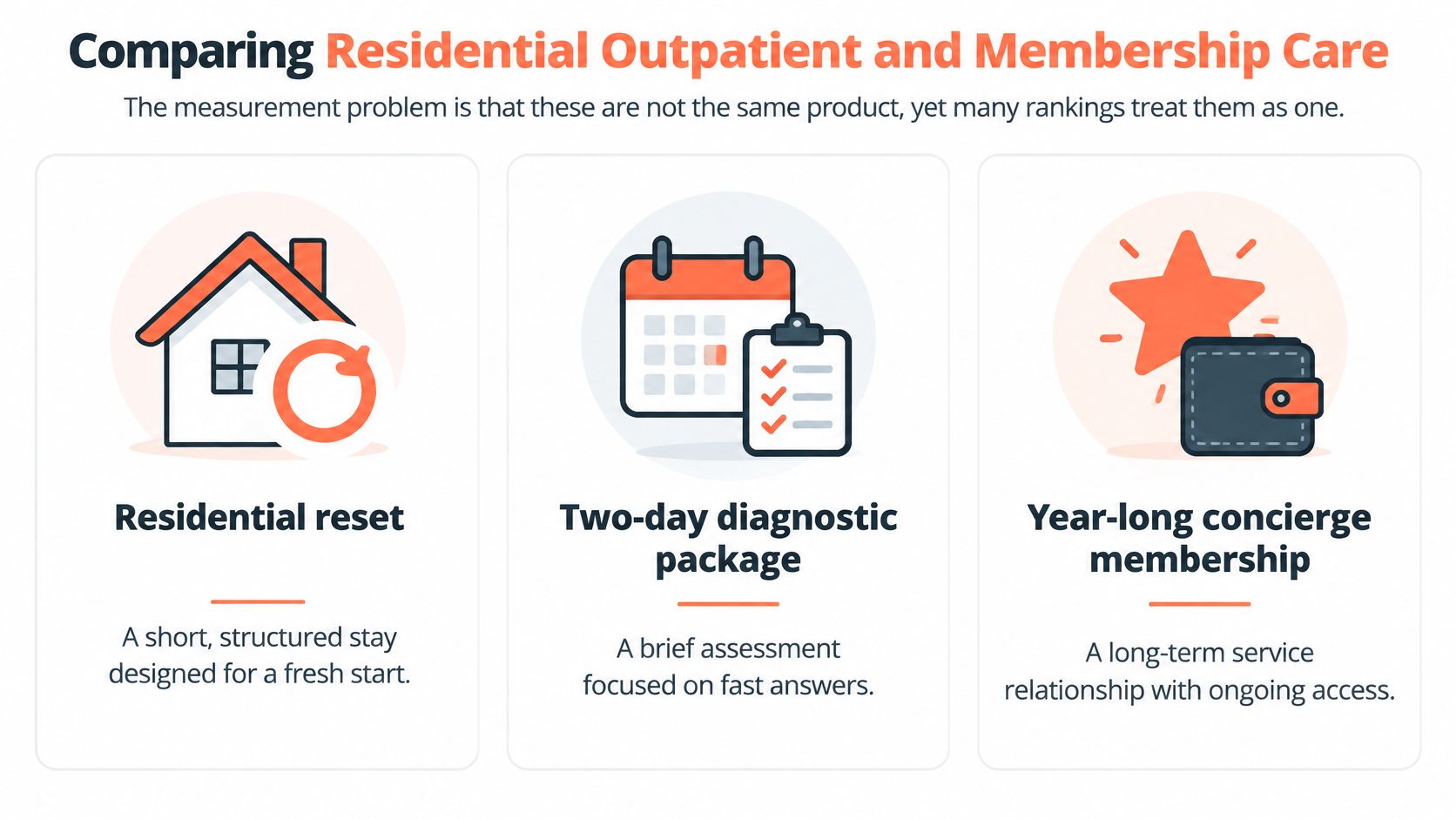
What can be compared across longevity clinic formats
| Format | Fair to compare | Do not treat as quality | Add to headline price |
|---|---|---|---|
| Residential reset | Short-stay intensity and on-site supervision | Volume of tests alone | Travel, stay, supplements and medications |
| Outpatient diagnostic day | Completeness and validity of the workup | A single biomarker swing | Repeat tests and follow-up visits |
| Membership or concierge year | Continuity, access, adherence and documented actions | More data points by default | Medications, extra panels and unused months |
For residential care, examine what happens during the stay and how responsibility transfers after departure. On-site supervision is relevant to the service delivered. It shouldn’t be converted into an assumption of continuing access once the patient returns home.
Include accommodation and travel where they’re excluded from the package. Supplements and medications also belong in the cost comparison when they’re part of the proposed programme.
Compare the promise with the delivery
For outpatient diagnostics, the central question is whether the workup is appropriate, valid and connected to a clinical decision. A large panel shouldn’t receive automatic credit merely because its contents are easy to count. Record who interprets the findings and whether subsequent appointments and repeat tests require additional payment.
For membership care, assess the continuing relationship: access, completed follow-up and documented responses to findings. An extensive stream of measurements can support that assessment, but the stream itself isn’t the outcome. When assessing value, distinguish contracted access from services the purchaser expects to use, including prepaid months that may go unused.
The distinction between residential and outpatient treatment helps establish which responsibilities belong inside the comparison.
Format-dependent measures include continuity, clinician access, follow-up completion, emergency escalation and documented outcomes. Format-neutral measures include diagnostic validity, risk disclosure and evidence quality. Compare the former within the relevant service model; apply the latter consistently across models.
For operators, the implication is direct: don’t add tests just to appear measurable. Document the clinical value of the work already performed. For purchasers, replace the search for an overall winner with a narrower question: highest for which care model, patient objective and time horizon?
Evidence Regulation and Marketing as Separate Scores
Regulatory permission, publication count and commercial adoption answer different questions. A clinic shouldn’t receive stronger scientific marks because a modality is available for sale, appears in numerous papers or features prominently in its marketing.
A scientific roadmap published in 2025 describes biological-age diagnostics, senolytics and longevity-focused clinics operating ahead of settled frameworks, and states that ageing biomarkers haven’t been qualified by the FDA or EMA because longitudinal evidence linking them to clinical outcomes remains insufficient. That is a limit on the claims those biomarkers can establish, not a declaration that every related measurement is useless.
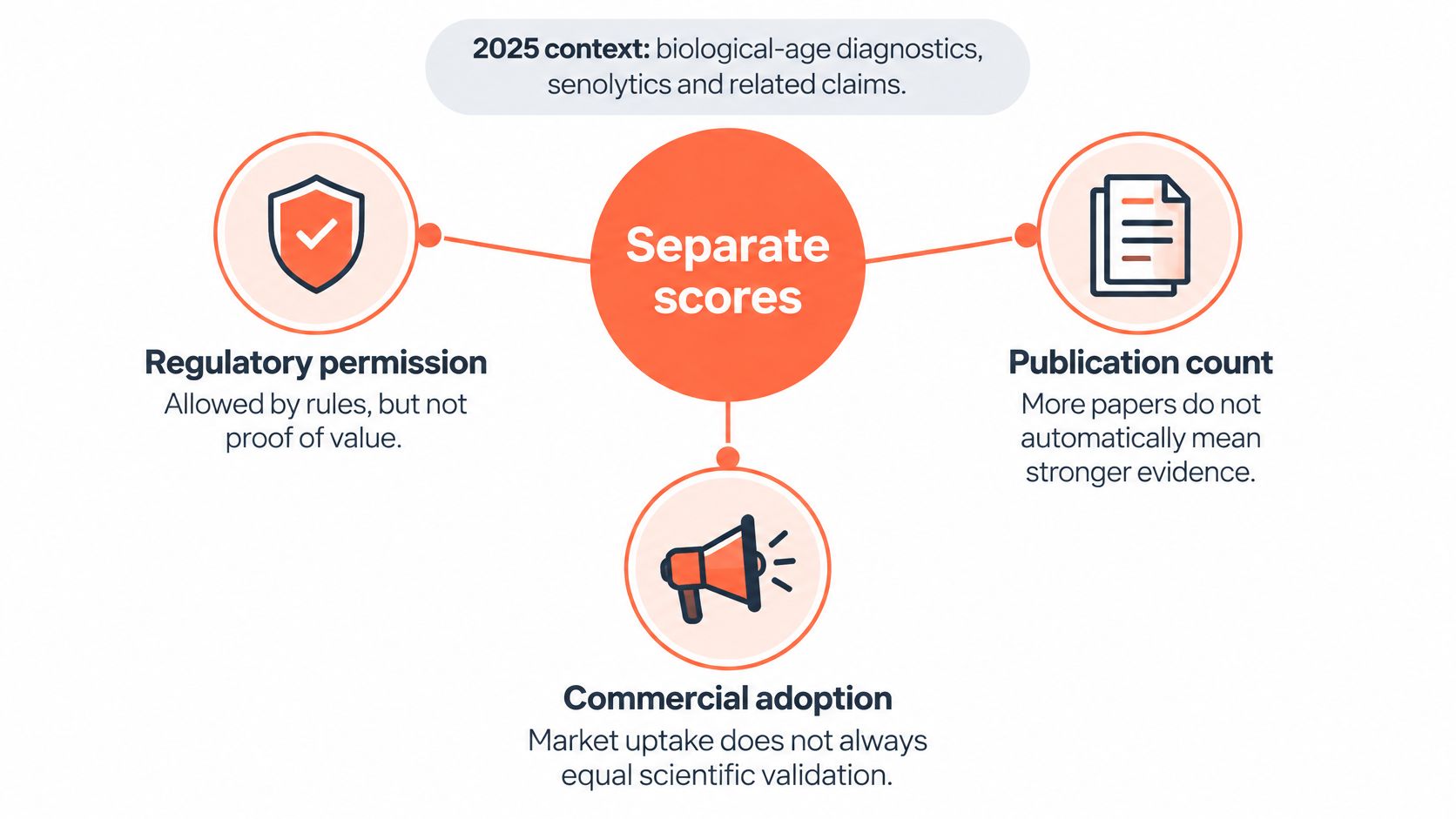
Separate the claims before judging them
A useful assessment records distinct marks rather than blending legality, scientific support and popularity:
- Human clinical evidence: Identify the intervention, population, named endpoint and observation period. Evidence about a related mechanism doesn’t establish the advertised patient benefit.
- Endpoint relevance: Distinguish surrogate measurements from functional capacity, adverse events and sustained behaviour change. Record what patients can reasonably infer from the result.
- Regulatory classification: State the applicable jurisdiction and classification. Permission to offer a service mustn’t become shorthand for validation of every associated longevity claim.
- Transparency: Examine whether the clinic explains uncertainty, experimental status and foreseeable harms in language a purchaser can understand.
An evidence-rating framework helps readers inspect the support for a particular claim rather than counting references. The relevant unit is the claim and its supporting evidence, not the length of the clinic’s bibliography.
Say a programme reports an improvement in a biological-age estimate. The analyst should identify what the estimate measures and what conclusions its validation supports. The reported change alone doesn’t establish improved function, fewer adverse events or longer life.
Legal availability answers whether a modality may be offered under applicable rules. It doesn’t answer whether it delivers the advertised benefit.
Reward honest uncertainty
An experimental modality shouldn’t earn a strong efficacy mark because the clinic labels it accurately. But transparent labelling should strengthen the transparency assessment. Those judgements can coexist without contradiction.
That separation gives operators a reason to disclose limitations rather than conceal them. It also prevents a cautious clinic from looking less credible because a competitor uses more confident language.
For buyers, “Does this work?” needs a precise object. Ask whether it works for which endpoint, over what period, with what safety evidence and under which regulator’s rules. If the benchmark can’t answer those questions, the evidence mark should remain limited, regardless of marketing momentum.
Risk Adjustment Before You Rank Outcomes
A clinic treating people with established disease may show worse outcomes than one enrolling highly screened, asymptomatic people. Unadjusted charts can therefore confuse differences in case mix with differences in clinical performance.
The OECD’s healthcare-quality guidance says nearly all outcome indicators require risk adjustment for patient factors outside a provider’s control. Without adjustment, providers serving older, sicker or more complex populations may be unfairly penalised.
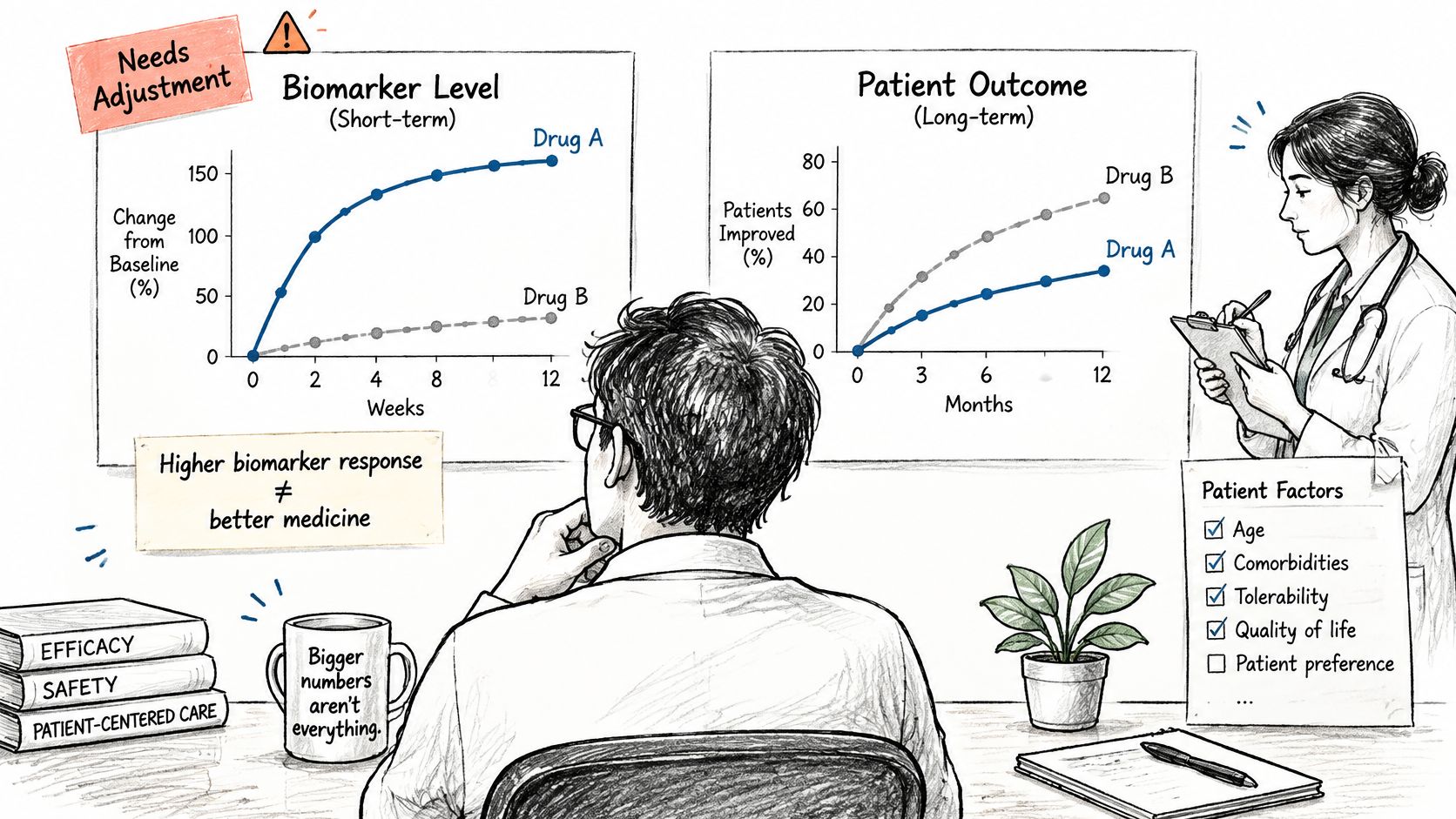
Establish the expected result
For longevity care, a case-mix specification should address age, sex, baseline disease burden, medication load, prior diagnostic findings and health-risk profile. It should also account for programme intensity, either in the model or in the comparison design.
Analysts can use direct standardisation or multivariable regression to estimate expected outcomes for each clinic’s patient population. Reporting observed-to-expected performance alongside a confidence interval makes both the estimated difference and its uncertainty visible.
Suppose one premium programme enrols healthy executives while another accepts patients with metabolic or cardiovascular disease. Smoother short-term biomarker trajectories in the first group do not, on their own, establish better management. Each population needs a credible expected result before the gap can be interpreted.
An individual discussion of clinical reasons for semaglutide nonresponse concerns a patient’s response, not a clinic’s comparative performance. An observed individual response is not a substitute for a case-mix model or clinical assessment.
Keep selection visible
Adjustment should not conceal selective enrolment. A benchmark should disclose:
- Eligibility: Who can enter the programme, and who is excluded?
- Retention: Which participants remain under observation?
- Missing follow-up: Whose later outcomes are unavailable?
- Referral out: Which patients leave the clinic’s care for management elsewhere?
These details help readers distinguish favourable outcomes among retained participants from results across everyone who entered. A model cannot correct for unexplained omissions in the outcome data.
Pair adjusted results with diagnostic completeness, documented clinician review, escalation pathways and adverse-event reporting. A preventive medicine clinic should be assessed through its clinical processes as well as its reported outcomes.
Don’t call a difference a quality gap until the expected result for that case mix is visible.
A biomarker change can inform an assessment, but it cannot prove programme quality by itself, especially when enrolment and follow-up differ.
Worked Gaps Operators and Buyers Can Act On
Suppose, in a hypothetical comparison, Clinic A and Clinic B receive the same composite score. Clinic A performs strongly on diagnostic depth but weakly on conflict freedom. Clinic B has a less extensive workup but clearer commercial separation.
The totals don’t identify the same improvement task or the same purchasing proposition. Their usefulness begins with the axis breakdown.
The operator’s reading
For Clinic A, commissioning additional tests wouldn’t address the identified weakness. The operator should inspect how fees, referral relationships and treatment-related incentives are disclosed and managed. The relevant question is whether the commercial structure could influence clinical recommendations, not whether the testing catalogue looks sufficiently extensive.
Clinic B needs a different investigation. Its diagnostic assessment should be examined for clinically important omissions, but a narrower catalogue shouldn’t automatically trigger expansion. The operator must distinguish missing capability from appropriate restraint.
Turn the diagnosis into a bounded action plan:
- Locate the weak criterion: Identify the specific rule behind the deduction.
- Check the supporting record: Separate an absent practice from an undocumented practice.
- Choose a matching remedy: Change the process or disclosure that caused the gap.
- Define verification: Specify what public evidence would demonstrate the correction.
This prevents score-chasing from replacing service improvement. A clinic can change what it publishes without changing care, just as it can improve care without immediately producing public documentation.
The purchaser’s reading
A buyer should interpret the same pair through the intended objective. If commercial independence is central to the decision, Clinic A’s diagnostic strength doesn’t cancel its weaker conflict assessment. If the proposed workup lacks something clinically relevant, Clinic B’s cleaner incentives don’t make that omission disappear.
When outpatient assessments are close, inspect eligibility, retention and fee exclusions, including repeat testing, medications and follow-up visits. Compare the full proposed pathway, not merely the initial appointment.
Our monitoring covers roughly 150 clinics across Europe, the Gulf, North America and Asia; 19 currently appear in our directory. We’ve also compared 232 tests. Those are coverage figures, not evidence that every programme is represented or that the broadest test menu is best.
Our assessments rely on public sources. No clinic is contacted, and no score is shown to a clinic before publication. That process limits provider influence, but it also requires restraint: a missing public fact stays missing rather than becoming an assumed strength or an unsupported allegation.
The buyer’s task is to identify the unresolved fact that could change the decision. The operator’s task is to identify the documented weakness that can be corrected.
Run and Audit a Benchmark in Five Steps
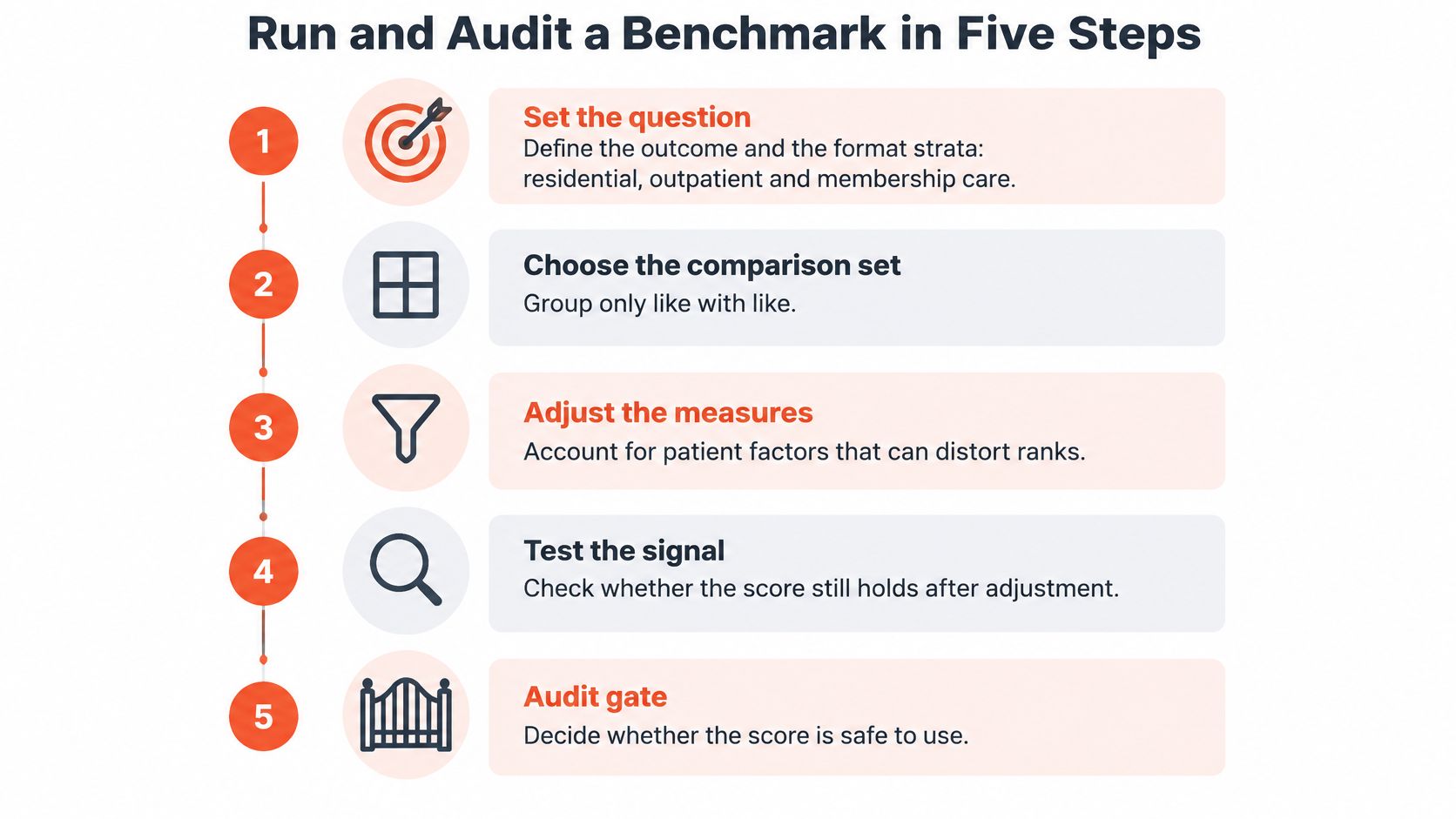
Use the analysis as a decision process with a stopping rule, not as a calculation that must produce a winner.
-
Set the question and format strata. Define the purchasing or operating decision before selecting clinics. Compare residential, outpatient and membership programmes within their own formats rather than searching for a universal leader.
-
Define shared measures. Specify inputs, outputs, documentation requirements and the observation period. Keep diagnostic validity, risk disclosure and evidence quality distinct from measures tied to a particular delivery model.
-
Prepare interpretable outcomes. Account for case mix and present observed-to-expected results with confidence intervals. Keep eligibility, retention, missing follow-up and referral-out disclosures available beside the outcome assessment.
-
Score and stress-test. Apply published axis weights and inspect sensitivity to alternative weights and scale assumptions. Preserve separate judgements for scientific evidence, regulatory status and marketing claims rather than allowing one to substitute for another.
-
Apply the audit gate. Confirm that the peer set is comparable, definitions are shared, evidence judgements remain distinct, expected outcomes are visible and modelling sensitivity is disclosed. If any check fails, don’t use the rank to choose care or claim leadership.
Audit the publisher too
Commercial separation belongs in the assessment of the benchmark itself. Our benchmarking report is editorially walled off from the directory, and the people running the scoring engine don’t see the report’s customer list. That separation addresses a different risk from methodological error, so neither safeguard replaces the other.
A sound industry benchmarking analysis doesn’t promise certainty. It makes the limits explicit enough that an operator or purchaser can decide whether the remaining uncertainty is acceptable.
Before paying a programme fee, open our published methodology and inspect a clinic’s axis breakdown against your intended care format and objective. Operators considering our annual industry benchmarking report should use it to investigate a specific operational gap; clinics may purchase the report, but they cannot influence it. In either case, pause the decision if a missing definition, outcome adjustment or disclosure could change the conclusion.