Preventive Medicine Clinic: Guide to Models and Outcomes
Discover how preventive medicine clinic models work. Compare screening bundles, risk stratification, and outcomes evidence to choose the right program.
You can feel fine, keep your routine, and still be carrying risk that only shows up years later. A preventive medicine clinic exists for that gap, the space between how you feel today and what your body may already be setting up for tomorrow. The question is not whether you had a check-up, it’s whether anyone turned that visit into a plan that changes risk.
Table of Contents
- Why Preventive Medicine Clinics Exist
- How Prevention Models Evolved
- What a Risk-Stratified Screening Workflow Looks Like
- How Clinics Balance Benefits Against Screening Harms
- Who Preventive Medicine Clinics Are Designed For
- How to Choose the Right Preventive Program
- Making Prevention Work Beyond the Clinic Visit
Why Preventive Medicine Clinics Exist
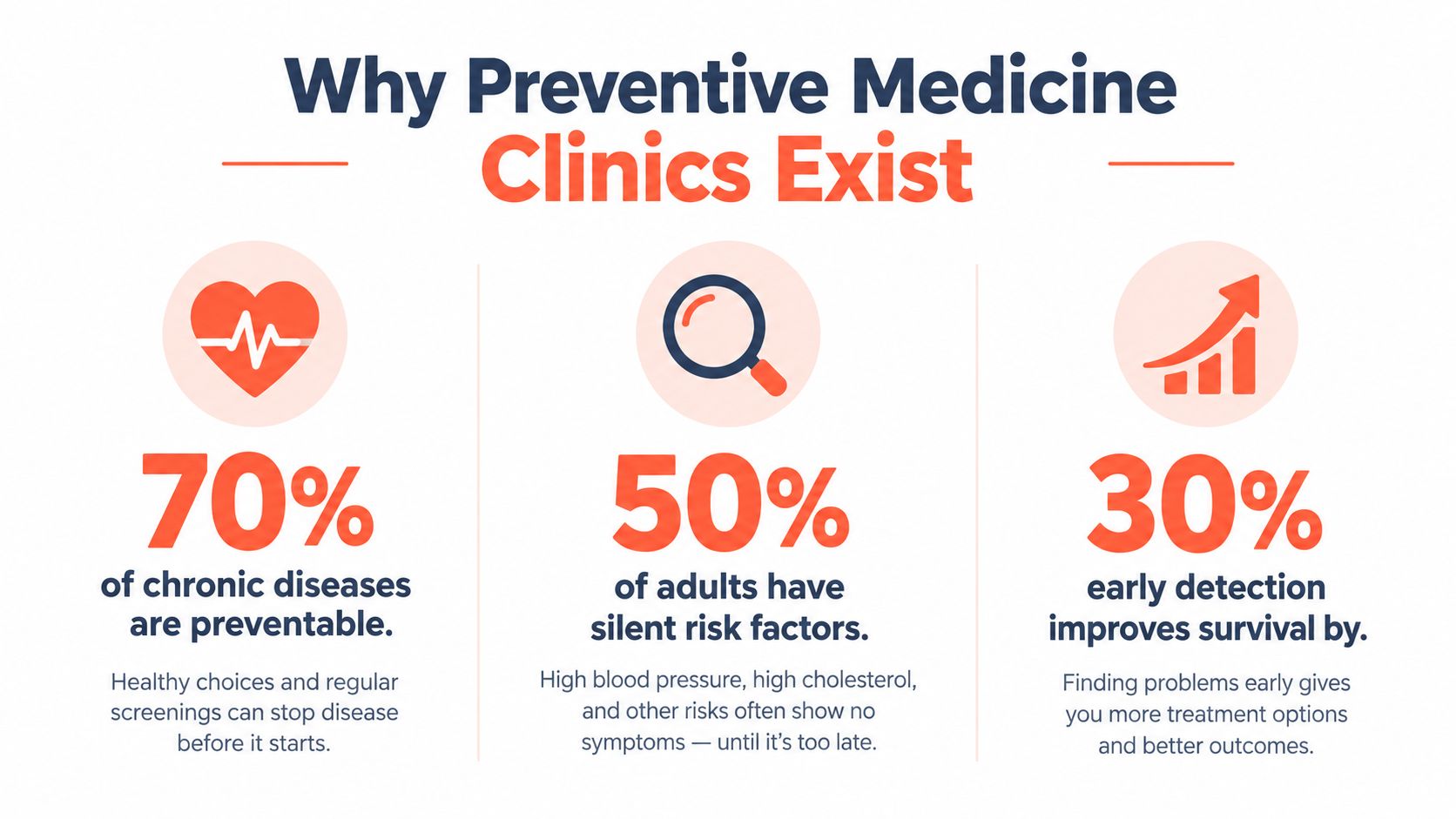
A patient can arrive feeling perfectly well, with normal energy, no pain, and no obvious reason to worry. Risk can still be building without warning, through rising blood pressure, worsening glucose control, tobacco exposure, inactivity, diet, alcohol use, or air pollution. A preventive medicine clinic exists to find modifiable risk before disease becomes advanced.
The burden driving prevention
The World Health Organization reports that noncommunicable diseases caused at least 43 million deaths in 2021, and that they represented 75% of deaths unrelated to pandemics (WHO fact sheet). Cardiovascular disease accounted for at least 19 million deaths, cancer for 10 million, chronic respiratory disease for 4 million, and diabetes for more than 2 million, including diabetes-related kidney disease. Those same four groups caused 80% of premature NCD deaths.
That burden is not evenly shared. WHO says 82% of the 18 million people who died from NCDs before age 70 in 2021 lived in low- and middle-income countries. For clinics, that matters because the job is broader than spotting an abnormal result. It has to address tobacco exposure, inactivity, diet-related risk, harmful alcohol use, air-pollution exposure, blood pressure, and metabolic risk before those factors harden into disease.
Practical rule: Prevention is only real when it changes what happens next, not merely what gets measured.
The case for these clinics is straightforward. WHO estimates that up to 80% of premature heart disease, stroke, and diabetes could be prevented through risk-factor control. That does not mean every illness is preventable, and it does not mean every test adds value. It does mean structured risk assessment, early detection, and follow-through are more defensible than waiting for symptoms and then treating late-stage disease.
How Prevention Models Evolved
A preventive medicine clinic grew out of public-health surveillance, epidemiology, and screening systems built to find risk before disease caused obvious harm. The modern clinic keeps that logic, then applies it to individual patients, where age, history, and exposures determine what should be checked and when.
A useful milestone came in 2013, when the 66th World Health Assembly adopted a global monitoring framework for NCD prevention and control containing 25 indicators (WHO EMRO data and statistics). That framework tracks exposure to risks, health outcomes, and health-system capacity, including infrastructure, personnel, policies, and access to essential care. It matters because it pushes clinics away from the assumption that a larger test panel automatically means better prevention.
Why volume is not the same as value
A clinic can order many biomarker tests and still fail as a preventive system. If results are not tied to baseline risk, if recommendations are never checked for follow-through, and if outcomes are never revisited, the patient leaves with data instead of care. The WHO framework keeps the focus on measurable inputs, clinically interpretable outputs, and follow-up that shows whether the intervention changed anything.
The broader targets reinforced that shift. The framework included a voluntary target to reduce premature NCD deaths by 25% by 2025, and UN Sustainable Development Goal 3.4 set a broader goal of reducing premature NCD mortality by one-third by 2030. WHO later extended its global NCD action plan from 2013–2020 to 2030, and created an implementation roadmap for 2023–2030 (WHO EMRO data and statistics).
The standard for a preventive medicine clinic is a system that connects diagnostics and recommendations to validated risk factors, established prevention targets, and follow-up outcomes. That is also the point of longevity medicine coverage in clinical education, since the label matters less than whether care stays accountable after the diagnostic day. A polished clinic page can still miss that part. Real prevention continues after the test results are printed.
What a Risk-Stratified Screening Workflow Looks Like
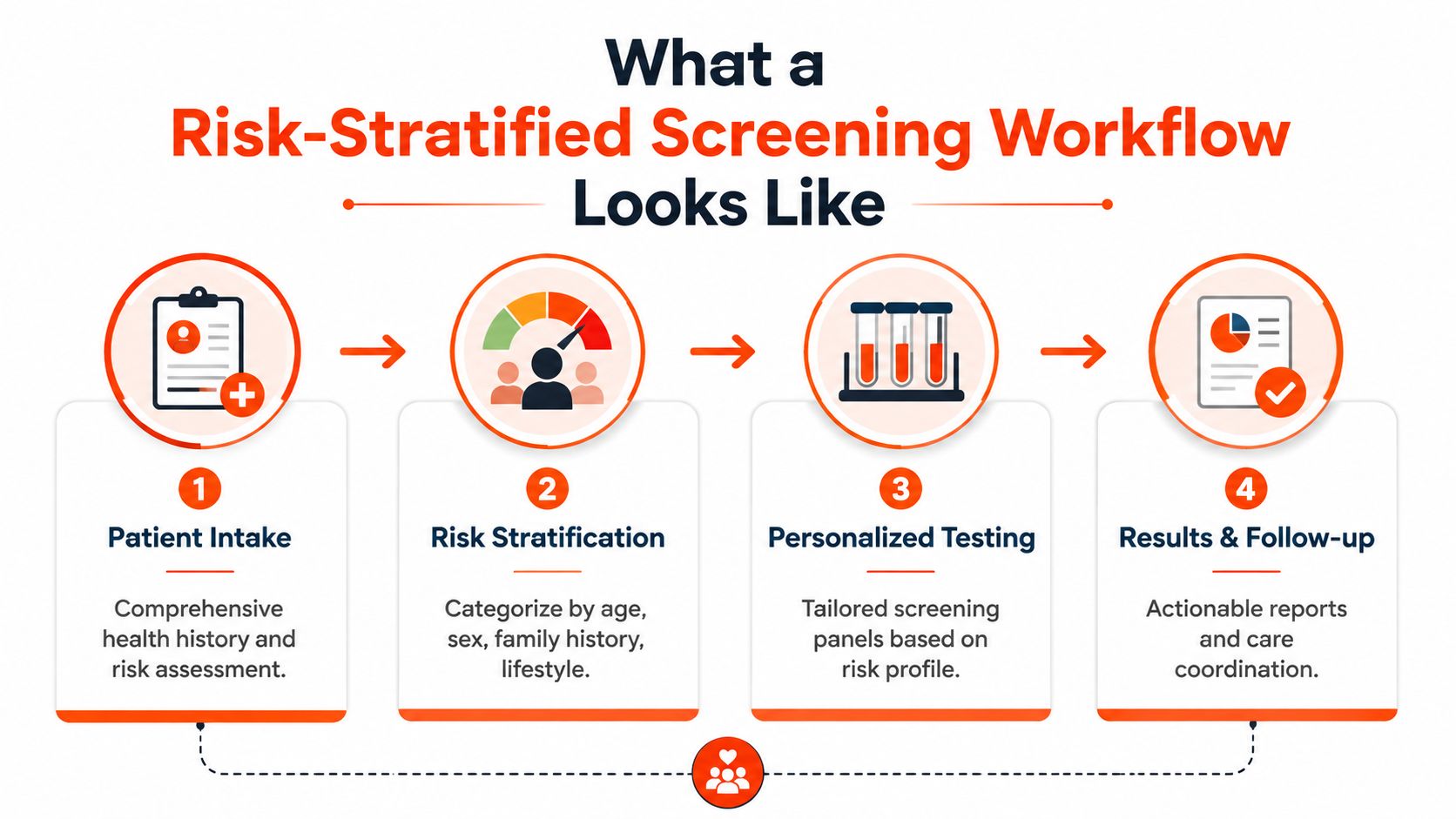
A preventive medicine clinic starts with a basic but disciplined intake. Age, body mass index, smoking history, family history, medications, prior results, and any previous abnormal findings shape the first pass. That information determines what deserves screening now, what can wait, and what should not be ordered at all.
The four-step workflow
The U.S. Preventive Services Task Force recommends screening asymptomatic adults aged 35–70 years for prediabetes and type 2 diabetes when they have overweight or obesity (USPSTF recommendations). For hypertension, it recommends annual screening for adults aged 40 years or older and for younger adults at increased risk, with high office measurements confirmed by validated ambulatory or home blood-pressure monitoring before treatment begins, per the same USPSTF recommendation statement.
A clinic that handles those cases well moves in sequence:
- Patient intake, with risk history and prior data reviewed before testing.
- Risk stratification, so the clinic knows who needs what.
- Personalized testing, matched to the risk profile rather than to a preset menu.
- Results and follow-up, with ownership assigned for abnormal findings and a next step written down.
That last step is where many clinics lose patients. A borderline blood pressure reading that is never confirmed outside the office can misclassify someone because of white-coat effect. A glycemic abnormality that is not routed into structured lifestyle or medical follow-up becomes another lab flag. A preventive medicine clinic has to close the loop, or the screening day ends before care begins.
What to ask before booking: who recalls patients with abnormal results, who documents follow-up, and who owns the next step if the result is outside range?
The logic is practical, not decorative. Identifying and treating hypertension reduces cardiovascular events, and confirmation testing limits misclassification from office-only readings, per the same USPSTF recommendation statement. A clinic should build for that reality, with documented recall intervals, confirmatory testing, treatment referral, and outcome tracking. Anything less is testing without a reliable pathway to action.
For readers comparing service models, this overview of preventive health screening is useful only if it shows how tests turn into action. A clinic that cannot explain its follow-up chain is incomplete, even if the diagnostics sound impressive.
How Clinics Balance Benefits Against Screening Harms
A screening visit can find disease earlier, and it can also create false positives, incidental findings, overdiagnosis, downstream procedures, and unnecessary anxiety. The U.S. Preventive Services Task Force lists labeling, confirmatory investigations, and overdiagnosis among screening harms (USPSTF procedure manual).
Selective programs handle that trade-off better. They use age- and risk-aware registries instead of one-size-fits-all panels, and they screen only when the expected benefit outweighs the likely harm. Screening is a decision that requires justification.
Eligibility is part of quality
For colorectal cancer, the USPSTF concludes that screening adults aged 50–75 years provides substantial net benefit, while ages 45–49 have moderate net benefit. For adults aged 76–85, screening should be selective because the average net benefit is small and depends on health status, previous screening, and patient preferences (USPSTF colorectal screening recommendation). A high-quality clinic should know that window and stop treating colonoscopy as universally appropriate.
Lung cancer screening has a similarly narrow boundary. Current USPSTF guidance identifies annual low-dose CT for adults aged 50–80 years with at least a 20 pack-year smoking history who currently smoke or quit within 15 years (USPSTF lung cancer screening recommendation). Those thresholds exist to balance earlier detection against false positives, incidental findings, radiation exposure, and invasive follow-up.
The operational standard is straightforward:
- Shared-decision documentation should be explicit, not implied.
- Abnormal-result ownership should be assigned before the patient leaves.
- Completion rates should be tracked so follow-up does not disappear.
- Stopping rules should be in place when the patient exits the evidence-based age or risk window.
A clinic that screens without those controls can do real harm, even when each test seems reasonable on its own. Broad “full-body” testing deserves the same scrutiny, because pre-test probability, test validation, follow-up duration, and referral responsibility all shape the outcome. If nobody can answer what happens after an abnormal result, the panel is too broad for responsible use.
For patients considering a more intensive format, full-body MRI screening coverage is useful only when it is discussed alongside downstream consequences. Treat imaging as a starting point that needs rules.
Who Preventive Medicine Clinics Are Designed For
A preventive clinic can be medically strong and still miss the people who need it most. The patients who do best in premium check-ups usually have time, money, digital fluency, and enough flexibility to move through follow-up without friction. That makes access part of the clinical outcome, not an afterthought.
The gap shows up in real-world use. In Medicare Advantage, Black beneficiaries received more preventive services than in traditional Medicare, yet Black-White disparities remained in both systems, and Latinx beneficiaries used several services less often than White beneficiaries (LDI analysis). A 2025 scoping review of rural immigrant populations found structural, language, transportation, financial, and trust barriers across 21 studies (BMC Public Health). Premium check-ups systematically under-serve patients without flexible schedules, insurance coverage, or high health literacy.
An accessibility audit that matters
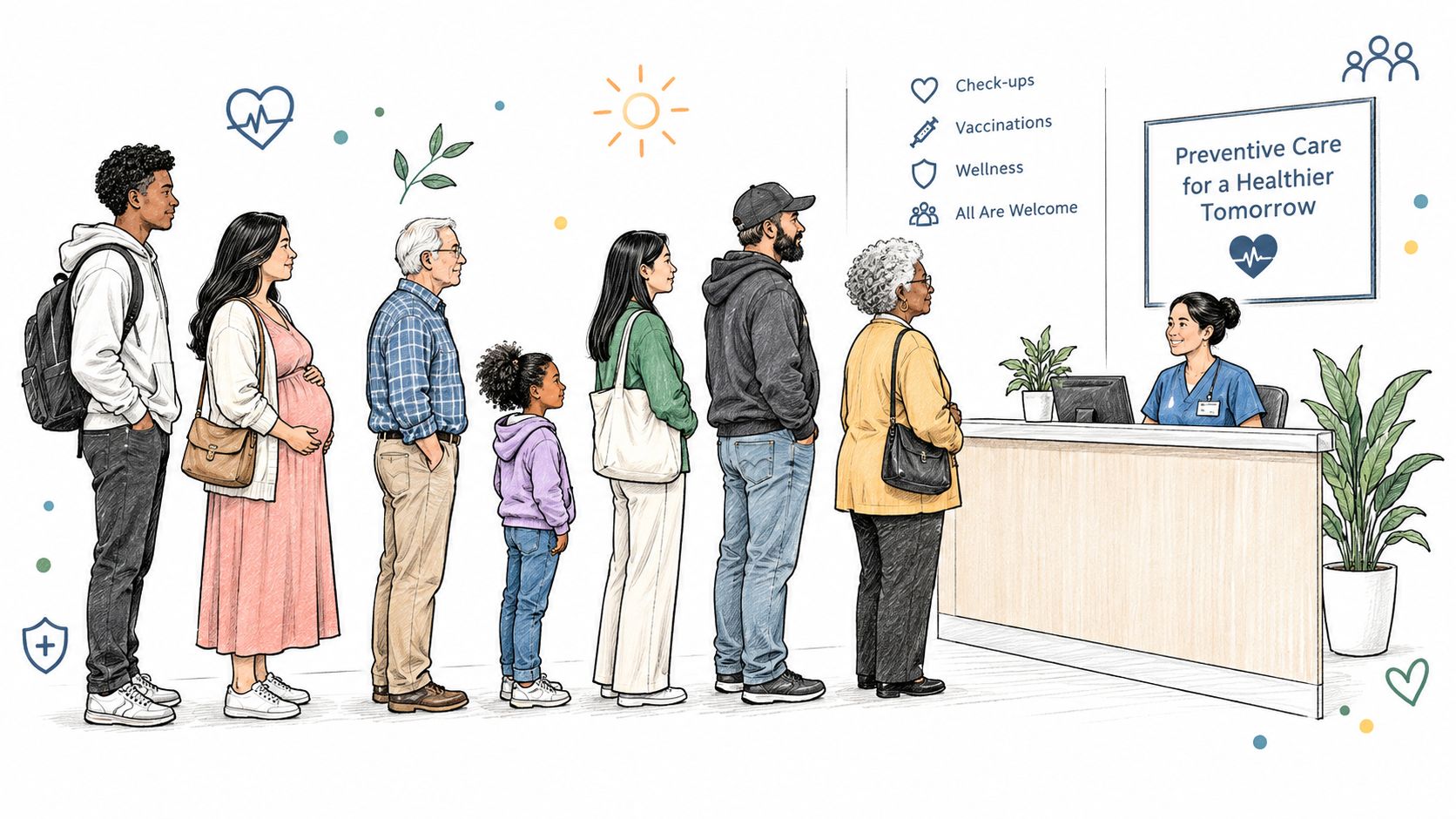
A serious clinic should answer basic questions before a patient books. Can the patient understand the pricing? Can the clinic explain what insurance covers and what it does not? Does it offer language access and disability accommodations? Are telehealth limits stated clearly? Does it coordinate with primary care when something abnormal appears?
A clinic fails prevention if the patient leaves with a report but no workable route to action.
That matters most for people who do not fit the ideal premium customer profile. A person may be highly motivated and still be unable to complete the pathway if they cannot get time off work, cannot afford confirmatory testing, or cannot interpret risk communication that assumes high health literacy. The question is not only what the clinic measures, but who can safely finish the care pathway after the screening day.
Clinics that deserve trust are explicit about referral pathways, continuity with primary care, and what happens when an abnormal result needs outside follow-up. If those details are vague, the clinic may look impressive while functioning like a detached diagnostic event. Prevention stops being preventive when follow-up falls apart.
How to Choose the Right Preventive Program
Different formats fit different needs, but they’re not interchangeable. A residential program can compress diagnostics and specialist time into a short stay. An outpatient clinic fits routine prevention and follow-up better. A membership model can support continuity if the clinic keeps the care plan active after the first visit.
Compare the model, not the marketing
The useful differences are practical. Residential programs usually promise concentrated diagnostics, but they can be expensive and may separate the screening experience from long-term primary care. Outpatient clinics tend to be more familiar and easier to integrate with existing doctors, though they may offer less depth. Membership programs can improve continuity if the relationship is real and the follow-up is documented, not just packaged.
If you’re comparing options, the criteria should be boring in the best way:
- Guideline support, does the clinic separate evidence-based prevention from exploratory testing?
- Follow-up responsibility, who owns abnormal results after the visit?
- Medical supervision, is there real physician oversight or just a sales layer?
- Shared decision-making, are risks and limitations explained before testing?
- Continuity, can the clinic coordinate with outside primary care if needed?
You can also see the value of structured comparison in tools like the Longevity Clinics directory, which standardizes program details across formats. That kind of comparison matters because format alone doesn’t guarantee quality. A membership label with weak follow-up is still weak care.
The most reliable programs separate clinically indicated diagnostics from experimental testing and are willing to say no to low-value screening. They also document who follows up, how results are interpreted, and when the clinic stops repeating tests that no longer fit the patient’s age or risk profile. Those are the differences that affect actual outcomes.
Making Prevention Work Beyond the Clinic Visit
The visit is the easy part. The days after it are where prevention succeeds or fails. A report without action is just paperwork, so the clinic should leave you with one written plan, one clear owner for follow-up, and a realistic timeline for the next contact.
Start with the basics. If the clinic recommends lifestyle change, ask how it will be tracked. If medication is needed, ask who manages adherence and side effects. If a specialist referral is required, confirm who places it and who checks that it was completed. If a result is uncertain, make sure the clinic has a stopping rule instead of endless retesting.
Keep the standard simple. Prevention works best when it is continuous, measurable, and shared with primary care when appropriate. It doesn’t work well when every abnormality becomes a new commercial upsell or when the clinic disappears after the report is emailed. A good plan should feel clear enough that you could hand it to your regular doctor and continue without confusion.
If you’re evaluating a preventive medicine clinic now, don’t start with the size of the test menu. Start with the follow-up pathway, the access policy, and the clinic’s rules for stopping unnecessary screening. Book only when the answers are specific, the referrals are clear, and the plan is built to carry you past the diagnostic day into actual prevention.