Is Concierge Medicine Worth It in 2026
Asking is concierge medicine worth it? See 2026 fees from $199 to $50,000, higher total spend, weak survival evidence and a join checklist.
Concierge medicine can be worth it for faster access and a smaller patient panel, but not for proven longer life or lower bills: switching was associated with roughly 30–50% higher total healthcare spending and no average mortality gain. Treat the retainer as an access purchase, not a health investment that’s expected to pay for itself.
The familiar advice to join if you can afford the fee asks the wrong question. An executive can comfortably afford a membership and still buy poor value if the physician’s availability is undefined, coordination is superficial, or the contract leaves expensive services outside the fee.
The better question is whether the practice can document a service improvement you’ll use. A direct phone number matters less than who answers it, how quickly a clinician responds, and who takes responsibility for the next decision.
Table of Contents
- What a 2026 Retainer Actually Buys
- Concierge Care Next to Traditional Primary Care
- Evidence on Health Versus Satisfaction
- Situations Where Membership Pays Off
- The Year Cost After the Membership Fee
- Access Promises and Safety Checks to Demand
- Decide Whether to Join, Negotiate or Walk Away
What a 2026 Retainer Actually Buys
A concierge retainer is easiest to misprice when it is treated as a badge of better medicine. The fee mainly reserves attention: a smaller panel, longer visits and a defined route to the physician. Its value depends on whether that route is specified tightly enough to use when the schedule breaks, and whether the practice can show response standards instead of relying on longevity language.
For price context, Fennemore’s industry overview placed annual concierge fees at approximately $2,000 to $5,000 per patient in 2024, while STAT News reported that some U.S. patients paid as much as $50,000 annually in 2024. Treat those figures as dated markers for reading a quote, not as a current national schedule.
Compare the service before comparing the price
Concierge retainer bands by date and what they leave unpaid
| Band | Annual retainer | What the fee is for | Usually still separate |
|---|---|---|---|
| Low-cost membership, reported | About $199 a year | Limited access extras on top of ordinary care | Premiums, deductibles, copays, specialists, tests |
| Earlier retainer, 2014 | About $1,500 to $1,700, as summarized in a 2024 literature review | Access and convenience extras | Insurance-billed care and diagnostics not expressly included |
| Common 2024 market band | About $2,000 to $5,000 | Smaller panel, longer visits, easier contact | Insurance-billed care and diagnostics not expressly included |
| Elite concierge membership, 2024 | Up to about $50,000 | Premium access and coordination, as contracted | Hospital, specialist and testing costs outside the contract |
| Founding high-fee model, MD², 1996 | $13,200 individual; $20,000 family | Low-panel care and high service intensity | Ordinary medical bills outside the retainer |
The low-cost example and founding prices come from EBSCO’s concierge-medicine overview, which describes a reported $199 annual membership and MD²’s launch in Washington and Oregon in 1996 at $13,200 for an individual and $20,000 for a family. The earlier retainer benchmark is historical context, not a suggested current quote; the service descriptions and exclusions remain contract questions rather than promises every practice in a band makes.
Concierge medicine never developed as a standardized benefit package. A modest access supplement and an intensive physician relationship can share the same label while buying very different responsiveness, coordination and exclusion lists.
Buy reserved capacity, not a prestigious label
A smaller panel gives the practice room to offer longer consultations, easier communication and more coordination. Capacity becomes valuable only when it is converted into contractual entitlement. A practice can advertise unusually attentive care while leaving the two details that matter vague: how quickly a clinician responds, and who owns the next decision.
Distinguish these deliverables:
- Appointment access: How soon can you see a clinician, and will it be your physician?
- Consultation time: Can you discuss several concerns without booking separate encounters?
- Between-visit work: Who reviews specialist notes, reconciles recommendations and closes outstanding results?
- Availability: What coverage exists when your physician is away?
- Proof of responsiveness: What response window is written into the agreement for calls, portal messages and urgent changes?
A hospital name, elaborate assessment or extensive welcome package does not establish that the practice will respond when your calendar or health changes. Ask for the answer pattern, not the ambience: who picks up, what happens after hours, how fast a physician reviews a new problem, and which clinician is accountable for closing the loop.
Mark the price band closest to your quote, then record every excluded service. The meaningful comparison is the promised relationship plus the medical bills that remain, because a retainer quote is only the first line of the year.
Concierge Care Next to Traditional Primary Care
Traditional primary care, concierge medicine and direct primary care solve different payment and capacity problems. Comparing them by appointment length alone misses the more important distinction: what you’re paying the practice to provide, and which clinical services it bills separately.
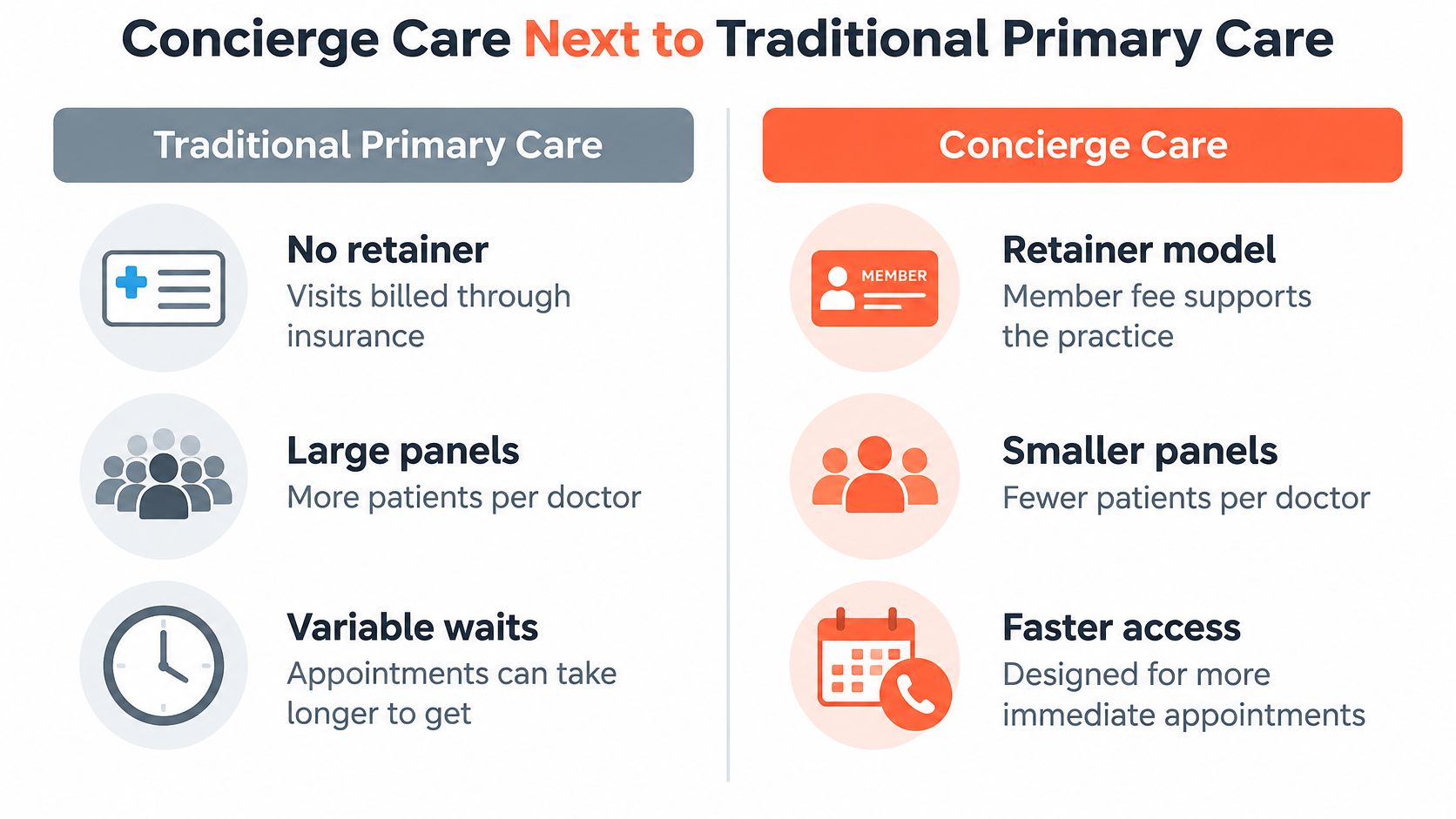
Compare the billing architecture
Traditional care, concierge medicine and direct primary care
| Criterion | Traditional primary care | Concierge medicine | Direct primary care |
|---|---|---|---|
| Annual membership | None in the conventional insurance model | Annual retainer, with the quoted bands above serving as dated context | Monthly membership; the survey benchmark is below |
| Insurance role | Pays covered visits, subject to plan terms | Often pays clinical bills alongside the retainer | Often replaces insurance billing for primary care itself |
| What the fee buys | Not applicable | Smaller panel, longer visits and direct access as contracted | Defined membership primary care; check any bundled labs |
| Panel and demand signal | Standard insurance-funded appointment capacity | Smaller-panel design; verify actual enrollment | Membership-funded capacity under a distinct contract |
In a 2024 survey of 465 U.S. practices, the Direct Primary Care Alliance found an average direct-primary-care membership price of $98.46 per month, according to Medical Economics. That’s a benchmark for a related model, not evidence that a concierge contract should cost the same.
The practical distinction is whether your payment purchases primary care itself or adds access benefits around insurance-billed care. Get the billing explanation before comparing the benefits brochure.
The concierge retainer is an access product. Insurance usually still sits underneath it.
Compare scope without confusing categories
Service descriptions can help you identify what needs clarification. For example, Restore Osteopathic Medicine’s primary care is a resource for examining how a practice describes its approach and scope, not proof that a particular payment model delivers better outcomes.
Likewise, distinguish an ongoing physician relationship from a diagnostic or optimization package. Our explanation of a health optimization clinic provides context for that separate category; an intensive assessment and dependable longitudinal primary care aren’t interchangeable purchases.
Consumer appetite doesn’t resolve the comparison. In 2025, 61% of 10,000 U.S. healthcare consumers surveyed by Qualtrics said they would pay extra for a premium healthcare experience, according to TechTarget. Willingness to pay establishes demand, not clinical effectiveness.
Price the column that matches your actual need: insured visits, an enhanced-access relationship, or membership-funded primary care. Don’t pay for an access supplement when what you need is a clearer primary-care billing arrangement.
Evidence on Health Versus Satisfaction

The strongest concierge evidence concerns experience. The weakest concerns survival. That gap matters because a retainer is sold as access, while its marketing often implies a health return.
A 2023 Journal of Health Economics analysis of Medicare claims and concierge-provider data, summarized by Penn’s Leonard Davis Institute of Health Economics, associated switching with approximately 30–50% higher total healthcare spending than patients’ pre-switch spending, with no average mortality improvement after accounting for patient-selection patterns. Those results describe a population, not every member’s bill, and they leave room for individual benefit.
Separate experience from clinical effectiveness
Higher spending can buy more attention, more testing or more follow-up. It can also reflect patients who were already healthier, wealthier or more likely to seek care. A polished membership roster therefore says little about whether the retainer caused better health.
The access case is easier to test than the longevity case. A practice can show average response times, after-hours arrangements and how urgently it handles routine problems. It cannot credibly promise added years from a service model whose measured advantage is convenience.
Market growth is adoption evidence, nothing more. Harvard Medical School’s account of concierge and direct-primary-care growth reports that U.S. practice sites increased 83.1%, from 1,658 to 3,036, between 2018 and 2023. Expansion shows that buyers value the model; it does not establish lower total cost or better outcomes.
Match the evidence to the promise
Use a different test for each claim:
- Better experience: Ask about communication, time with the physician and follow-through.
- Better access: Require appointment availability, response-time measures and after-hours coverage in writing.
- Better clinical outcomes: Look for appropriate comparison groups and outcomes that matter to patients.
- Lower spending: Require total-cost evidence, not examples of an avoided visit.
Our guide to GRADE evidence rating explains why confidence in a medical claim depends on the quality of supporting evidence, not how compellingly a clinic presents it.
Evidence rule: A satisfied patient can accurately describe an excellent experience without demonstrating a treatment effect.
The defensible conclusion is measured: concierge care can be a rational access purchase, while the evidence does not justify converting a service advantage into a longevity claim. Pay for documented responsiveness when that is the benefit being sold.
Situations Where Membership Pays Off
The useful answer to “is concierge medicine worth it” changes with the problem you’re trying to solve. Consider these hypothetical buyers, each evaluating the same general model against a different constraint.

When time or coordination is expensive
The travelling executive. A professional repeatedly rearranges travel because routine problems can’t be assessed promptly. A membership could be rational if the practice can accommodate urgent requests and provide usable advice while the patient is away, within appropriate clinical and jurisdictional limits.
The value comes from replacing actual disruption, not assigning an impressive hourly rate to hypothetical time savings. Judgement: rational when the promised access matches the recurring problem.
The patient managing several specialists. A patient receives recommendations from different offices but has no clear owner for reconciling them. A concierge physician could provide value by reviewing records, resolving conflicting instructions and keeping the plan coherent.
That value disappears if coordination means merely forwarding referrals. Judgement: potentially rational, but borderline until the practice defines responsibility for integrating care.
When the upgrade solves little
The low-utilization adult. A healthy patient already has a trusted physician, receives timely appointments and rarely needs between-visit help. A polished membership offer introduces a new expense without removing a meaningful obstacle.
A longer annual visit may be pleasant, but pleasant isn’t the same as necessary or cost-effective. Judgement: poor value unless the patient deliberately wants to purchase the experience as an amenity.
The older patient drawn to longevity language. A Medicare patient hears that closer monitoring offers a route to a longer life. The relevant question is whether the patient wants the service relationship on its own merits, without treating the fee as evidence of a survival benefit.
If the patient would decline the membership without the longevity promise, the purchase rests on the wrong premise. Judgement: poor value as a longevity intervention; potentially acceptable as an explicitly chosen service upgrade.
These scenes aren’t clinical eligibility rules. They distinguish a recurring operational problem from a general desire to receive more healthcare.
There’s also a cost outside the buyer’s calculation: a physician who reserves more capacity for a smaller paying panel may leave less capacity for non-members. Personal convenience and equitable access are different questions, and a favourable personal calculation doesn’t settle the second.
Identify the scene closest to your present care, not the one that resembles an imagined future emergency.
The Year Cost After the Membership Fee
Affordability is a cash-flow question. Value is a comparison question. Calculate both the full household healthcare budget and the additional expense caused by joining.
That distinction prevents two mistakes: counting insurance premiums as a new membership expense when you would pay them anyway, and overlooking new diagnostic or out-of-network bills because the membership itself is affordable.
Build the complete cost stack
Medicare generally doesn’t cover the concierge retainer, leaving members exposed to ordinary cost-sharing and other medical expenses alongside the membership fee, as discussed in The Cut’s examination of concierge care and primary-care access. Don’t assume an included consultation makes the resulting test, referral or prescription included.
Full-year cost stack beyond the retainer
| Cost line | Usually inside the retainer? | What to confirm in writing |
|---|---|---|
| Annual retainer | Yes, this is the membership payment | Exact fee, who is covered, renewal date |
| Insurance premiums | No | Plan kept alongside the membership |
| Deductible, copays, coinsurance | No | Medicare or commercial cost-sharing still owed |
| Diagnostics and labs | Often no | Cash prices, coverage and clinical rationale |
| Specialists and hospital care | No | Affiliations and who coordinates referrals |
| Prescriptions | No | Whether any drugs are discounted or expressly included |
| Travel and emergency care | No | Out-of-area arrangements and emergency exclusions |
| Cancellation | Contract sets the charge or refund | Refund, notice period and mid-year exit |
Fill each line with an expected amount, then identify uncertain expenses separately. Don’t count the same insured service under both a deductible estimate and a separate diagnostic estimate.
For laboratory services, resources describing blood testing with Vital iQ Health can help frame questions about separately purchased testing. A listing doesn’t establish that a test is appropriate for you, covered by insurance or included in a concierge agreement.
Separate the budget from the membership increment
Create two totals:
- Full-year budget: Everything you expect to pay across membership, coverage, care and travel.
- Incremental membership cost: The retainer plus expenses you wouldn’t otherwise incur, minus only savings you can reasonably substantiate.
Keep your personal out-of-pocket estimate separate from total healthcare spending. An insurer-paid hospital bill belongs in an economic analysis of utilization but isn’t automatically a household cash expense.
Testing deserves particular scrutiny. For every proposed panel, establish the clinical question, who interprets the result, what decision it could change and whether follow-up generates another bill. An included test without included interpretation and follow-through is an incomplete benefit.
A high value on saved time can justify a positive incremental cost. But don’t enter assumed downstream savings to make the worksheet balance, especially if your existing care is inexpensive, accessible and adequate.
Access Promises and Safety Checks to Demand
A 2024 literature review reported that concierge patients were seen approximately 30 minutes faster in 2020, a 40% reduction in door-to-doctor time, and described historical annual retainers of approximately $1,500–$1,700 in 2014, according to the published review. Treat the access finding as a reason to demand current operational evidence, not a guarantee that your prospective practice performs similarly.
Door-to-doctor time isn’t appointment lead time. A shorter waiting-room interval doesn’t tell you how long it takes to obtain the appointment.
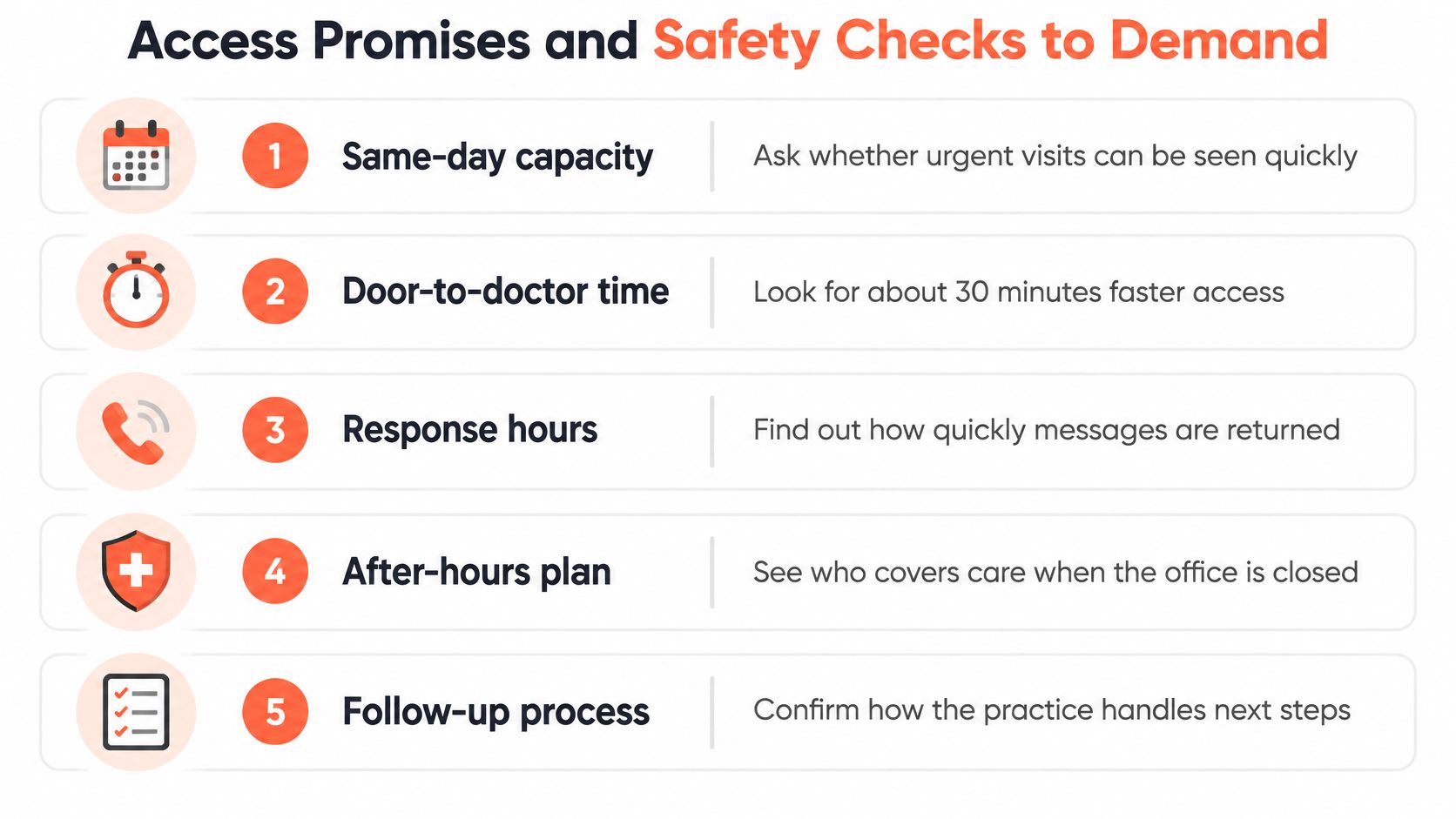
Request measurable operating terms
Have the practice supply these specifications in writing:
- Scheduling: Median routine appointment lead time, urgent appointment capacity and how it handles requests it can’t accommodate.
- Messages: Who triages them, who makes clinical decisions and the response commitment during and outside office hours.
- Panel capacity: Current physician panel size, enrollment limit and coverage arrangements when demand rises.
- Continuity: Who covers leave, whether that clinician can access your record and who owns unresolved results.
- Coordination: How specialist recommendations enter your care plan and who confirms completion of referrals.
Ask how each measure is calculated. A response-time average that combines administrative acknowledgements with clinical answers won’t tell you when you’ll receive medical advice.
Check clinical governance separately
Verify the treating physician’s licence through the appropriate medical regulator. For an overseas programme, identify the relevant licensing authority for the physician and the separate authority, where applicable, for products or procedures; don’t assume every regulator oversees every aspect of care.
Request named hospital affiliations and clarify what they mean operationally. An affiliation isn’t a promise of admission, a particular specialist appointment or coverage of hospital bills.
For preventive testing, ask the clinician to explain the guideline or individual clinical rationale and the consequences of an abnormal result. Our discussion of conflicts of interest in healthcare provides a framework for examining incentives when a practice recommends services it also sells.
Contract test: Replace every broad promise of personalized care with a named person, a defined responsibility and a measurable service commitment.
A practice that can document these arrangements offers something you can evaluate. If it won’t define them before payment, don’t assign financial value to them.
Decide Whether to Join, Negotiate or Walk Away
Join when delayed access or fragmented care creates a real personal cost, the practice documents how it will address that problem, and the full-year budget is comfortable without assumed survival benefits or savings.
Negotiate or wait when the need is genuine but important terms remain unclear. Seek written access commitments, a narrower service package or clearer testing exclusions rather than accepting a verbal assurance.
Walk away when longer life, lower bills or an expansive testing menu substitutes for a credible service agreement. The same applies when your existing primary care already meets your needs and the proposed upgrade has no identifiable use.
Verify before paying
Confirm the physician’s licence with the relevant medical regulator and obtain written confirmation of named hospital affiliations. Request recent appointment and response-time figures, including their definitions, measurement period and handling of unanswered requests.
Treat editorial clinic scores as assessments, not proof of medical effectiveness. We base our work on publicly available information and expert validation; we don’t arrange care, negotiate terms or confirm a clinic’s availability for an individual patient.
This content is editorial, not medical advice. Consult a qualified medical professional before booking a clinic or starting, changing or stopping care; pricing and booking enquiries belong with the clinic.
Before paying a deposit, complete the full-year cost worksheet and request the written access specifications. Compare those commitments with the specific delays or coordination failures you currently experience. If you can’t identify what the fee will change, keep your money until you can.