Longevity Medicine Clinic: What It Is and How to Pick One
Learn what a longevity medicine clinic offers, which tests and treatments have evidence, and how to verify a programme before you pay for one.
The most popular advice about choosing a longevity medicine clinic is to look for the most thorough testing package. That’s the wrong starting point. More testing is useful only when the results improve a decision, and more treatment is worthwhile only when the likely benefit justifies the risks.
A better question is what the clinic will help you preserve: independence, physical capacity, clear thinking, or control of an established health risk. Start there, then ask what each proposed test or treatment contributes.
Table of Contents
- What a Longevity Medicine Clinic Actually Does
- The Diagnostics a Credible Workup Includes
- Interventions Sorted by Evidence Grade
- How Clinics Are Scored and Compared
- Red Flags of Overtesting and Overtreatment
- Follow-Up Measures a Programme Should Track
- Confirm the Programme Before You Book
What a Longevity Medicine Clinic Actually Does
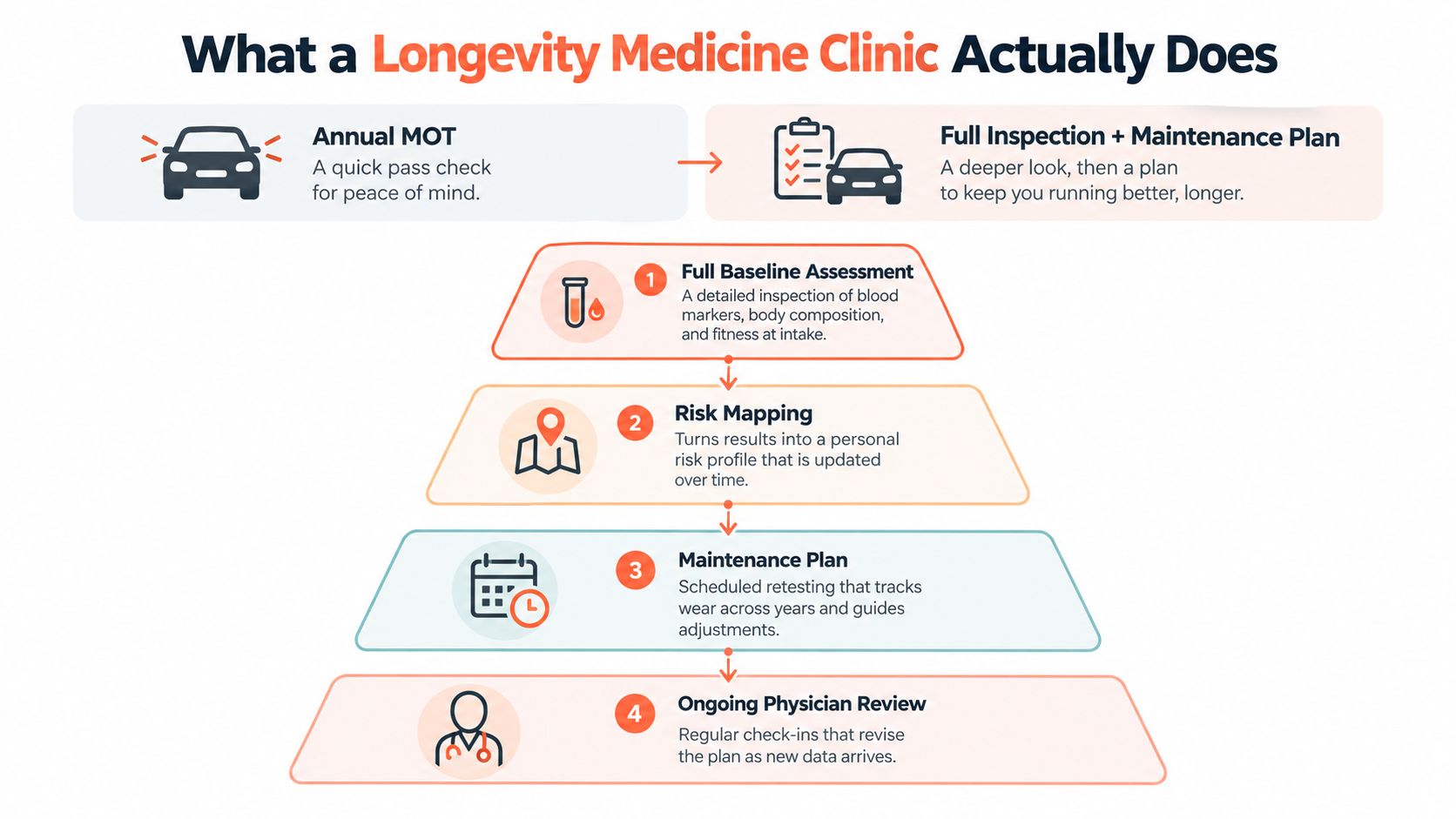
A standard check-up is a little like an annual MOT, a scheduled check of a car’s condition. A longevity clinic aims to offer something closer to a fuller inspection followed by a maintenance plan, although good primary care already includes prevention and ongoing monitoring.
Say you’re feeling well but have a family history of cardiovascular disease and have become less active. A credible programme would combine your history, preventive assessment, treatment of relevant risk factors, and repeated monitoring, rather than merely produce a biological-age certificate.
The wider context matters. The World Health Organization reports that global life expectancy at birth reached 73.3 years in 2024, an increase of 8.4 years since 1995. For patients, the practical priority is healthspan, the years spent in good health, not just lifespan.
Different formats, different practical questions
Residential programmes compress assessment into a stay. They can make appointments easier to coordinate, but you need to know who handles abnormal findings after you return home.
Outpatient clinics spread assessment and treatment across separate visits. This format allows decisions to unfold without requiring every test to fit into a short stay.
Membership or concierge models sell continuing access, scheduled reviews, and coordination. Access can be valuable, but it isn’t evidence that every included test is necessary.
For readers comparing terminology locally, Pause Medical’s guide to age management centers in Mississippi provides context for another label you may encounter. Whatever wording a business uses, verify its actual medical services and professional oversight.
Practical rule: Judge the clinical content, not the label on the door.
Ask every programme to name its clinical lead and explain who is responsible for prescribing, referrals, and follow-up. A polished website should never substitute for an identifiable clinician who takes responsibility for your care.
The Diagnostics a Credible Workup Includes
A credible workup begins with questions that can change treatment now. Your symptoms, medical history, medications, family history, and existing screening records should shape the test list, not merely accompany a package selected before anyone meets you.
Cardiometabolic assessment and blood-pressure measurement usually deserve attention before experimental ageing scores. Physical function matters too: a blood sample can’t tell the clinician how confidently you walk, rise from a chair, or maintain your balance.
Core diagnostic groups and what they can and cannot tell you
| Test group | Examples | What it can tell you | Evidence status |
|---|---|---|---|
| Cardiometabolic | HbA1c, lipid panel, fasting glucose, eGFR kidney function | Diabetes, cholesterol, and kidney risk | Established clinical standard |
| Blood pressure | Clinic readings, home monitoring, ambulatory readings | Hypertension and cardiovascular risk | Established clinical standard |
| Function | Grip strength, gait speed, standing balance, VO₂ peak | Physical capacity relevant to disability and falls | Validated in research and practice |
| Conventional screening | Cancer screening by age and sex under national guidelines | Early detection where evidence supports screening | Established for recommended groups, with overdiagnosis harms |
| Inflammation | hsCRP, IL-6 | General inflammation signals, not a diagnosis by themselves | Associated with risk; not a standalone treatment target |
| Biological-age estimates | Epigenetic clocks, telomere length | Estimates of aspects of biological ageing | Investigational for individual treatment decisions; validation is test-specific |
HbA1c helps assess longer-term glucose control. eGFR estimates kidney filtration, while a lipid panel informs cardiovascular risk assessment. These results still need interpretation alongside your history and current treatment.
Blood pressure deserves the same care. Ask how the clinic handles a reading that differs from your usual home measurements, rather than accepting a diagnosis or prescription from an isolated result.
Conventional cancer screening should follow the relevant national guidance and your individual risk. A longevity package isn’t a reason to repeat screening you’ve already completed or add tests without discussing their consequences.
The newer layer needs a clear purpose
A geroscience clinical-trial framework published in Nature Communications states that no biomarker of ageing is universally accepted and describes desirable properties including repeatability, minimal invasiveness, association with functional or mortality outcomes, and responsiveness to intervention.
Think of a biological-age estimate as a speedometer whose reading might change even when you drive the same road. Before interpreting movement as progress, the clinician must understand the instrument, testing conditions, and expected measurement variation.
Ask which assay the laboratory uses, which reference population supports the result, and whether recent illness or pre-test conditions affect interpretation. Our guide to advanced health screening provides additional context for evaluating the proposed workup.
Does it repeat reliably? Does it change a decision? Does it predict an outcome that matters? If the clinic can’t answer those questions, ask why the test belongs in your care plan.
Interventions Sorted by Evidence Grade
Think of longevity treatments as an evidence ladder. The foundation is established prevention, including exercise, resistance training, smoking cessation, blood-pressure treatment, and statins when indicated. Higher rungs introduce greater uncertainty, not necessarily greater benefit.
A sound programme builds from that foundation. It shouldn’t distract you from an untreated conventional risk factor by offering an infusion or experimental prescription with a more interesting name.
Geroscience investigates the biological mechanisms of ageing and their contribution to chronic disease. That’s a legitimate scientific aim, but it doesn’t establish that a commercial treatment extends human life.
Why plausible prevention still needs testing
The U.S. National Institute on Aging describes ASPREE, a randomized, double-blind, placebo-controlled trial involving 19,114 adults aged 65 or older, without cardiovascular disease, dementia, or disability at enrolment, in which daily low-dose aspirin did not increase disability-free survival. The institute also reported approximately 480 active Alzheimer’s and related-dementia trials as of September 2023.
The distinction is important: active investigation means scientists are testing a question, not that clinics can already promise the answer. A biologically plausible intervention can fail when researchers measure something patients actually value.
The same discipline should apply to a prescription offered during your consultation. Ask which patients were studied, what outcome improved, and whether your circumstances resemble theirs.
Intervention grades with examples and evidence basis
| Grade | Examples | Evidence basis | Regulatory status |
|---|---|---|---|
| A. Established prevention | Exercise and resistance training, blood-pressure treatment, smoking cessation, statins when indicated | Patient-outcome evidence supporting appropriate preventive use | Standard care |
| B. Proven for named conditions | Metformin for diabetes, GLP-1 medicines for diabetes or obesity | Evidence supports named indications; healthy-ageing benefit must be assessed separately | Approval is product-, indication-, and country-specific |
| C. Investigational | Rapamycin and analogues for healthy ageing, senolytic drugs | Investigational human evidence, not demonstrated lifespan gains in healthy people | Healthy-ageing use requires explicit clarification of off-label or trial status |
| D. Unproven or commercial | NAD+ infusions, high-dose supplement stacks, biological-age reversal protocols | Clinical benefit must not be inferred from mechanisms, testimonials, or biomarker changes | Verify the specific product and local status; wellness marketing isn’t medical approval |
These grades are a practical way to sort claims, not a substitute for reviewing each intervention. Our evidence-rating guide explains how to read evidence strength without treating every published study as equivalent.
A medicine’s approval for a disease doesn’t establish that it benefits healthy people who want to age more slowly.
For every proposed prescription, request the intended indication, expected benefit, known risks, and alternatives. A licensed medicine used for its approved indication belongs in a different conversation from the same medicine offered for healthy ageing without patient-outcome evidence.
How Clinics Are Scored and Compared
A long test menu can look impressive, yet tell you little about whether a clinic makes sound decisions. Compare the reasoning behind each programme: what it measures, who interprets the results, and whether the findings change care in ways that matter to the patient.
Longevity Clinics reviews programmes using publicly available information, scores them algorithmically against a four-axis rubric, and has physicians and editors validate every result. Sources include clinic websites, regulator records, peer-reviewed literature, and professional registries. Longevity Clinics has no contact with clinics, so an unreported service cannot be assumed to be absent, or to be provided.

Four scoring axes with strong and weak signs
| Axis | What it measures | Strong sign | Weak sign |
|---|---|---|---|
| Diagnostic depth | Breadth and repeatability of testing | Standardised baseline and repeat testing, each tied to a decision | Long panels without decision thresholds or repeat testing |
| Medical supervision | Who interprets results and prescribes | Licensed physicians, named clinical lead, documented referral routes | Sales or unlicensed staff making clinical decisions |
| Conflict freedom | Financial incentives behind recommendations | Disclosed fees and incentives; no referral revenue or product sales tied to plans | Undisclosed supplement sales or automatic test bundles |
| Evidence base | Support for each test and treatment | Human outcome evidence, with uncertainty stated per modality | Claims resting on testimonials, animal findings, or biomarker movement alone |
A programme might offer many tests but leave unclear what its team would do with an abnormal result. That suggests diagnostic breadth without a clear path from finding to decision. A narrower programme can be easier to assess when it explains who interprets results, when treatment is considered, and how follow-up is handled.
Read the components, not just the headline
A review of biological-ageing and senolytic research discusses unresolved questions about meaningful clinical endpoints, treatment timing, patient selection, and long-term safety. A score should therefore reflect how clearly a clinic describes uncertainty, not reward confident claims unsupported by patient outcomes.
For any advanced panel, ask whether the clinic sets action thresholds in advance and explains how repeat results could change a decision. More measurements do not automatically provide more useful information. If a result would lead to no change in care, its value may be limited, while further testing can create additional findings to interpret.
For executives comparing coordinated assessments, executive health program selection criteria provide questions to raise during a consultation. Judge the answers by whether they fit your needs and clarify clinical decisions, rather than by convenience or hospitality.
Read every sub-score separately. Extensive diagnostics or easy access cannot make up for weak evidence, unclear prescribing responsibility, or undisclosed financial incentives.
Red Flags of Overtesting and Overtreatment
Say a patient buys a thorough assessment and receives a favourable biological-age result. The clinic then recommends adding a drug despite identifying no clinical indication. The result may be reassuring, but it doesn’t explain why that patient should accept a new treatment risk.
That’s the pattern to watch: a measurement becomes a sales argument without a clear connection to benefit.

A UK prostate-cancer screening evidence review published in 2025 reported a 0.22% absolute reduction in prostate-cancer deaths after more than 20 years, about one death prevented per 456 men invited, alongside roughly 30% more diagnoses, with about half expected to represent overdiagnosis. This concerns a specific screening decision, not longevity programmes generally, but it illustrates why detection and benefit aren’t interchangeable.
Overdiagnosis means identifying a condition that wouldn’t have caused harm during the person’s lifetime. It differs from a false positive, where an initial suspicious result doesn’t prove to be the suspected disease.
Warning signs worth acting on
- No clinical question: Staff recommend testing without explaining its guideline basis or the concern it addresses.
- Clock-driven prescribing: A biological-age result becomes the main reason to start or intensify treatment.
- Bundled investigations without aftercare: The package includes finding abnormalities but not evaluating them.
- Missing safety information: The clinic can’t explain how it records false positives, invasive follow-up, or adverse events.
- Certainty about experimental drugs: Staff present rapamycin or related medicines as established ways to slow ageing in healthy people.
- Unclear financial incentives: The person recommending treatment also sells it without explaining that interest.
Our conflict-of-interest disclosure guide helps you examine the incentives behind a recommendation.
A reasonable refusal: If the result won’t change an appropriate action, declining the test can be good preventive care.
A responsible clinician should be willing to leave a test off the plan, require an appropriate indication before routine prescribing, or refer you to an independent specialist. Where treatment is genuinely experimental, ask whether a properly governed trial or registry is more appropriate than an ordinary commercial package.
Follow-Up Measures a Programme Should Track
Follow-up should show whether care is helping you function and manage risk, not merely whether a laboratory score moved. A 2025 international expert consensus identified 14 candidate ageing-outcome domains, with agreement ranging from 70% to 98%.
Those domains included IGF-1, GDF-15, hsCRP, IL-6, muscle mass, muscle strength, hand-grip strength, Timed Up-and-Go, gait speed, standing balance, frailty index, cognitive health, blood pressure, and DNA-methylation or epigenetic clocks. Candidate domains aren’t a mandatory shopping list for every patient.
Follow-up intervals by measure
The clinic should set intervals according to the condition being managed, the intervention, and the decision the next result will inform. A universal longevity calendar is less useful than a written, clinically justified schedule.
| Measure | Repeat interval | Linked intervention and rule |
|---|---|---|
| Blood pressure | At reviews, with agreed home monitoring between visits | Adjust treatment against the individual target and symptoms; specify escalation or stopping criteria |
| HbA1c | On a written schedule appropriate to treatment adjustment and clinical guidance | Assess metabolic treatment against an individual HbA1c target |
| Lipids | After treatment changes at the interval specified by the treating clinician | Assess response to indicated lipid-lowering treatment and review tolerability |
| Grip strength, gait speed, balance | At planned functional reviews using the same protocol | Adapt resistance training to strength, function, pain, and safety |
| Cognition | At baseline when appropriate, then according to risk, symptoms, and the assessment plan | Manage relevant risk factors; investigate deterioration rather than automatically adding a cognitive treatment |
Repeat measurements under comparable conditions. The clinic should document changes in laboratory assay, equipment, instructions, or testing protocol so that an apparent improvement isn’t mistaken for a methodological difference.
Connect each intervention to an action rule
For resistance training, the plan should connect the exercise prescription to strength and everyday function. If pain or declining performance develops, the clinician should reassess the programme instead of assuming more intensity is better.
For blood-pressure treatment, the plan should include both the intended risk reduction and what happens if you develop troublesome symptoms. Metabolic treatment likewise needs a defined target and a response plan when progress or tolerability is unsatisfactory.
Ask for a report that records adverse effects, adherence, and functional change alongside biomarker movement. A plan you can’t follow, or one that makes you feel worse, requires attention even if a selected laboratory result improves.
The useful endpoint is a better-informed care decision. A downward-moving biological-age score shouldn’t obscure worsening balance, reduced activity, medication intolerance, or a new symptom that needs conventional assessment.
Confirm the Programme Before You Book
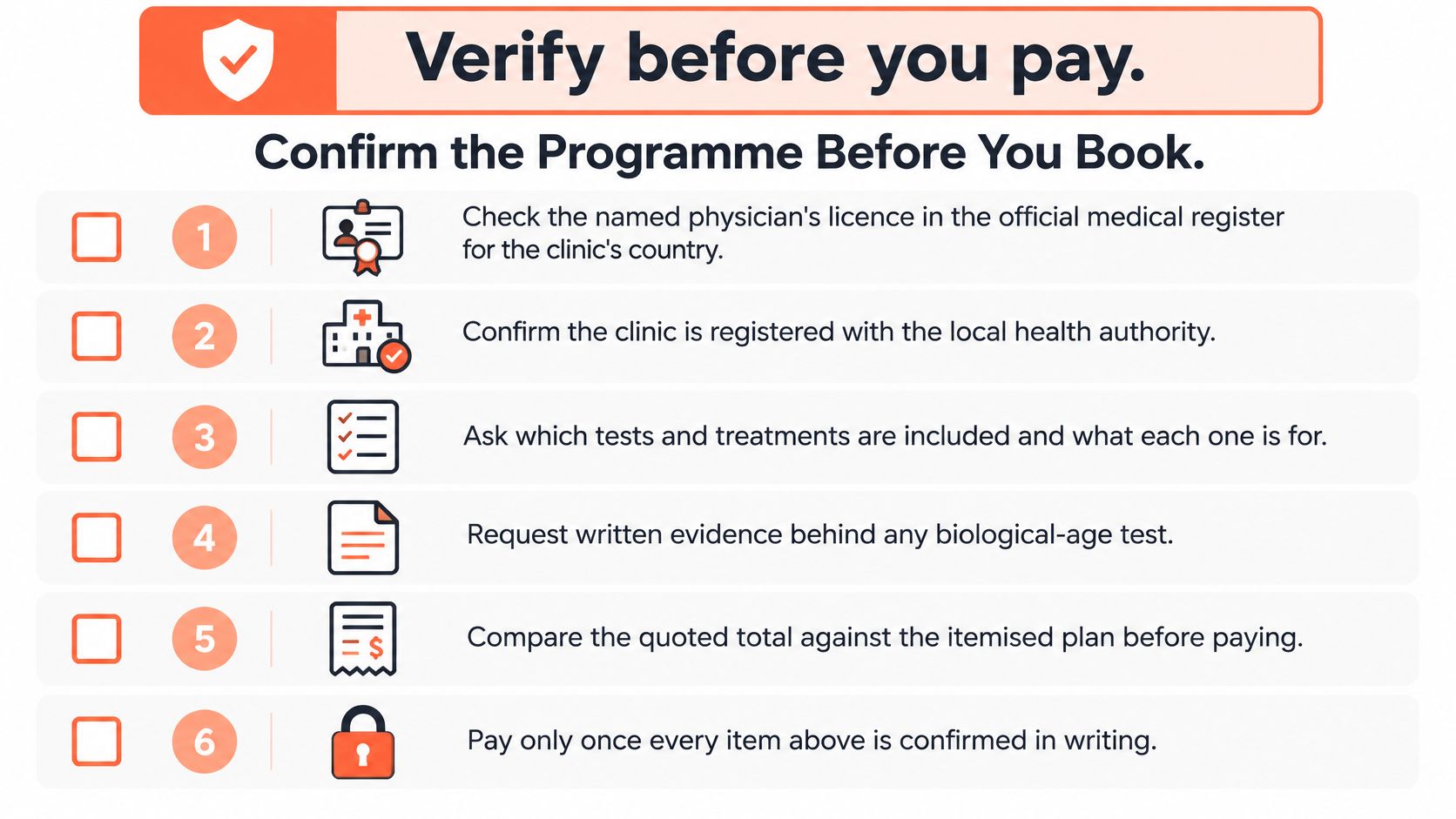
Verify before you pay. Request the clinical plan and commercial terms in writing so you can separate medical decisions from the pressure of a booking conversation.
A booking procedure you can use
-
Check the responsible physician. Verify the named clinician’s licence through the relevant official medical register, such as the GMC in the UK. A refusal to identify the clinical lead should stop the booking.
-
Request the complete test list. Ask what decision each test could change and confirm any required facility registration. A package described only as comprehensive doesn’t tell you what you’re buying.
-
Clarify treatment status. Have the clinic identify which proposed medicines are licensed for your indication, off-label, or available through research. Treat a claim that approval for another condition proves longevity benefit as a warning.
-
Get the follow-up plan. Confirm who reviews results, which measures repeat, and how unresolved findings are handed over. An assessment without a responsible follow-up clinician leaves important work unfinished.
-
Ask about unwanted findings and harm. Request the process for false positives, incidental findings, and adverse events, including access to independent specialists. Vague reassurance isn’t a reporting procedure.
-
Obtain itemised commercial terms. Confirm the total, exclusions, additional investigation costs, cancellation terms, and refund conditions directly with the clinic. Don’t accept a package price without its contents.
-
Use independent comparison carefully. Compare the evidence, oversight, and financial incentives, not just amenities. Missing public information should prompt a written question, not an assumption.
At Longevity Clinics, our independent scoring process combines publicly available information with algorithmic assessment and physician-editor validation. Our content is editorial, not medical advice, and we can’t provide personal clinic recommendations; booking and pricing enquiries must go directly to the clinic.
If answers remain vague, pause the transaction and request them in writing. Walk away if the programme won’t provide enough information for an informed decision.
Before booking, send your shortlisted clinic a request for its named clinical lead, itemised test-and-treatment plan, evidence grades, follow-up responsibilities, and full commercial terms. Take the response to your usual clinician to discuss what adds value to your existing care, and pay only when the purpose and consequences of the proposed programme are clear.