Longevity Reviews: 7 Clinic Review Sources Compared
Independent longevity reviews compared: 7 review sources, scoring methods, and red flags to check before choosing a longevity clinic programme.
You’re weighing a five-figure longevity programme. The clinic’s website promises extensive testing and personalised prevention, but your search turns up polished marketing pages and a handful of star ratings. You still can’t tell who’ll interpret an abnormal scan, whether follow-up is included, or which treatments have meaningful human evidence.
That’s the problem with using longevity reviews as if they all measure the same thing. Patient ratings describe an experience. Price directories describe an offer. Structured editorial reviews assess programmes against criteria chosen by their publishers. None, by itself, proves that a clinic improves health.
The review sources below are ordered by their usefulness for building an evidence-conscious shortlist, not by traffic or popularity. Each serves a different purpose, from comparing clinical oversight to checking costs and patient sentiment. Our own publication appears first, so that relationship is explicit. This is editorial analysis, not medical advice, and the order isn’t an independent clinical validation of these tools.
Table of Contents
- 1. Longevity Clinics
- 2. GCR – Global Clinic Rating
- 3. LongevityCost
- 4. Longevity Clinics Guide
- 5. Build My Longevity
- 6. Longevity Vanguard – Compare
- 7. Age Life Forward
- Longevity review sources at a glance
- Reading Reviews Like an Analyst, Not a Shopper
1. Longevity Clinics

Best for comparing programme structure, evidence and commercial incentives. Explore our editorial directory when you need more than patient ratings or a list of included tests.
Longevity Clinics is our reader-funded publication, not a medical provider. We review 19 programmes across eight countries, covering residential, outpatient and membership formats across Europe, the Gulf, North America and Asia.
Our 0–100 editorial rubric assesses diagnostic depth, medical supervision, conflict freedom and evidence base. We collect publicly available information from clinic websites, regulator records, professional registries and peer-reviewed literature, score it algorithmically, and have physicians and editors validate the results.
What the score can and can’t establish
The practical advantage is standardisation. Readers can compare tests, treatments, follow-up and regulatory context without assuming that a residential retreat and an ongoing medical membership deliver equivalent care.
We don’t accept affiliate links, sponsored sections, featured placements, clinic hospitality or pre-publication review. Funding comes from reader subscriptions and an annual industry benchmarking report that clinics may purchase but cannot influence.
Those policies address editorial incentives, but they don’t turn desk research into a clinical audit. We have no contact with clinics, and publicly available information can be incomplete or become outdated.
- Strength: The rubric separates medical supervision and evidence from diagnostic breadth.
- Limitation: The directory is selective, and an editorial score doesn’t establish patient outcomes.
- Best use: Examine the reasoning behind a score, particularly evidence gaps and follow-up arrangements, rather than choosing the highest number automatically.
For protocol-level questions, PepFlow’s longevity protocol guide offers an additional reading route. Keep protocol exploration separate from the medical decision about what’s appropriate for you.
2. GCR – Global Clinic Rating

A patient can describe clear communication, smooth scheduling and attentive staff without knowing whether a screening package was medically appropriate. That distinction is central to interpreting GCR’s longevity clinic rankings, which use verified patient-review information and a Bayesian model that considers ratings, review volume and recency.
GCR is most useful as an international patient-sentiment screen. Country filters and provider profiles can help you investigate how patients describe their experience, while the scoring method goes beyond a simple average of stars.
Read the experience, not just the position
Look for descriptions of explanation quality, responsiveness and what happened after results arrived. These accounts can generate useful questions, but they can’t establish diagnostic validity or treatment effectiveness.
The clinical distinction matters because an international expert consensus on ageing biomarkers includes functional, cognitive and physiological domains alongside laboratory markers and epigenetic clocks. A review score doesn’t tell you whether a programme measures those domains appropriately or uses results to change care.
Practical rule: Use patient reviews to investigate how care feels and how staff communicate, not to certify the medical value of the treatment.
GCR’s coverage also depends on available reviews. A missing clinic isn’t necessarily a poor clinic, and a prominent listing isn’t a clinical endorsement.
Pair it with our discussion of how to interpret longevity clinic reviews when deciding which patient observations deserve further investigation.
3. LongevityCost
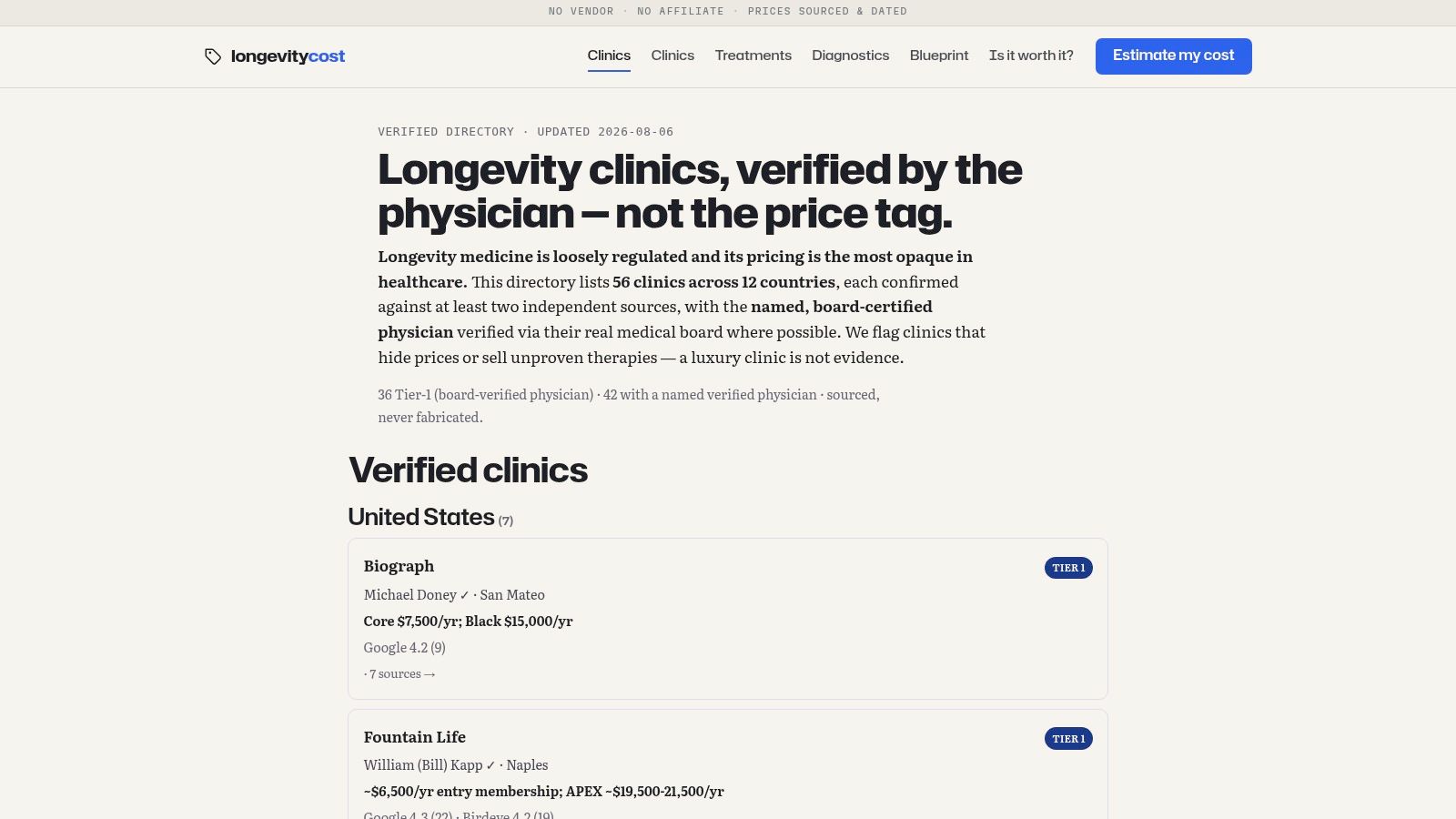
A published price is useful only when you know what it buys. LongevityCost’s clinic directory brings available prices, locations, named physicians, credential information and external ratings together, making it a practical starting point for checking an offer’s completeness.
Its value isn’t a standardised clinical-quality ranking. It’s the ability to spot missing information before you spend time comparing programmes that may have very different inclusions.
Say a diagnostic day includes testing and an initial consultation, while a membership includes ongoing physician access. The headline amounts aren’t directly comparable until you establish who interprets results, who handles referrals and whether repeat testing costs extra.
Compare the full care pathway
- Price scope: Separate the advertised package from optional imaging, supplements, repeat tests and specialist referrals.
- Clinical responsibility: Identify the named clinician and verify the relevant registration directly with the professional registry.
- Continuity: Establish whether follow-up means a written report, another appointment or continuing medical management.
This isn’t just budgeting discipline. The RACGP preventive-care guidelines describe potential screening harms, including unnecessary investigations, treatment and financial or psychological consequences.
A cheaper initial assessment can therefore leave you with an expensive unresolved finding. Conversely, a higher price doesn’t prove that appropriate follow-up is included.
Use our concierge medicine cost guide to frame recurring-care questions. LongevityCost can help identify the questions, but external ratings and credential checks aren’t substitutes for an independent clinical audit.
4. Longevity Clinics Guide
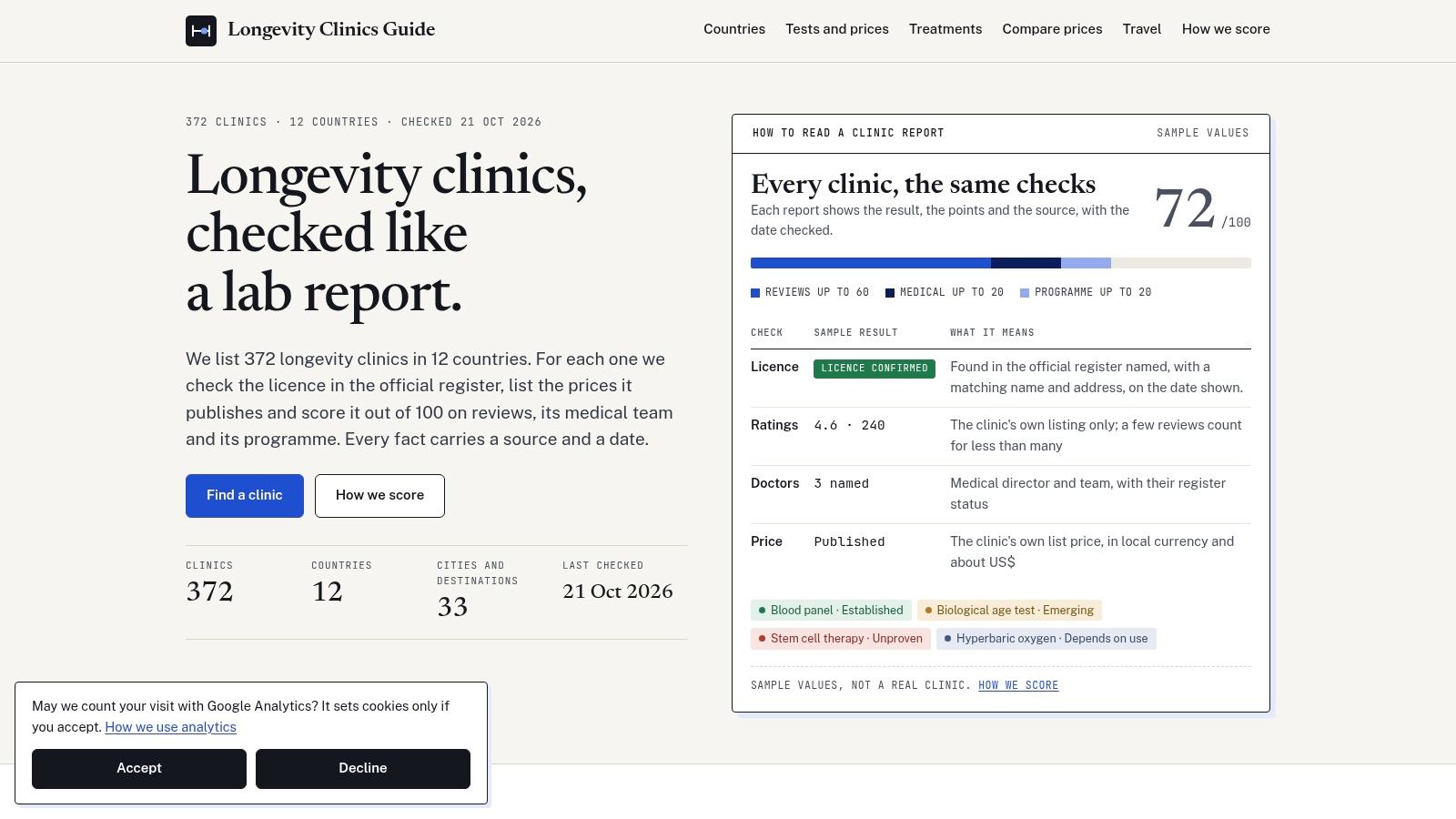
Longevity Clinics Guide sits between a patient-review directory and a programme comparison. Its stated framework combines public reviews with checks on medical credentials and details such as programme inclusions, consultations, written plans, prices and follow-up.
That makes it useful when a star average leaves too much unanswered. A named doctor and a documented follow-up plan provide context that an enthusiastic testimonial can’t.
The limitation is the weighting. Reviews make up the largest share of its score, so the result remains substantially influenced by patient sentiment rather than functioning as a clinical-evidence grade.
A transparent scoring formula lets you inspect the publisher’s judgement. It doesn’t make the chosen weights medically validated.
Inspect what earns credit
Ask whether a programme receives credit for having a service or for demonstrating that the service improves a patient-important outcome. A biological-age test, for example, may be clearly described and professionally delivered without establishing that changing its result improves health.
A responsible-longevity framework highlights gaps in the validation of composite ageing clocks and the preliminary nature of human evidence for senolytics. Those limitations matter whenever a directory treats new testing or interventions as positive programme features.
Use the guide to investigate credentials and care organisation, then examine the evidence separately. Our explanation of what to assess in a longevity medicine clinic provides another lens for distinguishing a well-described programme from a well-supported intervention.
5. Build My Longevity

You might not need a clinic membership at all. If you’re comparing ongoing care with a standalone test or imaging service, Build My Longevity’s comparison pages help separate the available formats.
The site focuses on US clinics, testing services, imaging providers and related products. Its comparisons include prices, delivery formats, locations and review information where available, with dated checks and labels identifying details the provider hasn’t stated.
Treat missing information as a question
Explicit uncertainty is useful. A detail marked as not stated tells you what remains unresolved; it doesn’t prove that the provider lacks the service or policy.
- For memberships: Establish whether ongoing access includes substantive medical management or mainly periodic testing.
- For laboratory services: Identify who interprets results and takes responsibility for any recommended next step.
- For imaging: Ask how incidental findings are communicated and who arranges follow-up.
The main comparison hazard is category confusion. A testing platform, an imaging provider and a physician-led clinic may appear alongside one another, but they aren’t interchangeable forms of care.
Build My Longevity is consequently most helpful before you’ve settled on a programme format. Use it to identify the type of service that matches your question, then compare providers within that category.
Its US emphasis limits its usefulness for an international shortlist. Dated checks improve interpretability, but neither a check date nor a detailed description guarantees that prices, access or inclusions remain unchanged.
6. Longevity Vanguard – Compare
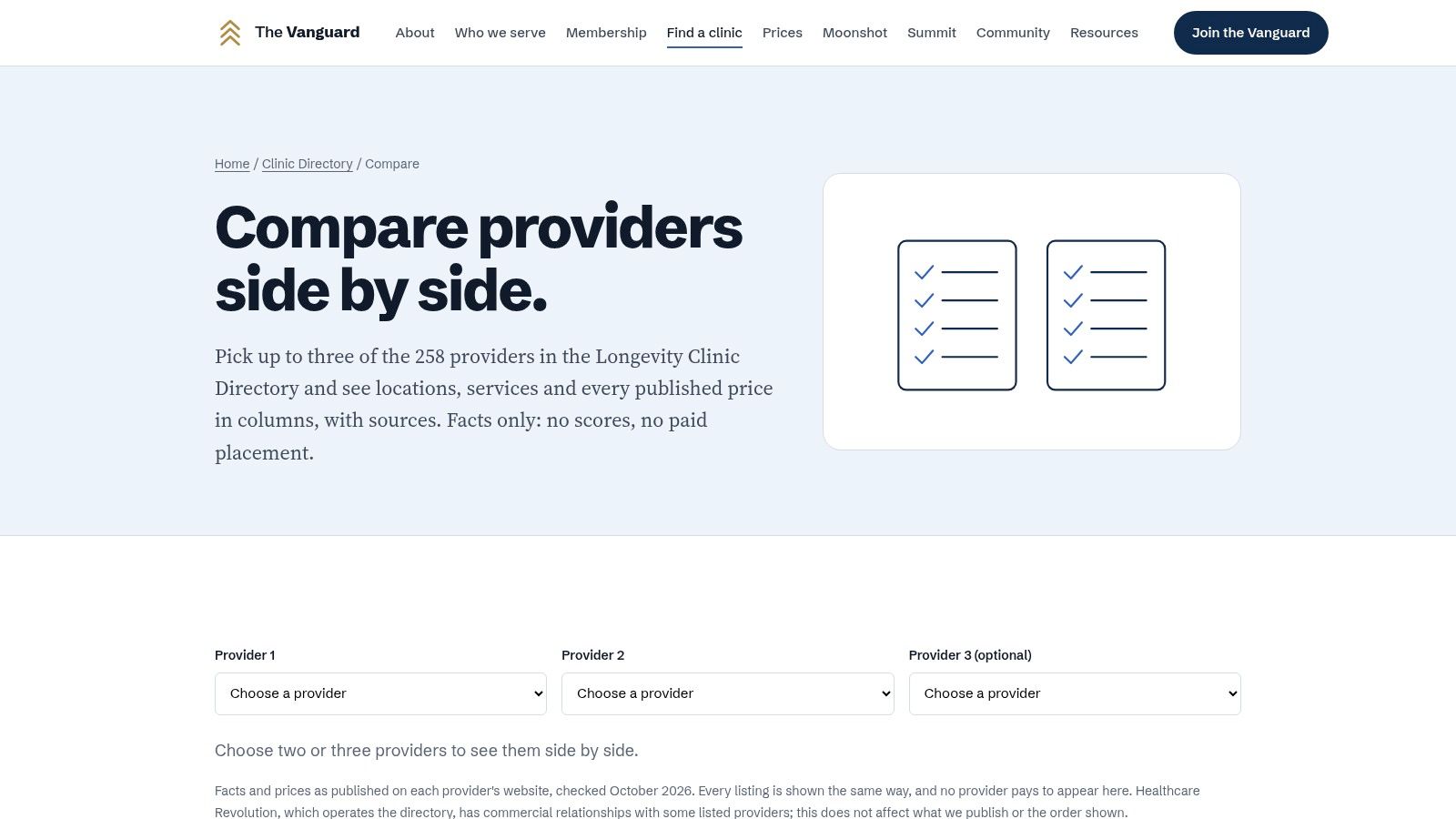
Once you know which service category you want, Longevity Vanguard’s comparison tool can help narrow providers by location, services and published prices. It also offers topic-based comparisons across procedures and programmes.
The site says its listings draw on provider websites and include checked dates. That makes it useful for comparing published offers, rather than demonstrating what happens in clinical practice.
Its disclosures require careful reading. The site says providers don’t pay to appear in the comparison, while also disclosing commercial relationships with some listed providers.
Separate listing policy from commercial independence
Those statements answer different questions. A no-payment listing policy concerns inclusion; commercial relationships remain relevant when judging the wider editorial context.
- Strength: Side-by-side presentation helps identify differences in stated services and costs.
- Limitation: Provider descriptions don’t independently establish effectiveness, safety or suitability.
- Best use: Narrow an already defined shortlist, then confirm the details directly with each clinic.
Decision filter: Compare equivalent services first. A lower entry price isn’t a better offer if the clinical interpretation and follow-up you need are excluded.
Don’t treat repeated information across directories as independent corroboration. If several sites reproduce the same provider description, you may have several presentations of a single underlying claim.
The stronger cross-check combines different evidence types: published programme details, regulator information, patient accounts and a transparent assessment of the intervention’s evidence. A comparison interface is helpful, but it can’t perform all of those jobs.
7. Age Life Forward
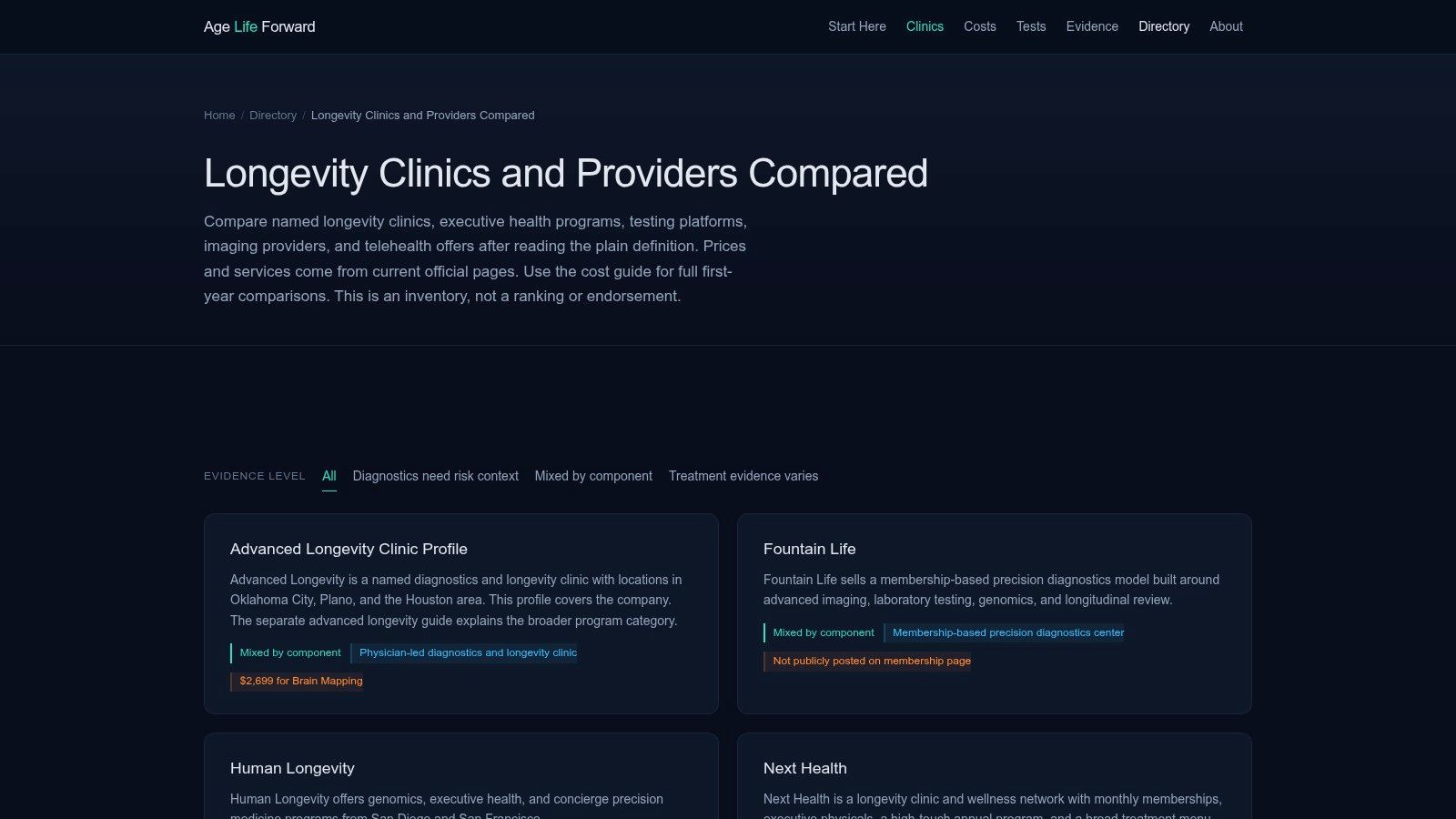
Sometimes the most useful directory is one that doesn’t declare a winner. Age Life Forward’s provider inventory covers longevity clinics, executive-health programmes, testing platforms, imaging providers and telehealth services without presenting its inventory as a provider endorsement.
It records programme type, stated price, oversight model and price clarity, while distinguishing evidence-related categories and risk context. That makes it useful for understanding what kind of service a provider offers.
Use categories before rankings
A medical oversight label is a starting point, not a complete description of responsibility. You still need to establish whether a physician reviews your history, interprets findings and manages follow-up, rather than merely being associated with the service.
Age Life Forward’s separation of provider claims from independent clinical evidence is particularly useful when comparing longevity offers. The World Health Organization reported global life expectancy of 73.3 years and healthy life expectancy of 63.7 years in 2019, illustrating why living longer and living in full health aren’t equivalent outcomes.
A provider’s longevity language therefore needs translation into specific aims: prevention, disease management, functional improvement or an experimental ageing endpoint. Those aims require different evidence.
The limitation is verification depth. An inventory isn’t a detailed independent clinic review, and a listed price may be promotional or cover only entry-level services.
Use Age Life Forward to classify options and identify uncertainty. Then investigate the medical team, the complete cost and the evidence behind the proposed intervention before treating any listing as a viable care option.
Longevity review sources at a glance
These sources measure different things, so their scores and listings are not directly interchangeable. Patient sentiment, prices, programme details and structured editorial criteria each answer a different question.
| Source | What it measures | Geographic scope | Scoring approach | Best for |
|---|---|---|---|---|
| Longevity Clinics | Diagnostics, medical supervision, conflicts, evidence, and programme details | 19 programmes across 8 countries | Published 0–100 rubric across four criteria | Comparing programmes using clinical and evidence-focused criteria |
| GCR, Global Clinic Rating | Verified patient review ratings, volume, and recency | International, with country filters | Bayesian model weighting ratings, volume, and recency | Comparing patient sentiment across international clinics |
| LongevityCost | Prices, locations, physician credentials, and external review ratings | Geographic coverage not specified | No standardized clinical-quality ranking | Shortlisting clinics by price and provider information |
| Longevity Clinics Guide | Reviews, credentials, prices, programme features, and follow-up | Geographic coverage not specified | Publisher-weighted score that combines reviews with credential and programme checks | Comparing review-led scores alongside programme details |
| Build My Longevity | Clinics, tests, imaging, prices, formats, and availability | United States | Side-by-side comparisons; no overall quality score stated | Comparing US clinics and standalone testing services |
| Longevity Vanguard, Compare | Provider locations, services, and published prices | Geographic coverage not specified | Side-by-side comparison of selected providers | Narrowing provider options by service and price |
| Age Life Forward | Service types, stated prices, oversight models, price clarity, and evidence or risk categories | Geographic coverage not specified | Inventory format; does not rank providers | Understanding differences among longevity-related services |
Reading Reviews Like an Analyst, Not a Shopper
The strongest shortlist won’t come from averaging directory scores. It’ll come from combining sources that answer different questions and recognising when they depend on the same underlying material.
Patient reviews can help you investigate communication and service. Price directories can clarify what’s being sold, while structured editorial comparisons can expose differences in oversight, evidence and incentives. None replaces a clinician’s assessment of whether a programme suits your health history.
Turn the shortlist into a verification process
- Cross-check across sources: Use more than one review source, choosing complementary approaches rather than several directories that repeat provider copy.
- Verify the people: Confirm the named clinician’s registration through the relevant professional registry and establish who is responsible for your care.
- Request written inclusions: Ask the clinic which diagnostics, consultations, reports and follow-up appointments the quoted price covers.
- Plan for abnormal results: Establish who orders confirmatory tests, arranges referrals and remains responsible after you return home.
- Test outcome claims: Ask what improved, how it was measured, what harms occurred and whether the result matters beyond a proprietary score.
If sources disagree, don’t choose the more flattering account. Check whether they assessed different programme versions, used different dates or measured different things.
Treat every score as one weighted editorial opinion, not proof of clinical quality. Longevity reviews provide context for a decision; they don’t provide personal medical advice or guarantee benefit.
Before paying a deposit, select your strongest candidates, cross-check them across complementary sources and send each clinic the same written questions about credentials, inclusions and follow-up. Bring the responses to a clinician who knows your history, and direct booking and pricing enquiries to the clinic itself. If you find a factual error in our directory, send Longevity Clinics a correction with supporting sources so our editorial team can assess it.