Peptide Therapy Clinic: What Patients Should Know
Learn what a peptide therapy clinic offers, how evidence and regulation vary by peptide, and the safety checks that separate a credible clinic from a risky one.
Peptide covers more than a century of medicine, from insulin to today’s approved incretins and investigational compounds. A clinic’s quality is judged peptide by peptide, not by the category label on the brochure.
The popular advice is to ask whether a clinic is “doctor supervised.” That question is too weak. The better question is whether the clinic can defend the exact molecule, dose, indication, sourcing, and monitoring plan it uses for each peptide, because FDA-approved medicines and compounded products sit in very different regulatory worlds, and those differences matter for safety and evidence quality (FDA history of therapeutic peptides, FDA concerns about unapproved GLP-1 drugs).
Table of Contents
- Why the Word Peptide Is Not Enough
- A Brief History of Peptide Medicine
- What Peptides a Clinic May Offer
- How Regulation Shapes the Clinic’s Menu
- The Safety Signal Behind the Headlines
- Monitoring and Stopping Rules That Distinguish a Real Clinic
- A Practical Clinic Evaluation Checklist
- Choosing a Peptide Therapy Clinic With the Right Frame
Why the Word Peptide Is Not Enough
A peptide therapy clinic can mean several different things, and the label alone tells you almost nothing. One practice may use an FDA-approved incretin for a labeled indication, another may rely on a compounded molecule, and a third may market a wellness injection with thin clinical support. The useful question is narrower: which specific active ingredient is being used, and under what regulatory basis?
Judge the molecule, not the slogan
Marketing language should never carry the burden of proof. A serious review asks four questions: what peptide is being used, for which diagnosis, in what formulation, and through which sourcing path. If the clinic cannot answer those questions clearly, the document in front of you is branding, not a medical protocol.
That distinction matters because peptide medicine includes approved drugs, off-label use, and products that sit outside normal approval pathways. The Food and Drug Administration separates approved medicines from compounded drugs because the evidence base, manufacturing controls, and oversight are different (FDA guidance on compounded drugs versus approved drugs). A responsible clinic makes those categories visible in its consent forms and follow-up plan.
Practical rule: if a clinic uses the phrase “peptide therapy” without naming the molecule and indication, treat that as a warning sign, not a selling point.
What a good clinic makes visible
At minimum, the chart should show the diagnosis, eligibility criteria, titration schedule, contraindication screening, and outcome measures. If the same peptide is offered for weight, recovery, “longevity,” and “metabolic optimization” without clear distinctions, the clinic is blending evidence tiers in a way that obscures clinical risk.
A useful reset is simple. Ask whether the clinic is responsible with this peptide for this patient. That question is more exacting than asking whether the practice sounds doctor-supervised, and it matches how regulation and safety work.
A Brief History of Peptide Medicine
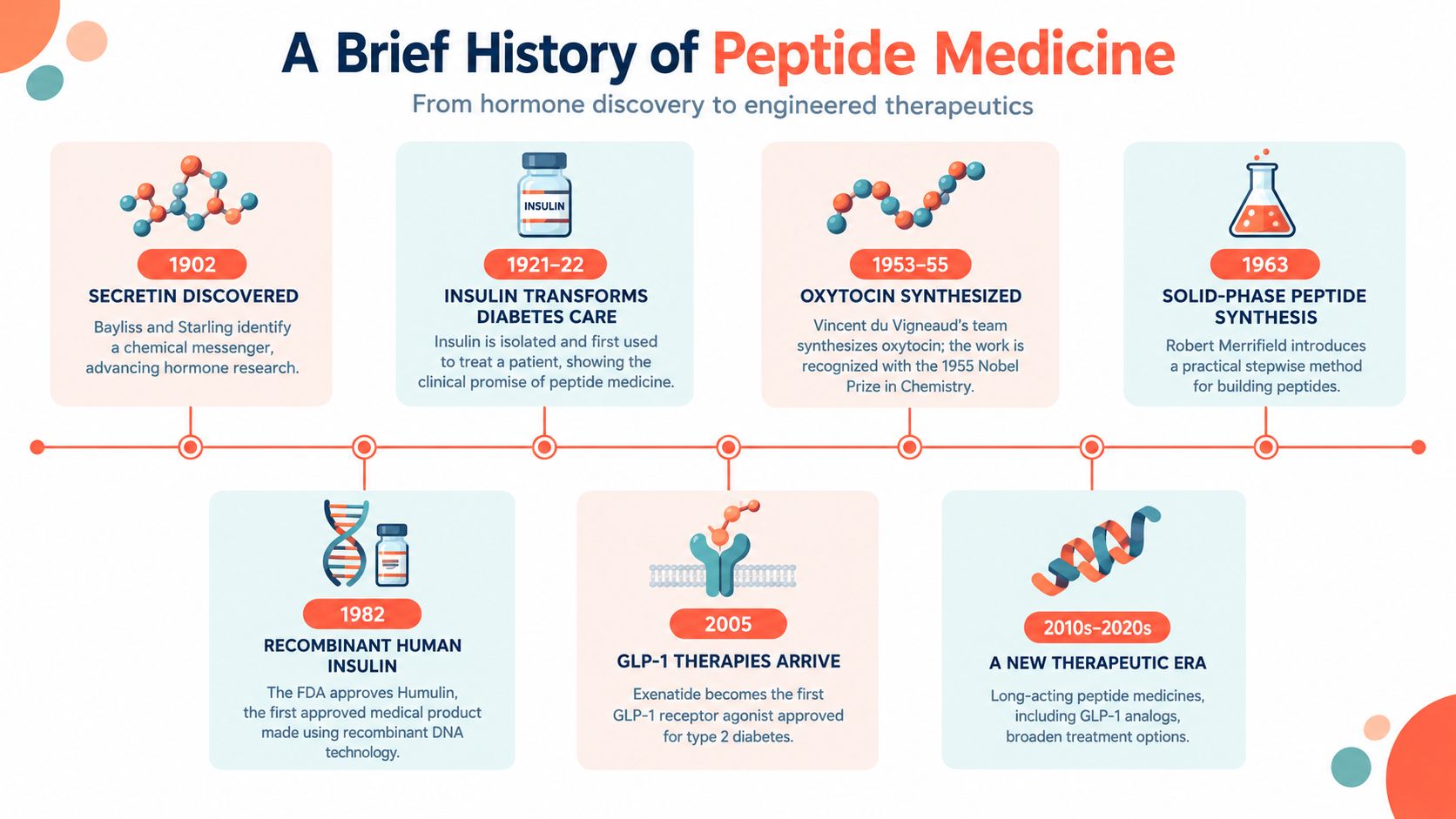
The modern peptide story begins with insulin. In 1921, Frederick Banting, Charles Best, J. J. R. Macleod, and James Collip showed insulin’s therapeutic value and changed diabetes care for patients who had previously depended largely on starvation-level, carbohydrate-restricted diets. By 1923, the University of Toronto had licensed Eli Lilly to develop and distribute insulin in the United States, an early case of academic discovery moving into large-scale pharmaceutical production (FDA history of therapeutic peptides).
Why that history matters now
The history cuts against the way many clinics present peptides today. The word sounds current, but peptide medicine has deep pharmaceutical roots. A 2024 peer-reviewed review reported that the FDA had authorized approximately 100 peptide therapeutics since insulin’s introduction, with uses that include diabetes, multiple sclerosis, and septic shock. The same review identifies insulin as the first major therapeutic peptide with a U.S. approval milestone of 1923.
That breadth is the point. “Peptide” is not a quality label, and it is not a promise of innovation either. It covers medicines with decades of evidence, medicines approved for narrow indications, and molecules that are still early in development or marketed for wellness rather than approved treatment.
The editorial implication for clinic reviews
A clinic that sells peptide therapy should be read like a prescribing environment, not like a lifestyle spa. The relevant comparison is how precisely the clinic distinguishes approved, off-label, compounded, and investigational use, and whether that distinction appears in consent forms, sourcing notes, and follow-up plans.
That history matters because it separates ordinary medicine from marketing language. Some peptide claims rest on established therapeutic use. Others rely on early-stage science or products that sit outside normal approval pathways.
What Peptides a Clinic May Offer
A clinic’s peptide menu is best read by regulatory status first, not by branding. Once the labels are sorted, the key question is whether the clinic is offering approved medicine, off-label prescribing, compounded product, or material with no approved U.S. indication.
Selected Peptides a Clinic May Prescribe
| Peptide | Typical example | Regulatory status | Primary indication |
|---|---|---|---|
| Semaglutide | Ozempic, Wegovy | FDA-approved | Type 2 diabetes or chronic weight management, depending on product |
| Liraglutide | Victoza, Saxenda | FDA-approved | Type 2 diabetes or chronic weight management, depending on product |
| Exenatide | Byetta, Bydureon | FDA-approved | Type 2 diabetes |
| Dulaglutide | Trulicity | FDA-approved | Type 2 diabetes |
| Lixisenatide | Adlyxin | FDA-approved | Type 2 diabetes |
| Tirzepatide | Mounjaro, Zepbound | FDA-approved | Type 2 diabetes or obesity-related treatment, depending on label |
| BPC-157 | Various wellness formulations | Investigational or wellness-marketed | No approved U.S. indication |
| TB-500 | Various wellness formulations | Investigational or wellness-marketed | No approved U.S. indication |
| MOTS-c | Various wellness formulations | Investigational or wellness-marketed | No identified clinical studies or human-exposure data in FDA briefing material |
| CJC-1295 | Various wellness formulations | Investigational or wellness-marketed | No approved U.S. indication |
| Ipamorelin | Various wellness formulations | Investigational or wellness-marketed | No approved U.S. indication |
Read the label like a regulator
The approved incretins are molecule-, formulation-, dose-, and indication-specific. Semaglutide is not a generic fat-loss ingredient, tirzepatide is not a general longevity compound, and liraglutide is not interchangeable with a compounded analog just because the drug class sounds similar (FDA guidance on approved incretin-based drugs).
Off-label use is a separate question, and a clinic should document the diagnosis, rationale, consent, and monitoring if it prescribes an approved drug for a different purpose. For example, if a clinic uses semaglutide for a non-labeled indication, the chart should show why that choice was made, what alternatives were considered, and what follow-up plan applies.
Compounded products are different again, because they are not FDA-approved and are not reviewed by the agency before marketing (FDA concerns about unapproved GLP-1 drugs).
Practical rule: if a clinic cannot say whether a peptide is approved, compounded, or investigational, it probably cannot explain how it will monitor it properly either.
The wellness-market peptides deserve the most skepticism. Their presence in a protocol does not prove fraud, but it raises the burden of proof. A legitimate clinic should be able to explain why a molecule is clinically justified, legally sourced, and appropriate for the patient’s risk profile.
How Regulation Shapes the Clinic’s Menu
Regulation sets the menu before the marketing copy does. It shapes what a clinic can claim, what it can source, and what it has to record. A peptide may sit in one legal category in one country and a different one elsewhere.
The United States
In the U.S., the key divide is between FDA-approved medicines and compounded drugs. Approved medicines have been reviewed for safety, effectiveness, and quality before marketing. Compounded drugs are not FDA-approved and are not reviewed before marketing, so a clinic has to supply that discipline through sourcing, consent, and monitoring.
Other jurisdictions
The same product can fall under a different rule set outside the U.S. In the EU, the European Medicines Agency sets the approval framework, while national authorities handle local use and enforcement. In Switzerland, Swissmedic authorizes medicines under its own system, so a product may be allowed there without being FDA-approved. Local health authorities in the Gulf and across Asia can add further limits on importation, compounding, and off-label use. A clinic in Zürich, Dubai, Bangkok, or Miami can therefore use similar language while relying on very different legal categories.
That is why “global” peptide access needs a local regulatory basis, not just a product name. A clinic treating traveling patients should be able to show whether the peptide is approved, compounded, imported, or prescribed off-label under local rules. Patients often return home with a plan that does not map neatly onto the rules where treatment started.
The point is not that one geography is better. The point is that the clinic should identify the legal category for each peptide, because that category sets the standard the clinic must meet.
The Safety Signal Behind the Headlines
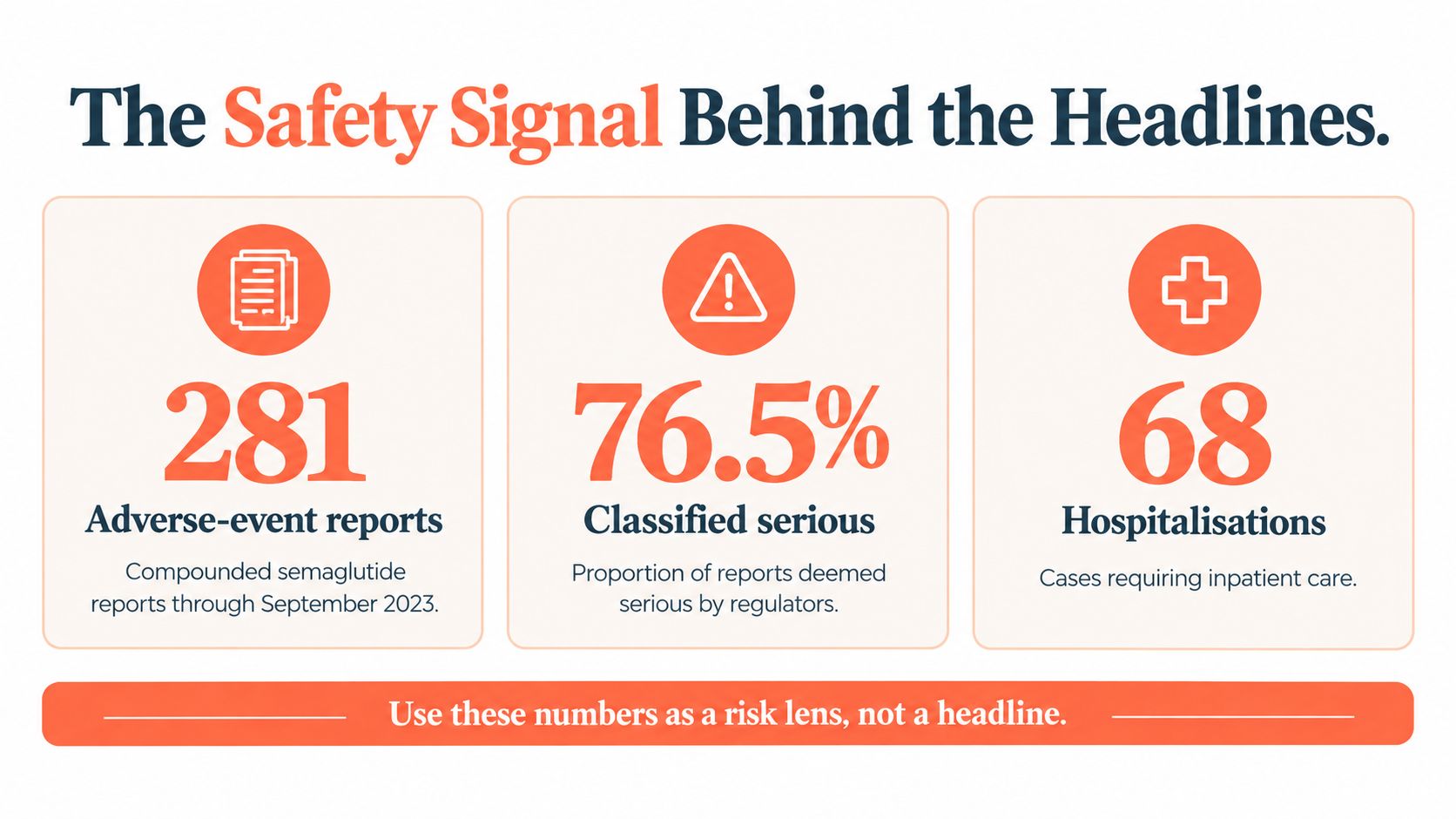
The clearest warning sign in this field comes from compounded GLP-1 products, because regulators have already documented concrete adverse-event reports. In a January 2024 FDA document using data through September 30, 2023, the FDA Adverse Event Reporting System contained 281 reports tied to compounded semaglutide, 215 classified as serious, 68 involving hospitalization, and two involving deaths (FDA concerns about unapproved GLP-1 drugs).
What those numbers do and don’t prove
Those figures are reports, not incidence rates. They do not show the chance that any one patient will be harmed, and they cannot adjust for underreporting or unknown exposure denominators. They do show why clinic quality controls matter when compounded or otherwise unapproved products are on the menu.
A later peer-reviewed review reported that by November 30, 2024, the FDA had received 392 adverse-event reports for compounded semaglutide and 215 for compounded tirzepatide. Read those as a signal, not as a risk rate.
Where harm enters the system
FDA materials also note that peptides may trigger immune responses and, in some circumstances, severe reactions including anaphylaxis. For 503A compounding, eligibility of a particular salt or ester does not automatically establish eligibility of the base compound or other salts and esters (FDA compounding guidance). That is why quality problems are not abstract. Identity, concentration, storage, sterility, and route of administration can all change the risk profile.
Recent reporting on two women hospitalized after peptide injections at a 2025 anti-aging conference makes the same point in a different register. A physician’s presence is only meaningful when it is backed by documented monitoring and stopping rules. Supervision without that system is theater.
Practical rule: if the clinic cannot explain how it would detect and respond to harm, its “medical oversight” is mostly a slogan.
Monitoring and Stopping Rules That Distinguish a Real Clinic
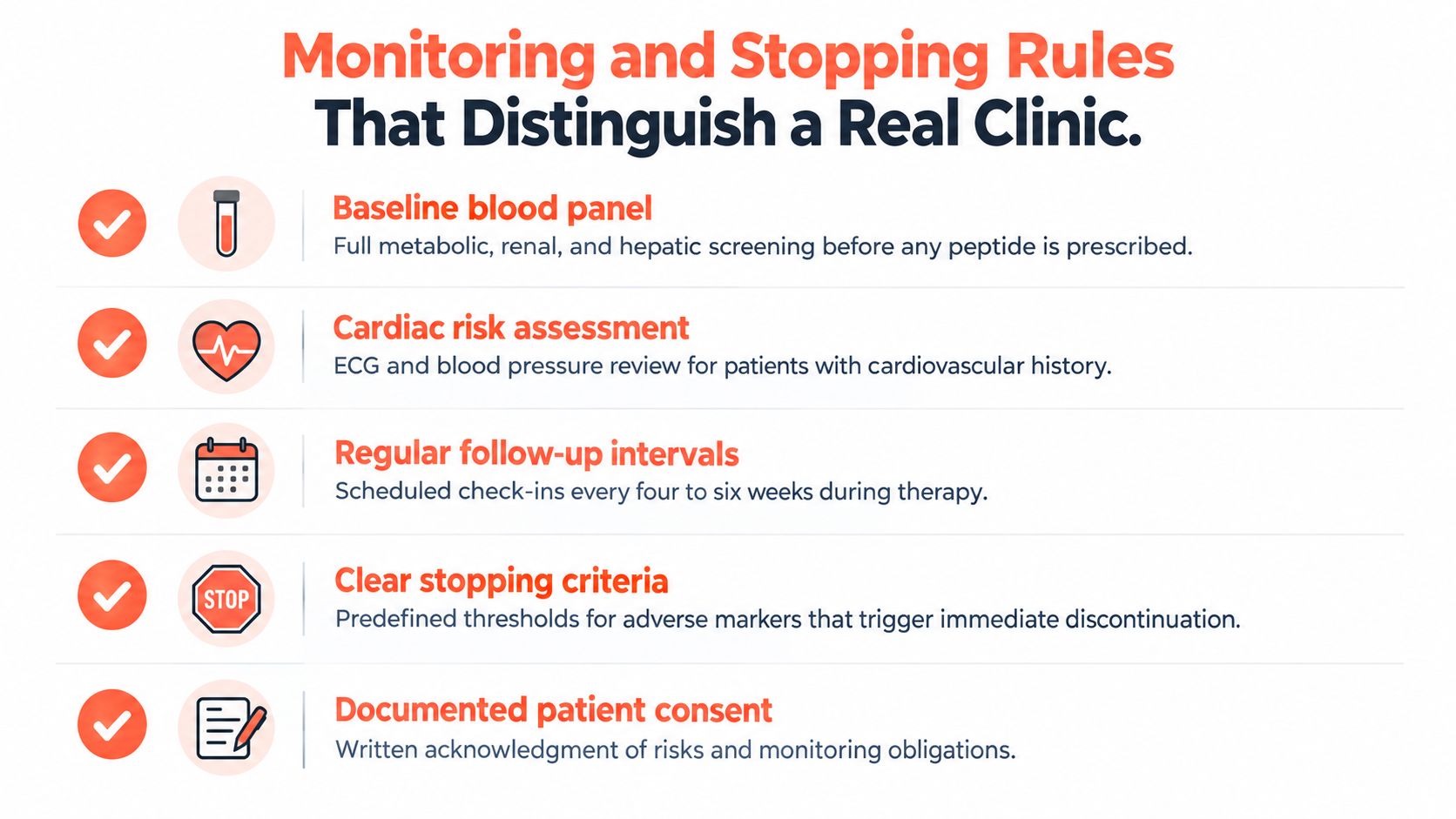
A real peptide therapy clinic proves itself by showing what happens before, during, and after prescribing. The operational test is whether the clinic has a monitoring system that spots problems early and stops treatment when risk changes.
What the clinic should already have in writing
A credible program should document contraindication review, drug-interaction screening, baseline testing, follow-up frequency, and a pathway for adverse-event escalation. It should also define objective goals, such as weight, glycaemia, gastrointestinal tolerance, hydration status, or treatment discontinuation, rather than relying on a patient’s vague sense that they “feel better.”
That documentation matters because supervision by name is not the same as longitudinal risk management. The recent conference hospitalizations show what happens when administration is treated as the endpoint instead of the start of monitoring.
Questions to ask the clinical lead
- What stops treatment? The clinic should define thresholds for dose reduction, dose holds, or discontinuation.
- What gets monitored? You should hear a clear list of labs, symptoms, and interval checks, not a vague promise of “follow-up.”
- Who handles adverse events? There should be a named escalation path, including urgent symptoms and after-hours contact.
- What product is being dispensed? Ask for the dispensing pharmacy, concentration, lot, expiry, storage conditions, and whether the product is compounded or approved.
- What consent did I sign? The clinic should separate approved use, off-label use, and investigational use in writing.
A clinic can still look polished and fail this test. A useful reference point is a hormone optimization clinic review framework, because the same discipline applies, written monitoring, named accountability, and a stopping rule the staff can explain without improvising.
If the answers are vague, the clinic is telling you what it is by omission. Strong medical service does not hide behind glossy outcomes language.
A Practical Clinic Evaluation Checklist
A useful shortlist is more concrete than a brochure and less forgiving than a sales call. Use the clinic’s own documentation to test whether its peptide program is built like medicine or like merchandizing.
What to review before booking
- Testing depth: Ask which biomarkers are checked before treatment begins, which are repeated, and why those tests match the peptide being used.
- Monitoring cadence: Look for scheduled follow-up rather than open-ended “reach out if needed” language.
- Sourcing detail: The clinic should state whether the product is approved, compounded, or investigational, and it should identify the pharmacy, concentration, lot, expiry, and storage requirements.
- Consent quality: Consent should distinguish approved use from off-label or investigational use, and it should describe uncertainty clearly.
- Conflict signals: Be cautious if the clinic earns more from selling the peptide than from evaluating whether you need it.
A directory can help if it documents these elements consistently. Longevity Clinics publishes comparative reviews that standardize clinic information across tests, treatments, follow-up models, and conflict-of-interest disclosures, which is useful precisely because peptide protocols are so easy to market and so hard to compare.
What a strong protocol should answer
A credible file doesn’t just say the patient is “under supervision.” It shows who prescribed, what was prescribed, how it was sourced, when it will be reviewed, and which outcome measures matter enough to stop the drug. That level of detail is not administrative clutter. It’s the difference between a treatment plan and a story.
For more on how oversight can break down in high-cost private medicine, review the clinic’s own disclosure framework alongside its treatment claims in this discussion of hormone optimization clinic standards and the broader longevity medicine review framework.
Practical rule: if the clinic can’t produce a document trail, assume the monitoring trail is weak too.
Choosing a Peptide Therapy Clinic With the Right Frame
A peptide therapy clinic should be judged by discipline, not by vocabulary. The right frame is simple, separate approved from compounded, verify sourcing, demand monitoring rules, and insist on written consent that matches the current regulatory status of the product.
That matters because “peptide” can mean a century of validated medicine or a loosely controlled wellness claim. A clinic that understands the difference will name the molecule, the indication, the source, and the stopping rules. A clinic that doesn’t will hide behind the brochure.
If you’re comparing programs, start with the product category, then move to monitoring, then to conflict of interest. That sequence tells you far more than any promise of being “doctor supervised.” For a structured comparison, also review how the clinic handles conflict of interest in healthcare before you commit to treatment.