Precision Medicine Clinic: What to Expect
Learn what a precision medicine clinic offers, how to evaluate one, and what to expect from your first visit in 2026.
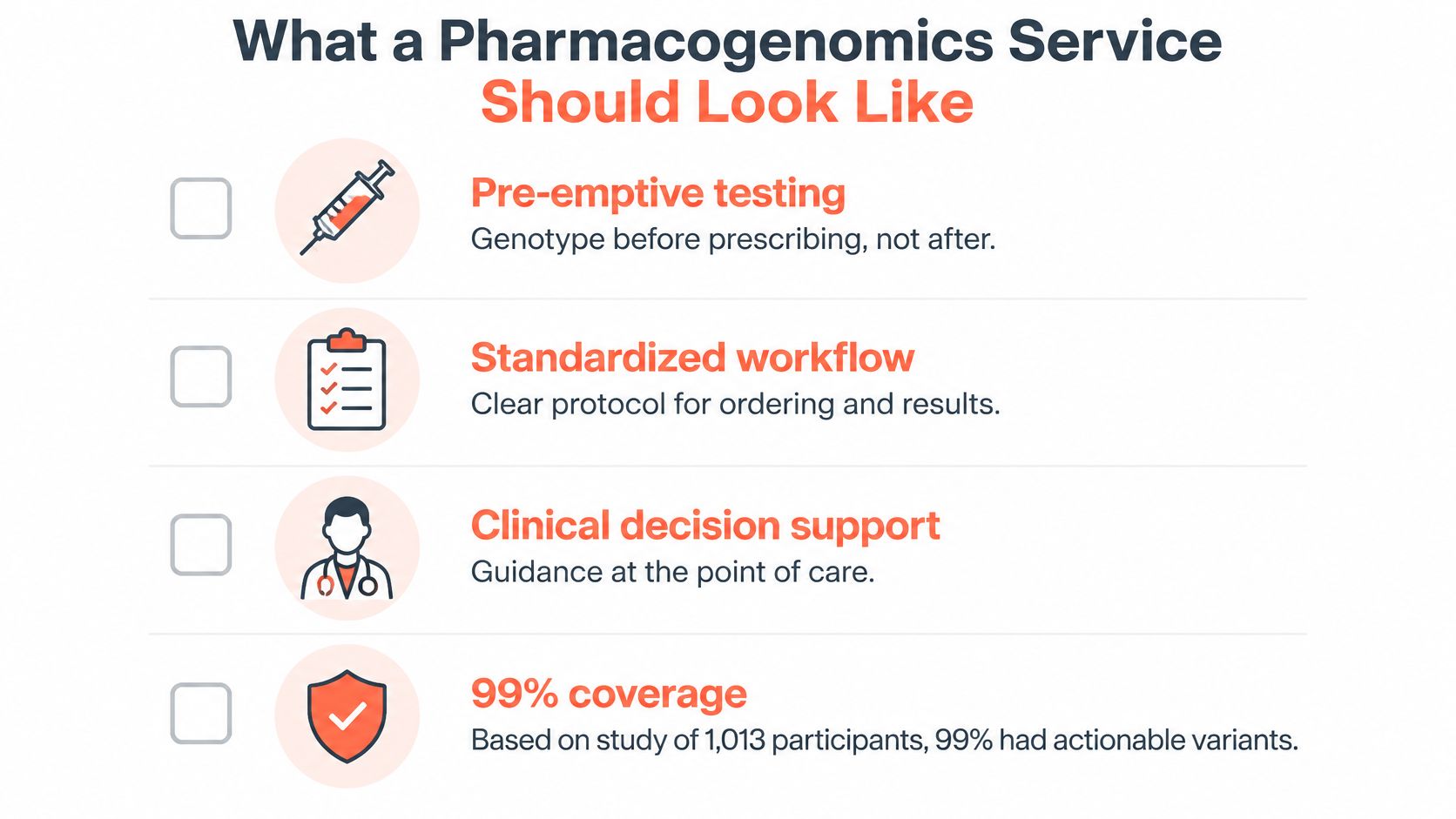
Almost everyone who gets a broad pharmacogenomic panel carries something that looks actionable, and that is precisely why the test alone tells you so little. In one implementation, 99% of participants carried at least one potentially actionable variant, yet value depended on whether clinicians translated that result into a prescribing decision, as described in the pre-emptive pharmacogenomics implementation study of 1,013 participants. A precision medicine clinic earns its fee after the laboratory report arrives. If you are comparing clinics by gene count, biomarker count, or page count, you are grading the easiest part of the process and missing the part where care changes.
Table of Contents
- What a Precision Medicine Clinic Actually Does
- How Precision Medicine Became a Clinical Field
- Pharmacogenomics as the Clearest Working Example
- What a Pharmacogenomics Service Should Look Like
- Separating Immediate, Future, and Informational Findings
- Why More Data Does Not Always Mean Better Care
- Consent, Privacy, and Incidental Findings
- Evaluating a Clinic and Frequently Asked Questions
What a Precision Medicine Clinic Actually Does
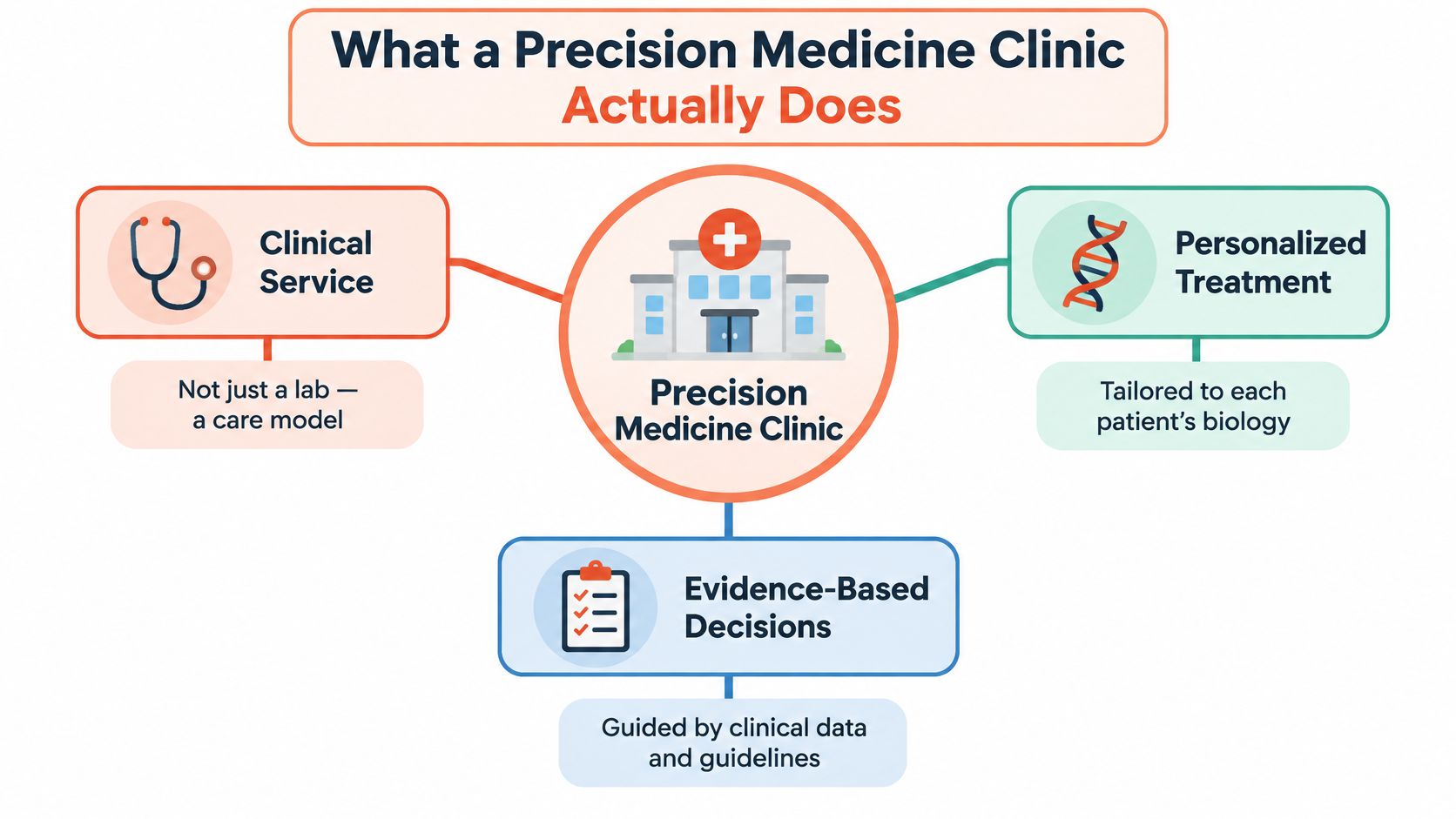
A precision medicine clinic isn’t defined by owning a sequencer. It’s a clinical service that uses genomic, molecular, lifestyle, and environmental information to change a prevention, diagnostic, or treatment decision for a specific person. If nothing changes, you’ve bought data, not precision care.
Conventional prescribing often works like buying a coat off the rack. The size fits many patients reasonably well, and clinicians adjust only after side effects or poor response appear. A precision approach is closer to tailoring. Clinicians measure relevant biology first, then choose, dose, monitor, or avoid an intervention based on those measurements.
Three Layers You Should Judge Separately
Most clinics coordinate three layers, and weakness in any one of them breaks the chain.
- Data generation: The clinic orders sequencing, biomarker testing, imaging, physical measurements, or other assessments and checks that the laboratory method is fit for the question.
- Interpretation: A qualified clinician translates variants into phenotypes, correlates findings with your history and medicines, and separates established signals from speculation.
- Action: The team changes a prescription, sets a monitoring interval, arranges confirmatory testing, refers you to a specialist, or explicitly decides that no change is warranted.
Practical rule: Ask what decision each test could change before you pay for it. A clinic that can’t answer clearly is selling measurement without a care pathway.
That distinction matters in longevity and preventive settings, where broad panels can produce a long report for a healthy person. A credible precision medicine clinic explains which findings affect care now, which might matter later, and which are informational. It also names who owns follow up. The report is an input. The clinic’s product is a documented, evidence based decision and a plan for revisiting it as your medicines, health status, and guidelines change.
How Precision Medicine Became a Clinical Field
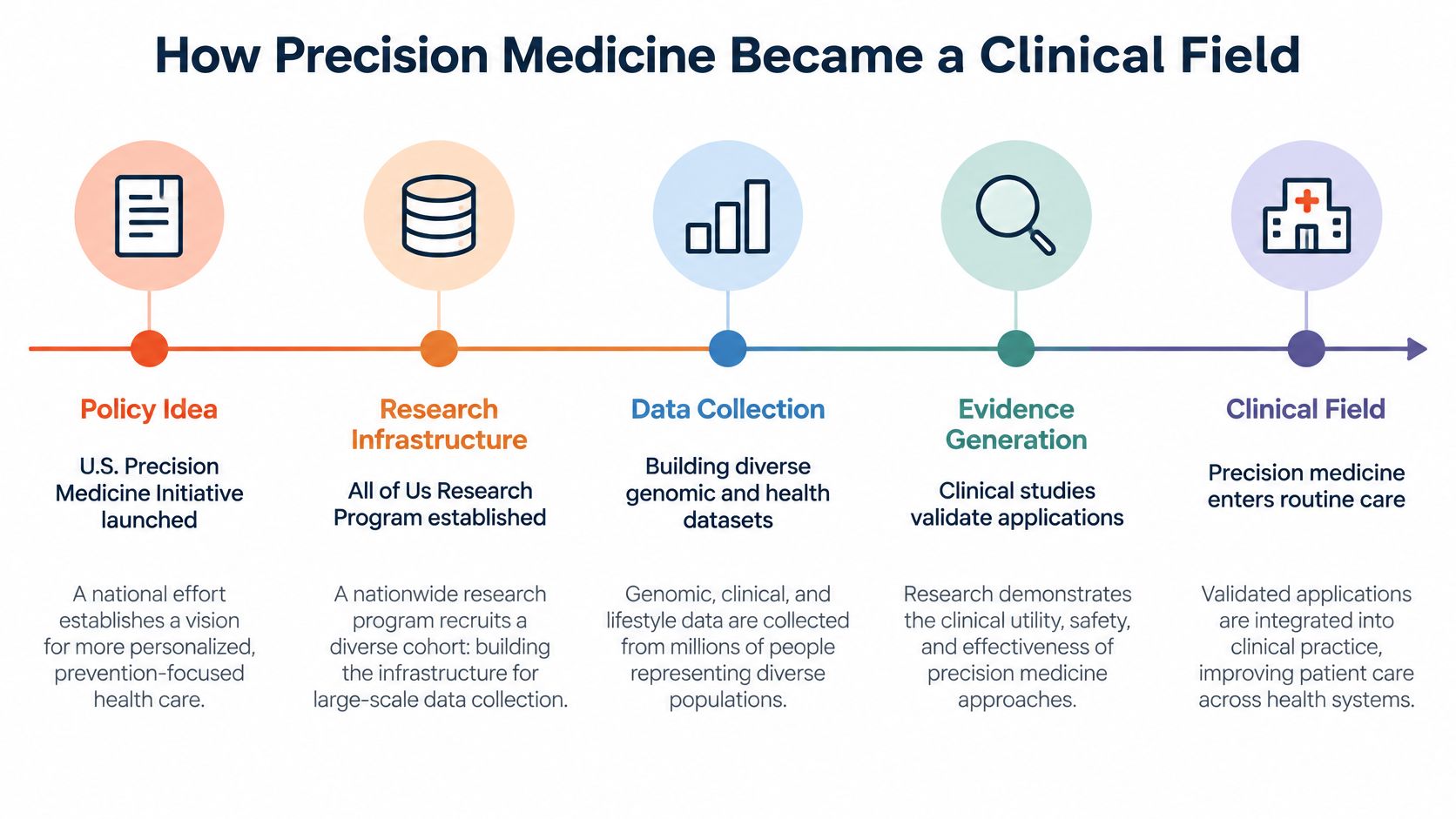
Precision medicine became credible when it stopped being only an appealing idea about individual biology and started building population evidence. President Barack Obama announced the Precision Medicine Initiative in January 2015, the National Institutes of Health established All of Us in 2016, national enrollment began in 2018, the public Data Browser launched in 2019, and the Researcher Workbench followed in 2020, according to the NIH history of the All of Us Research Program.
The program was designed to recruit at least 1 million people in the United States and combine electronic health records, surveys, physical measurements, biospecimens, activity monitor data, and genomic data. By January 2023, more than 590,000 participants had enrolled, more than 50% identified with a racial or ethnic minority group, and over 80% came from communities historically underrepresented in biomedical research. A later update reported more than 834,000 adult participants, more than 566,000 people completing all initial steps, and more than 730 enrollment sites.
Why Scale Matters for a Single Patient
That scale isn’t administrative trivia. A variant can be biologically plausible and still not help patients in practice. Mechanistic plausibility means a drug or intervention targets a pathway linked to a finding. Clinical utility means acting on that finding improves outcomes that matter, such as survival, symptoms, function, or avoidance of harm.
A private clinic can collect extensive data from you, but it can’t prove from your dataset alone that its recommended action works. That proof has to come from sufficiently large and representative populations. Diversity matters because variant frequency, drug response, and disease risk can differ across ancestry and environment, and evidence built in narrow cohorts may not transfer cleanly.
A rich personal dataset doesn’t replace population evidence. It only tells clinicians where you might fit within that evidence.
Use that benchmark when a clinic promotes a novel panel or algorithm. Ask which population was studied, whether people like you were represented, and what outcome improved. If the answer stops at biological plausibility, you’re looking at a hypothesis, not an established clinical service.
Pharmacogenomics as the Clearest Working Example
Pharmacogenomics is the clearest working example because the clinical question is concrete. Does a gene variant change which drug a clinician chooses, what dose they start, or how closely they monitor safety? When the answer is yes, the result has an obvious action attached to it.
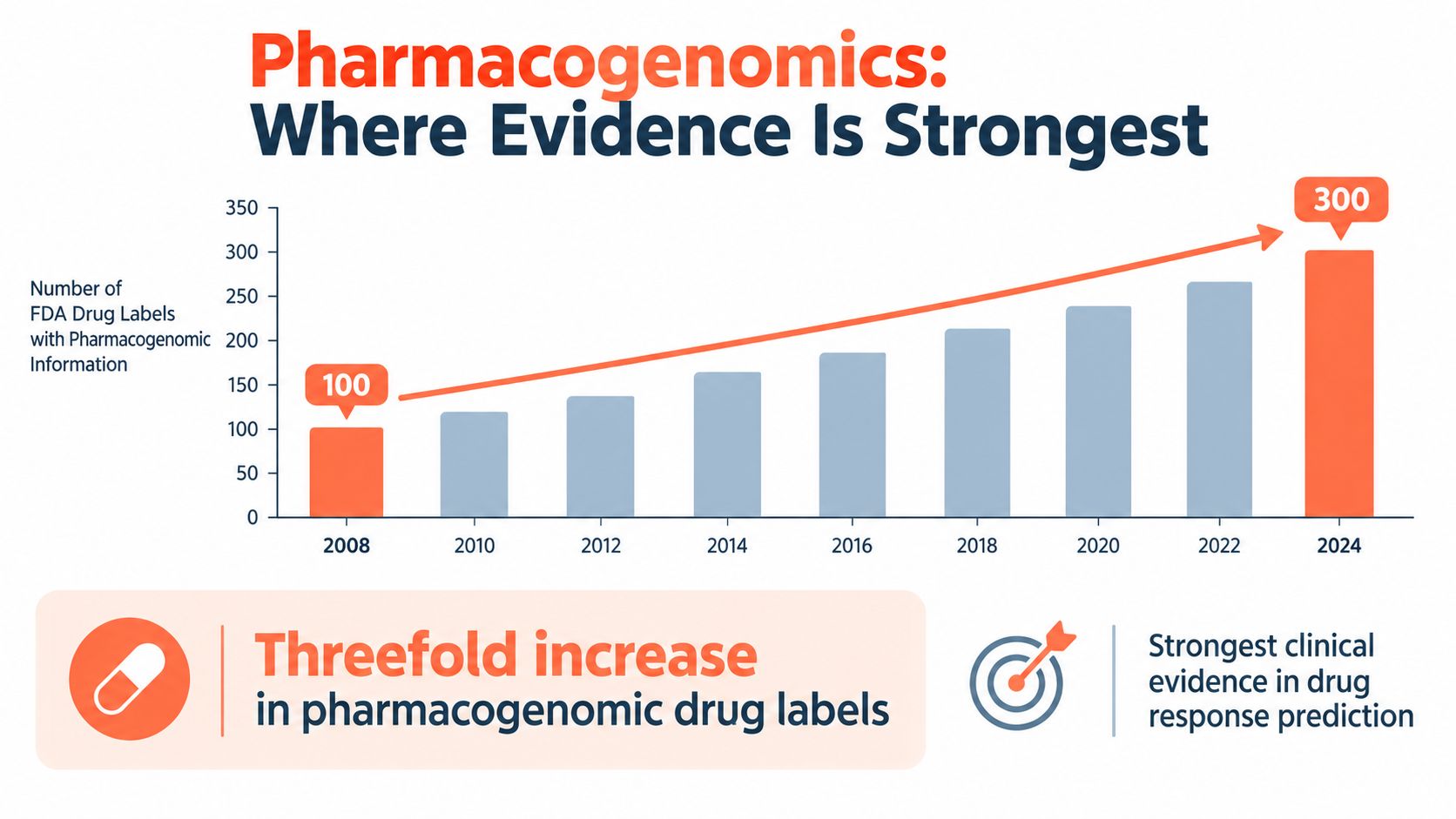
The regulatory record shows steady expansion. The annual share of new U.S. Food and Drug Administration approvals containing pharmacogenomic information rose from 10.3% in 2000 to 28.2% in 2020, across the full period 23.8% of new approvals per year included such labeling, and 136 drugs received pharmacogenomic labeling from 2011 to 2020 compared with 42 from 2000 to 2010, according to the 2000 to 2020 analysis of FDA drug labels. Cancer accounted for 75.5% of biomarker and drug pairs requiring testing, an average 52.0% of annual cancer drug approvals included pharmacogenomic labeling, and clinically actionable information appeared in 59.7% of cancer related pairs versus 40.3% in other areas.
Why Oncology Dominates the Evidence
Oncology lends itself to this model because tumours often carry identifiable molecular drivers and drugs are developed against those targets. Testing can therefore determine eligibility for a specific therapy. In many other specialties, genetics is one influence among kidney function, liver function, age, interacting medicines, adherence, and the condition being treated.
That doesn’t make non cancer pharmacogenomics useless. It makes context essential. Examples such as DPYD testing before fluoropyrimidine treatment or HLA-B*15:02 considerations before carbamazepine in certain populations are useful because each links a defined result to a defined prescribing action. A vague promise to optimise your medication response doesn’t meet the same standard.
Questions That Expose the Difference
- Which drug and gene pair: Can the clinic name the exact relationship it’s testing?
- Which decision changes: Will clinicians choose a different drug, adjust dose, add monitoring, or avoid treatment?
- Which evidence applies: Does an FDA label, professional guideline, or comparable regulatory source support that action?
If a clinic can’t connect those three points, genomic information alone isn’t proof of benefit. Strong pharmacogenomics is narrow, specific, and sometimes unglamorous. Broad optimisation language without a prescribing consequence should lower, not raise, your confidence.
What a Pharmacogenomics Service Should Look Like
A high quality service starts before prescribing, not after an adverse reaction forces a rethink. Pre-emptive testing means results are available when a relevant medicine is considered, stored in a form clinicians can use, and updated when interpretation changes.
The operational challenge is volume. Because actionable variants are common across several pharmacogenes, a clinic needs a system for reviewing findings against current and future medicines. A PDF filed in a patient portal doesn’t do that work. Neither does a colour coded report that labels you a normal, intermediate, or poor metaboliser without explaining the standard behind the label.
Minimum Dataset for a Safe Recommendation
Genotype alone isn’t enough for a prescribing recommendation. Before a precision medicine clinic acts, it should reconcile the result with:
- Current prescriptions and over the counter medicines: Interactions can change the practical phenotype and the safest choice.
- Renal and hepatic function: Organ function affects drug exposure independently of genotype.
- Disease indications: The reason for treatment determines acceptable alternatives and urgency.
- Allergies and prior adverse reactions: Past intolerance may matter as much as predicted metabolism.
- Relevant diagnoses and planned procedures: Future anaesthesia, cardiology care, psychiatry, pain treatment, or oncology care may activate a dormant finding.
Interpretation also needs auditability. Phenotype assignments have conflicted between a commercial laboratory and CPIC based interpretation in a substantial share of CYP2D6 and CYP2C19 cases described in the verified implementation literature, so a clinic should disclose its laboratory, reference allele standards, phenotype translation method, guideline version, and named reviewer. It should also explain its escalation route for ambiguous findings and how results enter the medical record as decision support.
You’re not buying a genotype. You’re buying a maintained clinical decision support service that stays accurate as guidelines and prescriptions change.
Judge performance by completed actions. Useful measures include the proportion of actionable results reviewed by a qualified clinician, time to medication reconciliation, and the share of relevant prescriptions that receive a documented, guideline concordant decision. The percentage of patients tested is a sales metric. The percentage whose care changes appropriately is a clinical one.
Separating Immediate, Future, and Informational Findings
Broad sequencing creates a sorting problem. In a prospective study of rapid whole genome sequencing in 50 adults with acute cardiovascular events or cardiac arrest survival, 64% carried at least one curated pharmacogenetic variant while only 14% had a genotype relevant to immediate management, and multisite implementation found potentially actionable results in 88% to 99% of patients but only 16% had an actionable result for a current medication under CPIC criteria, as reported in the rapid whole genome sequencing cardiovascular study. That gap is the difference between information and immediate utility.
A precision medicine clinic should sort every finding into an operational tier before it reaches you as a recommendation. The same logic applies when genomic results sit alongside imaging findings from services such as full body MRI screening, where detection also needs a defined next step.
| Tier | Meaning | Required clinic response |
|---|---|---|
| Immediate | A current medicine or urgent risk needs action | Named clinician, short turnaround, direct contact, documented change |
| Future | A result matters if a relevant drug or condition arises | Record alert, medication review trigger, clear patient explanation |
| Informational | Evidence is weak, investigational, or not decision changing | Plain language limits, no treatment upsell, optional reanalysis date |
What Each Tier Requires
Immediate findings need speed and ownership. If a result suggests a current prescription is unsafe or unlikely to work, you should know who contacts you, how quickly, and whether they coordinate with the original prescriber. A portal message weeks later isn’t an adequate safety system.
Future findings need durability. The result should survive staff changes, clinic software changes, and your move to another clinician. Ask whether you’ll receive a portable summary that another prescriber can interpret without buying the original clinic’s proprietary report again.
Informational findings need restraint. Common risk alleles and investigational associations may be interesting, but they shouldn’t trigger supplements, off label medicines, or repeated testing without stronger evidence. A clinic that treats every signal as an intervention opportunity is confusing sensitivity with usefulness.
Ask for the tier, turnaround time, responsible clinician, communication method, and follow up interval for each category. If those operational details don’t exist, the clinic hasn’t finished designing the service. It’s still designing the test menu.
Why More Data Does Not Always Mean Better Care
More data can improve care, but it can also create cost, anxiety, false reassurance, and interventions that don’t help. The weak point is often downstream access. One 2025 review reported that 72% of precision medicine tests improved health outcomes, only 20% produced cost savings, and approximately one third of patients receiving next generation sequencing could not obtain an FDA approved targeted drug, according to the review of challenges facing precision medicine. A matched result isn’t useful if the matched treatment is unavailable, unaffordable, or unsupported for your situation.
Three Kinds of Validity
Clinics often emphasise the strongest link in the chain. You should examine the weakest.
- Analytical validity: Does the test measure the variant or biomarker accurately and reproducibly?
- Clinical validity: Does that measurement reliably predict a disease, risk, or drug response?
- Clinical utility: Does acting on the result improve outcomes compared with not acting?
A laboratory can measure a variant perfectly while the clinical meaning remains uncertain. A variant can predict risk while no proven intervention reduces that risk. In both cases, selling the result as actionable stretches the word beyond its useful meaning.
Costs also extend past the test. Pre test counselling, specialist interpretation, confirmatory testing, family cascade screening, treatment matching, and long term monitoring can all add expense. Coverage is inconsistent, particularly when testing is for prevention rather than active disease. That’s why broad packages, including those marketed alongside advanced health screening, need a total pathway estimate, not just a headline price.
Actionable should mean this: There’s a validated intervention, it’s available to you, the clinic can coordinate it, and the expected benefit outweighs cost and harm.
Ask what percentage of findings in the clinic’s own programme lead to a completed intervention, what happens after negative or uncertain results, and who pays for confirmation and referrals. Also ask what the clinic does when evidence changes. Reanalysis can upgrade or downgrade a finding, and a responsible service tells you whether reinterpretation is included or sold later.
More measurement is valuable when it answers a sharper clinical question. When the question is vague, more measurement mostly produces more ambiguity.
Consent, Privacy, and Incidental Findings
Genomic consent isn’t a signature at intake. Your sequence is identifying, so it can’t be fully anonymised in the way a simple laboratory value sometimes can. Broad sequencing may also reveal medically important information unrelated to the reason you booked the appointment, including inherited cancer or cardiac risk.
The American College of Medical Genetics and Genomics recommends discussing possible incidental findings before clinical sequencing, noting that patients may decline sequencing if they judge the consequences too burdensome, as summarised in the Swissethics guidance on further use of genomic data. Declining is a legitimate choice, not a failure to be proactive.
Questions to Ask Before Testing
- Access: Who can view raw data, interpreted results, and identifying information, both inside and outside the clinic?
- Reuse: Will data be sold, shared, or used for research, product development, or algorithm training?
- Storage: Where is data stored, for how long, and does it cross national borders?
- Withdrawal: Can you withdraw consent, restrict future use, or request deletion, and what limits apply?
- Incidental findings: Which categories will be returned, which won’t, and can you choose in advance?
- Family support: Who explains findings to relatives and coordinates cascade screening if they want it?
Reporting practices vary internationally because healthcare systems and ethical frameworks differ. Patients generally prefer receiving findings, while professional support depends on actionability and age. That variation makes local policy details important, especially if a clinic sends samples or data abroad.
For healthy people in longevity programmes, the stakes are different from diagnostic testing in active disease. You may learn about a future risk you can’t change, face insurance or family implications depending on jurisdiction, or need years of surveillance. Genetic counselling should therefore happen before testing, not only after an unexpected result appears.
A privacy policy alone doesn’t prove good governance. Look for granular consent, a reanalysis policy, named accountability for follow up, and clear rules on retention and transfer. Those are patient safety features, not legal decoration.
Evaluating a Clinic and Frequently Asked Questions
Bring five questions to any precision medicine clinic. Which decisions will testing change? Which laboratory and guideline version will you use? Who reviews results and contacts me for urgent findings? What are my consent, deletion, and data sharing choices? What follow up and reinterpretation are included in the price?
Longevity Clinics publishes independent clinic profiles scored for diagnostic depth, medical supervision, conflict freedom, and evidence base, which can help you compare programmes before you use those questions directly. Also read its explanation of conflict of interest in healthcare if a clinic profits from treatments it recommends.
Frequently Asked Questions
Is a direct to consumer test the same as a clinic service? No. A clinic should add clinical correlation, medication reconciliation, counselling, and follow up.
How often should results be reinterpreted? Whenever guidelines, medicines, or your health status change materially, and on the clinic’s stated reanalysis schedule.
What if a clinic can’t name its laboratory or guideline version? Treat that as a red flag and pause.
Does insurance usually cover this care? Coverage is inconsistent, especially for preventive testing, so confirm the test, consultation, confirmation, and follow up separately.
Before you book, take the five evaluation questions to two clinics and compare the specificity of their answers in writing. Choose the team that can show its laboratory standards, decision pathways, consent choices, and follow up ownership most clearly, not the team with the longest test list.