Types of Clinical Evidence Ranked for Clinics
See the types of clinical evidence ranked from trials to opinion, and how each type should change the way you read a longevity clinic claim.
The most popular advice about clinical evidence is to trust the highest rung on the evidence ladder. That’s a useful starting point, but it can still lead you astray. A randomized trial showing a change in a laboratory marker doesn’t establish longer life, and a systematic review doesn’t turn irrelevant outcomes into meaningful benefits. For a longevity decision, judge the study design, the endpoint, and the gap between the result and the promise.
Table of Contents
- Why Evidence Type Changes a Longevity Decision
- The Main Types of Clinical Evidence Ranked
- How Reviews Raise or Lower Certainty
- Real-World Evidence and Its Real Limits
- Biomarkers Tests and Outcomes Patients Feel
- What Common Longevity Claims Can Actually Show
- Score the Evidence Before You Book
Why Evidence Type Changes a Longevity Decision
Say a longevity brochure promises a programme that extends healthspan, lowers biological age, and finds disease early. It reads like one offer, but it contains different scientific questions.
Extending healthspan concerns patient-important outcomes, such as maintaining independence or avoiding disability. Lowering biological age concerns an intermediate measurement. Finding disease early concerns a test’s accuracy and whether acting on its findings helps.
Clinical evidence is more than a published result. To interpret it, you need to know who entered the study, what comparison group existed, how treatment was assigned, which outcome researchers chose beforehand, and how long they followed participants.
Different evidence answers different questions
Think of a building inspection. A photograph of the facade, a laboratory test of the concrete, and structural monitoring all provide evidence. None replaces the others.
The same distinction matters when a clinic combines exercise coaching, supplements, medication, and repeated testing. A favourable result might concern the complete package, one component, or the patients who stayed engaged.
- Slow outcomes: Disease prevention and sustained independence require follow-up that matches those claims.
- Bundled changes: Diet, exercise, sleep, and treatment may change together.
- Incomplete follow-up: Patients who stop returning may have different outcomes from those who remain.
A before-and-after clinic series also leaves room for regression to the mean, when an unusually poor initial measurement becomes less extreme on retesting, alongside measurement noise and concurrent habit changes.
For help examining the paper behind a headline, REVETIX’s guide to reading research behind healthy aging claims offers a useful companion exercise. Keep the claim itself beside the evidence ranking: the relevant question isn’t just whether evidence exists, but whether it supports the promised benefit.
The Main Types of Clinical Evidence Ranked
Types of clinical evidence and what they can show
| Evidence type | What it can show | Main weakness | Fitting longevity use |
|---|---|---|---|
| Systematic review of randomized trials | A pooled estimate across relevant trials when pooling is appropriate | Inherits weak, inconsistent, or off-target studies | An intervention studied repeatedly |
| Single randomized controlled trial | A causal estimate when allocation, adherence, and follow-up hold | Selected patients, limited duration, or an unsuitable comparator | A defined intervention or programme |
| N-of-1 trial | An individual treatment comparison using the person as their own control | Needs reversible effects and careful control of expectations | A symptom or dose question |
| Prospective cohort | Outcome rates over time in exposed and unexposed groups | Treatment choice may track prognosis, wealth, and other care | Durability, adherence, and uncommon harms |
| Case-control study | An association assessed by comparing people with and without an outcome | Recall and selection bias | Investigation of a rare adverse event |
| Case series or case report | What happened to treated patients, including possible harms | No comparator to separate treatment effects from other changes | A clinic’s before-and-after account |
| Diagnostic accuracy study | Sensitivity and specificity against a reference standard | Estimates depend on patient selection, thresholds, and methods | Evaluating a scan or test |
| Mechanistic or preclinical data | Biological plausibility in cells, animals, or pathways | Doesn’t establish human clinical benefit | A supplement or hormone rationale |
| Expert opinion or clinical experience | A reasoned interpretation when direct studies are absent | Authority isn’t a measurement | A protocol white paper |
The ordering is most useful for treatment benefit. Diagnostic accuracy and biological plausibility answer different questions, so they aren’t weaker versions of a treatment trial.
A systematic review gathers relevant studies using explicit methods. Its position near the top assumes the included trials address the decision you’re making.
A randomized controlled trial, or RCT, assigns treatment by chance. Think of shuffling a deck: measured and unmeasured differences are distributed probabilistically, rather than treatment going preferentially to people who can pay or whose prognosis is better.
An N-of-1 trial asks a narrower question: which option works better for this person? Repeated treatment and comparison periods can help with reversible symptoms, but they aren’t a shortcut to demonstrating disease prevention.
Observation, signals, and plausible explanations
A prospective cohort follows exposed and unexposed groups forward. It can describe how outcomes develop in ordinary patients, although the groups may differ before treatment begins.
A case-control study starts with an outcome and looks back at exposure. That makes it useful for investigating rare harms, but selecting controls and reconstructing past exposure require care.
A case report or series describes patients without a comparison group. It may identify an unexpected adverse event worth investigating, but improvement alone doesn’t establish benefit.
Diagnostic studies evaluate classification rather than treatment effects. Cell, animal, and pathway studies establish a rationale for human investigation. Expert opinion helps interpret uncertainty but can’t remove it.
Practical rule: A credible mechanism justifies a question. It doesn’t supply the answer in patients.
This distinction is useful when comparing approved medicines versus experimental wellness peptides: separate regulatory status, mechanistic rationale, and evidence of human benefit rather than treating them as interchangeable.
Observational evidence shouldn’t be dismissed automatically. A 2000 analysis in the New England Journal of Medicine found that well-designed cohort and case-control studies didn’t systematically overestimate treatment effects compared with randomized trials addressing the same questions. Evidence hierarchies also allow exceptions for dramatic effects. The table row is a starting grade, not a final score.
How Reviews Raise or Lower Certainty
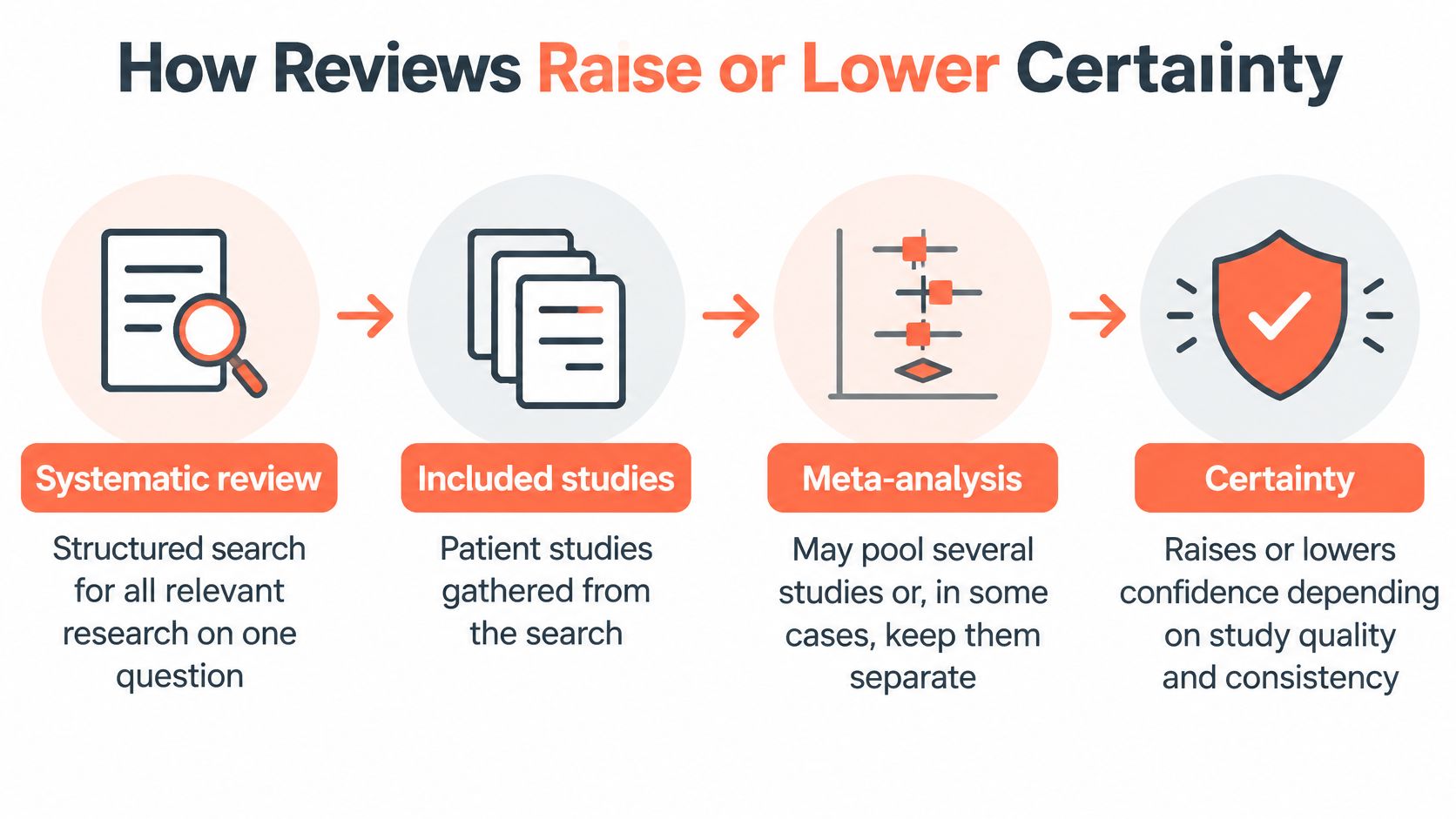
A systematic review is not a stronger kind of patient study. It is a structured way to find, select, assess, and interpret studies that address a defined question. A meta-analysis is the statistical pooling of results that may accompany a review.
Cochrane’s explanation of systematic reviews describes how explicit methods and relevant findings can improve interpretation and precision. The value is not a larger pile of papers. Readers can examine the review’s eligibility rules and see which studies were included.
Start with design, then examine weaknesses
GRADE assesses certainty in a body of evidence for a particular outcome. Randomized trials start at high certainty; non-randomized intervention studies start at low certainty because treatment selection and confounding can distort comparisons.
GRADE can lower or raise that starting assessment based on:
- Risk of bias: Were assignment, outcome assessment, or missing results handled poorly?
- Inconsistency: Do studies produce meaningfully different results without a convincing explanation?
- Indirectness: Do the population, intervention, comparison, or endpoint differ from the question being asked?
- Imprecision: Is the uncertainty wide enough to allow substantially different conclusions?
- Publication bias: Could unavailable results change the overall picture?
Observational evidence can sometimes be upgraded, including when an effect is exceptionally large. The GRADE evidence-rating guide explains why certainty depends on the body of evidence, not the number of papers alone.
Apply certainty to the claimed outcome
Suppose a randomized longevity study reports a change in a methylation score after a short treatment period. Even if the measurement is reliable, using it to claim improved disability-free survival introduces indirectness. The study measured a marker; the claim concerns how people function over time.
The marker result can still be informative. The key is to attach confidence to the outcome the researchers measured, rather than assuming it proves a benefit they did not measure.
Study designs also resist simple slogans. A Cochrane review comparing randomized and observational estimates reported a pooled ratio of ratios of 1.08, with a 95% confidence interval of 1.01–1.15. This indicates a small systematic difference in that pooled comparison. It is not a conversion factor for judging any individual observational result.
Before relying on a review, check its eligibility criteria, whether pooling was appropriate, and how the authors explain changes to certainty. A precise pooled estimate can still answer the wrong question.
Real-World Evidence and Its Real Limits
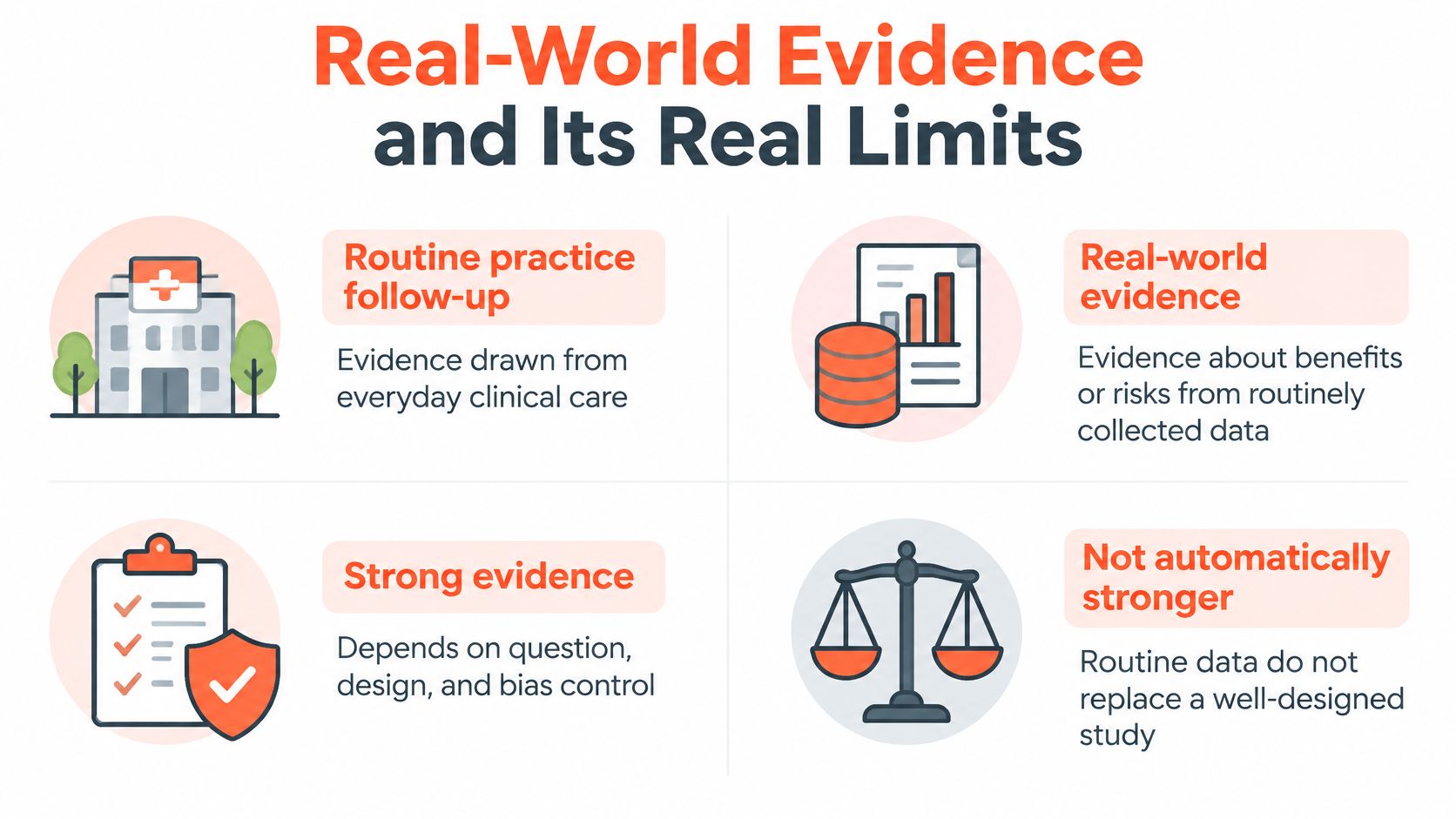
Does follow-up from routine clinical practice count as strong clinical evidence? Sometimes. Calling it real-world evidence doesn’t settle the question, but neither does calling it observational.
The FDA’s real-world evidence framework defines evidence about benefits or risks derived from routinely collected data and recognizes designs including pragmatic randomized trials, externally controlled trials, cohorts, and case-control studies. Real-world describes the data context, not a single study design.
A registry can answer questions a short trial cannot
A tightly controlled trial might establish whether an intervention changes a marker under ideal conditions. A well-maintained registry may be more informative about continued use, uncommon harms, and durability in routine care.
The difficulty is determining what the registry missed. Say a clinic reports favourable results among members who returned for repeat testing. Those members might be more adherent, wealthier, or healthier than those who left. Their outcomes can’t automatically represent everyone who enrolled.
Grade the dataset, not the label
Use these questions to distinguish useful follow-up from a selected success story:
- Prespecified outcomes: Did investigators decide what to measure before examining the results?
- Complete denominator: Do the findings account for all enrolled patients, not just returning members?
- Missing outcomes: How many patients were lost, why did they leave, and how did analysts handle their absence?
- Relevant comparator: What happened in a credible alternative group?
- Clinical meaning: Would the difference matter to patients, beyond meeting a statistical threshold?
Changing protocols create another problem. If clinicians alter supplements, testing schedules, and eligibility criteria during follow-up, the published result may not describe the programme currently offered.
Regulators do use this evidence. Between September 2021 and February 2023, the European Medicines Agency initiated 30 real-world-data studies. A 2025 analysis of European drug-approval reports found real-world evidence in 39 of 423 reports, or 9.2%.
Those examples establish regulatory use, not blanket endorsement of clinic registries. A dataset becomes useful through relevant measurements, credible comparisons, and transparent accounting for uncertainty.
The label real-world is not a grade. Count the missing patients as carefully as the favourable outcomes.
Biomarkers Tests and Outcomes Patients Feel
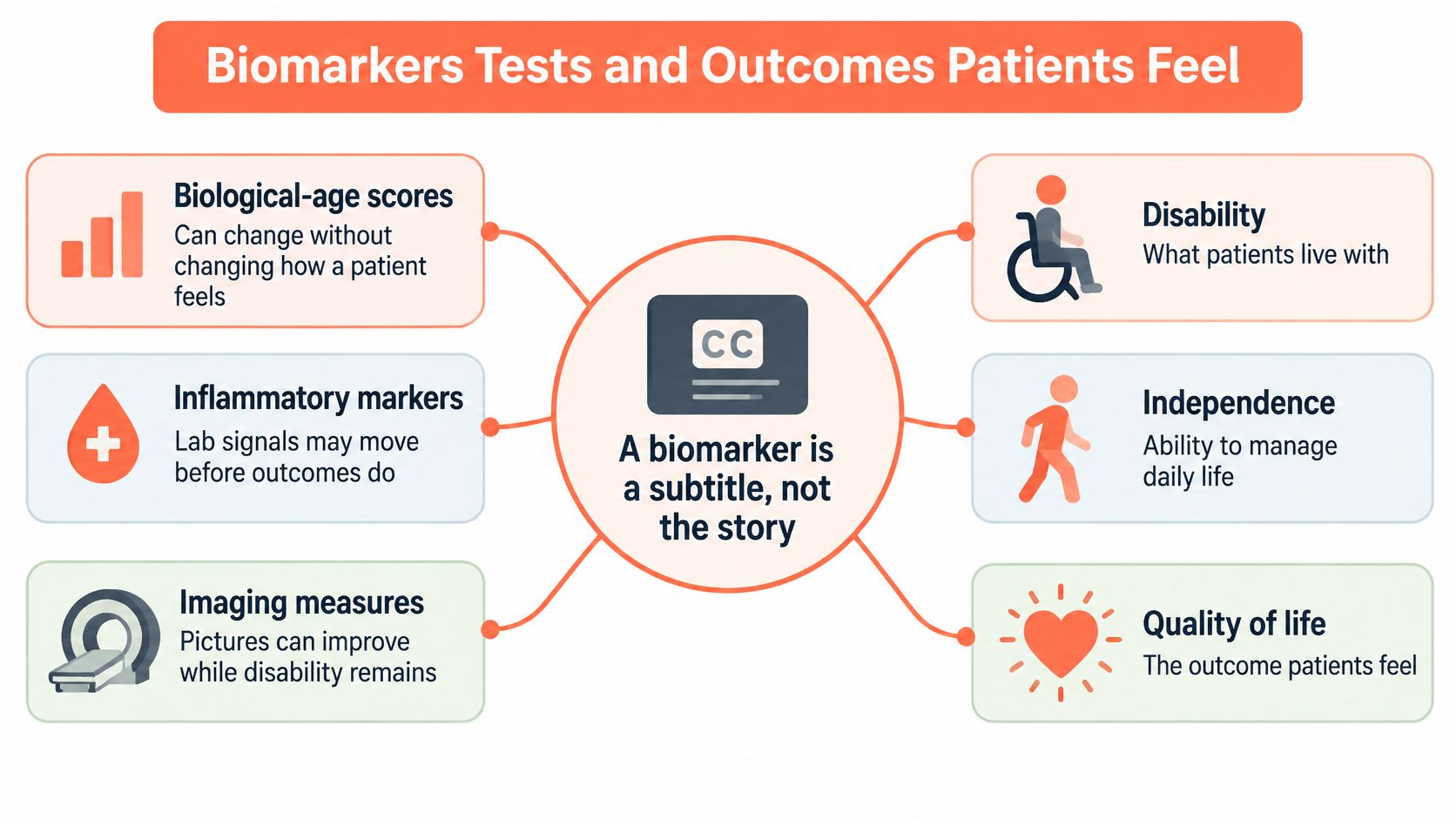
A biomarker is a subtitle, not the story. Biological-age scores, inflammatory markers, and imaging measurements can help describe a biological process. They don’t necessarily tell you whether someone feels better, remains independent, or lives longer.
Researchers use intermediate endpoints because patient-important outcomes may take longer to observe. The interpretive mistake is treating the easier measurement as an established substitute without showing that the substitution is valid.
Patient experience needs deliberate measurement
Patient-reported outcomes can capture symptoms and quality of life that laboratory testing misses. But including a questionnaire somewhere in a trial doesn’t mean the trial was designed around that outcome.
In a systematic review published in eClinicalMedicine00590-4/fulltext), among 27 studies reporting patient-reported outcomes in trials supporting genitourinary-cancer drug approvals, none used them as the primary endpoint, while 14 studies, or 52%, treated them as secondary outcomes. That finding concerns cancer drug trials, but it illustrates the importance of checking an endpoint’s role rather than merely its presence.
For a longevity marker, require a clear translation into the proposed benefit:
- Validated connection: Is there evidence linking the marker to the later outcome in the relevant setting?
- Meaningful change: Was the threshold for an important difference specified beforehand?
- Visible uncertainty: Are confidence intervals reported, rather than only an impressive point estimate?
Accurate testing isn’t the same as useful screening
Tests introduce a different question. Sensitivity is the proportion of people with the target condition who test positive; specificity is the proportion without it who test negative.
The STARD diagnostic-reporting guidance emphasizes that studies estimate these properties under particular conditions. Patient selection, the reference standard, thresholds, missing results, and blinding all affect interpretation.
Predictive value also depends on how common the condition is in the screened population. In low-risk screening, even a test with high sensitivity and specificity can produce many false positives.
Clinical utility goes further than accuracy. A management study can show whether results change care appropriately; ideally, a trial then establishes patient-important benefit without excessive downstream procedures or harms.
Our guide to longevity testing provides context for separating established screening from exploratory measurement. Diagnostic depth can be informative, but the important question is what useful decision follows from the result.
What Common Longevity Claims Can Actually Show
Longevity claims matched to evidence
| Claim | Evidence that matches | Still unproven |
|---|---|---|
| The programme improves healthspan | A trial or rigorous cohort measuring disability, independence, or mortality | That changing a biomarker delivers the same benefit |
| Biological age fell by several years | A prespecified before-and-after marker study | Longer life, fewer diseases, or better function |
| This scan finds disease early | Accuracy against a reference standard, plus utility evidence | Net screening benefit after false positives and extra procedures |
| This supplement protocol works | Mechanistic data or an expert protocol supports plausibility only | Human benefit compared with another choice |
| Our registry shows it is safe | Complete follow-up, stated losses, and a comparator support safety assessment | Effectiveness or the absence of every possible harm |
These claims require different evidence. A large sample doesn’t repair a mismatch between the promise and the outcome measured.
Benefits, marker changes, and early detection
The programme improves healthspan. The relevant evidence needs to concern how people function, develop disease, or survive. A randomized comparison offers stronger causal attribution; a carefully designed cohort may contribute longer-term information.
Consider the imitation of benefit: participants improve their diet while receiving treatment. Without an appropriate comparison, the programme’s distinctive intervention may receive credit for changes participants could have achieved another way.
Biological age fell. This can describe a measured result without establishing a clinical benefit. A change in laboratory method or scoring algorithm can complicate comparison, so consistency of measurement matters.
A scientifically cautious account names the assay, the prespecified analysis, and its uncertainty. It doesn’t translate a clock-score change directly into extra years of life.
This scan finds disease early. Earlier detection is not itself the final benefit. The decision concerns whether detecting and treating those findings improves outcomes enough to justify false positives and additional procedures.
A selected group of patients with clearer disease may also make a test look more useful than it would be among healthy people attending a screening day.
Plausibility and safety need narrower wording
This supplement protocol works. Cell experiments, animal work, and a clinician’s white paper can support testing a hypothesis. They don’t estimate the benefit a person should expect compared with an alternative.
Regression to the mean can make a protocol appear effective when patients begin after an unusually poor test result. Repeating the test may yield improvement even without the proposed active ingredient.
Our registry shows it is safe. A registry may provide useful information about observed harms, treatment discontinuation, and adherence. Its conclusions need to identify the patients, exposures, follow-up, and events captured.
Follow-up limited to satisfied returning members can create false reassurance. People who stopped because of side effects must remain part of the assessment, rather than disappearing from the denominator.
Before judging scale: Label the claim as a treatment benefit, marker result, diagnostic finding, mechanism, or safety observation. Then decide whether the study matches it.
Score the Evidence Before You Book
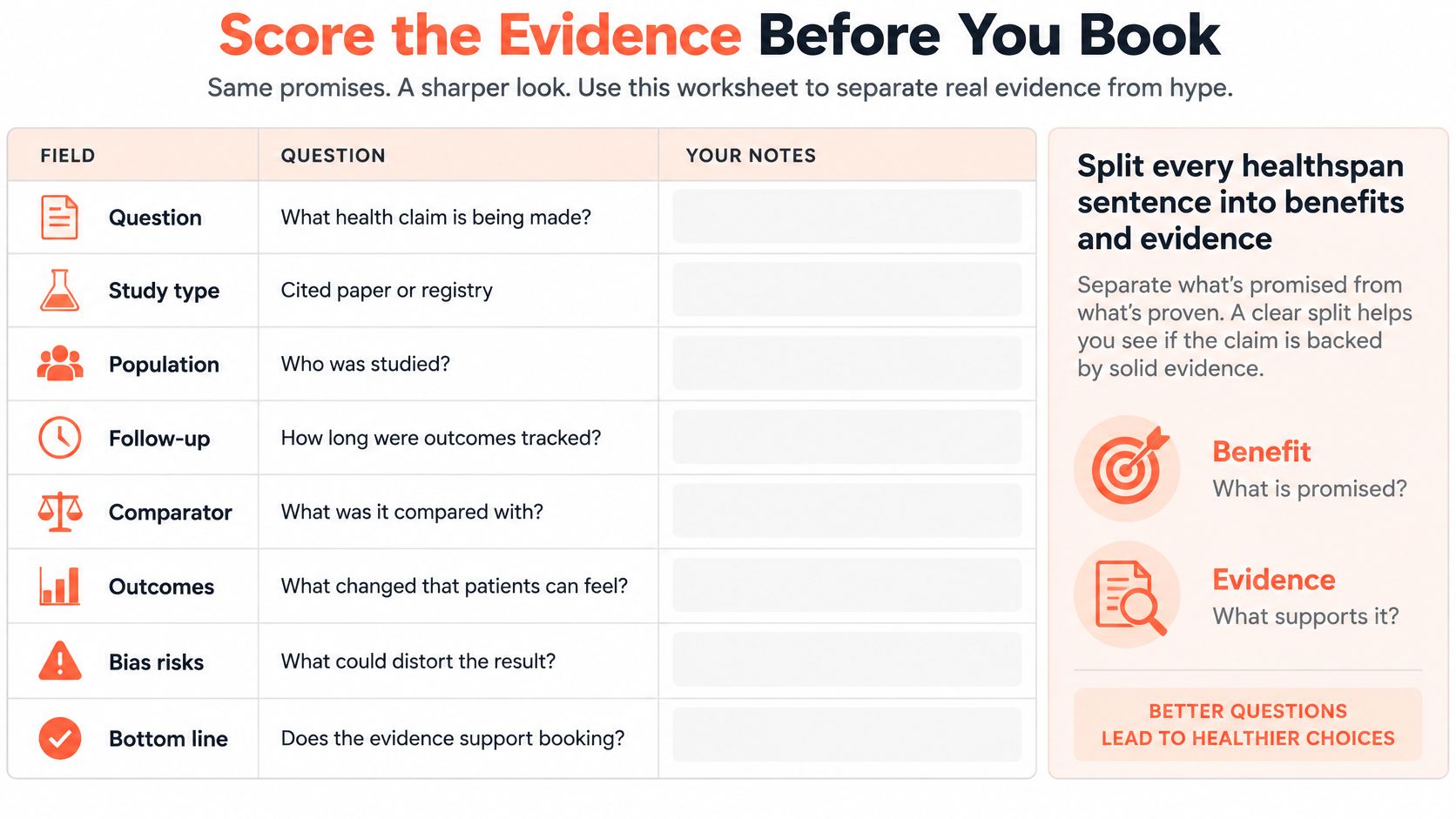
Choose one claim rather than trying to grade an entire programme at once. Split its promise into mechanistic plausibility, short-term marker change, and patient-important benefit, then assess each separately.
The Oxford levels of evidence organize evidence around the question being asked. That’s the useful habit to adopt: don’t award a paper the same authority for every sentence a clinic attaches to it.
Record what would change your confidence
Evidence scoring worksheet
| Field | What to record | Red flag |
|---|---|---|
| Design | Trial, cohort, case series, or biomarker study | Only a before-and-after marker series |
| Comparator | Untreated or alternative group | None stated |
| Randomization | How assignment was made and concealed | Assignment by choice or no randomization |
| Sample size | Number enrolled and analyzed | A small sample behind a dramatic headline |
| Follow-up length | Duration relative to the claimed outcome | Brief follow-up for a long-term prevention claim |
| Prespecified endpoint | Primary outcome registered in advance | Outcome changed after results were known |
| Attrition | Losses to follow-up and their handling | Dropouts omitted from results |
| Independent replication | Whether another group reproduced the finding | Only the sponsor’s own findings |
These fields help identify why confidence should fall; they aren’t interchangeable points in a validated medical calculator. A biomarker-only before-and-after study cannot establish disease prevention or longer life, regardless of how polished its presentation is.
For a complementary check of marketing language, Sunridge Medical’s guide to spotting unsupported alternative medicine claims can help frame the distinction between a proposed explanation and demonstrated benefit.
Keep evidence separate from other clinic qualities
At Longevity Clinics, we score each clinic across four axes worth 25 points each: diagnostic depth, medical supervision, conflict freedom, and evidence base. The composite runs from 0 to 100, but strong diagnostic depth doesn’t establish treatment effectiveness.
Medical reviewers check every clinical claim before publication. Our conflict-of-interest disclosure addresses a separate question: what incentives might affect how information is presented?
Tonight, take the most impressive claim on a programme page and complete the worksheet for its supporting paper or registry. Use our clinic comparison tool to keep evidence base separate from testing breadth and supervision, then discuss the remaining uncertainties with a qualified clinician. This grading is editorial context, not medical advice: consult a qualified medical professional before booking a clinic or starting, changing, or stopping treatment.